
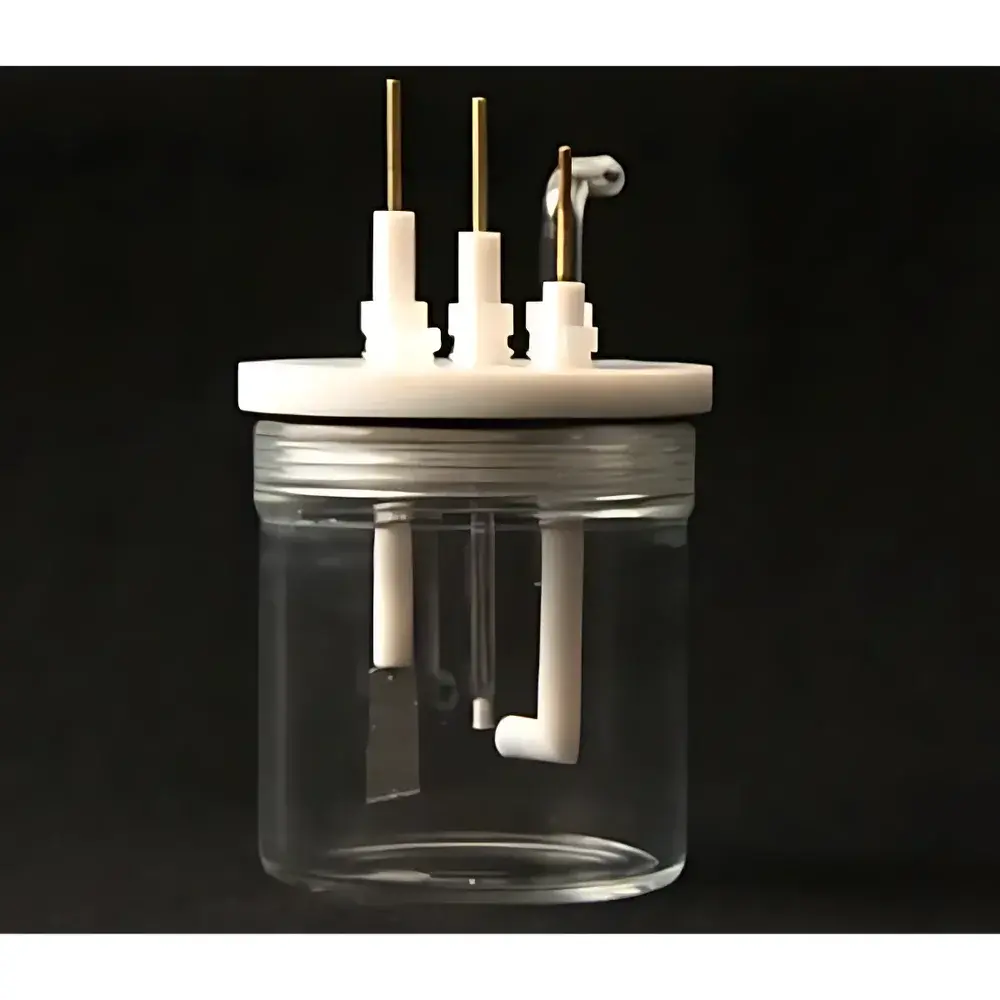
Sealed Electrochemical Cell (Zhongjiaojinyuan Model)
| Brand | Zhongjiaojinyuan |
|---|---|
| Origin | Beijing, China |
| Manufacturer Type | Direct Manufacturer |
| Country of Origin | China |
| Model | Sealed Electrochemical Cell |
| Pricing | Available Upon Request |
| Cell Body Material | Borosilicate Glass |
| Cap Material | PTFE (Polytetrafluoroethylene) |
| Electrode Configuration | Three-Electrode System (Working, Reference, Counter) |
| Gas Inlet/Outlet Ports | Dual Standard Luer Lock Fittings |
| Available Volumes | 20 mL, 30 mL, 50 mL, 100 mL, 150 mL, 250 mL |
Overview
The Zhongjiaojinyuan Sealed Electrochemical Cell is a precision-engineered laboratory device designed for controlled electrochemical investigations under inert or reactive gas atmospheres. It operates on the fundamental principle of potentiostatic and galvanostatic electrochemistry, enabling quantitative measurement of current–potential relationships, charge transfer kinetics, and interfacial processes at electrode/electrolyte interfaces. The cell’s hermetic sealing architecture—achieved via PTFE compression gasketing and threaded borosilicate glass assembly—ensures long-term gas-tight integrity (<1 × 10⁻⁸ mbar·L/s He leak rate), critical for oxygen-sensitive reactions (e.g., CO₂ reduction, Li–S battery electrolyte studies) and volatile electrolyte systems. Its modular design supports both static and dynamic gas purging protocols, facilitating in situ electrochemical impedance spectroscopy (EIS), cyclic voltammetry (CV), and chronoamperometry under reproducible ambient control.
Key Features
- Borosilicate glass body (Duran®-grade) with thermal shock resistance (ΔT ≤ 150 °C) and UV transparency (280–2000 nm), enabling simultaneous optical monitoring and photoelectrochemical coupling.
- Chemically inert PTFE cap with integrated O-ring sealing and precision-machined electrode ports—compatible with standard 6 mm OD rod electrodes and Ag/AgCl, SCE, or Hg/HgO reference electrodes.
- Dual Luer lock gas inlet/outlet ports (female, 0.125″ thread) supporting regulated mass flow controllers (MFCs) and online gas chromatography (GC) or mass spectrometry (MS) interfacing.
- Three-electrode configuration with independent, adjustable electrode positioning: working electrode (WE) holder accommodates disk, mesh, or custom substrates; reference electrode (RE) port includes fritted junction for stable potential referencing; counter electrode (CE) port accepts Pt wire or graphite rods.
- Volume scalability across six standardized options (20–250 mL), each validated for pressure stability up to 3 bar(g) and compatible with magnetic stirring (via external stir plate) without compromising seal integrity.
Sample Compatibility & Compliance
The cell accommodates aqueous, non-aqueous, and ionic liquid electrolytes—including LiPF₆ in EC/DMC, EMIM-BF₄, and aqueous KOH—without material degradation. Electrode compatibility spans carbon-based materials (glassy carbon, graphite), metals (Pt, Ni, Cu), semiconductors (TiO₂, BiVO₄), and conductive polymers. All wetted components comply with USP Class VI biocompatibility standards and meet ASTM D543 requirements for chemical resistance. The assembly adheres to ISO 9001-certified manufacturing protocols, and documentation supports GLP-compliant experimental traceability (batch-specific calibration certificates, material traceability reports). For regulated environments, the cell integrates seamlessly into workflows aligned with FDA 21 CFR Part 11 when paired with compliant potentiostats and electronic lab notebooks (ELNs).
Software & Data Management
While the cell itself is hardware-only, it is fully interoperable with industry-standard electrochemical workstations (e.g., BioLogic SP-300, Gamry Interface 5000E, Pine Research WaveNow) and their associated software suites (EC-Lab®, Framework, AfterMath®). These platforms provide automated method sequencing, real-time data streaming (up to 100 kS/s), and built-in compliance features including audit trails, electronic signatures, and raw data export in open formats (MATLAB .mat, CSV, MPT). Experimental metadata—including gas composition logs, temperature timestamps, and electrode history—is embeddable directly into data files, satisfying FAIR (Findable, Accessible, Interoperable, Reusable) data principles.
Applications
- Electrocatalysis research: CO₂ reduction, nitrogen fixation, and water splitting under controlled pO₂/pCO₂ conditions.
- Battery interface science: Solid-electrolyte interphase (SEI) formation studies in Li-metal and Na-ion systems using volatile carbonate solvents.
- Corrosion electrochemistry: Monitoring localized corrosion mechanisms in chloride-containing media under deaerated or sulfide-sparged environments.
- Photoelectrochemical (PEC) characterization: Integration with solar simulators for incident photon-to-current efficiency (IPCE) mapping under inert atmosphere.
- Electrosynthesis optimization: Scalable reaction screening for pharmaceutical intermediates requiring strict moisture/oxygen exclusion.
FAQ
Can this cell be used with high-temperature electrochemical measurements?
Yes—when equipped with high-temp PTFE variants (up to 260 °C) and compatible electrolytes, the cell supports experiments up to 200 °C with appropriate pressure relief considerations.
Is custom volume or port configuration available?
Yes—Zhongjiaojinyuan offers OEM engineering services for non-standard volumes, additional gas ports, optical windows, or integrated temperature sensors (PT100), subject to minimum order quantities.
How is leak integrity verified prior to shipment?
Each unit undergoes helium mass spectrometry leak testing per ISO 10648-2, with individual test reports provided upon request.
What reference electrodes are recommended for non-aqueous systems?
A silver wire pseudo-reference or an internal ferrocene/ferrocenium (Fc/Fc⁺) redox couple is typically employed; full calibration protocols are included in the user manual.
Does the cell support rotating disk electrode (RDE) configurations?
Yes—RDE shafts with standard 6 mm OD fit directly into the working electrode port; optional Teflon-coated rotation adapters minimize vibration-induced seal stress.



