
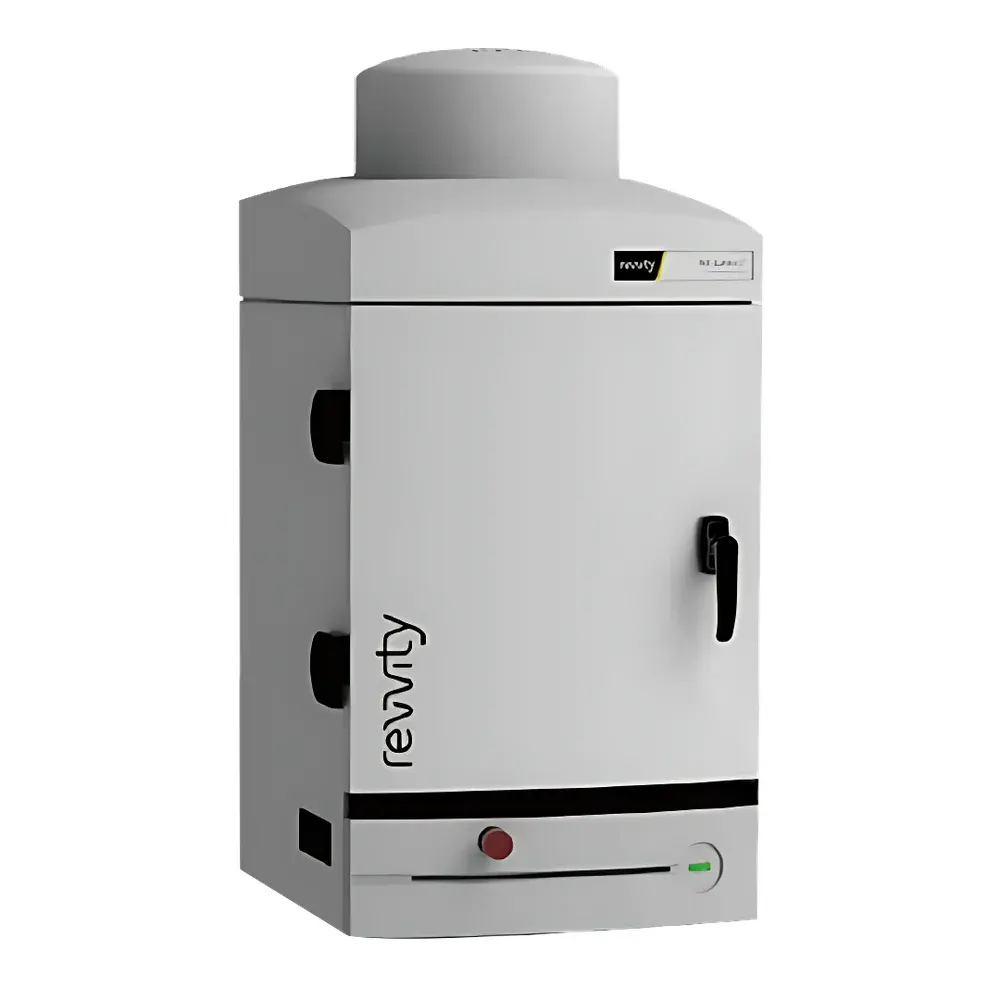
Revvity IVIS Lumina S5 Small Animal In Vivo Optical Imaging System
| Brand | Revvity |
|---|---|
| Origin | USA |
| Manufacturer Type | Original Equipment Manufacturer (OEM) |
| Origin Category | Imported |
| Model | IVIS Lumina S5 |
| Instrument Type | Optical Imaging System |
| Animal Species | Mouse (also compatible with rat) |
| Throughput | Up to 5 mice per imaging session |
| Imaging Modalities | Bioluminescence, Fluorescence (multispectral unmixing), Cerenkov Luminescence Imaging (CLI) |
| Camera | Scientific-grade back-illuminated CCD with large field-of-view and high quantum efficiency |
Overview
The Revvity IVIS® Lumina S5 is a fourth-generation, high-sensitivity two-dimensional in vivo optical imaging platform engineered for preclinical research in oncology, immunology, infectious disease, gene therapy, and drug development. Built upon the established IVIS platform—widely recognized as the industry benchmark for bioluminescence quantification—the Lumina S5 integrates a newly designed, large-format back-illuminated CCD camera with enhanced quantum efficiency across the visible to near-infrared (NIR) spectrum (400–900 nm). This architecture enables superior photon capture, reduced read noise, and improved signal-to-noise ratio—critical for low-light bioluminescent signals and weakly fluorescent probes. The system operates on core optical principles including enzymatic bioluminescence (e.g., luciferase–luciferin reactions), excitation-emission fluorescence spectroscopy, and Cerenkov luminescence imaging (CLI) from β−-emitting radionuclides (e.g., 90Y, 131I, 18F). Its modular design supports both longitudinal studies and high-throughput screening workflows without compromising quantitative rigor.
Key Features
- High-Throughput Imaging: Simultaneous acquisition from up to five anesthetized mice in a single field of view—optimized for standardized positioning and reproducible ROI placement using integrated animal staging hardware.
- Bioluminescence Sensitivity: Engineered for detection of sub-picomolar luciferase activity with calibrated radiance quantification (photons/sec/cm²/sr), traceable to NIST standards.
- Multispectral Fluorescence Unmixing: Acquires sequential images across ≥7 user-defined wavelength bands (e.g., 500–850 nm); employs constrained linear unmixing algorithms to resolve overlapping fluorophore spectra (e.g., GFP/mCherry, Cy5.5/Cy7, IRDye 800CW/AF750) with minimal crosstalk.
- Cerenkov Luminescence Imaging (CLI) Capability: Enables direct optical detection of therapeutic and diagnostic radioisotopes without scintillation agents—supporting dosimetry correlation and theranostic validation under identical imaging conditions.
- Integrated Anesthesia & Temperature Control: Precision vaporizer-based isoflurane delivery with real-time feedback and heated stage maintaining physiological core temperature (36–37 °C) during acquisition.
- Modular Hardware Expansion: Supports optional accessories including automated filter wheels, spectral calibration modules, fluorescence excitation light sources (LED or laser), and dual-modality alignment fixtures for co-registration with micro-CT or MRI data.
Sample Compatibility & Compliance
The IVIS Lumina S5 is validated for use with murine models (including transgenic, xenograft, syngeneic, and humanized mice) and compatible with juvenile and adult rats (up to ~500 g). Sample handling adheres to IACUC-approved protocols; the system’s non-ionizing optical detection modality eliminates cumulative radiation exposure concerns associated with PET or SPECT. Data acquisition and analysis comply with GLP-aligned documentation practices. Image metadata—including exposure time, binning, f-stop, filter set, and animal ID—is embedded in DICOM-compliant files and preserved in audit-trail-enabled acquisition logs. Software export formats support FDA 21 CFR Part 11–compliant electronic signatures when deployed with appropriate IT infrastructure.
Software & Data Management
Living Image® 4.7+ software provides end-to-end workflow management—from instrument control and spectral unmixing to kinetic analysis, region-of-interest (ROI) normalization, and multi-cohort statistical comparison. The software includes built-in tools for background subtraction, auto-thresholding, and batch processing of longitudinal datasets. All image processing steps are fully scriptable via Python API (Living Image Scripting Interface), enabling integration into automated pipelines compliant with FAIR (Findable, Accessible, Interoperable, Reusable) data principles. Raw and processed data are stored in vendor-neutral HDF5 containers, supporting third-party analysis in MATLAB, Python (scikit-image, napari), or ImageJ/Fiji environments. Audit trails record user actions, parameter changes, and timestamped version history—essential for regulatory submissions and internal QA/QC reviews.
Applications
- Longitudinal tumor burden monitoring using luciferase-expressing cell lines or CRISPR-engineered reporter models.
- Immune cell trafficking and activation studies employing NIR fluorescent dyes (e.g., DiR, ZW800-1) or genetically encoded reporters (e.g., tdTomato, iRFP).
- Pharmacokinetic/pharmacodynamic (PK/PD) assessment of antibody–drug conjugates (ADCs) and nanotherapeutics via CLI and fluorescence dual-mode imaging.
- Infection dynamics modeling with bioluminescent pathogens (e.g., Staphylococcus aureus, Pseudomonas aeruginosa) and host-response reporters.
- Gene therapy vector biodistribution and persistence evaluation using promoter-specific luciferase constructs.
- Validation of novel contrast agents and molecular probes across multiple preclinical species and disease models.
FAQ
What is the minimum detectable bioluminescent flux for the IVIS Lumina S5?
The system achieves calibrated detection limits below 100 photons/sec/cm²/sr under standard acquisition settings (1–5 min exposure, f/1.2 lens, −90 °C sensor cooling), depending on luciferase expression level and substrate kinetics.
Can the IVIS Lumina S5 perform true 3D tomographic reconstruction?
No—it is a planar 2D imaging system. For quantitative 3D localization, it must be used in conjunction with complementary modalities such as micro-CT or MRI for anatomical reference and depth correction.
Is spectral unmixing supported for autofluorescence subtraction?
Yes. The system includes predefined tissue autofluorescence templates and allows user-defined reference spectra for robust background removal in complex biological matrices.
Does the system support GMP-compliant operation?
While the hardware and software architecture support GMP-aligned workflows (e.g., role-based access control, electronic signatures, audit trails), formal GMP validation requires site-specific IQ/OQ/PQ protocols executed by qualified personnel.
What anesthesia systems are compatible with the IVIS Lumina S5?
The platform is optimized for integrated isoflurane delivery via the XGI-8 gas anesthesia system (included); alternative vaporizer-based systems may be used if they meet flow-rate stability and concentration accuracy specifications outlined in the Installation Qualification document.





