
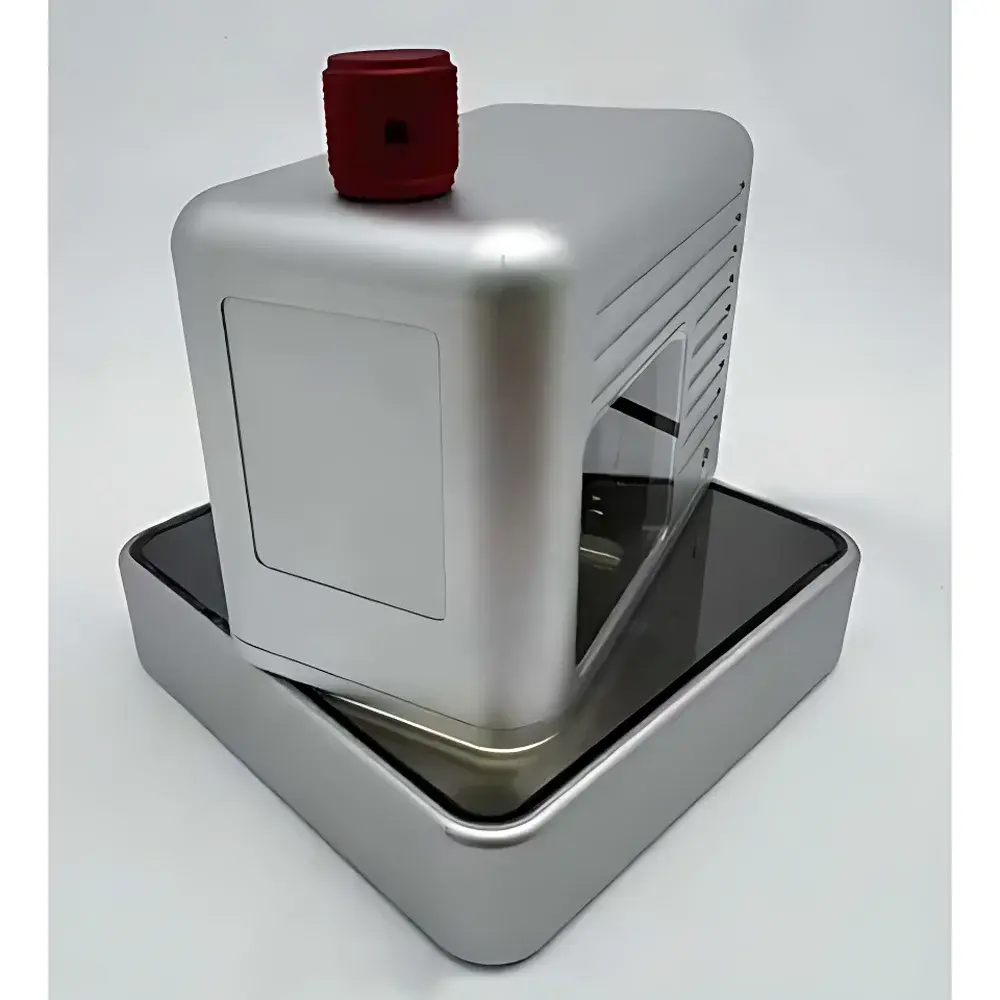
LEI-TECH LK-RYCLY200 Portable Flexographic Dot Measurement System
| Brand | LEI-TECH |
|---|---|
| Origin | Tianjin, China |
| Manufacturer Type | Direct Manufacturer |
| Regional Classification | Domestic (China) |
| Model | LK-RYCLY200 |
| Form Factor | Portable |
| Integrated Image Analysis Software | Yes |
| Total Optical Magnification | 200× |
| Sensor | Dual CMOS Cameras (1.3 MP Color) |
| Image Resolution | 1280 × 720 px |
| Dimensions (Main Unit) | 97 × 55 × 72 mm (L×W×H) |
| Weight (Main Unit) | ~625 g |
| Illumination | 8× High-Brightness White LEDs (Transmitted, Bottom-Lit) + 1× 45° Oblique LED (Reflected) |
| Transilluminator Dimensions | 100 × 100 × 25 mm |
| Transilluminator Emission Area | 90 × 90 mm |
| Transilluminator Power | DC 12 V / 2 A |
| Main Unit Power & Interface | USB 3.0 Bus-Powered |
| Operating Temperature | 5–35 °C |
| Storage Temperature | −20–+50 °C |
| Length Measurement Accuracy | ±1 µm |
| Dot Area Coverage Accuracy | ±0.1% |
Overview
The LEI-TECH LK-RYCLY200 Portable Flexographic Dot Measurement System is an engineered optical metrology instrument designed specifically for quantitative assessment of dot geometry in flexographic printing plates and printed substrates. It operates on the principle of high-resolution digital microscopy combined with calibrated transmitted and oblique reflected illumination to capture true-to-scale images of semi-transparent photopolymer plates, resin-based relief plates, and finished print samples. Unlike conventional optical comparators or subjective visual inspection, the LK-RYCLY200 delivers traceable, repeatable measurements of dot size (diameter), dot area coverage (%), line screen frequency (lpi), edge acuity, shoulder slope, and surface uniformity—critical parameters directly linked to ink transfer efficiency, tone reproduction fidelity, and press stability. Its compact, field-deployable architecture enables real-time plate verification at prepress labs, platemaking facilities, and pressrooms—reducing trial-and-error waste and minimizing unplanned press stoppages caused by out-of-spec dot growth.
Key Features
- Portable dual-illumination platform: Simultaneous bottom-transmitted white LED array (8×) and 45° oblique incident LED for comprehensive visualization of dot morphology—including subsurface structure and surface topography.
- Dual CMOS imaging system: 1.3-megapixel color sensors optimized for high-contrast, low-noise capture of semi-transparent flexo plates under controlled lighting conditions.
- Fixed 200× total magnification (referenced to 17-inch display), enabling consistent scaling across measurement sessions without manual calibration drift.
- USB 3.0 bus-powered operation: Eliminates external power adapters; ensures plug-and-play compatibility with Windows-based engineering workstations and QC laptops.
- Integrated image analysis engine: Performs automated dot detection, threshold segmentation, perimeter tracing, and statistical reporting per ISO 12233 and ASTM D724-17 guidelines for print evaluation.
- Ruggedized aluminum-magnesium alloy housing (97 × 55 × 72 mm; ~625 g): Designed for repeated transport between lab, factory floor, and client sites without optical misalignment.
Sample Compatibility & Compliance
The LK-RYCLY200 supports a defined range of flexographic media types, including photopolymer plates (e.g., DuPont Cyrel®, Flint Nyloflex®), rubber-based relief plates, processed film positives/negatives, and finished printed sheets on paper, corrugated board, or flexible packaging films. It accommodates specimens up to 90 × 90 mm under the transilluminator stage. All measurement algorithms comply with fundamental metrological principles outlined in ISO/IEC 17025 for testing laboratories and align with data integrity expectations of GLP and GMP environments. While not FDA 21 CFR Part 11-certified out-of-the-box, the system’s audit-trail-ready software architecture allows integration into validated workflows when deployed with supplementary electronic signature and version-controlled report generation modules.
Software & Data Management
Bundled LEI-Vision™ Analysis Suite provides a deterministic, non-proprietary file format (.lvd) for raw image storage, metadata tagging (operator ID, timestamp, sample ID, environmental conditions), and export to CSV, TIFF, and PDF. Each measurement session generates a structured report containing mean dot area %, standard deviation, min/max diameter, line screen deviation (lpi), and grayscale histogram distribution—exportable for SPC charting in Minitab or JMP. The software enforces user-level access control (admin/operator modes), maintains immutable log files for all edits, and supports configurable pass/fail thresholds based on customer-defined tolerances. Raw image archives are stored locally with optional network drive synchronization for centralized QA review.
Applications
- Prepress quality assurance: Validation of plate exposure, washout, and drying processes against target dot gain curves.
- Plate manufacturer certification: Generation of plate-specific dot expansion profiles for customer documentation and ISO 9001 compliance.
- Pressroom troubleshooting: Correlation of plate dot metrics with actual printed output to isolate causes of mottle, pinholing, or highlight loss.
- Material qualification: Comparative analysis of new photopolymer formulations or backing tapes for consistency in shoulder angle and base thickness.
- Training & process standardization: Objective benchmarking for operator competency assessments and cross-site process harmonization.
FAQ
What is the minimum resolvable feature size under standard operating conditions?
The system achieves a lateral resolution limit of approximately 1 µm, verified using NIST-traceable USAF 1951 test targets under optimal focus and illumination.
Can the LK-RYCLY200 measure dot gain on printed samples with heavy ink laydown or gloss varnish?
Yes—via adjustable 45° oblique illumination, which minimizes specular reflection artifacts and enhances edge contrast on coated or laminated substrates.
Is calibration required before each use?
No routine recalibration is needed; the fixed optical path and factory-applied pixel-to-micron mapping ensure long-term stability. Optional annual verification using certified step gauges is recommended for ISO 17025-accredited labs.
Does the software support multi-user deployment across a LAN?
Yes—the LEI-Vision™ Suite supports concurrent network licensing and shared database repositories for enterprise-wide data aggregation and trend analysis.
What environmental conditions must be maintained during operation?
Ambient temperature must remain between 5 °C and 35 °C, with relative humidity below 80% non-condensing. No air filtration or vibration isolation is required for typical industrial environments.






