
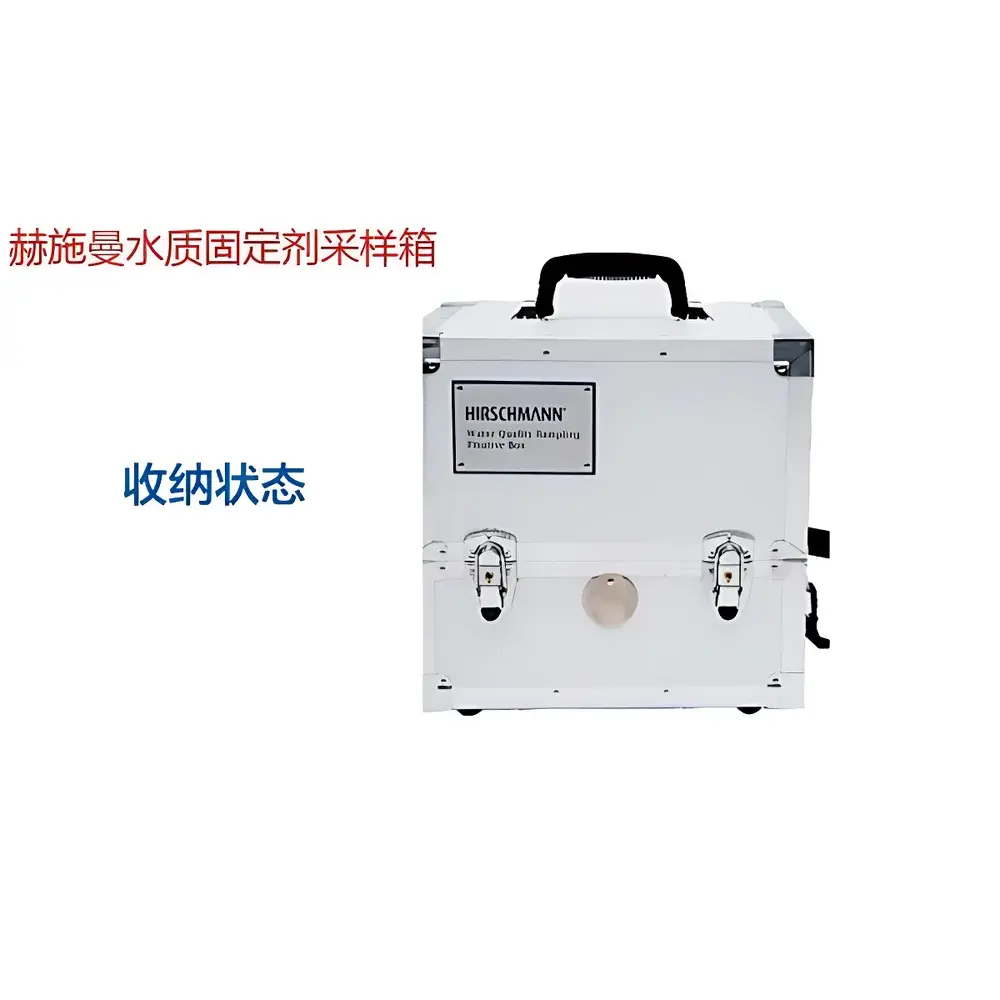
Hirschmann Environmental Water Quality Sampling Fixative Box (EPA/ISO-Compliant Field Kit)
| Brand | Hirschmann |
|---|---|
| Origin | Germany |
| Model | Water Quality Sampling Fixative Box |
| Instrument Type | Portable Manual Sampler |
| Sampling Method | Quantitative Fixed-Volume Addition |
| Single Sample Volume | 1 Unit (Configurable per Standard Vial Size) |
| Dispensing Accuracy | ±0.05% |
| Reagent Dispensing Rate | Up to 1000 operations/hour |
| Minimum Sampling Interval | 1 minute |
| Maximum Sampling Depth | 0–10 m |
| Compliance | Designed per HJ 493–2009, ASTM D3370, ISO 5667-3, and US EPA Guidance for Preservation of Aqueous Samples |
Overview
The Hirschmann Environmental Water Quality Sampling Fixative Box is a field-deployable, manually operated reagent dispensing system engineered for standardized, on-site preservation of aqueous environmental samples. It operates on the principle of precision volumetric delivery—utilizing calibrated glass or high-purity PFA syringe-based dispensers—to introduce trace-accurate volumes of preservatives (e.g., HNO₃ for metals, NaOH for cyanide, MnSO₄/alkaline iodide for dissolved oxygen, H₃PO₄ for phosphorus, or thiosulfate for residual chlorine) directly into pre-labeled, certified sample vials immediately post-collection. This eliminates post-sampling handling delays, minimizes analyte degradation (e.g., oxidation of Fe²⁺, volatilization of phenols, microbial metabolism of nutrients), and ensures compliance with internationally recognized sample integrity protocols. The system is not an automated sampler but a purpose-built fixative integration module intended for use alongside standard grab samplers (e.g., Kemmerer, Van Dorn, or Niskin bottles) in surface water, groundwater, wastewater, and drinking water distribution networks.
Key Features
- Modular, lightweight aluminum-alloy chassis with IP54-rated enclosure—designed for rugged field deployment across diverse topographies including riverbanks, wells, reservoirs, and municipal pumping stations.
- Chemically inert reagent pathways: borosilicate glass barrels, PFA-coated plungers, and fluoropolymer tubing ensure zero leaching—even with concentrated mineral acids (up to 65% HNO₃), alkalis, or chelating agents.
- Pre-calibrated fixed-volume dispensers (1.0 mL, 2.0 mL, 5.0 mL options) with dual-scale engraved graduations and locking collars—enabling rapid, tool-free volume verification and adjustment per analytical method requirements (e.g., 1.0 mL HNO₃ for heavy metals per EPA Method 200.8; 2.0 mL NaOH for cyanide per ISO 6703-1).
- Integrated vial holder tray accommodating up to 24 × 60 mL or 12 × 250 mL EPA-compliant polyethylene or amber glass vials—each position labeled with alphanumeric indexing for chain-of-custody traceability.
- Zero-cross-contamination design: disposable tips and independent fluid paths per reagent channel prevent carryover between sulfur compounds, oxidants, and microbiological preservatives.
- Field-serviceable components with documented calibration certificates traceable to PTB (Physikalisch-Technische Bundesanstalt, Germany) and NIST standards.
Sample Compatibility & Compliance
The Fixative Box supports preservation protocols for over 30 regulated analytes, including but not limited to: sulfides (ZnAc₂ fixation), cyanides (NaOH pH >12), Cu/Zn/Pb/Cd (HNO₃ acidification to pH 8), Se/Sb/Bi (HNO₃/HCl mixture), petroleum hydrocarbons (HCl acidification), dissolved oxygen (MnSO₄ + alkaline KI), volatile phenols (H₃PO₄), and coliform indicators (sodium thiosulfate for chlorine neutralization). All dispensing performance meets the accuracy and repeatability criteria specified in ISO/IEC 17025-accredited laboratories. The system is validated for conformance with HJ 493–2009 (China MEP), ASTM D3370-22 (Standard Practices for Sampling Water), ISO 5667-3:2018 (Preservation and Handling), and US EPA SW-846 Chapter One (Sample Preservation Tables). It is routinely deployed in GLP-regulated environmental monitoring programs requiring full audit trails and method-defensible sample custody.
Software & Data Management
While the Fixative Box is a hardware-only, non-electronic system, it integrates seamlessly into digital field workflows via companion documentation tools. Each unit ships with a laminated, QR-coded Quick Reference Guide linking to downloadable SOP templates (PDF/Word), electronic chain-of-custody logbooks (Excel-compatible), and a reagent compatibility matrix aligned with EPA, ISO, and HJ-series methods. Optional integration with LIMS platforms (e.g., LabWare, Thermo Fisher SampleManager) is supported through standardized CSV export of sample ID → reagent type → volume → time stamp metadata. Calibration logs and maintenance records are maintained offline in accordance with 21 CFR Part 11 Annex 11 principles—requiring handwritten signatures, dated entries, and controlled document revision tracking.
Applications
- Regulatory environmental monitoring by national and provincial ecological environment bureaus conducting routine surface water quality assessments (e.g., Yangtze River Basin surveillance).
- Groundwater quality mapping for geological survey agencies—preserving redox-sensitive species (Fe²⁺/Fe³⁺, As(III)/As(V)) during deep-well sampling at depths up to 10 m.
- Drinking water safety audits by CDC and municipal water authorities—ensuring accurate quantification of disinfection byproducts (e.g., trihalomethanes) and trace metals in distribution systems.
- Emergency response scenarios (e.g., chemical spills, algal bloom events)—where rapid, standardized fixation prevents analyte loss during transport to central labs.
- Research-grade limnology and hydrogeochemistry field campaigns requiring inter-laboratory comparability under ISO 5725-2 precision criteria.
FAQ
Does the Fixative Box include sample collection hardware?
No—it is a dedicated reagent addition module. Users must pair it with compatible manual or mechanical grab samplers (e.g., stainless-steel bailers, depth-integrated samplers) meeting ISO 5667-10 specifications.
Can it dispense multiple reagents simultaneously into one vial?
No. Each dispenser channel is single-reagent dedicated to prevent cross-reactivity; sequential addition is required per preservation protocol (e.g., acidify first, then add biocide).
Is calibration verification required before each sampling campaign?
Yes. A three-point gravimetric check (using certified weights and Class A volumetric flasks) is recommended prior to deployment and after any transport-induced impact, per ISO/IEC 17025 Clause 6.5.2.
What vial materials are compatible?
Certified low-extractables HDPE, LDPE, amber glass, and fluorinated ethylene propylene (FEP) vials—validated for use with aggressive preservatives under EPA Method 1631 and ISO 11567.
How is temperature stability managed during summer fieldwork?
The box includes insulated foam inserts and optional passive cooling packs (gel-based, non-leaking) to maintain reagent integrity between 4–25 °C for ≤8 hours without refrigeration.







