
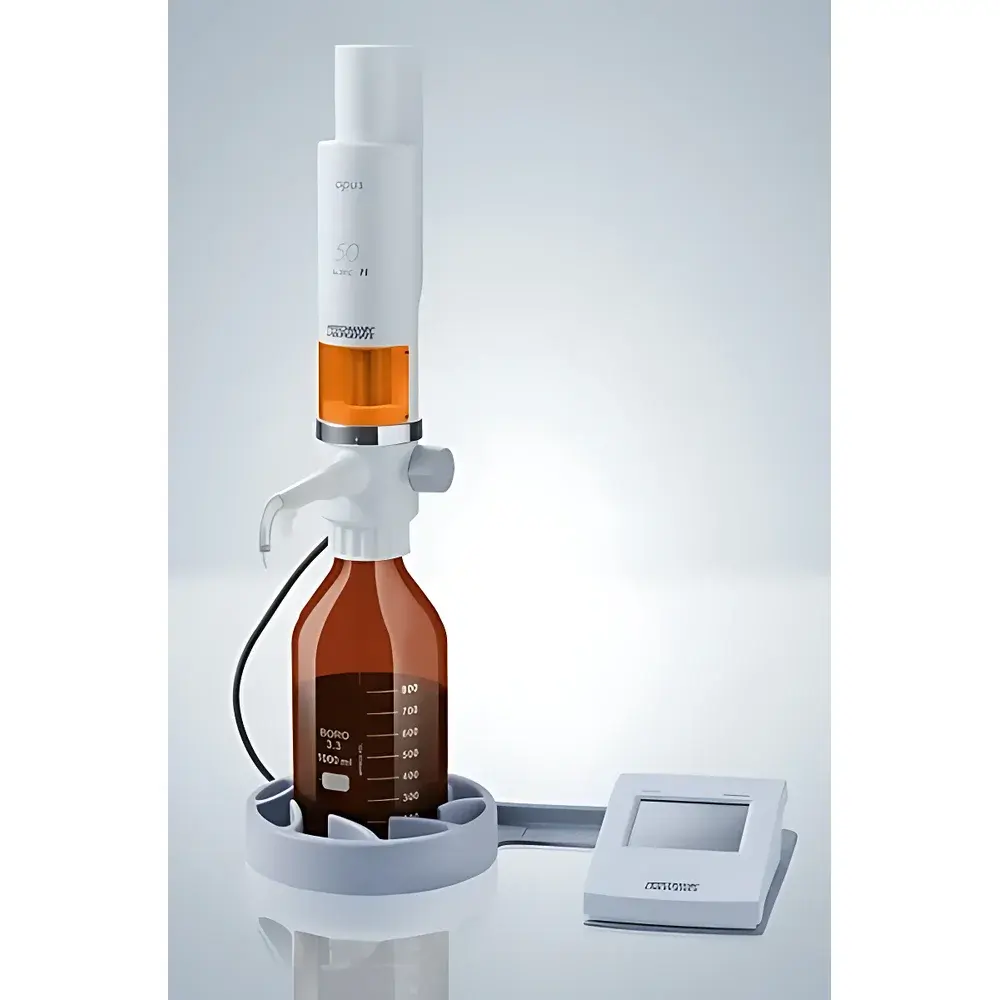
Hirschmann Opus Electronic Burette Model 9581050
| Brand | Hirschmann (Germany) |
|---|---|
| Origin | Germany |
| Model | 9581050 |
| Volume Range | 20–50 mL |
| Minimum Dispensing Increment | 0.01 mL |
| Accuracy (A) | ≤0.2% |
| Coefficient of Variation (CV) | ≤0.05% |
| Materials in Contact with Liquids | ECTFE, FEP, PTFE, Borosilicate Glass |
| Compliance | ISO 8655, DIN EN ISO 9001, GLP, GMP |
Overview
The Hirschmann Opus Electronic Burette Model 9581050 is a precision-engineered, motor-driven burette designed for high-reproducibility volumetric titration in regulated laboratory and production environments. Unlike manual or semi-automated burettes, the Opus employs closed-loop stepper motor control to drive piston displacement with digital positional feedback—eliminating parallax error, operator-dependent variability, and mechanical backlash. Its core measurement principle adheres to ISO 8655-3 (volumetric apparatus — burettes), ensuring traceable accuracy across its full 20–50 mL operating range. The device operates as a standalone instrument via integrated TFT touchscreen interface or integrates seamlessly into automated workflows via RS232/USB connectivity, supporting both local execution and remote orchestration through LIMS or ELN platforms.
Key Features
- Digital volumetric dispensing with programmable delivery modes: rapid fill, pre-titration, fine-drip endpoint approach, and pause/resume functionality—enabling method-specific optimization for acid-base, redox, complexometric, and precipitation titrations.
- High-resolution dispense control at 0.01 mL increments, validated to ≤0.2% accuracy (A) and ≤0.05% coefficient of variation (CV) per ISO 8655 calibration protocols.
- Chemically inert fluid path constructed entirely from fluoropolymers (ECTFE, FEP, PTFE) and borosilicate glass—compatible with aggressive solvents, strong acids (excluding HF), bases, and oxidizers; eliminates leaching, adsorption, or degradation over extended use.
- Modular human-interface options: capacitive touchscreen, external USB mouse, footswitch (optional), or PC-based control—supporting ergonomic operation inside fume hoods, gloveboxes, or cleanroom environments.
- Integrated safety features: factory-calibrated pressure-relief valve, optional desiccant drying tube for hygroscopic reagents, and brown-window variant for light-sensitive titrants (e.g., iodine, silver nitrate, KMnO₄).
- Automatic priming and air-removal sequence executed via reverse-pump algorithm—reducing setup time and minimizing bubble-induced volume uncertainty.
Sample Compatibility & Compliance
The Opus 9581050 accommodates aqueous, organic, and mixed-phase titrants without material compatibility compromise. All wetted components meet USP Class VI and FDA 21 CFR 177.1550 requirements for fluoropolymer contact surfaces. Device firmware and data handling architecture support ALCOA+ principles (Attributable, Legible, Contemporaneous, Original, Accurate, Complete, Consistent, Enduring, Available). Audit trails, electronic signatures, and user-access-level configuration comply with 21 CFR Part 11 when operated under validated software environments. Full serial-number traceability, individual factory calibration certificates (including gravimetric verification data), and ISO 9001-aligned documentation packages are provided—directly embeddable into quality management systems for ISO 9001:2015, ISO/IEC 17025, or pharmaceutical GMP audits.
Software & Data Management
Data acquisition occurs in real time during titration via internal memory (500+ method storage) or external export to CSV/Excel via USB or serial interface. Optional Hirschmann TitraSoft™ software enables method development, multi-step protocol scripting, statistical analysis (mean, SD, RSD), and PDF report generation with embedded calibration metadata. All data logs include timestamp, operator ID, environmental temperature (via optional sensor input), and raw step-by-step volume delivery records—satisfying GLP documentation requirements for regulatory submissions. Firmware updates maintain backward compatibility and incorporate periodic enhancements aligned with evolving ISO 8655 revision cycles.
Applications
- Pharmaceutical QC labs performing assay validation per USP , , and EP 2.2.3.
- Food & beverage testing for acidity (titratable acidity), salt content (argentometric), and preservative quantification.
- Environmental analysis including COD, alkalinity, chloride, and hardness determination per APHA Standard Methods.
- Chemical manufacturing process control where batch consistency requires <0.1% volumetric repeatability.
- Academic research labs requiring traceable, operator-independent titration for kinetic studies or standard solution preparation.
FAQ
Does the Opus 9581050 require recalibration after routine maintenance?
Yes—per ISO 8655-3, recalibration is required following any disassembly of the piston assembly, seal replacement, or after 12 months of continuous operation. A full recalibration certificate with gravimetric verification data is issued post-service.
Can the device be integrated into a LIMS with electronic signature capability?
Yes, when used with TitraSoft™ v3.2+ and configured under a validated IT infrastructure, it supports 21 CFR Part 11-compliant electronic signatures and audit-trail archiving.
Is the brown-window version available for Model 9581050?
Yes—the optional amber-view window (Order Code: 9581050-BR) is mechanically interchangeable and maintains identical metrological performance.
What is the maximum operating temperature for the fluid path?
The fluoropolymer/glass system is rated for continuous operation up to 120 °C; short-term exposure to 140 °C is permissible with reduced cycle life.
How is air bubble elimination handled during startup?
The built-in auto-prime function executes a three-phase sequence: reverse suction, forward purge, and static hold—verified by real-time flow-rate monitoring before method initiation.



