
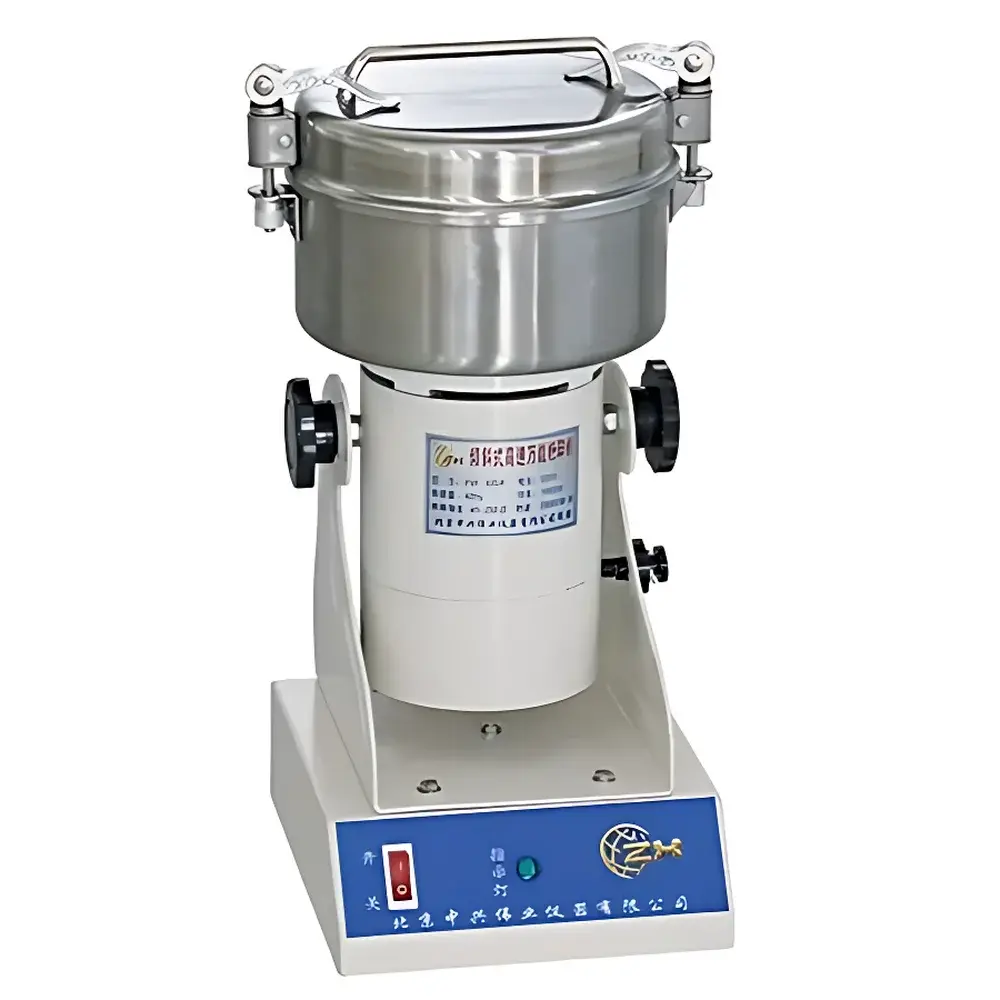
Zhongke Aobo FW80 High-Speed Laboratory Crusher
| Brand | Zhongke Aobo |
|---|---|
| Origin | Beijing, China |
| Model | FW80 |
| Voltage | AC 220 V, 50 Hz |
| Power | 200 W |
| Speed | 10,000 rpm |
| Chamber Dimensions | Φ80 × 40 mm |
| Batch Capacity | 50–400 g |
| Feed Size | ≤1 mm |
| Output Particle Size | 40–200 mesh (≈74–420 µm) |
| Minimum Output Granularity | ≥0.5 mm |
| Net Weight | 2.5 kg |
| Gross Weight | 2.7 kg |
| Equipment Type | Benchtop Impact Crusher |
| Sample Type | Hard, brittle, dry materials |
Overview
The Zhongke Aobo FW80 High-Speed Laboratory Crusher is a compact, benchtop impact grinding instrument engineered for rapid size reduction of hard, brittle, and dry solid samples in analytical and preparatory laboratory workflows. It operates on the principle of high-speed rotor-driven impact comminution: a centrally mounted stainless-steel blade rotates at up to 10,000 rpm inside a sealed, cylindrical grinding chamber, subjecting feed material to repeated mechanical impact and shear forces against the chamber wall and blade edges. This mechanism enables efficient particle size reduction without significant thermal degradation—critical for preserving sample integrity prior to elemental analysis, X-ray fluorescence (XRF), inductively coupled plasma (ICP), or gravimetric assay. Designed for routine use in quality control labs, geological survey units, agricultural research stations, pharmaceutical R&D facilities, and academic teaching laboratories, the FW80 delivers reproducible, operator-independent results across diverse inorganic and organic matrices including minerals, ores, soil aggregates, dried plant tissues, pharmaceutical tablets, and ceramic powders.
Key Features
- Stainless-steel grinding chamber and precision-machined rotor blade (AISI 304 grade) ensure chemical inertness, corrosion resistance, and minimal metal contamination during sample processing.
- Benchtop footprint (Φ110 × 210 mm) and low net weight (2.5 kg) enable flexible placement on fume hoods, laminar flow cabinets, or shared instrumentation benches.
- Single-phase AC 220 V / 50 Hz input compatibility aligns with standard electrical infrastructure across Asia, Africa, Latin America, and select European research institutions.
- Interlocked safety lid with microswitch cutoff prevents operation when open—meeting IEC 61000-4-2 ESD immunity and basic functional safety expectations for Class I laboratory equipment.
- Tool-free chamber access and smooth internal surface geometry facilitate rapid cleaning and cross-sample decontamination between batches.
- No external cooling or vacuum interface required—suitable for intermittent operation in non-controlled ambient environments (15–30 °C, <70% RH).
Sample Compatibility & Compliance
The FW80 is validated for use with non-fibrous, non-sticky, low-moisture (<5% w/w) solid samples exhibiting Mohs hardness ≤6.5 (e.g., limestone, quartz sand, dried leaf tissue, granular excipients). It is not suitable for wet, oily, fibrous, polymeric, or thermolabile substances. While not certified to ISO/IEC 17025 or ASTM D2974 (for coal analysis), its mechanical design conforms to general principles outlined in ASTM E11–22 (Standard Specification for Woven Wire Test Sieve Cloth and Test Sieves) for downstream particle sizing validation. The device supports GLP-aligned documentation practices through manual batch logging; however, it does not incorporate electronic audit trails or 21 CFR Part 11-compliant data capture.
Software & Data Management
The FW80 is a standalone electromechanical instrument with no embedded firmware, touchscreen interface, or digital connectivity. All operational parameters—including run time, speed, and batch identification—are manually recorded by the user. For traceability, laboratories are advised to integrate the crusher into existing SOPs using paper-based or LIMS-linked log sheets specifying: sample ID, pre-crush mass, chamber cleaning protocol, post-crush sieve analysis method (e.g., ASTM E11), and operator signature. No proprietary software, drivers, or cloud services are associated with this model.
Applications
- Preparation of homogenized subsamples for geochemical assay (e.g., XRF quantification of SiO₂, Fe₂O₃, Al₂O₃ in rock powders).
- Routine size reduction of agricultural soils prior to heavy metal extraction (EPA Method 3050B).
- Fragmentation of pharmaceutical dosage forms for content uniformity testing per USP <905>.
- Grinding of botanical materials for proximate analysis (moisture, ash, crude fiber) under AOAC 973.18.
- Production of consistent feedstock for pressed pellet preparation in infrared spectroscopy (FTIR) and XRD sample mounting.
FAQ
What types of samples are incompatible with the FW80?
Samples with high moisture content (>5%), elasticity (rubber, polymers), fibrous structure (wood chips, cotton), or thermal sensitivity (volatile organics, enzymes) are unsuitable due to clogging risk, incomplete fragmentation, or decomposition.
Can the FW80 achieve sub-40 mesh output?
No—the mechanical impact design and chamber geometry limit practical fineness to 40–200 mesh (74–420 µm); finer particle distributions require planetary ball milling or jet milling.
Is the grinding chamber autoclavable?
The chamber is constructed from AISI 304 stainless steel and may be sterilized via dry heat (160 °C, 2 h); however, repeated autoclaving is not recommended due to potential gasket degradation and dimensional drift in threaded interfaces.
How often should the rotor blade be replaced?
Under typical usage (≤5 batches/day, mineral samples), blade service life exceeds 500 operating hours; visual inspection for edge rounding or microcracking is the primary maintenance indicator.



