
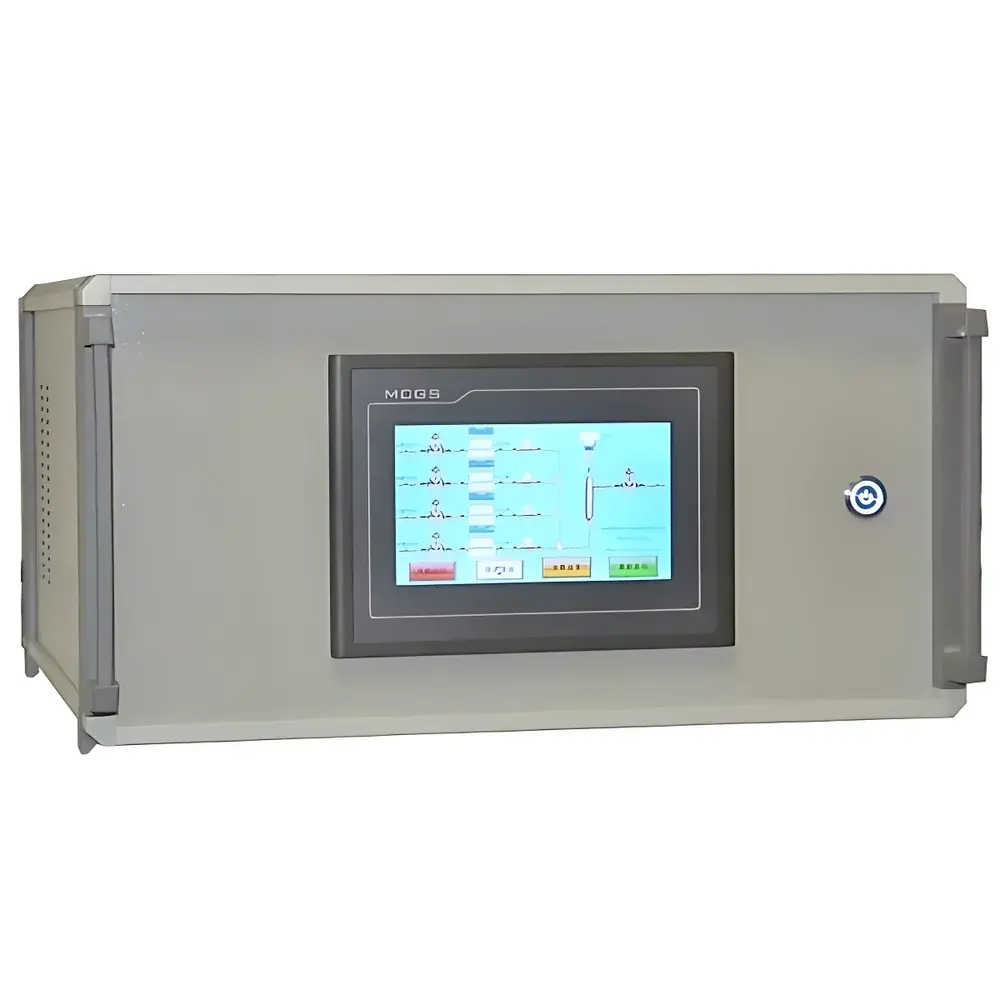
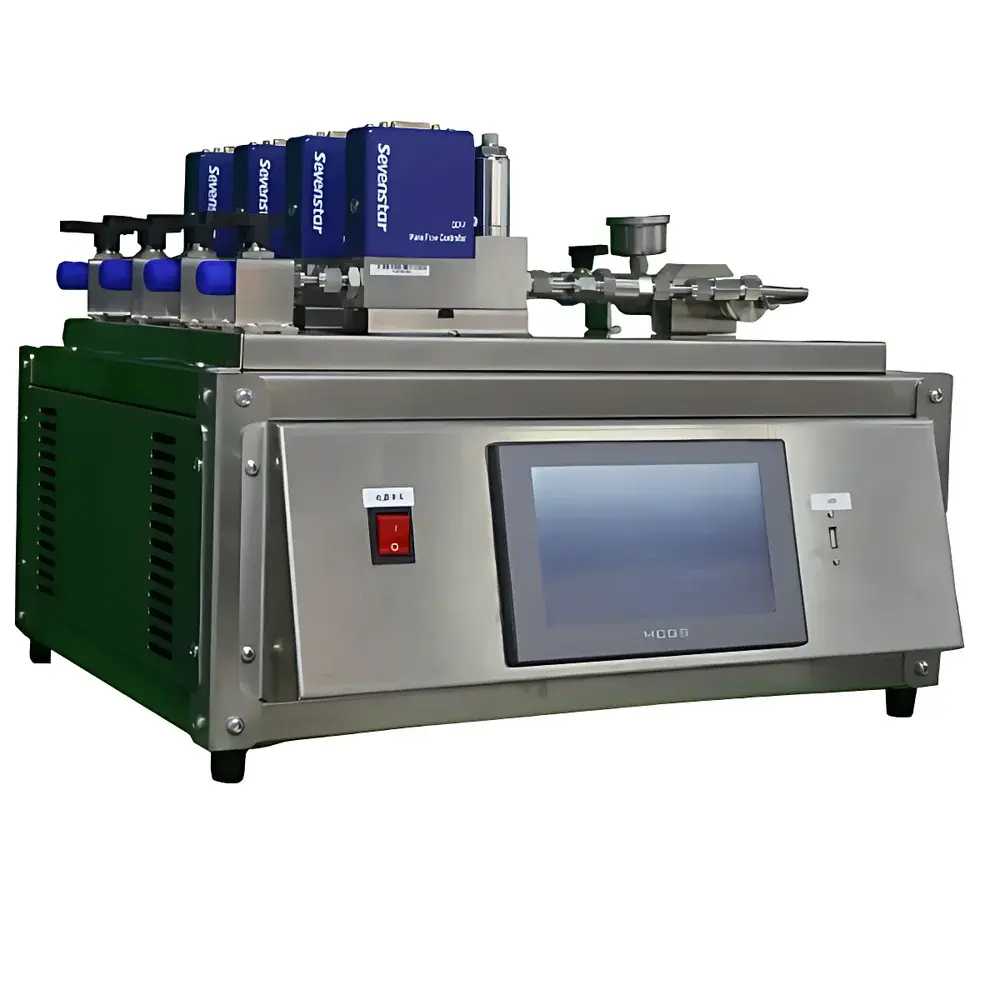
Zhongke Aobo PQ-C4Z Intelligent Gas Blending System
| Brand | Zhongke Aobo |
|---|---|
| Origin | Beijing, China |
| Model | PQ-C4Z |
| Flow Range | 20 sccm – 30 slm (configurable per gas) |
| Accuracy | ±1% F.S. (standard), ±1% F.S. (high-precision) |
| Repeatability | ±0.2% F.S. |
| Linearity | ±0.5% F.S. (high-precision), ±1% F.S. (standard) |
| Response Time | ≤2 s (high-precision), ≤4 s (standard) |
| Operating Temperature | 5–45 °C |
| Power Supply | 85–265 VAC, 50/60 Hz |
| Max. Power Consumption | 40 W |
| Inlet Pressure Limit | ≤0.6 MPa |
| Outlet Pressure Monitoring | 0–0.6 MPa |
| Gas Mixing Chamber | Integrated |
| Programmable Stages | 5-segment time–flow profile |
| Auto-Cleaning Function | Yes |
| Flow Accumulation | Yes |
| Electromagnetic Interference Shielding | Yes |
| Housing Material | 316 stainless steel tubing & dual-ferrule fittings |
| Dimensions | 460 × 210 × 480 mm |
| Weight | 18 kg |
Overview
The Zhongke Aobo PQ-C4Z Intelligent Gas Blending System is an engineered solution for precise, programmable, and reproducible gas mixture generation in controlled-atmosphere laboratory environments. Designed for integration with vacuum tube furnaces, gloveboxes, and catalytic reaction chambers, the system employs mass flow control based on thermal-based mass flow meters (MFM) with proton-conductive sensor elements—ensuring stable, temperature-compensated measurement across a wide dynamic range. Unlike pressure-based blending methods, this system delivers true volumetric flow control under varying backpressure conditions, enabling reliable stoichiometric gas dosing for oxidation, reduction, carburization, nitridation, and inert purging protocols. Its modular architecture supports up to four independent gas channels, each with individual MFM calibration traceable to NIST-traceable standards, and accommodates both reactive (e.g., H₂, NH₃, Cl₂) and inert (e.g., Ar, N₂, He) gases through chemically resistant 316 stainless steel fluidic pathways.
Key Features
- Four-channel independent mass flow control with configurable range selection (20 sccm to 30 slm per channel)
- High-precision thermal mass flow sensors with ±1% full-scale accuracy and ±0.2% F.S. repeatability
- Integrated 7-inch industrial-grade capacitive touchscreen HMI with intuitive parameter navigation and real-time flow visualization
- Five-stage programmable flow profile engine: user-defined time–flow sequences with millisecond-level timing resolution
- Dual-ferrule 316 stainless steel compression fittings (3 mm, 6 mm, 1/8″, 1/4″ options) ensuring leak-tight connections per ISO 8573-1 Class 2 purity requirements
- Onboard auto-cleaning routine with nitrogen purge cycle to prevent sensor drift from condensate or particulate accumulation
- Real-time cumulative flow logging and outlet pressure monitoring (0–0.6 MPa) with alarm thresholds
- EMI-hardened electronics compliant with IEC 61326-1 for operation in electromagnetically noisy lab environments (e.g., near RF plasma sources or induction heaters)
Sample Compatibility & Compliance
The PQ-C4Z is compatible with gases classified under ISO 8573-1:2010 Air Quality Classes 2–4, including corrosive, flammable, and oxidizing species when used with appropriate gas-specific MFMs and optional corrosion-resistant internal coatings. All wetted materials—including tubing, valves, and sensor housings—are constructed from electropolished 316 stainless steel (ASTM A270), certified for use with ultra-high-purity (UHP) gases per SEMI F57 standards. The system meets CE marking requirements for electromagnetic compatibility (2014/30/EU) and low-voltage directive (2014/35/EU). While not intrinsically safe, it may be deployed in non-hazardous areas (Zone 2 / Class I, Division 2) when installed with external gas detection and interlock systems per IEC 60079-10-1.
Software & Data Management
The embedded firmware supports data export via USB host interface in CSV format, including timestamped flow values, pressure readings, program stage transitions, and error logs. Optional RS-485 Modbus RTU communication enables integration into SCADA or LabVIEW-based supervisory systems for centralized process orchestration. Audit trail functionality records all parameter changes, program uploads, and manual overrides—supporting GLP-compliant documentation workflows. Although native support for FDA 21 CFR Part 11 electronic signatures is not included, the system’s deterministic behavior and immutable event logging allow third-party validation packages to satisfy GMP traceability requirements.
Applications
- Atmosphere control in high-temperature synthesis (e.g., CVD, PVD, sintering) requiring precise O₂/N₂ or CO/CO₂ ratios
- Controlled oxidation/reduction studies in catalysis research using dynamically adjustable H₂/Ar mixtures
- Calibration gas generation for FTIR, GC-TCD, and residual gas analyzers
- Inert gas purging of gloveboxes prior to air-sensitive material handling (e.g., Li-ion battery electrode fabrication)
- Multi-step thermal treatment protocols with timed gas switching (e.g., annealing → nitriding → cooling under N₂)
- Environmental simulation testing where gas composition must replicate industrial exhaust or combustion effluent profiles
FAQ
What gases are compatible with the PQ-C4Z system?
The system supports common industrial and research gases—including N₂, Ar, He, H₂, O₂, CO, CO₂, NH₃, and CH₄—provided the appropriate mass flow meter calibration and wetted material compatibility are verified. Reactive or corrosive gases require optional sensor coatings and dedicated MFM modules.
Can the system be integrated with a PLC or external controller?
Yes. RS-485 Modbus RTU interface is standard; optional Ethernet/IP or Profibus DP modules are available upon request for factory-configured OEM integration.
Is the mixing chamber heated?
The base configuration includes a passive stainless steel mixing chamber. An optional heated version (ambient to 350 °C, ±1 °C stability) is available with PID-controlled cartridge heaters and thermocouple feedback.
How is calibration maintained over time?
Each MFM is supplied with a factory calibration certificate (NIST-traceable). Users may perform zero-point verification at atmospheric pressure; full recalibration requires return to an authorized service center or accredited metrology lab.
Does the system support emergency gas shutoff?
Yes. Dry-contact relay outputs are provided for integration with external emergency stop circuits or gas detection alarms, triggering immediate valve closure and flow termination within <100 ms.



