
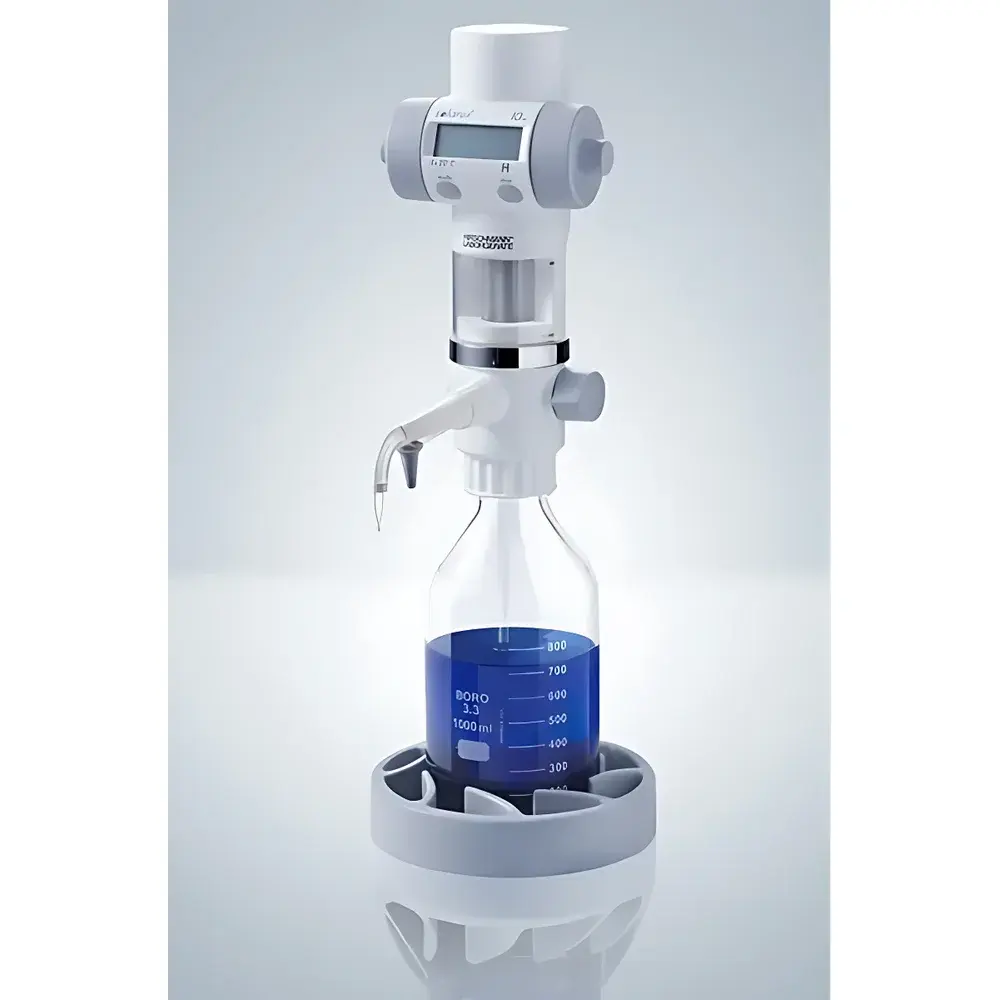
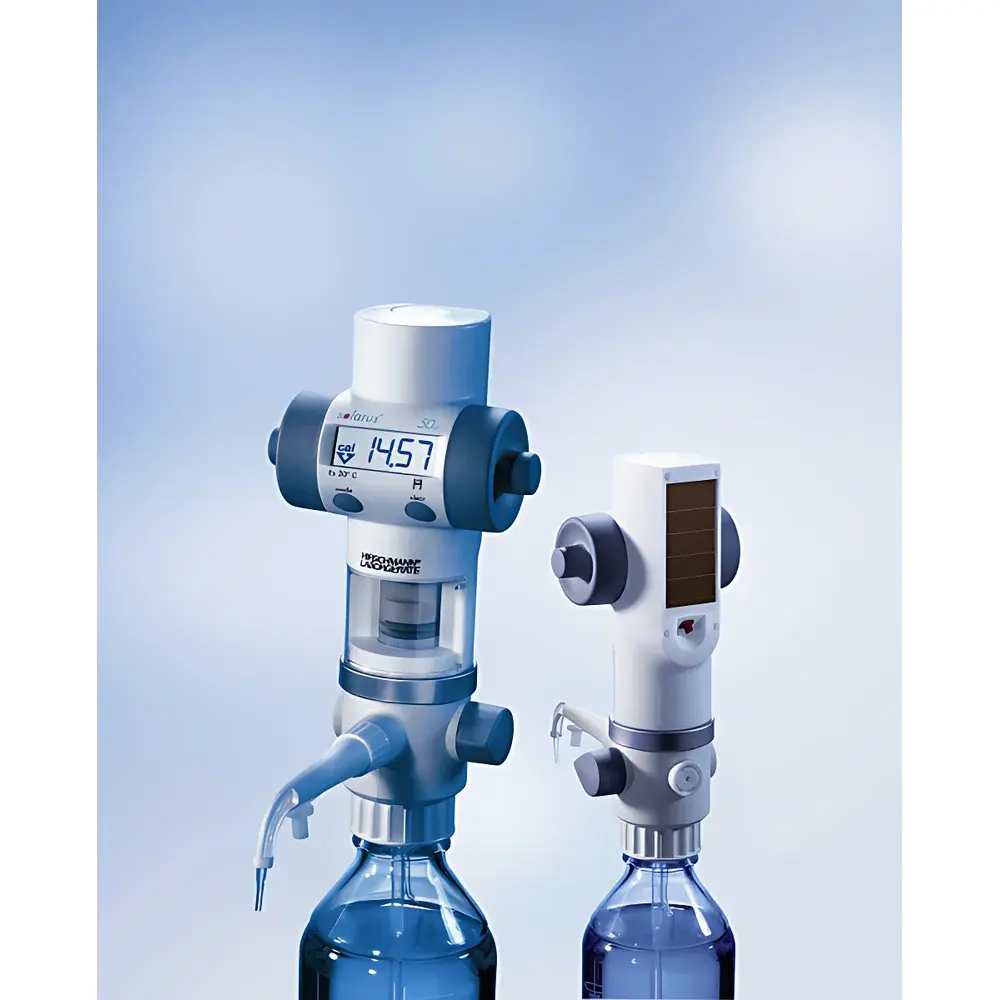
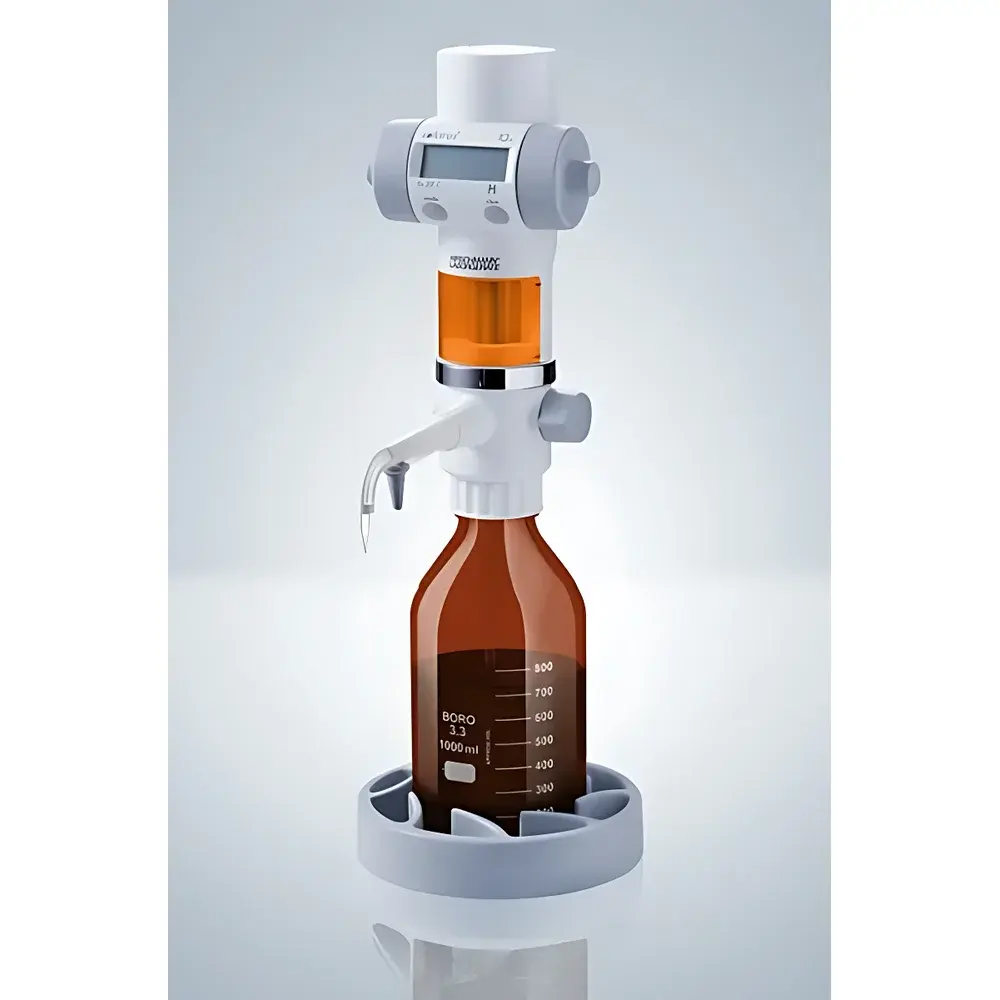
Hirschmann solarus Solar-Powered Electronic Titrator
| Brand | Hirschmann (Germany) |
|---|---|
| Origin | Germany |
| Model | solarus |
| Volume Range | 0.01–99.99 mL |
| Minimum Increment | 0.01 mL |
| Accuracy | ±0.2% to ±0.3% (depending on model) |
| Precision (CV) | ≤0.1% |
| Power Source | Integrated amorphous silicon solar cell + supercapacitor energy storage |
| Display | Digital LCD with backlight |
| Interface | RS232 and USB (optional) |
| Compliance | ISO 8655-3, DIN EN ISO 9001, GLP/GMP-ready, ASTM E2758 |
| Software | liqui-soft v2.x for calibration, data logging, and audit trail |
| Certifications | CE, RoHS, REACH |
| Dimensions (W×D×H) | 95 × 140 × 280 mm |
| Weight | ~0.85 kg |
| Material | Chemically resistant PTFE-coated piston, borosilicate glass syringe body, UV-stabilized ABS housing |
| Optional | Brown-tinted viewing window (standard), sterile-compatible configurations available |
Overview
The Hirschmann solarus Solar-Powered Electronic Titrator is a precision-engineered, ISO 8655-3 compliant liquid delivery system designed for volumetric titration in regulated laboratory and production environments. Unlike conventional burettes or motor-driven titrators reliant on disposable batteries or AC power, the solarus employs an integrated amorphous silicon photovoltaic cell coupled with a maintenance-free supercapacitor energy storage system. This architecture eliminates battery leakage risk, reduces long-term operational waste, and ensures uninterrupted operation under ambient laboratory lighting—including standard LED and fluorescent illumination—without requiring direct sunlight. The device operates on the principle of positive displacement via a high-precision, PTFE-coated ceramic piston driven by a stepper-motor-controlled lead-screw mechanism. Volumetric delivery is achieved through calibrated linear displacement, enabling reproducible dispensing across its full range (0.01–99.99 mL) with traceable accuracy per ISO 8655-3 Annex B and DIN EN ISO 9001 documentation requirements.
Key Features
- Solar-harvesting power system: No batteries required; zero risk of electrolyte corrosion or voltage decay over time.
- Digital volumetric readout with 0.01 mL resolution and real-time dispense confirmation—eliminates parallax error and meniscus misreading inherent to glass burettes.
- Modular, tool-free disassembly: All wetted components—including syringe barrel, piston, sealing valve, and drip tip—can be fully separated for cleaning, sterilization (autoclavable up to 121°C/2 bar), or replacement without calibration loss.
- Integrated air purge and retraction function: Automatic bubble expulsion prior to titration; post-run reagent return to reservoir minimizes chemical waste and cross-contamination.
- Adjustable dispensing speed: Programmable flow rates from 0.1 mL/min to 10 mL/min, supporting both macro- and micro-titration protocols down to 10 µL increments.
- One-touch self-calibration: Verified against certified reference standards; generates timestamped calibration reports compliant with GLP audit trails.
- UV-protective brown viewing window (standard): Maintains stability of light-sensitive titrants (e.g., iodine, cerium(IV), potassium permanganate).
- Ergonomic form factor: Compact footprint (95 × 140 × 280 mm) enables stable operation inside fume hoods, laminar flow cabinets, or confined analytical workstations.
Sample Compatibility & Compliance
The solarus is compatible with aqueous, organic, and mildly corrosive solutions (pH 1–12), including common titrants such as NaOH, HCl, EDTA, AgNO₃, and KMnO₄. Its chemically inert fluid path—comprising borosilicate glass, PTFE, FFKM, and stainless steel 316—ensures long-term integrity with solvents like acetone, ethanol, and dichloromethane. Each unit undergoes individual volumetric verification at three points (10%, 50%, and 90% of nominal capacity) using NIST-traceable gravimetric methods. Full inspection reports—including serial-numbered calibration certificates, uncertainty budgets, and conformity statements—are supplied with every instrument and are structured to integrate directly into ISO 9001:2015 quality management documentation. The system supports FDA 21 CFR Part 11 compliance when used with liqui-soft software configured for electronic signatures, audit logs, and role-based access control.
Software & Data Management
The optional liqui-soft v2.x software provides bidirectional communication via RS232 or USB interfaces. It enables remote titration protocol definition, real-time data capture (volume, time, temperature if external probe connected), automated report generation (PDF/CSV), and secure archival with timestamped digital signatures. All calibration events, user logins, parameter changes, and dispense records are stored in an immutable audit trail meeting GLP and GMP requirements. Data export supports LIMS integration via standardized CSV templates aligned with ASTM E1578 and ISO/IEC 17025 metadata conventions. Firmware updates are delivered via signed binary packages to ensure integrity and version traceability.
Applications
The solarus is validated for use in pharmaceutical QC (USP , EP 2.2.44), environmental analysis (EPA 300.0, ISO 9963), food & beverage testing (AOAC 984.27, ISO 8549), and academic research requiring metrologically sound titration workflows. Typical applications include acid-base, redox, complexometric, and precipitation titrations; Karl Fischer water determination (with compatible reagents); and standardization of primary reference materials. Its low CV (≤0.1%) and documented accuracy make it suitable for method validation studies under ICH Q2(R2) guidelines.
FAQ
Does the solarus require direct sunlight to operate?
No. Its amorphous silicon solar cell functions effectively under typical laboratory lighting (≥300 lux), including LED and fluorescent sources. Full charge is achieved in ≤4 hours under standard lab conditions.
Can the solarus be used with aggressive solvents such as concentrated HNO₃ or HF?
No. While compatible with pH 1–12 aqueous and common organic solvents, hydrofluoric acid, hot concentrated phosphoric acid, and molten alkalis are incompatible due to material limitations.
Is firmware upgrade capability built-in?
Yes. Updates are performed via USB using digitally signed firmware packages; version history and installation logs are retained in internal memory.
How is traceability maintained during calibration?
Each calibration event generates a unique, timestamped certificate referencing NIST-traceable weights and certified reference solutions, with full uncertainty budgeting per ISO/IEC 17025 Clause 7.7.
Can multiple solarus units be managed centrally via liqui-soft?
Yes. liqui-soft supports concurrent connection to up to eight devices via USB hub or RS232 multiplexer, with synchronized reporting and centralized user administration.
Related Products



