
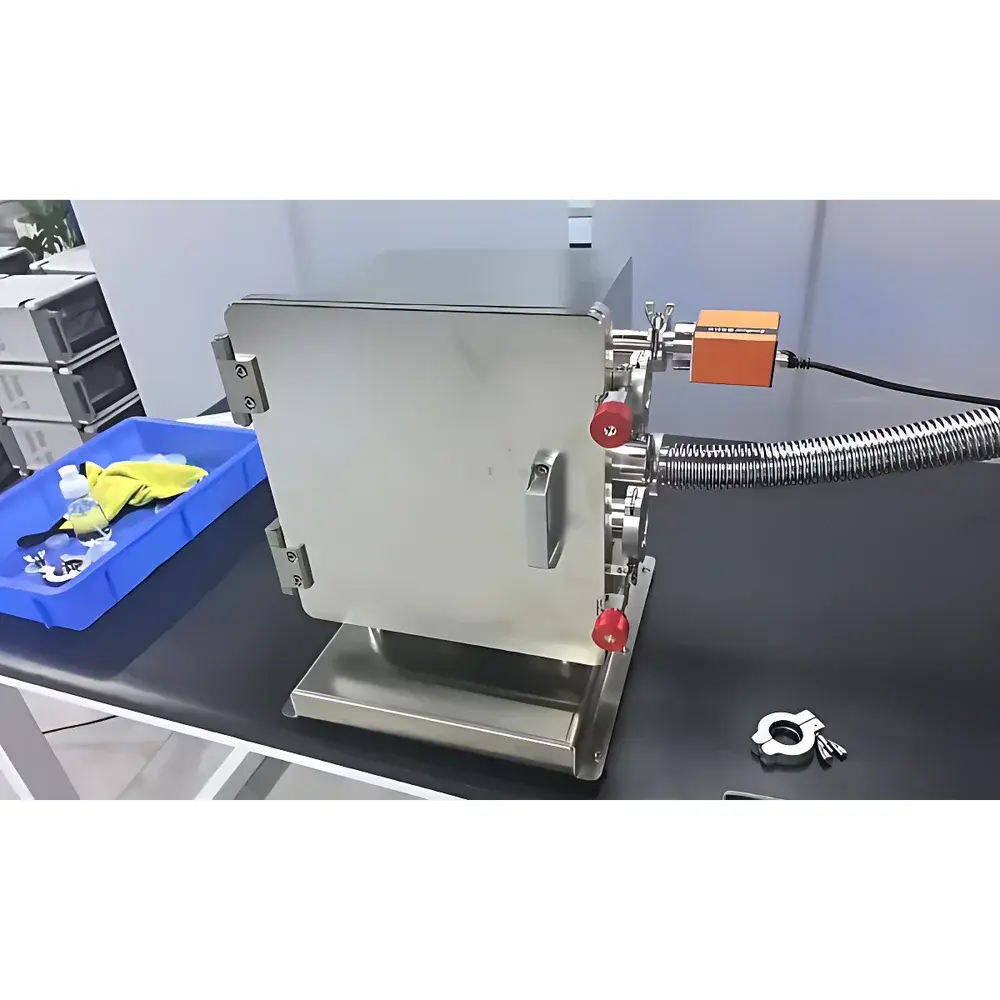
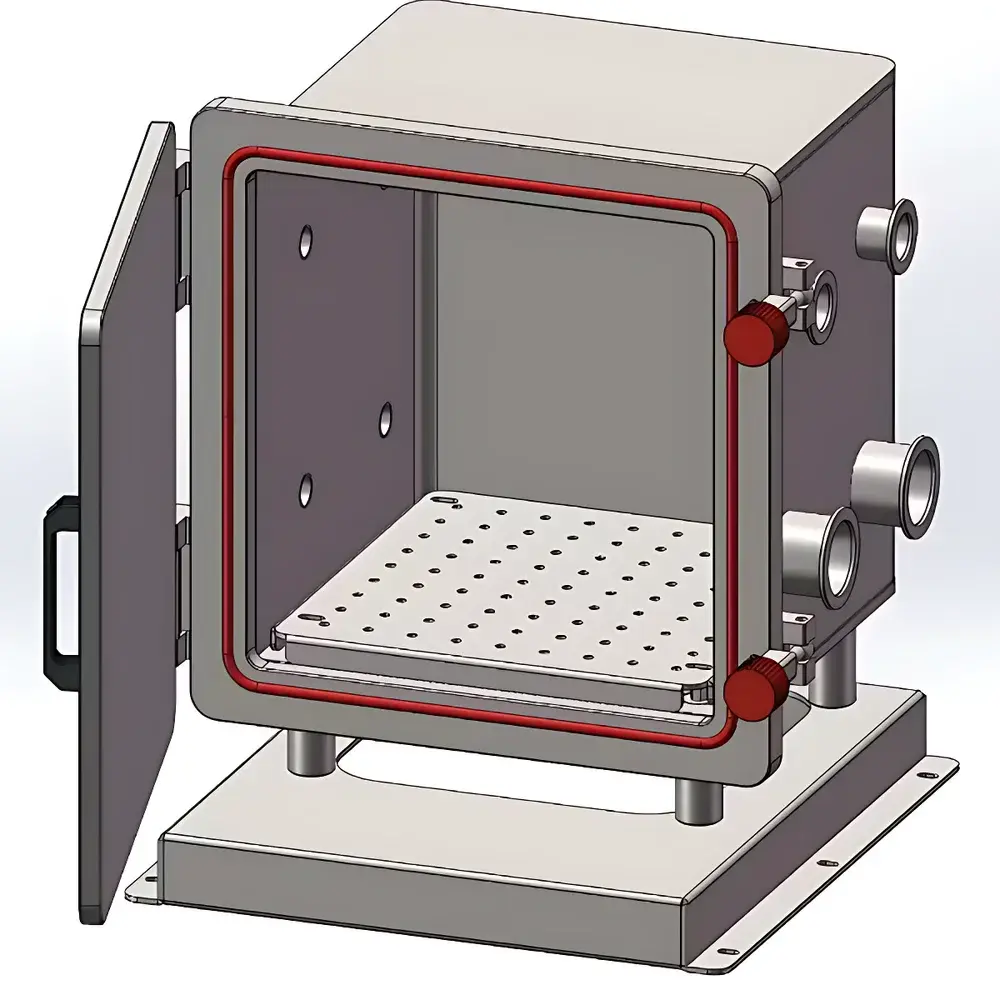
Zhongke Aobo DZ Custom Ultra-High Vacuum Chamber System
| Brand | Zhongke Aobo |
|---|---|
| Origin | Beijing, China |
| Manufacturer Type | Authorized Distributor |
| Country of Origin | China |
| Model | DZ |
| Price | USD 2,800 (FOB Beijing) |
| Chamber Material | 304 Stainless Steel (customizable to 316 SS, aluminum, or carbon steel) |
| Internal Dimensions | Φ88 mm × 59 mm |
| External Dimensions | Φ112 mm × 65 mm |
| Weight | ~2.6 kg |
| Viewport Diameter | Φ47 mm |
| Vacuum Flanges | KF25 (pumping), KF16 (gauge), metric/inch gas fittings (M3/M6, 1/8″/1/4″), silicone diaphragm liquid injection port |
| Electrical Feedthroughs | 2 × 8-pin hermetic signal connectors (8 A rating) |
| Max Positive Pressure | ≤0.1 MPa |
| Base Pressure | ≤5 Pa (with rotary vane pump, 5 min) |
| Ultimate Pressure | ≤5×10⁻³ Pa (with turbomolecular pump, 30 min) |
| Operating Temperature Range | −190 °C to +1000 °C (chamber body) |
| sample stage | RT to +400 °C |
| Sample Stage | 28 mm × 28 mm stainless steel, resistive heating, PT100 sensing, ±0.5 °C accuracy, 50 °C/min max ramp rate |
| Temperature Control | 30-segment programmable PID with auto-tuning, 0.1 °C resolution, 7-inch HMI display |
| Surface Finishes | Electropolished, passivated, sandblasted, acid-washed, or mirror-finished per ASTM A967 / ISO 15730 |
| Sealing Options | Fluoroelastomer (FKM) O-rings or oxygen-free copper (OFHC) metal gaskets |
| Welding Process | Orbital TIG welding under high-purity argon purge |
| Leak Detection | Helium mass spectrometry (≤1×10⁻¹⁰ mbar·L/s sensitivity) |
Overview
The Zhongke Aobo DZ Custom Ultra-High Vacuum (UHV) Chamber System is an engineered solution for research and industrial applications requiring precise environmental control under reduced pressure. Designed around fundamental vacuum physics principles—including conductance-limited gas flow, outgassing kinetics, and thermal management in low-pressure environments—the DZ chamber serves as a modular platform for surface science, thin-film deposition, cryogenic characterization, and in-situ material testing. Its structural integrity relies on orbital TIG welding under inert argon atmosphere, ensuring leak-tightness compliant with ISO 10110-7 and UHV-compatible surface preparation standards. The chamber operates across an extended thermal range (−190 °C to +1000 °C), enabling compatibility with liquid nitrogen cooling, resistive heating, and high-temperature annealing protocols—critical for studies involving phase transitions, catalytic reactivity, or electron-beam interactions.
Key Features
- Modular non-standard design process: Full 3D parametric modeling (SolidWorks-based) initiated from client-provided sketches, dimensional constraints, or functional requirements
- Material flexibility: Standard 304 stainless steel construction; optional upgrade to 316L SS, OFHC copper, aluminum alloy 6061-T6, or low-outgassing carbon steel per ASTM F1317
- Multi-level sealing architecture: Dual-option gasket system—FKM elastomer O-rings for rapid cycling (≤10⁻⁶ mbar base) or OFHC copper knife-edge seals for UHV operation (≤10⁻¹⁰ mbar)
- Surface engineering compliance: Electrochemical polishing (ASTM B912), citric acid passivation (ASTM A967), and ultrasonic cleaning validate low particulate generation and minimal water vapor desorption
- Integrated thermal management: Sample stage with embedded Pt100 sensor, calibrated to ±0.5 °C, supports 30-segment temperature ramps and real-time data logging synchronized with vacuum status
- Hermetic electrical interface: Two 8-pin feedthroughs rated to 8 A DC, designed for low-noise signal transmission in EM-sensitive measurements (e.g., transport, Hall effect, STM)
Sample Compatibility & Compliance
The DZ chamber accommodates diverse sample geometries up to 28 mm × 28 mm and integrates seamlessly with standard vacuum infrastructure including turbomolecular pumps (TMPs), ion getter pumps (IGPs), and residual gas analyzers (RGAs). It meets mechanical and procedural requirements outlined in ISO 27432 (vacuum systems safety), ISO 14644-1 (cleanroom classification for assembly environments), and ASTM E575 (vacuum practice for materials testing). All metallic components undergo helium mass spectrometry leak testing (per ASTM E499) with documented traceability. Surface roughness (Ra ≤ 0.4 µm after electropolishing) and hydrogen embrittlement mitigation (per NACE MR0175/ISO 15156) are validated for corrosive process gas exposure (e.g., Cl₂, NH₃, H₂S). Optional bake-out capability (up to 150 °C chamber wall) supports UHV conditioning per ESA PSS-01-101.
Software & Data Management
Temperature control is managed via an embedded 7-inch HMI running deterministic real-time firmware with dual-channel PID regulation and auto-tuning algorithms compliant with IEC 61131-3. All thermal profiles—including setpoint sequences, actual readings, ramp rates, and dwell times—are timestamped and exportable in CSV format. Optional RS485/Modbus RTU or Ethernet/IP integration enables centralized SCADA linkage for GLP/GMP audit trails (21 CFR Part 11–ready with user authentication and electronic signature support). Vacuum gauge outputs (via KF16 port) can be routed to external controllers for pressure-triggered event logic—e.g., initiating deposition cycles upon reaching ≤1×10⁻³ Pa.
Applications
- In-situ XRD and Raman spectroscopy under controlled gas atmospheres or vacuum
- Cryogenic electrical transport measurements (Hall bar, van der Pauw) with LN₂-cooled stages
- Thermal desorption spectroscopy (TDS) and temperature-programmed desorption (TPD)
- Atomic layer deposition (ALD) precursor screening with pulsed gas injection ports
- High-temperature oxidation/reduction studies of catalysts and battery electrode materials
- Electron microscopy sample transfer lock systems interfacing with FE-SEM or TEM columns
FAQ
What documentation accompanies the chamber for regulatory validation?
A full Certificate of Conformance (CoC), helium leak test report (including test pressure, duration, and maximum allowable leak rate), surface finish verification (Ra measurement log), and material mill certificates (ASTM A240 for 304 SS) are provided.
Can the chamber be configured for reactive gas handling (e.g., O₂, Cl₂)?
Yes—compatible with corrosion-resistant wetted materials (316L SS, Hastelloy C-276 liners), fluoropolymer-sealed viewports, and gas panel integration meeting CGA G-4.1 standards.
Is remote monitoring supported?
Standard Modbus RTU over RS485 allows integration into LabVIEW, Python-based control suites, or commercial SCADA platforms; optional Wi-Fi/Ethernet module enables cloud-synced log archiving.
How is thermal uniformity across the sample stage verified?
Each unit undergoes thermal mapping at three critical points (center, corners) using calibrated micro-thermocouples during factory acceptance testing (FAT), with uniformity reported per ASTM E220.
What is the lead time for custom configurations?
Typical delivery is 6–8 weeks from final 3D model approval; expedited fabrication (4-week) available with priority engineering review and pre-approved material stock.



