
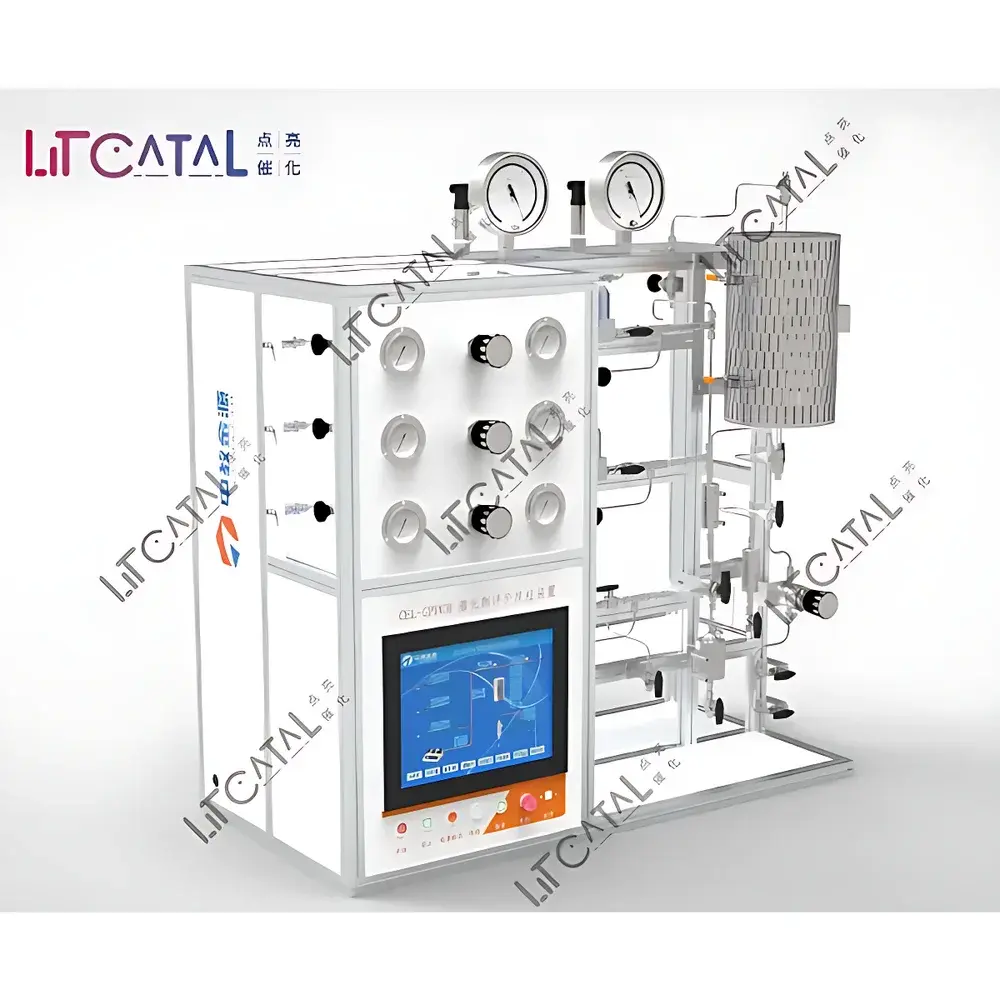
CEL-GPPCH Fixed-Bed Catalyst Evaluation Reactor System (Custom-Configured)
| Brand | CEAULIGHT |
|---|---|
| Origin | Beijing, China |
| Manufacturer Type | OEM Manufacturer |
| Region of Origin | Domestic (China) |
| Model | CEL-GPPCH Fixed-Bed Catalyst Evaluation Reactor System (Custom-Configured) |
| Pricing | Available Upon Request |
| Frame Dimensions | 1130 mm × 550 mm × 1000 mm |
| Construction Material | ASTM A240 Grade 316L Stainless Steel |
| Reactor Temperature Range | 0–800 °C |
| Vaporization Zone Temperature Range | 0–300 °C |
| Tubing Trace Heating Range | 0–200 °C |
| Maximum Operating Pressure | < 10 MPa |
| Liquid Flow Rate Range | 0.1–5 mL/min |
| Catalyst Bed Volume Capacity | < 5 mL |
| Gas Flow Rate Ranges (selectable) | 0–5 sccm |
| Control Interface | Industrial Touchscreen PC with Integrated SCADA Software |
| Safety Features | Dual-stage overpressure relief, real-time thermal/pressure interlock logic, redundant temperature and pressure monitoring with audible/visual alarms |
Overview
The CEL-GPPCH Fixed-Bed Catalyst Evaluation Reactor System is a fully integrated, custom-configurable benchtop platform engineered for rigorous kinetic assessment, activity screening, and stability testing of heterogeneous catalysts under controlled gas-phase, liquid-phase, or combined gas–liquid feed conditions. It operates on the fundamental principle of steady-state and transient-state fixed-bed reactor dynamics, enabling precise regulation of residence time, partial pressure, temperature gradient, and mass transfer limitations—critical parameters in catalytic reaction engineering per ISO 10723 and ASTM D3241 standards. Designed for laboratory-scale process intensification studies, the system supports both isothermal and programmed temperature ramping (linear heating profiles), facilitating TPR, TPD, and step-response experiments. Its modular architecture allows seamless integration with external analytical instrumentation—including GC, HPLC, IC, and in situ spectroscopic tools (e.g., Raman, SPV, TPV)—to support mechanistic investigation and product speciation across varying thermodynamic and kinetic regimes.
Key Features
- Modular fixed-bed reactor core constructed from ASTM A240 316L stainless steel, rated for continuous operation up to 800 °C and 10 MPa, with full traceability of material certifications.
- Multi-zone thermal management: independently controlled reactor furnace, vaporizer section (0–300 °C), and heated transfer lines (0–200 °C) to prevent condensation and ensure plug-flow behavior.
- Dual-pressure architecture: integrated high-precision back-pressure regulator (BPR) with low-pressure (<1 MPa) and high-pressure (up to 10 MPa) modes, supported by calibrated pressure transducers and Class 0.25 mechanical gauges.
- Automated mass flow control: digitally regulated gas mass flow controllers (MFCs) covering three ranges (0–5 / 0–50 / 0–100 sccm), plus syringe pump-driven liquid delivery (0.1–5 mL/min) with pulseless flow and solvent compatibility verification.
- Real-time safety interlock system: hardware-level thermal cutoffs at all heated zones, pressure-triggered venting via proportional relief valves, and software-enforced operational limits compliant with IEC 61511 functional safety guidelines.
- Benchtop footprint (1130 × 550 × 1000 mm) with extruded 6063-T5 aluminum frame—rigid, corrosion-resistant, and designed for cleanroom or fume hood installation without anchoring.
Sample Compatibility & Compliance
The CEL-GPPCH accommodates powdered, pelleted, or monolithic catalyst forms with bed volumes up to 5 mL, ensuring representative scaling for structure–activity correlation studies. It is compatible with corrosive feeds (e.g., H₂S, NH₃, Cl₂-containing streams) due to 316L wetted-path construction and optional Hastelloy C-276 upgrades. All control and data acquisition functions comply with GLP and GMP documentation requirements, including electronic audit trails, user access levels, and 21 CFR Part 11–ready configuration options upon request. System validation packages (IQ/OQ/PQ) are available for pharmaceutical and fine chemical applications requiring regulatory submission.
Software & Data Management
Control and monitoring are executed via a dedicated Windows-based SCADA platform running on an industrial-grade touchscreen PC. The software provides synchronized logging of >120 process variables at 100 ms resolution, programmable ramp/soak temperature profiles, multi-step pressure sequencing, and automated event-triggered sampling commands for downstream analyzers. Data export conforms to ASTM E1447 (CSV, XML) and includes metadata tagging (operator ID, batch number, calibration timestamps). Optional API integration enables bidirectional communication with LIMS or ELN systems.
Applications
- Hydrogenation, dehydrogenation, oxidation, and reforming kinetics under industrially relevant conditions
- Catalyst deactivation studies (coking, sintering, poisoning) via long-term isothermal runs
- Structure–performance mapping using combinatorial catalyst libraries
- Reaction mechanism elucidation through isotopic labeling coupled with online GC-MS
- Process simulation input generation for ASPEN Plus or gPROMS modeling
- Academic research in sustainable chemistry, CO₂ utilization, and green ammonia synthesis
FAQ
Can the CEL-GPPCH be configured for ultra-high-purity applications (e.g., semiconductor-grade catalysis)?
Yes—optional electropolished 316L tubing, metal-sealed VCR fittings, and helium leak-tested assemblies are available.
Is remote monitoring and control supported?
Standard Ethernet/IP connectivity enables secure remote access via VPN; optional OPC UA server module available for enterprise integration.
What validation documentation is included with shipment?
Factory acceptance test (FAT) report, material certificates (EN 10204 3.1), pressure vessel design calculations, and as-built P&ID drawings are provided.
How is catalyst loading and unloading performed safely?
The reactor employs a quick-disconnect flange with ceramic fiber gasketing and integrated purge ports to enable inert-atmosphere catalyst handling without exposure.
Does the system support dynamic gas composition switching during a run?
Yes—via optional multi-channel MFC manifold with sub-second response time and coordinated software sequencing.



