
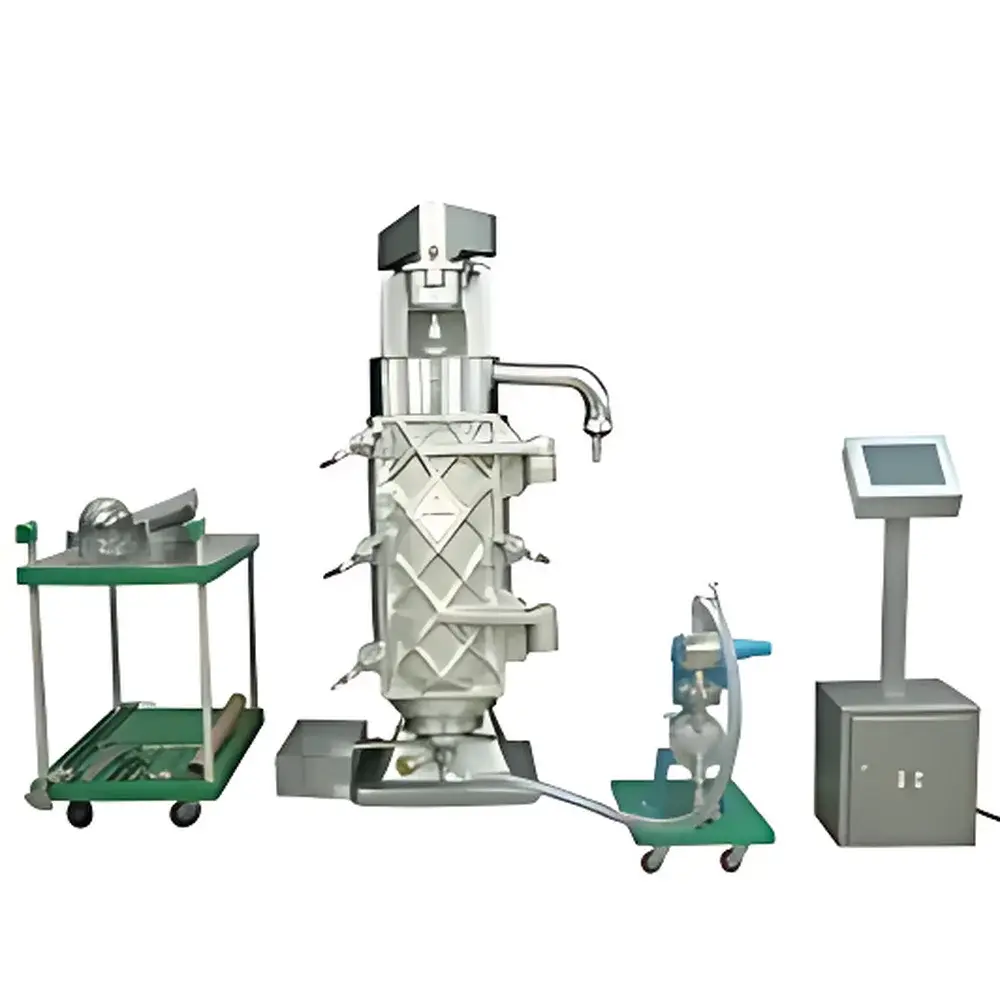
Hanil J-1250 Tubular Continuous-Flow Centrifuge
| Brand | Hanil |
|---|---|
| Origin | South Korea |
| Model | J-1250 |
| Instrument Type | Floor-standing Centrifuge |
| Speed Range | 10,000–30,000 rpm (Max. 15,000 rpm) |
| Max. RCF | 15,800 × g |
| Flow Rate | 2.2 L/h |
| Rotor Capacity | 9 L |
| Motor Power | 3.7 kW |
| Dimensions (W×D×H) | 500 × 845 × 1550 mm |
| Weight | 600 kg |
| Display | LCD Touchscreen (RPM, RCF, Time, Status) |
| Noise Level | ≤70 dB(A) |
| Safety | Quadruple Interlocked Door Lock System |
| Construction | Corrosion-Resistant Housing |
| Sample Collection | PTFE-Coated Collection Tray |
Overview
The Hanil J-1250 Tubular Continuous-Flow Centrifuge is an engineered solution for high-throughput, continuous separation of biological suspensions, microbial cultures, and plant-derived extracts. Unlike batch-mode centrifuges, the J-1250 operates on the principle of sedimentation in a vertically oriented, narrow-diameter rotating tube—enabling uninterrupted processing under controlled hydrodynamic conditions. Its tubular geometry maximizes residence time while maintaining laminar flow profiles, making it particularly effective for separating particles with low sedimentation coefficients (e.g., intact cells, subcellular organelles, or virus-like particles) where differential centrifugation at high g-forces (>15,000 × g) is required. Designed for integration into pilot-scale bioprocessing workflows, the system supports GMP-aligned operations in academic core facilities, contract development and manufacturing organizations (CDMOs), and industrial R&D laboratories conducting downstream process development.
Key Features
- Continuous-flow architecture enabling steady-state operation at up to 2.2 L/h throughput without manual intervention between cycles
- Robust stainless-steel and corrosion-resistant housing engineered for long-term exposure to aqueous buffers, organic solvents, and mildly acidic/alkaline media
- Quadruple mechanical interlock system with force-sensing door latches, compliant with IEC 61010-1 safety standards for laboratory equipment
- Integrated spindle protection design—main shaft and upper assembly share a single coaxial support structure, minimizing radial runout and vibration transmission
- Low-noise operation (≤70 dB[A] at 1 m distance) achieved via precision-balanced rotor dynamics and acoustic-dampening chassis insulation
- PTFE-coated sample collection tray facilitating rapid, non-adhesive recovery of concentrated pellets—critical for preserving labile biomolecules during lyophilization or cryopreservation
- Front-access door configuration with ergonomic opening angle (≥110°), allowing unobstructed access to the tubular rotor chamber for cleaning and maintenance
- LCD touchscreen interface with real-time display of RPM, RCF, elapsed time, and operational status; all parameters adjustable via intuitive touch controls
- Compact footprint (0.42 m² floor area) optimized for constrained laboratory environments without compromising thermal or mechanical stability
Sample Compatibility & Compliance
The J-1250 accommodates a broad range of suspension types, including mammalian cell harvests (CHO, HEK293), bacterial lysates (E. coli, Bacillus spp.), yeast fermentations (S. cerevisiae), plant tissue homogenates, and clarified fermentation broths. Its 9-L effective rotor volume and stable high-g field support efficient clarification of low-density particulates (e.g., exosomes, microvesicles) when paired with appropriate buffer density gradients. The instrument conforms to ISO 13485–aligned manufacturing practices and meets essential requirements of the EU Machinery Directive 2006/42/EC. While not certified as Class I medical device, its construction and documentation support validation under FDA 21 CFR Part 11-compliant data integrity frameworks when integrated with qualified LIMS or ELN systems.
Software & Data Management
The embedded control firmware logs all critical operational parameters—including actual RPM, calculated RCF, total runtime, and door cycle events—with timestamped records stored internally for ≥30 days. Export functionality supports CSV format via USB port for traceable audit trails. Though the J-1250 does not include network connectivity or remote monitoring, its deterministic control logic ensures repeatable performance across shifts and operators—supporting GLP-compliant documentation practices. Protocol templates can be saved and recalled directly from the touchscreen, reducing setup variability during routine runs.
Applications
- Harvesting and concentration of microbial biomass prior to downstream extraction or enzymatic digestion
- Clarification of crude plant extracts containing polyphenols, alkaloids, or terpenoids without thermal degradation
- Preparative isolation of extracellular vesicles from conditioned media in exosome research workflows
- Continuous removal of cell debris during perfusion-based bioreactor harvesting
- Concentration of viral vectors (AAV, lentivirus) for gene therapy process development
- Separation of lipid droplets or protein aggregates in structural biology sample preparation
FAQ
What is the maximum allowable sample viscosity for continuous operation?
The J-1250 is validated for aqueous-phase suspensions with viscosities up to 15 cP at 25°C. Higher-viscosity feeds require pre-dilution or inline shear reduction to maintain laminar flow and prevent rotor imbalance.
Can the tubular rotor be autoclaved?
No—the rotor assembly is not designed for steam sterilization. Cleaning is performed using validated aqueous detergents and 70% ethanol wipe-downs per Hanil’s maintenance protocol.
Is rotor balancing required before each run?
The factory-balanced rotor eliminates user-performed balancing; however, visual inspection for residual solids and verification of PTFE tray integrity are mandatory prior to startup.
Does the system support programmable ramp-up/down profiles?
Yes—acceleration and deceleration rates are fixed at 150 rpm/s to ensure mechanical longevity, but start/stop timing is fully programmable within the touchscreen interface.
What documentation is provided for IQ/OQ validation?
Hanil supplies a Factory Acceptance Test (FAT) report, mechanical calibration certificate (traceable to KRISS), and standard operating procedure (SOP) template aligned with ASTM E2500-13 guidelines.



