
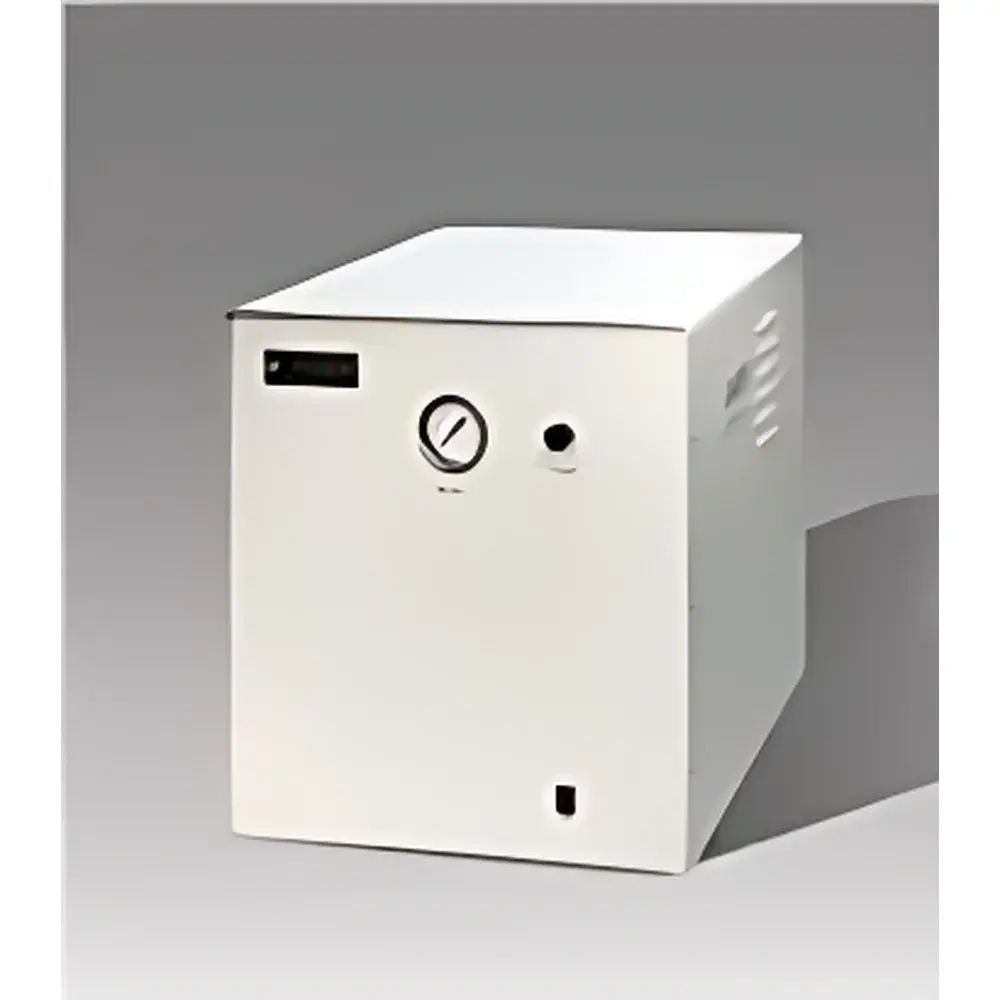
A-10 Oil-Free Automatic Air Generator
| Output Flow | 0–10 L/min @ 0.4 MPa |
|---|---|
| Output Pressure | 0–0.5 MPa (factory-set to 0.4 MPa) |
| Pressure Stability | < 0.003 MPa |
| Power Consumption | 550 W |
| Dimensions (W×H×D) | 380 × 570 × 400 mm |
| Net Weight | ~38 kg |
| Compressor Type | Oil-Free Diaphragm |
| Noise Level | ≤52 dB(A) |
| Internal Sealing Material | Low-Sulfur Silicone Rubber |
| Gas Purity | Hydrocarbon-free, Oil-free, Particulate-free (< 0.01 µm), Dew Point ≤ −40 °C @ 0.4 MPa |
Overview
The A-10 Oil-Free Automatic Air Generator is an engineered solution for laboratories requiring continuous, high-purity compressed air without oil contamination or manual maintenance. Designed specifically for analytical instrumentation—particularly gas chromatography (GC), atomic absorption spectroscopy (AAS), and evaporative light scattering detection (ELSD)—the A-10 employs a diaphragm-type oil-free compression mechanism to eliminate hydrocarbon carryover, ensuring baseline stability and detector longevity. Unlike traditional piston or scroll compressors, the diaphragm architecture provides intrinsic separation between the compression chamber and drive mechanism, guaranteeing zero lubricant migration into the airstream. The unit operates within a regulated pressure range of 0–0.5 MPa, with factory calibration at 0.4 MPa to meet standard instrument inlet requirements. Its pressure stability of < 0.003 MPa supports consistent carrier gas flow control in precision GC applications, while the integrated desiccant-drying system achieves a dew point of ≤ −40 °C at operating pressure—critical for moisture-sensitive detectors and long-term column integrity.
Key Features
- Oil-free diaphragm compressor ensures absolute hydrocarbon-free output, eliminating risk of column contamination or FID baseline drift.
- Automatic condensate drainage system with level-sensing float switch enables unattended operation for extended periods—no manual bleeding or periodic maintenance required.
- Acoustic enclosure with vibration-damping mounts and optimized airflow path reduces operational noise to ≤52 dB(A), suitable for shared lab environments and ISO 14644-compliant cleanrooms.
- Low-sulfur silicone rubber seals throughout the gas path minimize sulfur compound outgassing—a known interferent in sulfur chemiluminescence detection (SCD) and pulsed flame photometric detection (PFPD).
- Integrated dual-stage filtration: particulate filter (0.01 µm retention) followed by activated carbon + molecular sieve adsorption bed for residual hydrocarbons, moisture, and trace organics.
- Intelligent pressure regulation via proportional solenoid valve with real-time feedback loop maintains setpoint stability within ±0.003 MPa under variable demand conditions.
Sample Compatibility & Compliance
The A-10 delivers air meeting ASTM D6299-22 specifications for instrumental air used in petroleum and chemical analysis, as well as ISO 8573-1:2010 Class 1.2.1 (solid particles, water, oil) when operated within rated parameters. It is validated for use with flame-based GC detectors (FID, NPD, FPD), ELSD systems requiring dry, particle-free air for nebulization, and AAS air-acetylene combustion systems where oil-derived carbon deposits compromise burner head performance. All wetted materials comply with USP for polymeric components, and internal elastomers are certified per FDA 21 CFR 177.2600 for indirect food contact—supporting GLP/GMP-aligned validation protocols. No external oil traps or coalescing filters are required for routine operation.
Software & Data Management
While the A-10 operates as a standalone analog-controlled generator, it includes a digital pressure display with RS-232 interface (optional) for integration into centralized lab monitoring systems. The controller logs cumulative runtime, pressure deviation events, and automatic drain cycles—data exportable via ASCII serial protocol for audit trail generation. When deployed in regulated environments, the unit supports 21 CFR Part 11-compliant electronic recordkeeping when paired with validated third-party SCADA platforms. Firmware updates are performed offline via USB port, preserving configuration integrity during service interventions.
Applications
- Primary air source for multiple GC systems in high-throughput QC labs—eliminates dependency on bulk cylinders or central plant air with inconsistent quality.
- Support gas for AAS air-acetylene flames, reducing carbon buildup and extending burner lifetime versus oil-lubricated alternatives.
- Neat air supply for ELSD aerosol generation, where moisture and hydrocarbons induce signal noise and non-linear response.
- Zero-air generation for ambient air monitoring calibrations when coupled with catalytic scrubbers (not included).
- Benchtop air supply for pneumatic actuators, sample dilution manifolds, and automated liquid handling systems requiring clean, dry, oil-free actuation gas.
FAQ
Is the A-10 suitable for use with flame ionization detectors (FID)?
Yes—the oil-free diaphragm design and low-sulfur sealing materials prevent hydrocarbon and sulfur contamination that cause elevated baselines or erratic response in FID operation.
Can the A-10 support more than one GC simultaneously?
Yes—its 10 L/min maximum flow at 0.4 MPa allows concurrent supply to up to three mid-range GC systems equipped with standard split/splitless inlets and FID detectors.
Does the unit require periodic filter replacement?
Yes—the dual-stage filter cartridge has a recommended service interval of 6,000 operating hours or 12 months, whichever occurs first; replacement kits include both particulate and adsorption media.
What safety certifications does the A-10 hold?
It complies with IEC 61010-1:2010 for laboratory electrical equipment, carries CE marking under the EMC and Low Voltage Directives, and meets RoHS 2011/65/EU material restrictions.
Is remote monitoring possible without additional hardware?
Basic pressure readout is local-only; RS-232 communication requires optional interface module and host-side software for data logging or alarm triggering.



