
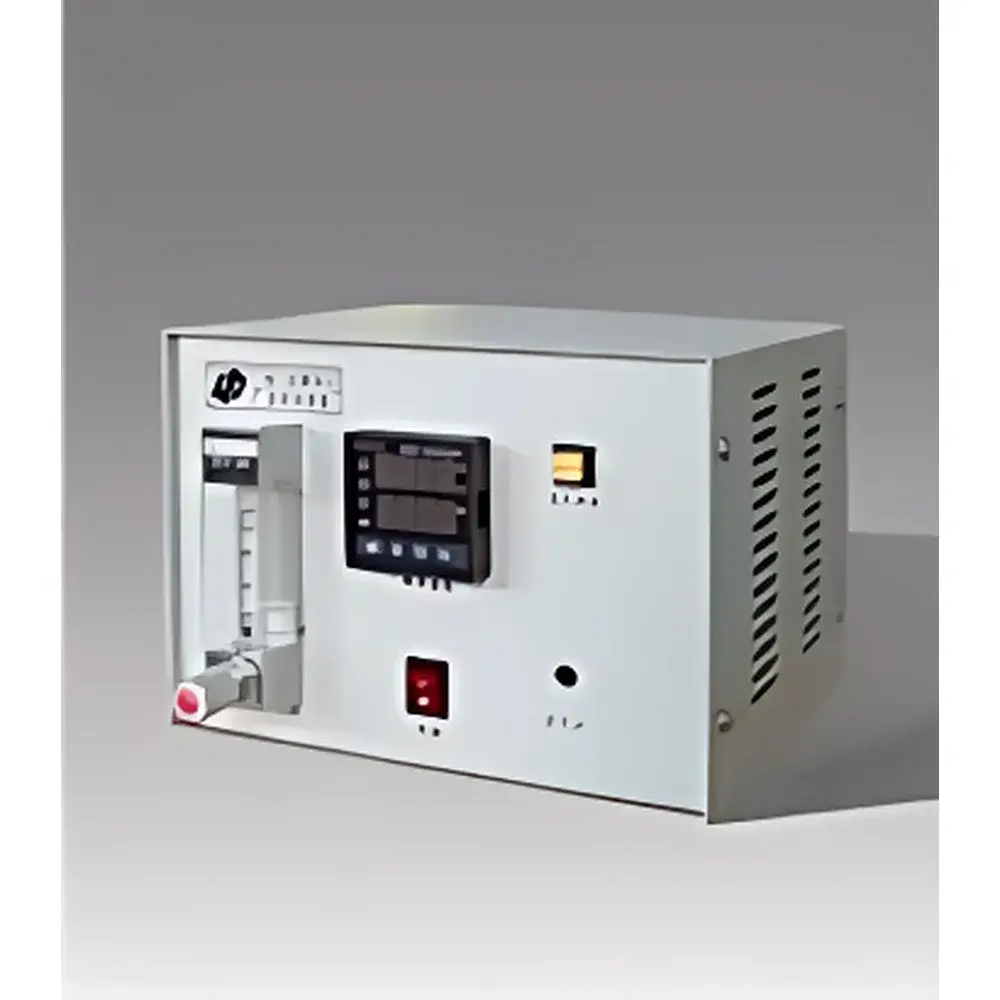
JX-1 Manual Thermal Desorber
| Origin | Beijing, China |
|---|---|
| Manufacturer Type | Distributor |
| Origin Category | Domestic (China) |
| Model | JX-1 |
| Pricing | Upon Request |
| Desorption Temperature Range | Ambient to 400 °C |
| Temperature Control Accuracy | < ±0.5 °C |
| Carrier Gas Flow Rate | 10–160 mL/min (adjustable) |
| Desorption Efficiency | ≥85% |
| Sample Tube Dimensions | Ø6 mm, length >120 mm |
| Compatible Carrier Gas | High-purity N₂ (≥99.999%) |
| Power Supply | 220 V ±10%, 50–60 Hz |
| Operating Ambient | 10–40 °C, ≤85% RH |
| Unit Dimensions | 170 × 200 × 150 mm |
| Sampling Method | Manual injection |
| Flow Control | Precision rotameter |
| Tubing Material | Passivated and electropolished 316 stainless steel |
| Sealing Material | Silicone rubber O-rings (low-outgassing) |
| Interface Design | Direct coupling between desorption tube and 100 mL gas-tight syringe (zero-dead-volume transfer) |
Overview
The JX-1 Manual Thermal Desorber is a benchtop sample introduction system engineered for quantitative transfer of volatile and semi-volatile organic compounds (VOCs and SVOCs) from sorbent-packed thermal desorption tubes into gas chromatography (GC) or GC–mass spectrometry (GC–MS) systems. It operates on the principle of controlled thermal desorption—where analytes adsorbed onto solid-phase sorbents (e.g., Tenax TA, Carbopack B/C, or multi-bed traps) are thermally released under inert carrier gas flow and transferred quantitatively to the analytical instrument. Designed in strict compliance with Chinese national standards—including GB/T 5750.8–2023 (Standard Methods for Examination of Drinking Water – Organic Parameters) and HJ 644–2013 (Environmental Air – Determination of Volatile Organic Compounds by Adsorption–Thermal Desorption–Gas Chromatography–Mass Spectrometry)—the JX-1 delivers reproducible, low-background performance for ambient air, indoor air, workplace air, and polymer emission testing.
Key Features
- Manually operated, single-tube desorption workflow optimized for routine laboratory throughput and method validation studies.
- Precision temperature control across 0–400 °C range with stability better than ±0.5 °C, ensuring consistent analyte release kinetics and minimizing thermal degradation of labile compounds.
- Adjustable carrier gas flow (10–160 mL/min) regulated via calibrated rotameter, enabling optimization for diverse sorbent types and analyte volatilities.
- Zero-dead-volume interface: desorbed effluent is delivered directly from the heated tube into a 100 mL gas-tight glass syringe, eliminating condensation zones and bypass tubing that compromise recovery.
- Ultra-low contamination architecture: all wetted surfaces consist of passivated, electropolished 316 stainless steel; sealing elements use high-purity silicone rubber with certified low extractables and negligible VOC bleed.
- Compact footprint (170 × 200 × 150 mm) and universal 220 V AC input make it suitable for shared instrumentation labs and mobile environmental monitoring setups.
Sample Compatibility & Compliance
The JX-1 supports standard 6 mm OD thermal desorption tubes (length >120 mm), compatible with industry-standard sorbents including graphitized carbon blacks (Carbograph), polymeric resins (Tenax), and carbon molecular sieves. Its design aligns with ISO 16000-6:2011 (Indoor air – Part 6: Determination of volatile organic compounds using thermal desorption–gas chromatography), ASTM D6196–22 (Standard Practice for Selecting Analytical Methods for Monitoring Airborne Volatile Organic Compounds), and U.S. EPA TO-17 requirements for tube conditioning and desorption parameters. While not equipped with automated calibration or electronic audit trails, its mechanical consistency and adherence to reference methods support GLP-compliant data generation when integrated into validated SOPs.
Software & Data Management
As a manually operated thermal desorber, the JX-1 does not include embedded firmware, touchscreen interface, or proprietary software. All operational parameters—including temperature setpoint, dwell time, and flow rate—are configured via analog controls and verified using external calibration tools (e.g., digital thermocouple readers, bubble flow meters). Users maintain full traceability through laboratory notebooks or LIMS-integrated procedural logs. For laboratories requiring 21 CFR Part 11 compliance, manual operation allows direct integration with validated GC data systems where desorption events are documented as discrete sample injections within the chromatographic sequence table.
Applications
- Indoor air quality (IAQ) assessment per GB/T 18883–2022 and ISO 16000 series.
- Workplace exposure monitoring for benzene, toluene, xylene (BTX), formaldehyde precursors, and halogenated solvents.
- Material emission testing of carpets, adhesives, furniture composites, and automotive interior components.
- Method development and cross-validation against automated thermal desorption systems (e.g., Gerstel, Markes, PerkinElmer).
- Educational laboratories demonstrating fundamental principles of adsorption equilibrium, breakthrough behavior, and thermal desorption kinetics.
FAQ
Is the JX-1 compatible with autosamplers or robotic GC injectors?
No—the JX-1 is strictly a manual desorption unit. It requires user intervention for tube loading, syringe actuation, and GC injection. It is not designed for integration with autosampler arms or timed injection triggers.
What carrier gas purity is required for optimal performance?
High-purity nitrogen (≥99.999%) is recommended to minimize baseline interference and prevent catalytic oxidation of sensitive analytes during desorption.
Can I use quartz or fused silica desorption tubes with this instrument?
No—the JX-1 is mechanically configured for standard 6 mm outer diameter stainless steel or glass-lined metal tubes. Quartz tubes with non-standard dimensions or thermal expansion profiles are not supported.
Does the instrument include tube conditioning capability?
No—tube conditioning (baking under inert gas flow prior to sampling) must be performed externally using a dedicated tube oven or programmable furnace.
How is temperature calibration verified?
Users should perform periodic verification using a NIST-traceable calibrated thermocouple inserted into a representative tube well, referenced against the front-panel temperature display.





