
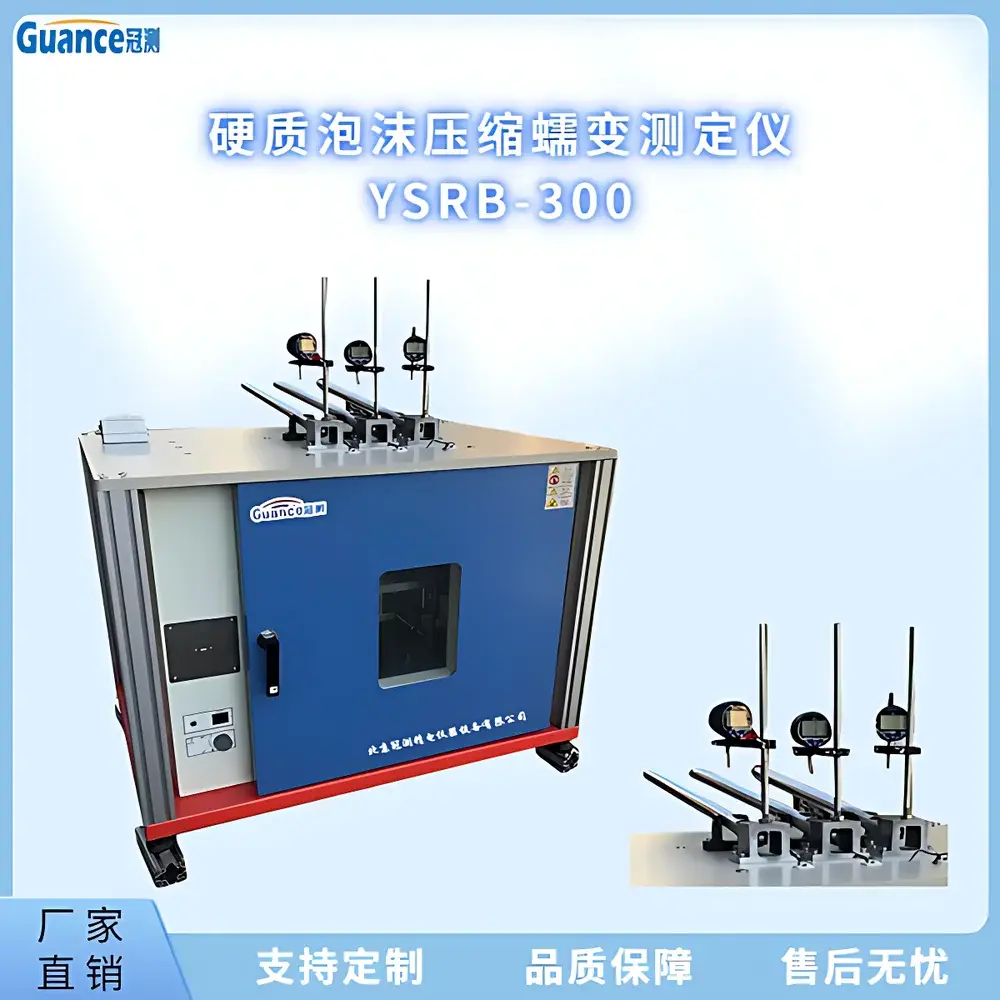
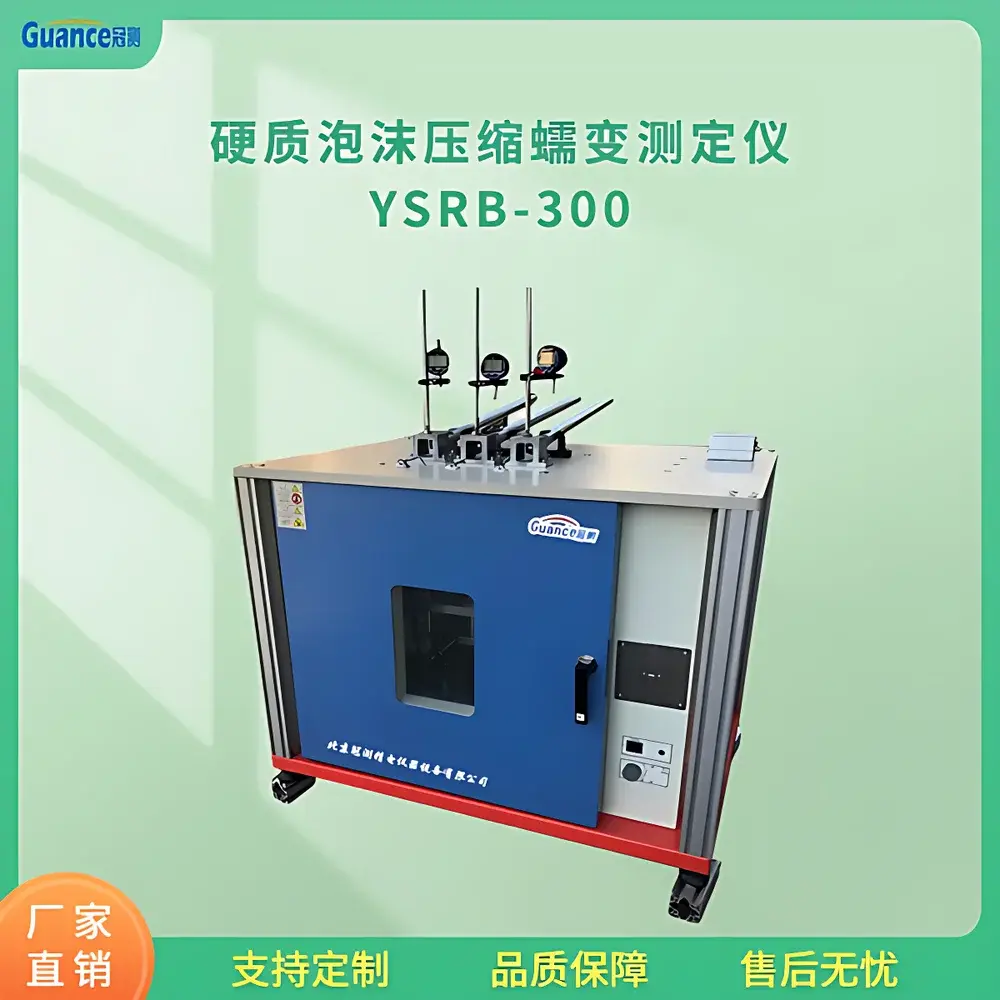
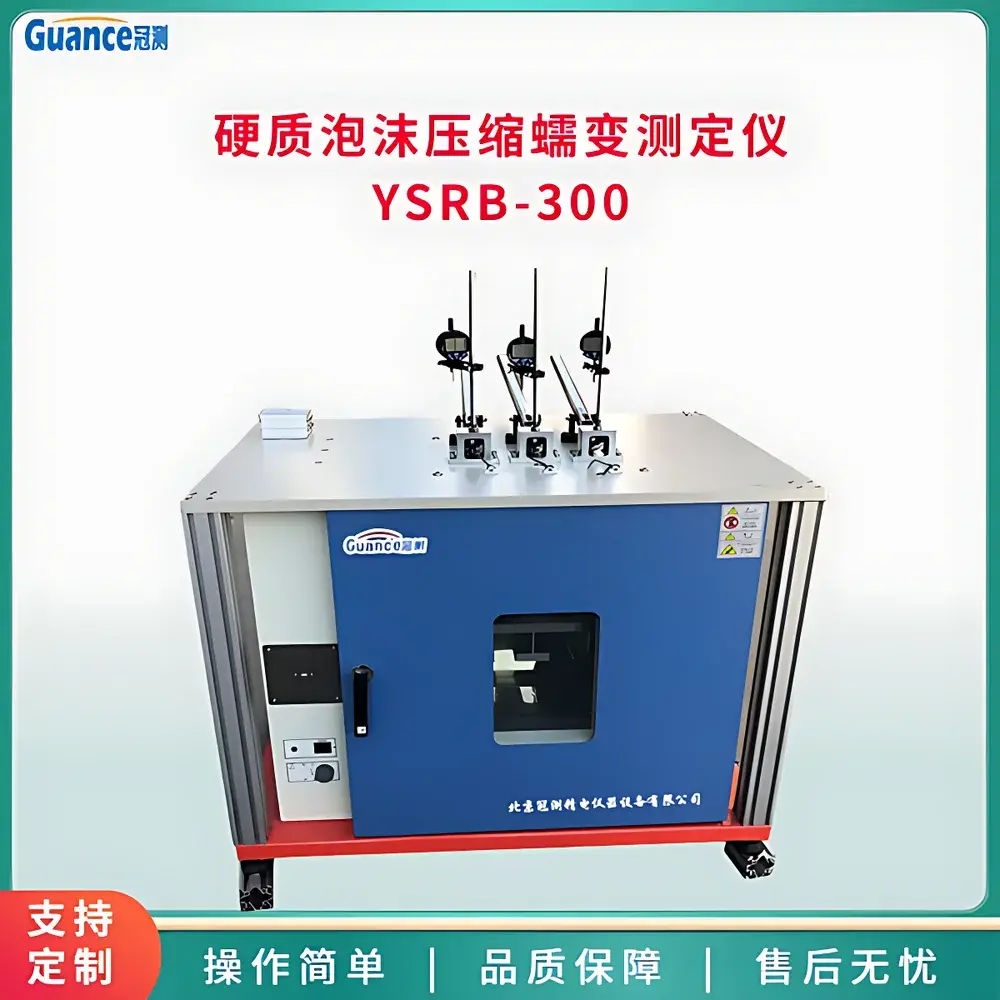
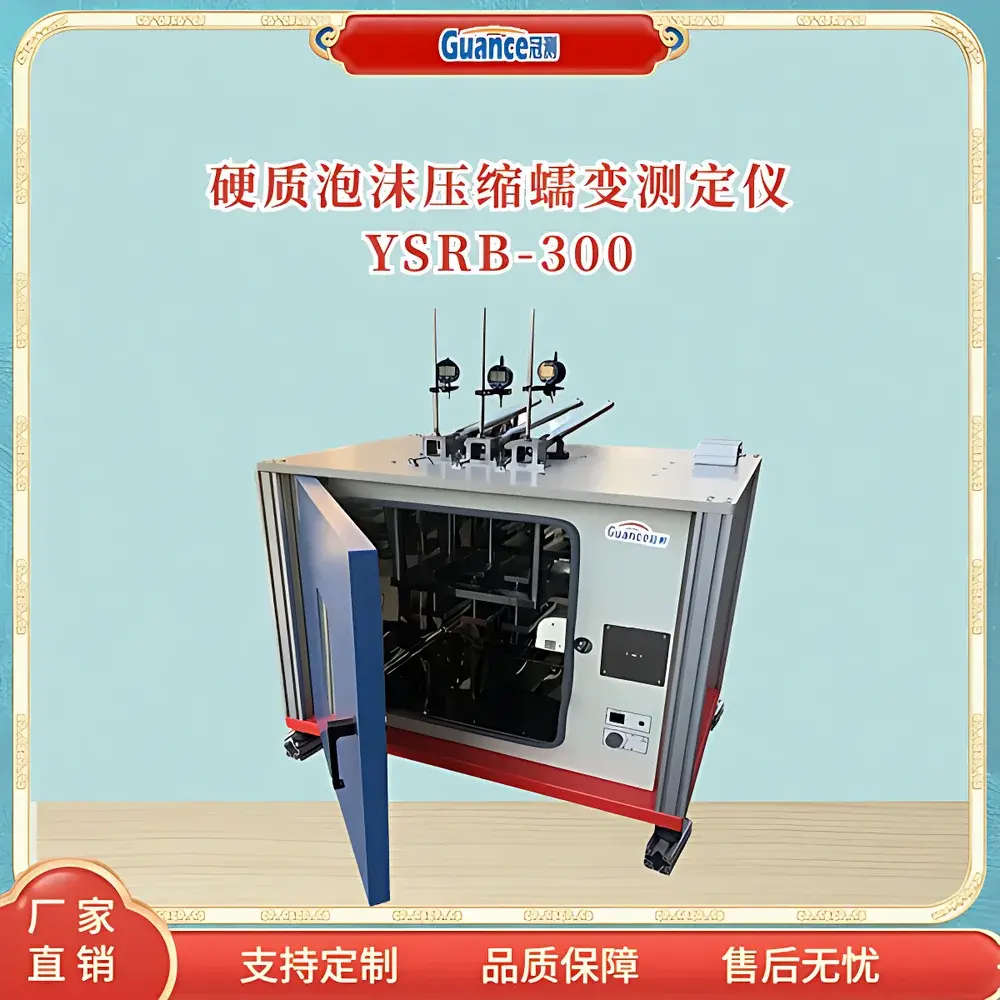
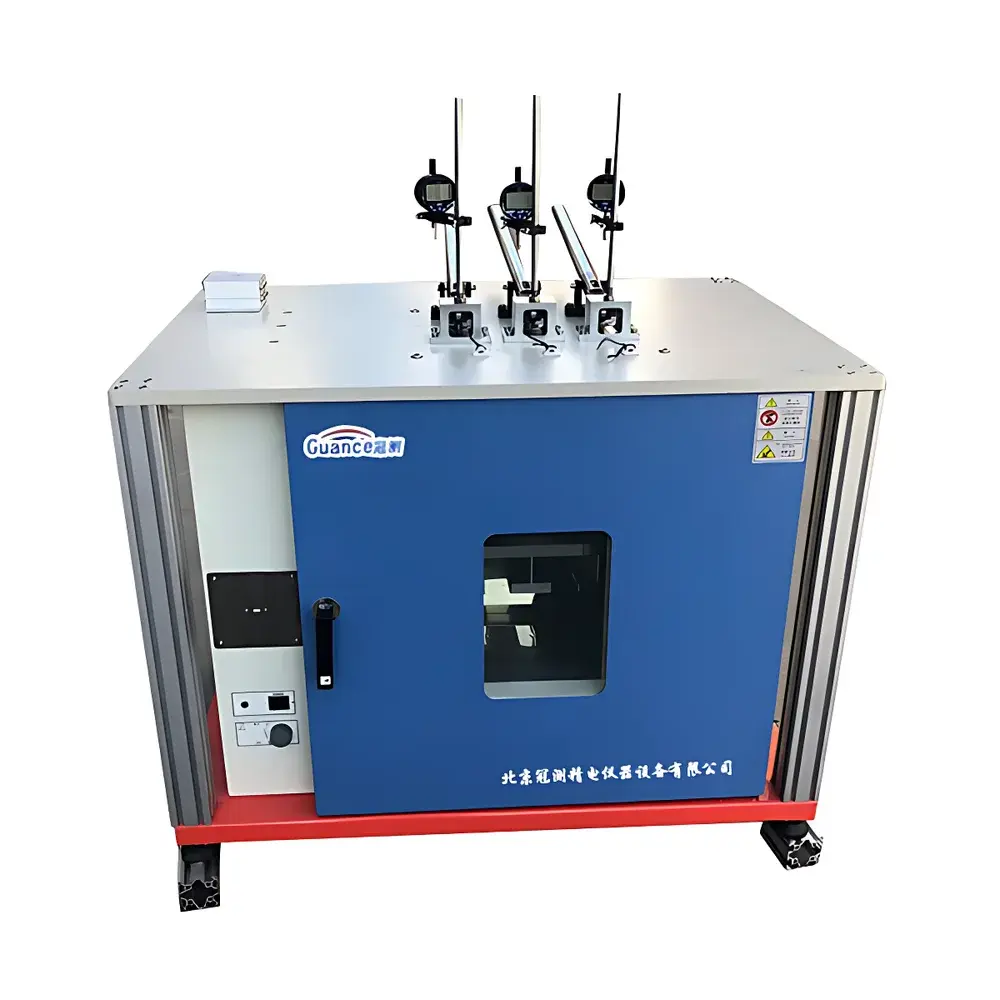
GuanCe Instruments YSRB-300.2 Hard Foam Compression Creep Testing Machine
| Brand | GuanCe Instruments |
|---|---|
| Origin | Beijing, China |
| Manufacturer Type | Authorized Distributor |
| Country of Origin | China |
| Model | YSRB-300.2 |
| Instrument Type | Electromechanical |
| Maximum Test Load | 100 kN |
| Max Plunger Stroke | 180 mm |
| External Dimensions | 350 mm × 400 mm × 400 mm |
| Net Weight | 70 kg |
| Heating Method | Air Bath |
| Test Channels | 3 |
| Temperature Range | Ambient to 300 °C |
| Temperature Stability | ±2 °C |
| Heating Rate Options | 50 ± 3 °C/h or 10 ± 2 °C/12 min |
| Temperature Resolution | 0.1 °C |
| Deformation Measurement Accuracy | ±0.002 mm |
| Specimen Dimensions | 50 mm × 50 mm × 50 mm or 40 mm × 40 mm × 20 mm |
| Compression Platen Size | 50 mm × 50 mm (×3) |
| Recommended Load Range | 0–1 MPa |
| Heating Chamber Volume | 350 mm × 400 mm × 400 mm |
| Lever Load Amplification Ratio | 1:32 |
| Loading Configuration | Compression (lever-weighted), Flexural (direct-weighted) |
| Standard Compliance | GB/T 20672–2006, DIN 53424 |
Overview
The GuanCe Instruments YSRB-300.2 Hard Foam Compression Creep Testing Machine is a precision electromechanical system engineered for the standardized evaluation of time-dependent compressive deformation in rigid cellular polymers under controlled thermal and mechanical stress. It operates on the fundamental principle of sustained uniaxial compression creep testing—applying constant load via lever-amplified deadweight systems while maintaining specimen temperature within a calibrated air-bath chamber. The instrument is explicitly designed to meet the procedural requirements of GB/T 20672–2006 (“Determination of Compression Creep of Rigid Cellular Plastics Under Specified Load and Temperature”) and DIN 53424 (“Dimensional Stability of Rigid Foams Under Compressive and Bending Stress at Elevated Temperatures”). Its dual-mode capability supports both compression and flexural creep configurations, enabling comparative assessment of structural stability across loading geometries—critical for validating material performance in automotive insulation, building envelope components, and aerospace core materials.
Key Features
- Triple-channel independent test configuration enables concurrent evaluation of up to three specimens under identical thermal-mechanical conditions, improving statistical robustness and throughput.
- Air-bath heating system with PID-controlled thermal regulation maintains chamber uniformity within ±2 °C across the full operating range (ambient to 300 °C), validated per ASTM E220 calibration practices.
- High-resolution optical grating displacement sensors (±0.002 mm accuracy) provide traceable, low-drift deformation measurement—fully compliant with ISO 9513 Class 1 requirements for extensometry.
- Lever-based mechanical load amplification (1:32 ratio) ensures stable, vibration-insensitive force application without servo drift or electronic feedback dependency—ideal for long-duration tests exceeding 1,000 hours.
- Integrated real-time data acquisition records temperature, load, and axial deformation synchronously at user-defined intervals, generating time-stamped CSV and PDF reports with embedded metadata (operator ID, calibration certificate IDs, environmental log).
- Modular platen and fixture design accommodates standard specimen geometries (50 mm × 50 mm × 50 mm and 40 mm × 40 mm × 20 mm) and supports optional custom tooling for non-standard cross-sections.
Sample Compatibility & Compliance
The YSRB-300.2 is optimized for rigid polyurethane (PUR), phenolic, melamine, and polystyrene (PS) foams used in structural insulation, fire-rated panels, and transportation composites. Specimens must be machined to dimensional tolerances specified in GB/T 20672–2006 (±0.2 mm in all axes) and preconditioned per ISO 291 prior to testing. The system’s mechanical architecture and thermal management comply with the essential safety and metrological requirements of EN 12697-25 (for bituminous binders, where foam modifiers are evaluated), and its data integrity framework aligns with GLP audit expectations—including secure user authentication, electronic signature support, and immutable audit trails for all parameter changes and report exports.
Software & Data Management
The embedded control software runs on an industrial-grade Windows OS platform and supports dual-mode operation: automated sequence programming (predefined temperature ramps, dwell times, and load steps) and manual intervention mode for exploratory protocol development. All raw sensor data are stored in hierarchical timestamped directories with SHA-256 checksum verification. Export formats include ASTM E1434-compliant .tdms files, ISO/IEC 17025-ready PDF reports with embedded uncertainty budgets, and Excel-compatible .csv for third-party statistical analysis (e.g., Arrhenius modeling of creep activation energy). System validation documentation includes IQ/OQ protocols aligned with FDA 21 CFR Part 11 Annex 11 requirements for regulated environments.
Applications
- Quantifying long-term compressive set in sandwich panel cores subjected to cyclic thermal exposure in HVAC ducting applications.
- Evaluating dimensional retention of fire-retardant phenolic foams under sustained load at 150–250 °C—critical for passive fire protection systems.
- Supporting ISO 11337-compliant creep rupture life prediction for polymer matrix composites incorporating rigid foam interlayers.
- Generating master curves for time–temperature superposition (TTS) analysis using multi-temperature, constant-load datasets.
- Validating supplier material specifications against OEM technical datasheets requiring creep strain ≤0.5% after 1,000 h at 1 MPa and 80 °C.
FAQ
What standards does the YSRB-300.2 directly support?
GB/T 20672–2006 and DIN 53424 are fully implemented in hardware configuration, test sequence logic, and reporting templates.
Can the system perform creep recovery measurements?
Yes—by integrating programmable unloading phases into the test sequence, enabling strain recovery kinetics analysis per ISO 899-2 Annex C.
Is remote monitoring supported?
The system includes Ethernet connectivity and supports secure VNC access for real-time observation; however, remote parameter modification requires local administrator credentials.
How is traceability ensured for deformation measurements?
Each grating sensor is individually calibrated against NIST-traceable laser interferometer standards, with certificates stored in the instrument’s secure firmware partition.
What maintenance intervals are recommended?
Biannual verification of thermal uniformity (per ASTM E220), annual load cell recalibration (ISO 7500-1 Class 1), and quarterly optical path inspection of displacement sensors.



