
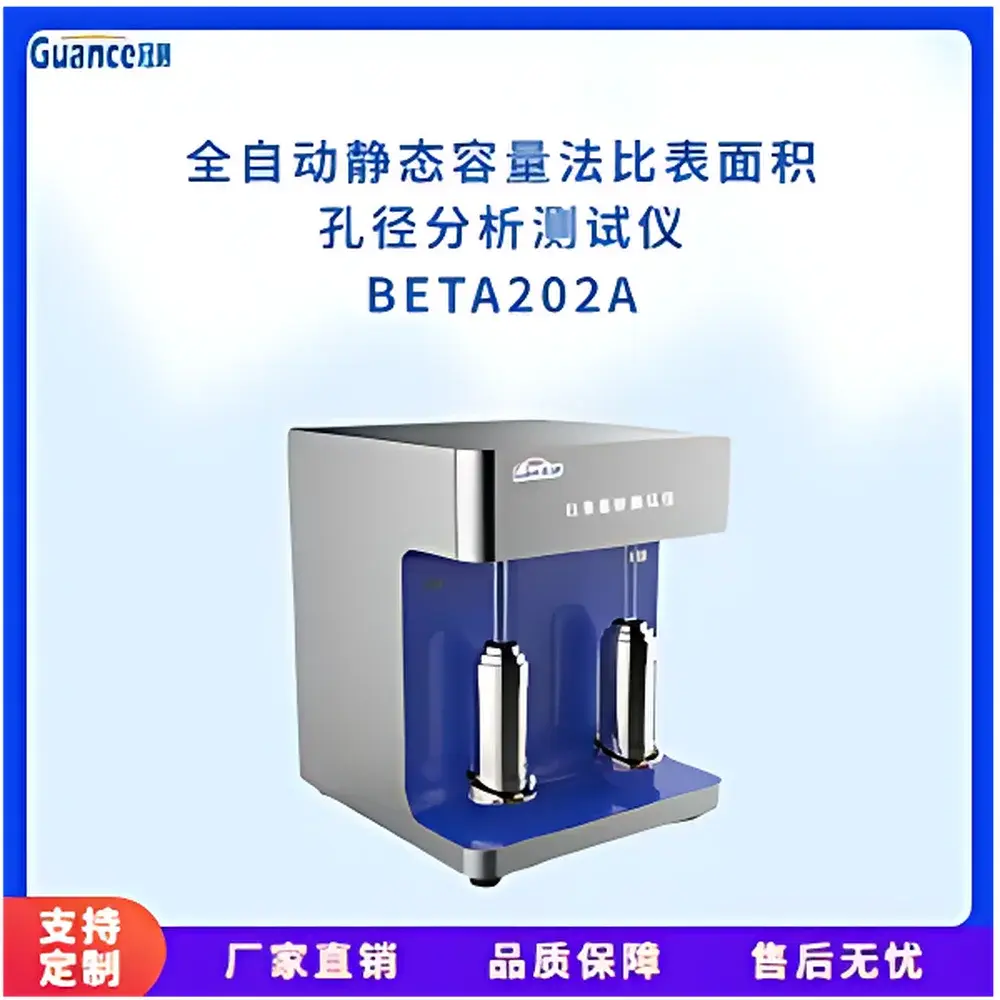
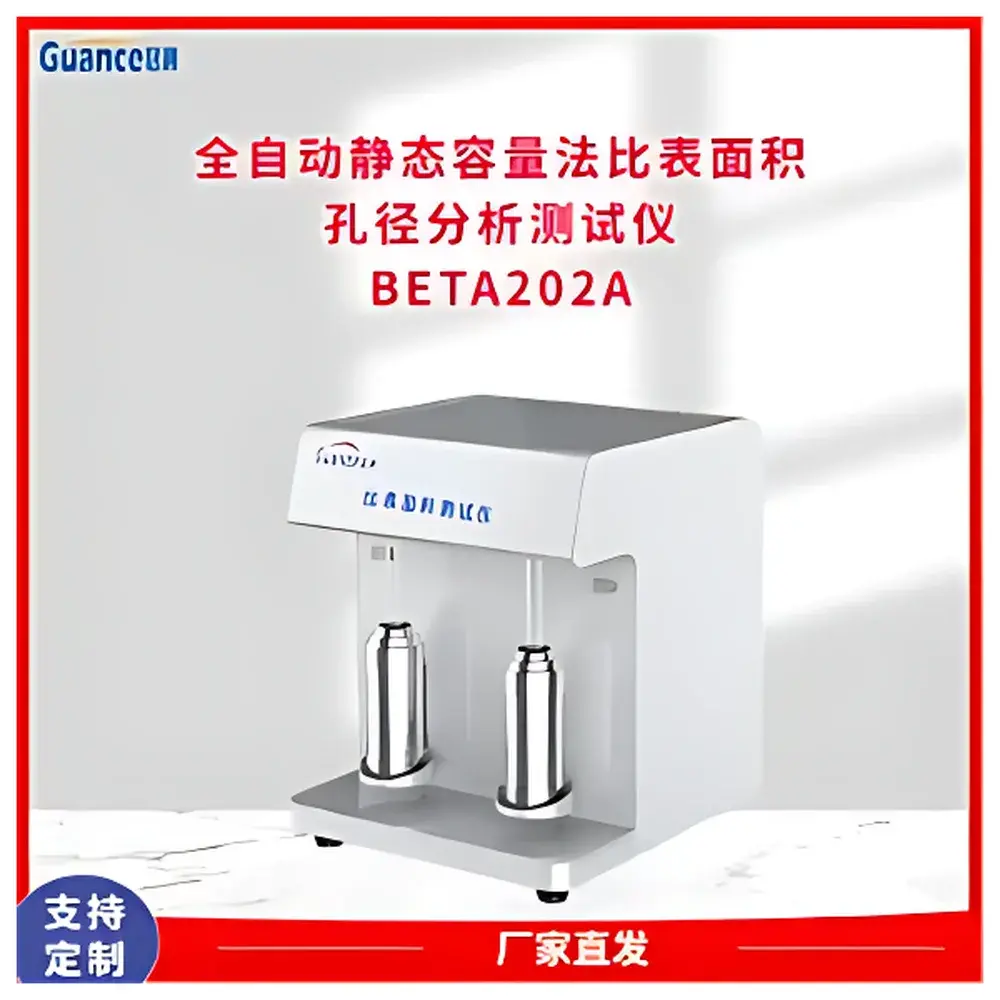
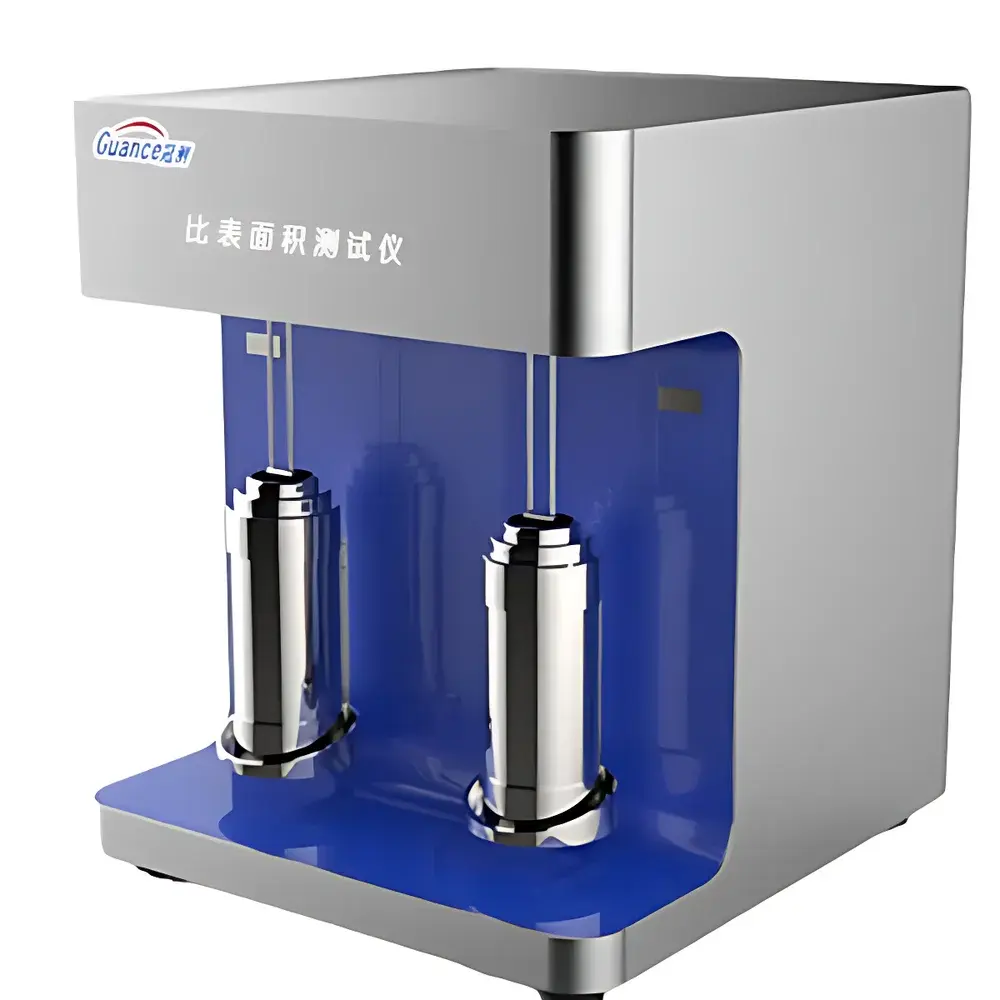
GuanCe Instruments BETA202A3 Dynamic Specific Surface Area and Pore Size Analyzer
| Brand | GuanCe Instruments |
|---|---|
| Origin | Beijing, China |
| Model | BETA202A3 |
| Instrument Type | Specific Surface Area and Pore Size Analyzer |
| Principle | Dynamic & Static Gas Adsorption (N₂, Ar, Kr, CO₂, etc.) |
| Analysis Stations | 100 (software-configurable multi-sample queue) |
| Surface Area Range | 0.0005 m²/g (Kr) to unlimited |
| Pore Diameter Range | 0.35 nm – 500 nm |
| Minimum Detectable Pore Volume | 0.0001 cm³/g (N₂) |
| Pressure Measurement Range | 0–10 Torr & 0–1000 Torr |
| Absolute Pressure Accuracy | ±0.1% FS (capacitive transducers, 24-bit ADC) |
| P/P₀ Resolution | up to 10⁻⁷ |
| Ultimate Vacuum | ≤1×10⁻⁸ Torr (with optional turbomolecular pump) |
| Repeatability | <±1% RSD |
| Analysis Time | ~25 min per BET surface area |
| Isotherm Points | Up to 1000 data points per run |
| Dewar Hold Time | 70 h (standard 3.5 L liquid N₂ dewar) |
| Gas Compatibility | N₂, Ar, Kr, CO₂, H₂, O₂, CH₄, C₄H₁₀, NH₃ (non-corrosive only) |
| Vacuum System | All-stainless-steel manifold with metal-sealed valves, silver-plated internal surfaces, dual-layer vacuum jacketing |
| Data Output | PDF/Excel export, bilingual (EN/CN) reporting, time-series comparative analysis, customizable test protocols |
| Compliance | Designed for GLP-compliant environments |
Overview
The GuanCe Instruments BETA202A3 Dynamic Specific Surface Area and Pore Size Analyzer is a high-precision, fully automated gas adsorption system engineered for rigorous physical characterization of porous and powdered materials. It operates on the fundamental principles of gas adsorption isotherm analysis—primarily nitrogen (77 K), argon (87 K), or krypton (77 K) adsorption—combined with dynamic flow control and static volumetric measurement techniques. The instrument implements standardized theoretical frameworks including BET (Brunauer–Emmett–Teller), Langmuir, t-plot, DFT (Density Functional Theory), and NLDFT (Non-Local Density Functional Theory) models to derive specific surface area, pore size distribution (PSD), total pore volume, micropore/mesopore/macropore volumes, and adsorption-desorption hysteresis analysis. Its dual-mode operation—supporting both dynamic flow-through and static manometric acquisition—ensures adaptability across diverse sample types, from ultra-low-surface-area catalysts (<0.001 m²/g) to highly microporous MOFs and zeolites.
Key Features
- Fully automated,无人值守 operation with zero manual panel controls—entire workflow managed via PC interface.
- Dual independent pressure sensor channels enable simultaneous analysis of two samples, plus a dedicated P₀ reference sensor for real-time saturation pressure validation (P/P₀ resolution down to 10⁻⁷).
- Ultra-high-vacuum architecture: all-stainless-steel manifold, metal-sealed valves, silver-plated internal surfaces, and dual-layer vacuum jacketing ensure base pressure ≤1×10⁻⁸ Torr (with optional turbomolecular pumping).
- Integrated 3.5 L liquid nitrogen dewar with isothermal sleeve maintains stable 77 K temperature for >70 hours; optional auto-refill module enables unattended multi-day runs.
- Intelligent vacuum management: adaptive pump cycling reduces noise, extends pump life, and minimizes thermal drift during long desorption equilibration.
- Patented dual-path thermal desorption design isolates heating gas flow from analysis gas path—eliminating cross-contamination between degassing and measurement phases.
- 24-bit high-resolution ADC circuitry paired with calibrated capacitive absolute pressure transducers (0–10 Torr and 0–1000 Torr ranges) delivers <0.1% full-scale accuracy across the entire pressure spectrum.
- Comprehensive contingency systems: automatic atmospheric repressurization, power-loss recovery, emergency vacuum isolation, and quartz tube break detection ensure data integrity under operational anomalies.
Sample Compatibility & Compliance
The BETA202A3 accommodates powders (e.g., battery cathodes, activated carbons, silica gels), granules (zeolites, molecular sieves), monoliths (ceramic filters, aerogels), fibers (carbon nanotubes, polymer membranes), and thin films. Sample holders support standard 6 mm and 9 mm OD quartz tubes. The system meets essential metrological and regulatory expectations for research and quality control laboratories: vacuum performance aligns with ISO 15901-1 and ASTM D3663; data acquisition architecture supports traceability and electronic record retention in accordance with FDA 21 CFR Part 11 when configured with role-based authentication, audit logging, and digital signature modules. All hardware interfaces comply with CE electromagnetic compatibility (EMC) directives and RoHS material restrictions.
Software & Data Management
The proprietary GuanCe Analytical Suite (v5.2+) provides bilingual (English/Chinese) GUI with intuitive workflow navigation, protocol templating, and real-time isotherm visualization. It supports USB 2.0 and Ethernet (TCP/IP) connectivity—enabling remote monitoring, diagnostics, and multi-instrument control via standard network routers. The database stores >50 preloaded analysis methods (BET, Langmuir, BJH, DH, HK, SF, QSDFT), each editable for custom model parameters and fitting constraints. Users may define new protocols with variable temperature ramps, pressure step durations, and degas profiles. Raw data (pressure vs. time, adsorbed volume vs. P/P₀) are stored in vendor-neutral CSV format; reports export to PDF with embedded metadata (operator ID, timestamp, calibration logs, instrument serial number). Time-series comparison tools allow overlay of multiple isotherms from identical samples tested under varying conditions—critical for stability assessment and batch release.
Applications
This analyzer serves core R&D and QC functions across advanced materials science and industrial manufacturing: quantifying active surface area of Li-ion battery cathode materials (NCM, LFP) and anode coatings; characterizing pore architecture in FCC catalysts and FCC equilibrium catalysts per ASTM D4605; evaluating carbon black dispersion in rubber compounds; verifying pore uniformity in pharmaceutical excipients (e.g., microcrystalline cellulose, silicas); assessing aging effects in insulating aerogels and thermal barrier coatings; validating membrane selectivity in hydrogen separation membranes; and supporting DOE-funded projects on CO₂ capture sorbents (MOFs, amine-grafted silicas). Its Kr-adsorption capability extends reliable surface area measurement to materials with <0.1 m²/g—such as dense ceramics, sintered metals, and geological specimens—where N₂ uptake is statistically insufficient.
FAQ
Does the BETA202A3 require helium for free space calibration?
No. The system uses nitrogen-only calibration with a dedicated P₀ reference tube and real-time saturation pressure tracking—eliminating helium dependency and associated supply chain constraints.
Can it perform CO₂ adsorption at 273 K for ultramicropore analysis?
Yes. With optional cryo-cooler integration (not liquid N₂ dependent), the instrument supports CO₂ adsorption at 273 K and other sub-ambient temperatures for enhanced resolution below 0.7 nm.
Is the software compliant with 21 CFR Part 11 for regulated pharmaceutical labs?
The base software supports audit trail generation and user-level permissions. Full Part 11 compliance—including electronic signatures and system validation documentation—is achievable through GuanCe’s GxP Validation Package (sold separately).
What is the minimum detectable pore volume, and how is it verified?
Minimum detectable pore volume is 0.0001 cm³/g (N₂, 77 K), confirmed via repeated analysis of certified reference material (CRM) NIST SRM 1930 and internal gravimetric calibration checks.
How does the dual-layer vacuum jacket improve measurement stability?
The outer vacuum jacket thermally isolates the analytical manifold from ambient fluctuations, reducing temperature-induced pressure drift by >80% compared to single-wall systems—critical for low-P/P₀ (<10⁻⁴) micropore filling quantification.



