
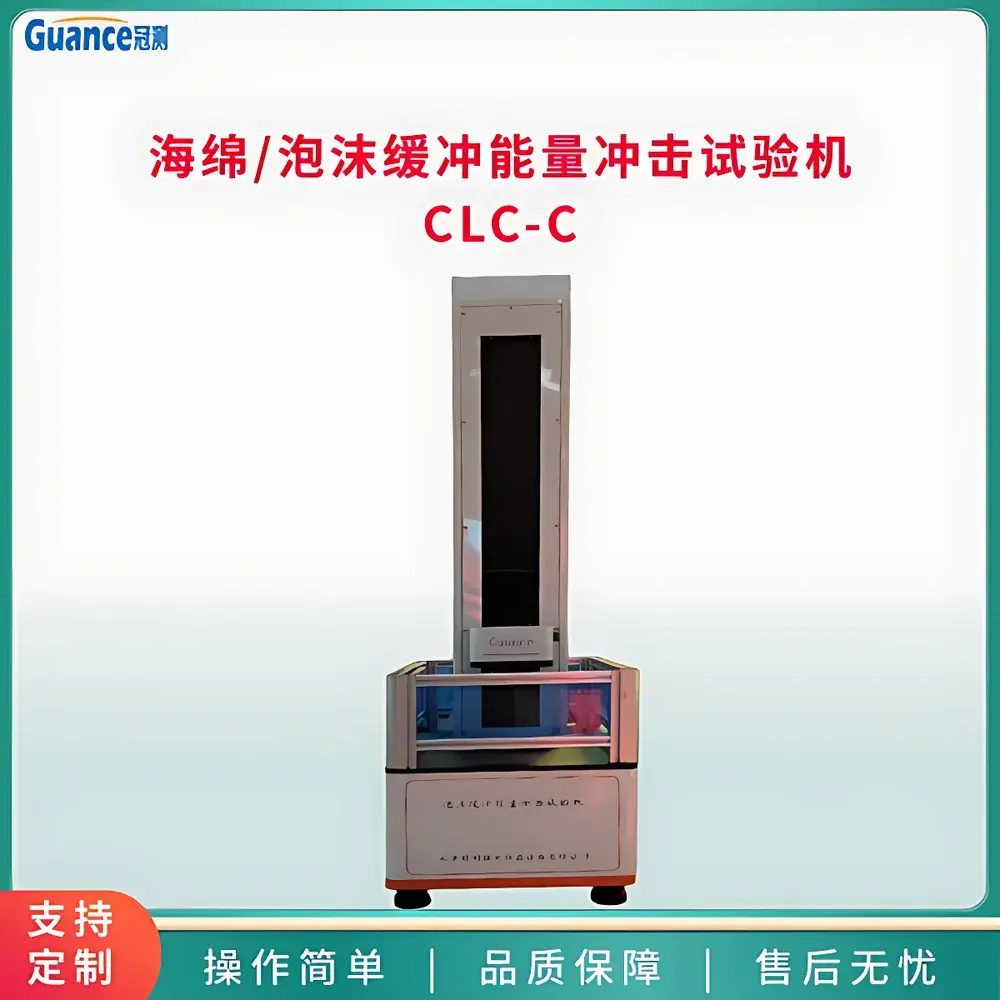
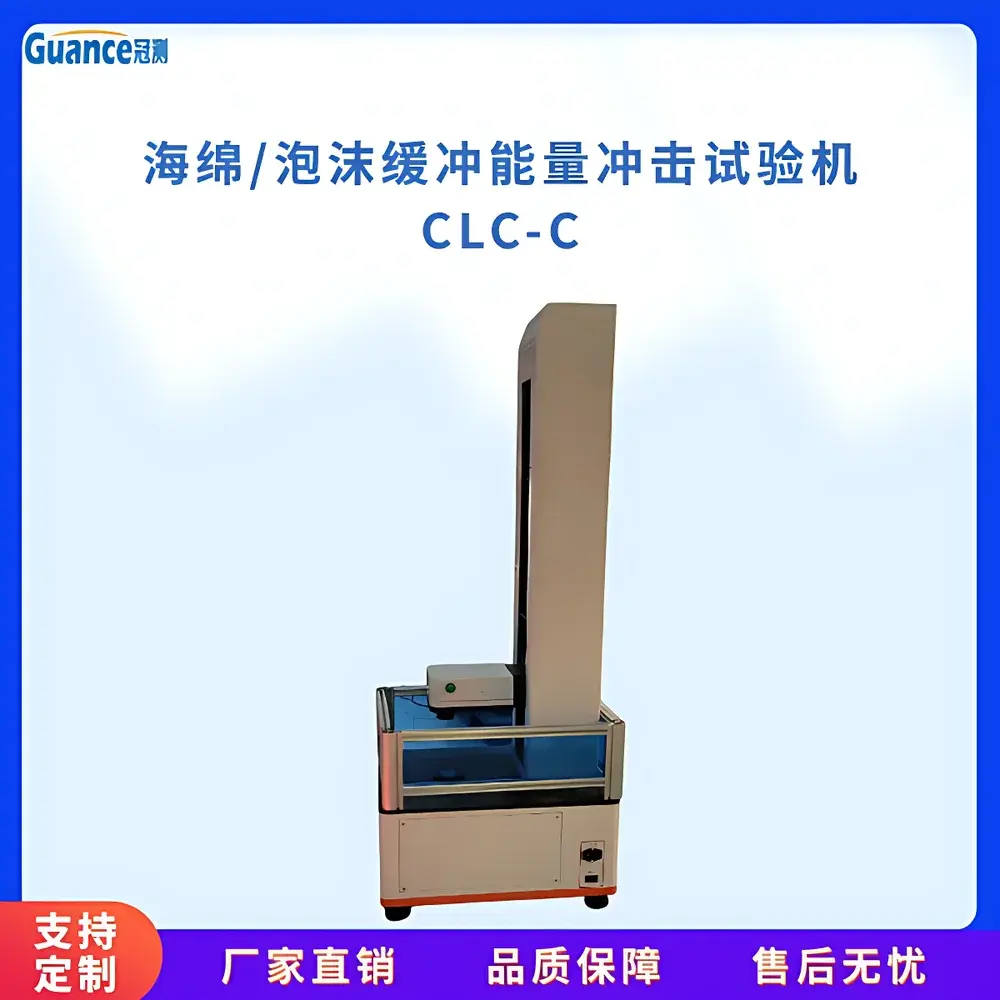
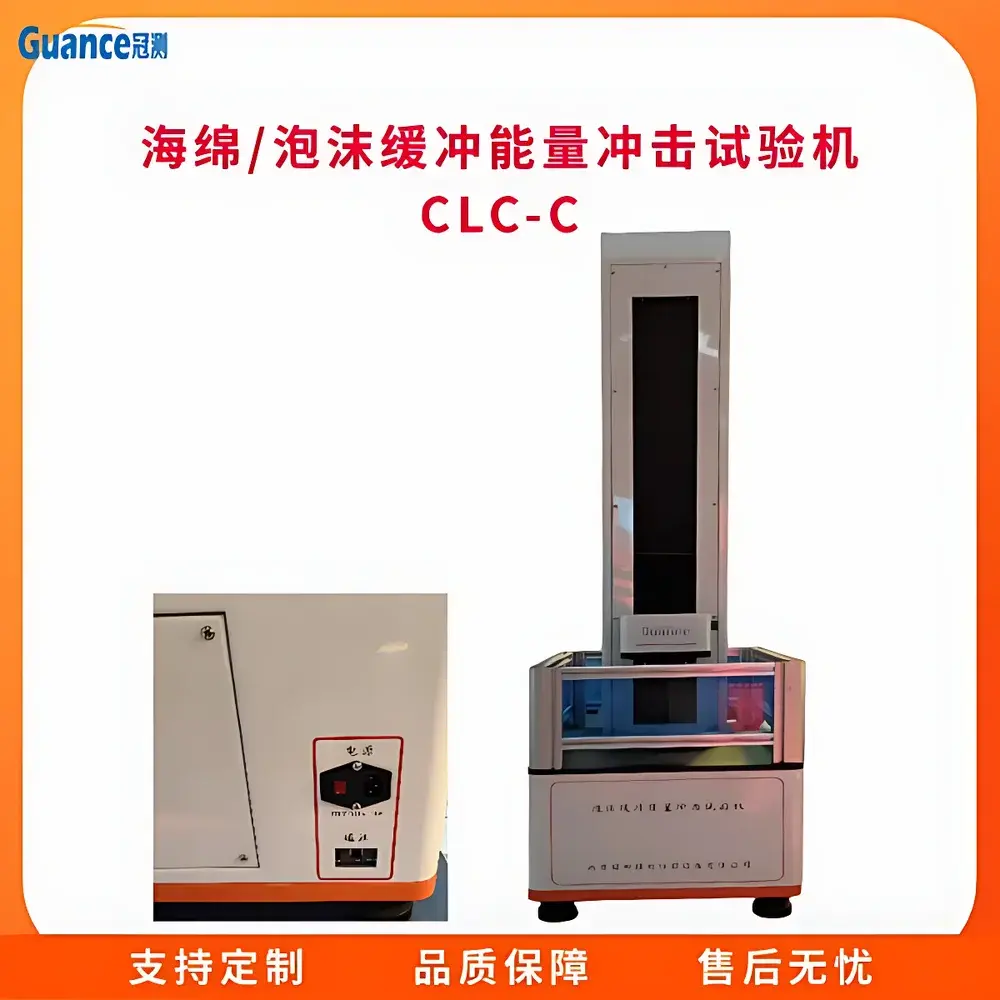
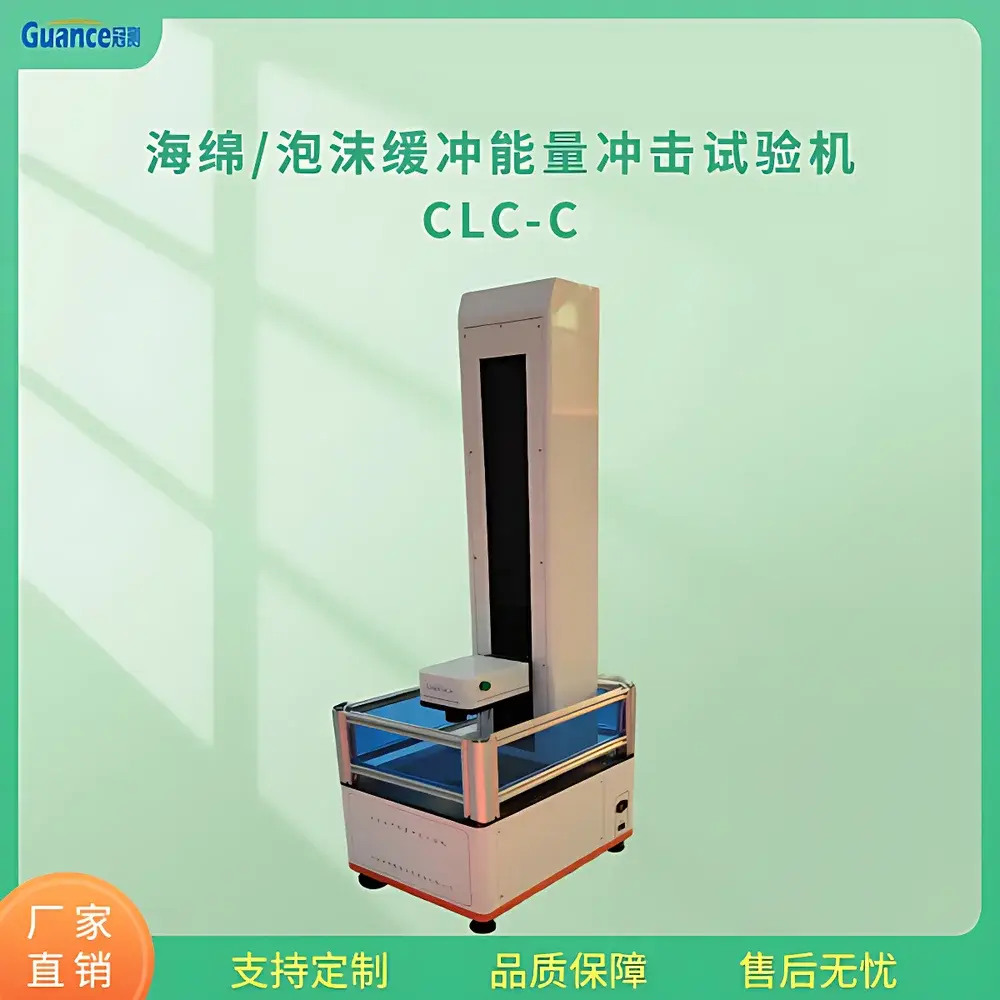
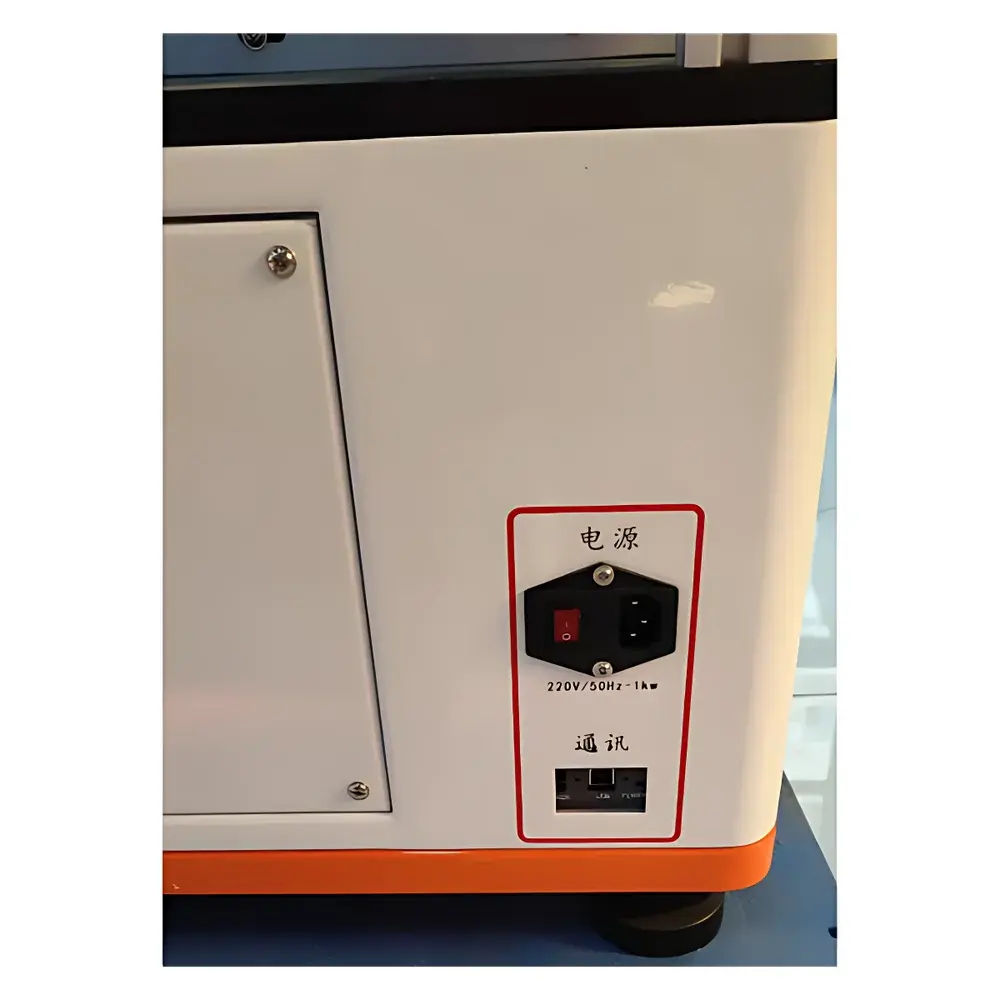
GuanCe Instruments GCCLC-C Foam Cushioning Performance Impact Tester
| Brand | GuanCe Instruments |
|---|---|
| Origin | Shanghai, China |
| Manufacturer Type | Authorized Distributor |
| Country of Origin | China |
| Model | GCCLC-C |
| Instrument Category | Other Impact Testing Machines |
| Impact Energy Range | Adjustable drop height 0–500 mm / 0–1000 mm |
| Impact Velocity | Determined by free-fall kinematics (9.81 m/s²) |
| Force Sensor Options | 2 kN / 5 kN / 10 kN (user-selectable) |
| Pendulum Moment (Impact Constant) | 800 N·mm/rad |
| Force Sensor Measurement Range | 10–80 N (for low-force cushioning characterization) |
| Maximum Lift Height | 80 mm (for sensor pre-tensioning or minor vertical adjustment) |
| Drop Mass | Standardized steel spheres (mass configurable per ASTM D3574, ISO 18562-3, or customer specification) |
| Data Acquisition Rate | 1 MHz |
| Actuation | Motorized height adjustment & solenoid-triggered release |
| Compliance | Designed to support testing protocols aligned with ASTM D1564, ASTM D3574 Section 12 (Cushioning Performance), ISO 18562-3 (Biocompatibility of breathing gas pathways – impact resilience), and GB/T 20485.21 (Chinese national standard for vibration and shock testing) |
Overview
The GuanCe Instruments GCCLC-C Foam Cushioning Performance Impact Tester is an electromechanically actuated, high-speed impact evaluation system engineered for quantitative mechanical characterization of low-density, viscoelastic cushioning materials—particularly polyurethane (PU), ethylene-vinyl acetate (EVA), expanded polystyrene (EPS), and cross-linked polyethylene (XLPE) foams used in electronics packaging, medical device transport, and consumer product protective layers. Unlike conventional Charpy or Izod pendulum testers, the GCCLC-C implements a controlled free-fall methodology: a calibrated steel sphere is elevated to a precisely defined height (0–1000 mm), then released under gravity to impact either a rigid anvil (baseline condition) or a test specimen mounted atop the anvil. The resulting transient force-time history is captured at 1 MHz using a high-fidelity piezoelectric or strain-gauge-based load cell. From this waveform, three primary metrics are derived: peak impact force (Fmax, in N), total impact energy (Eimpact = m·g·h, in J), and absorbed energy (Eabsorbed = Eimpact − Erebound, estimated via integral analysis of the force-displacement curve). This physics-based framework enables objective ranking of energy dissipation efficiency, compression set resistance, and dynamic stiffness—critical parameters for validating drop-protection designs in smartphones, wearables, and diagnostic cartridges.
Key Features
- Motor-driven vertical positioning system enabling repeatable, programmable drop heights from 0 to 1000 mm in 0.1 mm increments
- Electromagnetically triggered, zero-jitter release mechanism ensuring temporal synchronization between drop initiation and data acquisition start
- Modular force sensor architecture supporting interchangeable 2 kN, 5 kN, or 10 kN full-scale transducers—optimized for both thin films (50 mm)
- Integrated safety enclosure with interlocked steel ball containment shield compliant with ISO 13857 (safety distances) and IEC 61000-6-2 (EMC immunity)
- Real-time waveform preview and post-test parametric extraction including Fmax, impulse (N·s), time-to-peak (ms), and energy absorption ratio (%)
- Calibration traceability to national metrology institutes (NIM, China) with documented uncertainty budgets per ISO/IEC 17025
Sample Compatibility & Compliance
The GCCLC-C accommodates planar specimens up to 200 × 200 mm with thicknesses ranging from 1 mm to 100 mm. Fixturing includes vacuum-assisted sample retention plates and optional clamping frames for anisotropic foams. Test configurations adhere to core industry standards: ASTM D3574 Method 12 (Drop-Weight Impact on Flexible Cellular Materials), ASTM D1564 (Standard Practice for Testing Cushioning Materials), and GB/T 20485.21-2018 (Vibration and Shock—Calibrators—Part 21: Vibration Calibrators for Low-Frequency Accelerometers). While not certified for regulatory submission out-of-the-box, the system’s audit-ready data structure—including timestamped raw waveforms, operator ID logging, and version-controlled calibration certificates—supports GLP-compliant workflows and FDA 21 CFR Part 11 readiness when deployed with validated software configuration.
Software & Data Management
The proprietary GCCLC Control Suite (v3.2+) runs on Windows 10/11 and provides full test lifecycle management. Users define test sequences via intuitive wizard-driven templates; each run auto-generates a structured .csv and .tdms file containing synchronized force, displacement (via optional LVDT), and time vectors. The software features automatic zero-drift compensation prior to each drop, statistical batch reporting (n ≥ 5 replicates), comparative overlay of force-time curves across material lots, and export to PDF/Excel formats with embedded metadata (test date, operator, sensor serial number, calibration expiry). All data files are SHA-256 hashed and stored in a write-once-read-many (WORM) archive mode to satisfy integrity requirements for internal quality audits.
Applications
- Quantifying crush resistance of die-cut EVA gaskets in hearing aids and implantable sensor housings
- Evaluating energy absorption hysteresis in multi-layer PU foam stacks used in aerospace avionics packaging
- Validating consistency of cross-link density in radiation-cured silicone foams per ISO 18562-3 Annex C
- Screening batch-to-batch variability in recycled PET foam buffers for e-commerce logistics
- Supporting Design Failure Mode and Effects Analysis (DFMEA) for smartphone mid-frame drop scenarios (MIL-STD-810H Method 516.8)
FAQ
What standards does the GCCLC-C directly support?
It is configured to execute test methods defined in ASTM D3574 Section 12, ASTM D1564, ISO 18562-3, and GB/T 20485.21. Full compliance documentation (including uncertainty statements and fixture drawings) is supplied upon request.
Can the system measure rebound velocity or coefficient of restitution?
Not natively—the GCCLC-C focuses on force-time response. However, optional high-speed imaging (10,000 fps) or laser Doppler vibrometry modules can be integrated for kinetic parameter derivation.
Is sensor calibration performed in-house or by third-party labs?
Initial calibration is conducted at GuanCe’s Shanghai facility against NIM-traceable deadweight standards. Annual recalibration services are available through authorized regional metrology partners with ISO/IEC 17025 accreditation.
Does the software support multi-user role-based access control?
Yes—administrator, technician, and reviewer roles are enforced with password protection and activity logging per user session.
What is the typical turnaround time for spare steel spheres and sensor replacement?
Standard 16 mm and 25.4 mm steel spheres (AISI 52100, HRC 60–65) ship within 3 business days from Shanghai warehouse; custom-mass spheres require 10–14 days lead time.



