
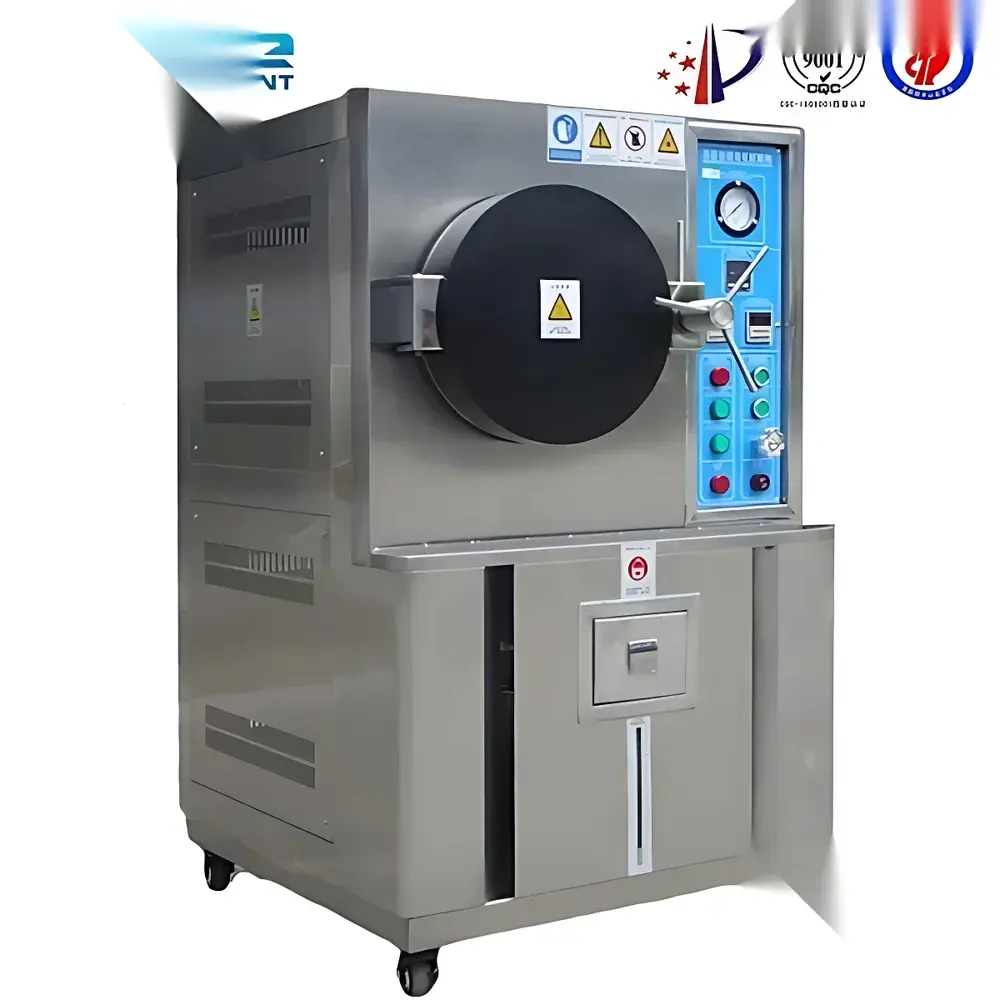
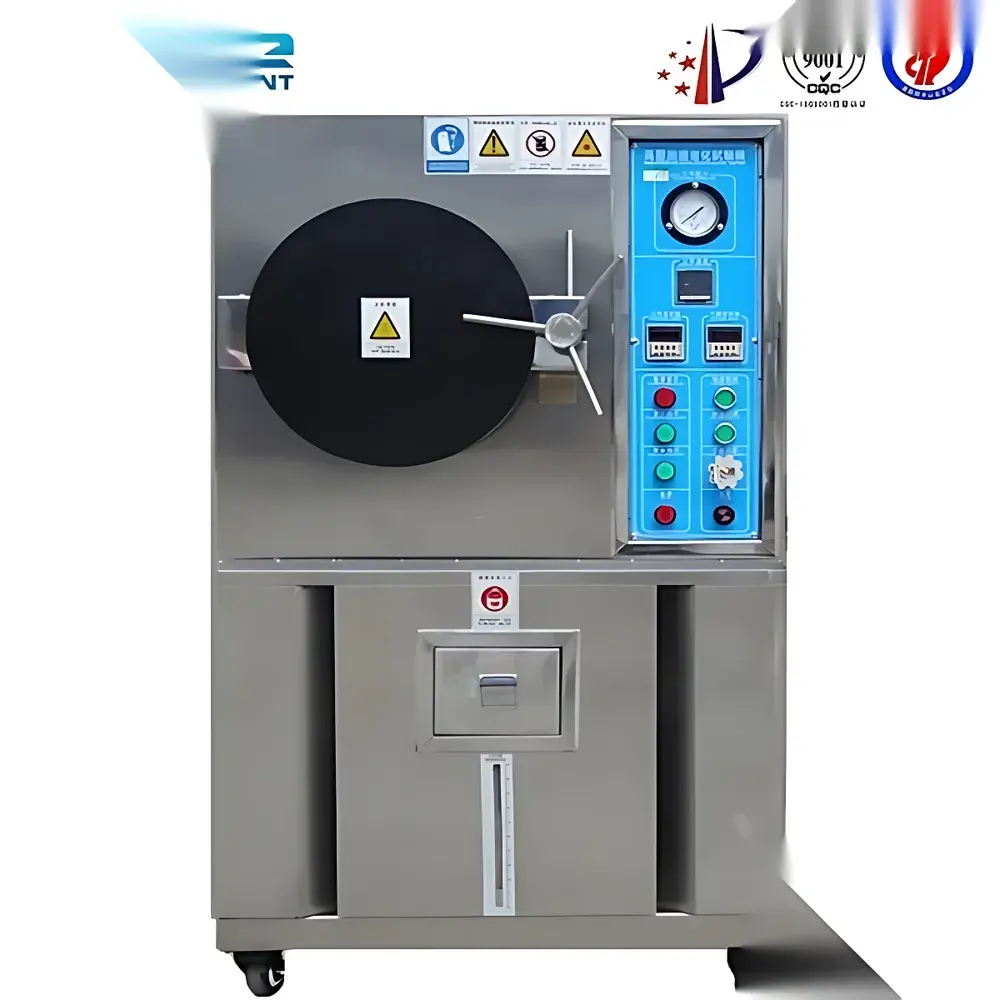
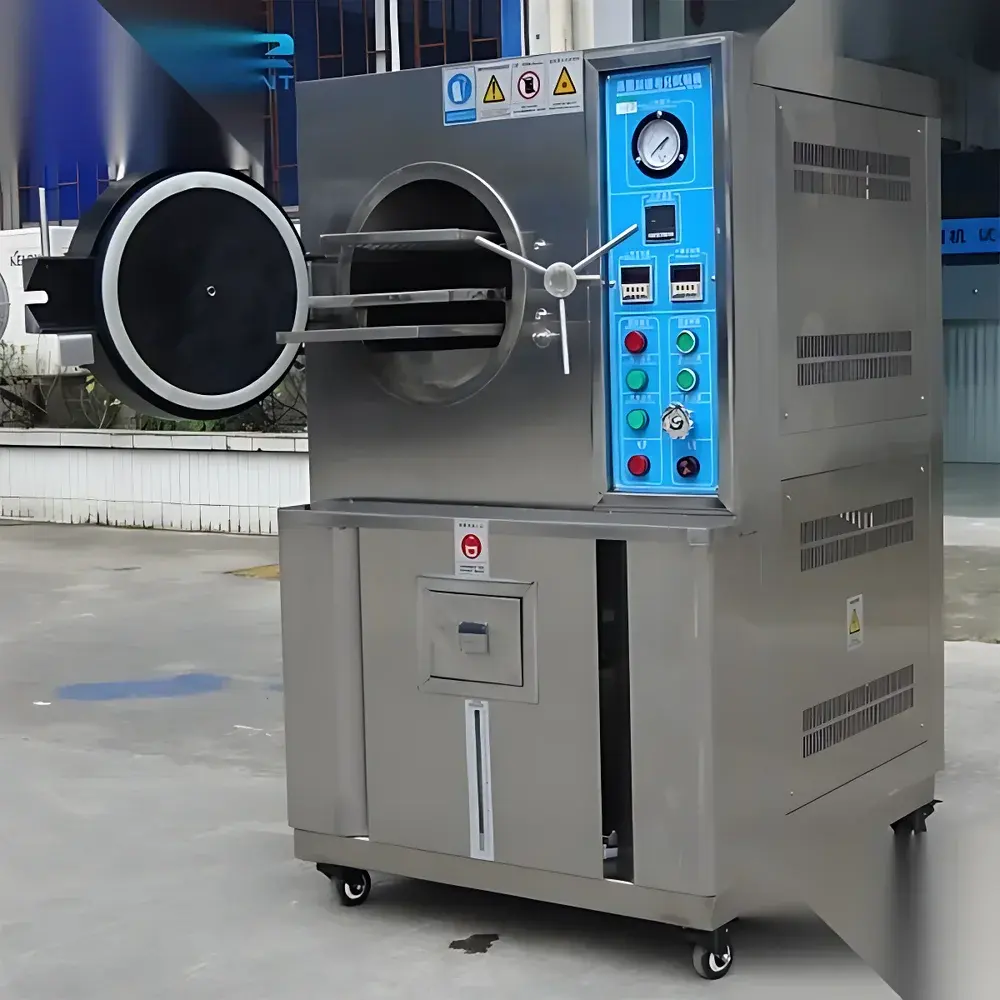
OK-PCT Series Pressure Cooker Test Chambers for IC Package Reliability Testing
| Brand | OK Instruments |
|---|---|
| Origin | Imported |
| Manufacturer Type | Authorized Distributor |
| Voltage | 220–240 V, 50/60 Hz, Single-Phase |
| Temperature Range | +10 °C to 132 °C (optional custom up to 147 °C) |
| Pressure Capacity | 2.0 kg/cm² (≈0.196 MPa), 3.0 kg/cm² (≈0.294 MPa) |
| Pressurization Time | ~45 min (to 2.0 kg/cm²), ~55 min (to 3.0 kg/cm²) |
| Chamber Materials | Interior – AISI 316 stainless steel |
| Humidification System | Immersed electric heating tube |
| Water Replenishment | Stainless steel float valve system |
| Internal Dimensions (Ø × H, mm) | 250 × 300 |
| Safety Features | Interlocked circular door with pressure-dependent start inhibition, dual-mode pressure relief (automatic + manual), low-water-level auto-refill during 200-h continuous test, cylindrical inner liner to prevent thermal shock to samples |
| Timer | LED digital timer with temperature-triggered start (initiates only after chamber reaches setpoint per ASTM E154 / JESD22-A102) |
Overview
The OK-PCT Series Pressure Cooker Test (PCT) Chambers are engineered for accelerated reliability validation of integrated circuit (IC) packages under high-humidity, high-temperature, and elevated-pressure conditions. Based on the fundamental principle of saturated steam exposure—where samples are subjected to pressurized water vapor at temperatures above 100 °C—the system replicates worst-case moisture ingress scenarios that accelerate intermetallic corrosion, wire bond degradation, and delamination in plastic-encapsulated microcircuits. Compliant with industry-standard test methods including JEDEC JESD22-A102 (Autoclave), MIL-STD-883 Method 1008.3, and AEC-Q100 stress qualification protocols, these chambers provide a controlled environment for evaluating package hermeticity, mold compound integrity, and die attach stability. The cylindrical internal chamber geometry—combined with a seamless AISI 316 stainless steel liner—ensures uniform steam distribution and eliminates localized superheating that could induce non-representative thermal shock to sensitive semiconductor devices.
Key Features
- Interlocked circular door mechanism: Mechanical and pressure-sensing interlocks prevent test initiation unless both door closure and internal pressure safety thresholds are met—ensuring operator protection and process integrity.
- Auto-refill function with stainless steel float valve: Maintains consistent water level throughout extended test cycles (up to 200 hours), eliminating manual intervention and reducing risk of dry-run damage or test interruption.
- Cylindrical inner liner design: Minimizes turbulent steam flow and thermal gradient variation across the sample zone, improving repeatability between runs and alignment with JEDEC-defined thermal uniformity requirements.
- Dual-mode pressure relief system: Integrated automatic pressure dump valve activates at preset overpressure thresholds; supplemented by a manually operable safety release valve for emergency depressurization.
- Temperature-triggered digital timer: LED-based timing logic initiates only after chamber temperature stabilizes at the target setpoint—enforcing strict adherence to test duration definitions in ASTM E154 and JESD22-A102.
- Robust construction: Interior chamber fabricated from corrosion-resistant AISI 316 stainless steel; exterior available in powder-coated carbon steel or optional stainless cladding for cleanroom or high-humidity lab environments.
Sample Compatibility & Compliance
The OK-PCT chambers accommodate standard IC packaging formats—including QFP, SOP, BGA, QFN, and wafer-level chip-scale packages—within configurable stainless steel sample racks. Each model (OK-PCT-250 to OK-PCT-650) is dimensionally validated to support industry-standard test board layouts and thermal mass loading per JEDEC’s recommended maximum sample volume-to-chamber-volume ratio (≤30%). All units undergo factory calibration traceable to NIST standards and include documentation supporting ISO/IEC 17025-compliant verification. The system architecture meets mechanical safety requirements outlined in IEC 61010-1 and incorporates fail-safe logic aligned with GLP and GMP audit expectations—including event-logged door open/close cycles, pressure ramp profiles, and temperature deviation alerts.
Software & Data Management
While the base configuration operates via front-panel digital controls, optional RS-485 or Ethernet interfaces enable integration with laboratory information management systems (LIMS) and centralized data acquisition platforms. Real-time logging of chamber temperature, pressure, elapsed time, and refill events supports 21 CFR Part 11-compliant electronic records when paired with validated third-party software. Audit trail functionality captures user actions, parameter changes, and alarm acknowledgments—essential for regulated environments requiring full traceability per FDA or ISO 9001 quality management systems.
Applications
- Qualification testing of new IC package designs prior to production ramp-up
- Failure analysis root cause determination for moisture-related field returns
- Process validation of molding compound formulations and curing parameters
- Supplier qualification audits for outsourced assembly and test (OSAT) partners
- Reliability screening of automotive-grade components per AEC-Q100 Rev H stress test schedules
- Supporting IPC-J-STD-020 moisture sensitivity level (MSL) reflow simulation prep
FAQ
What is the maximum allowable test duration without manual intervention?
The auto-refill system enables uninterrupted operation for up to 200 hours under continuous PCT conditions, provided initial water volume meets manufacturer-specified minimum fill levels.
Can the chamber be calibrated for ISO/IEC 17025 compliance?
Yes—factory calibration certificates are provided with NIST-traceable references; on-site recalibration services and uncertainty budgets are available upon request.
Is the unit suitable for use in Class 1000 cleanrooms?
With optional stainless steel exterior finish and filtered exhaust routing, the OK-PCT series meets particulate emission limits for ISO Class 6 (Class 1000) environments when installed with appropriate HVAC integration.
Does the system support custom pressure ramp profiles?
Standard operation follows fixed-rate pressurization per JEDEC; programmable ramp profiles require optional controller upgrade and firmware validation per customer-specific test method requirements.
What electrical infrastructure is required for installation?
A dedicated 220–240 V, 50/60 Hz, single-phase circuit with minimum 30 A breaker capacity and proper grounding per IEC 60364-5-54 is mandatory—no neutral line required.



