
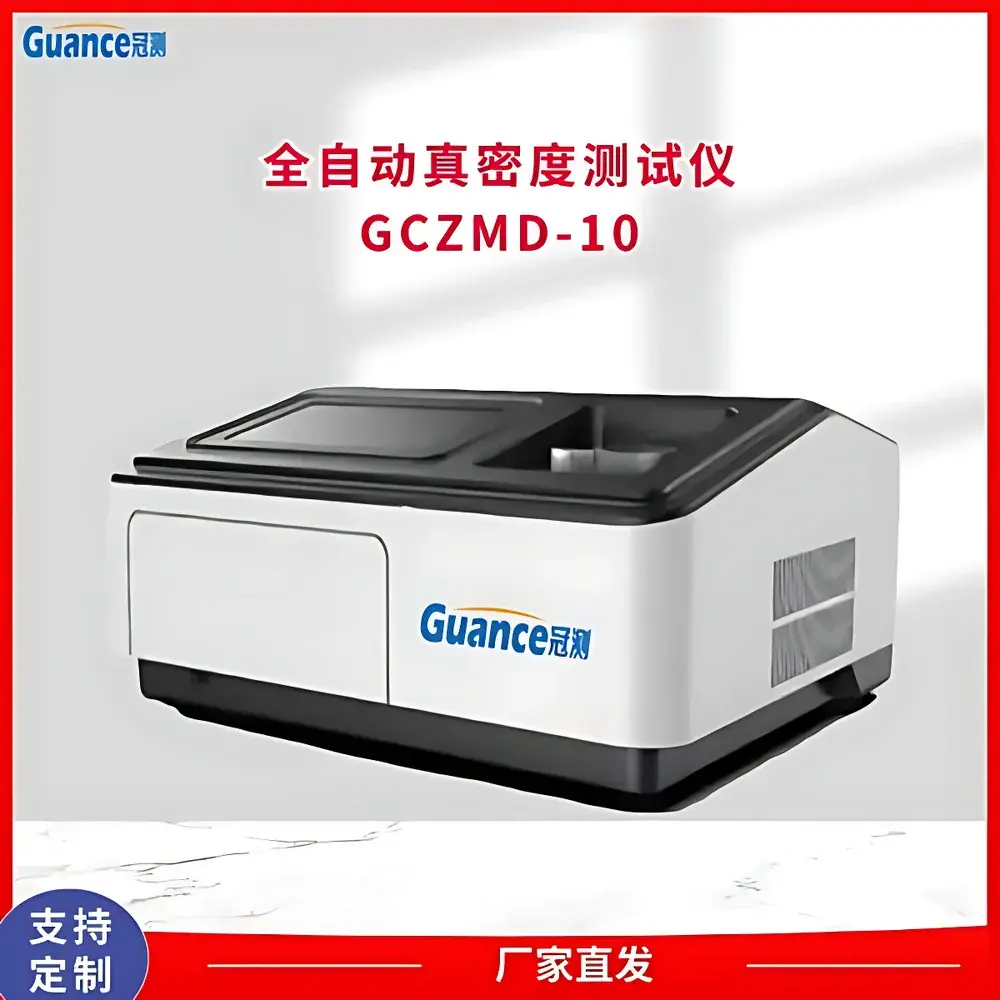
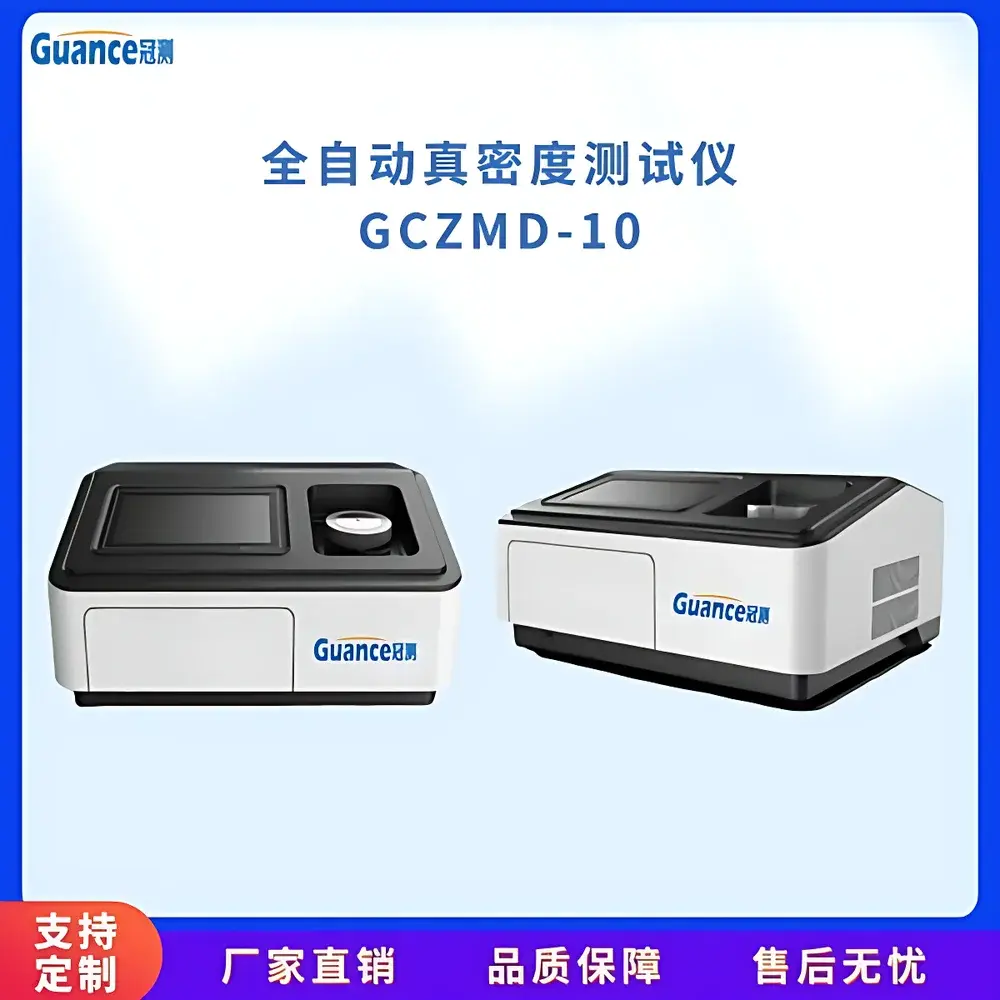
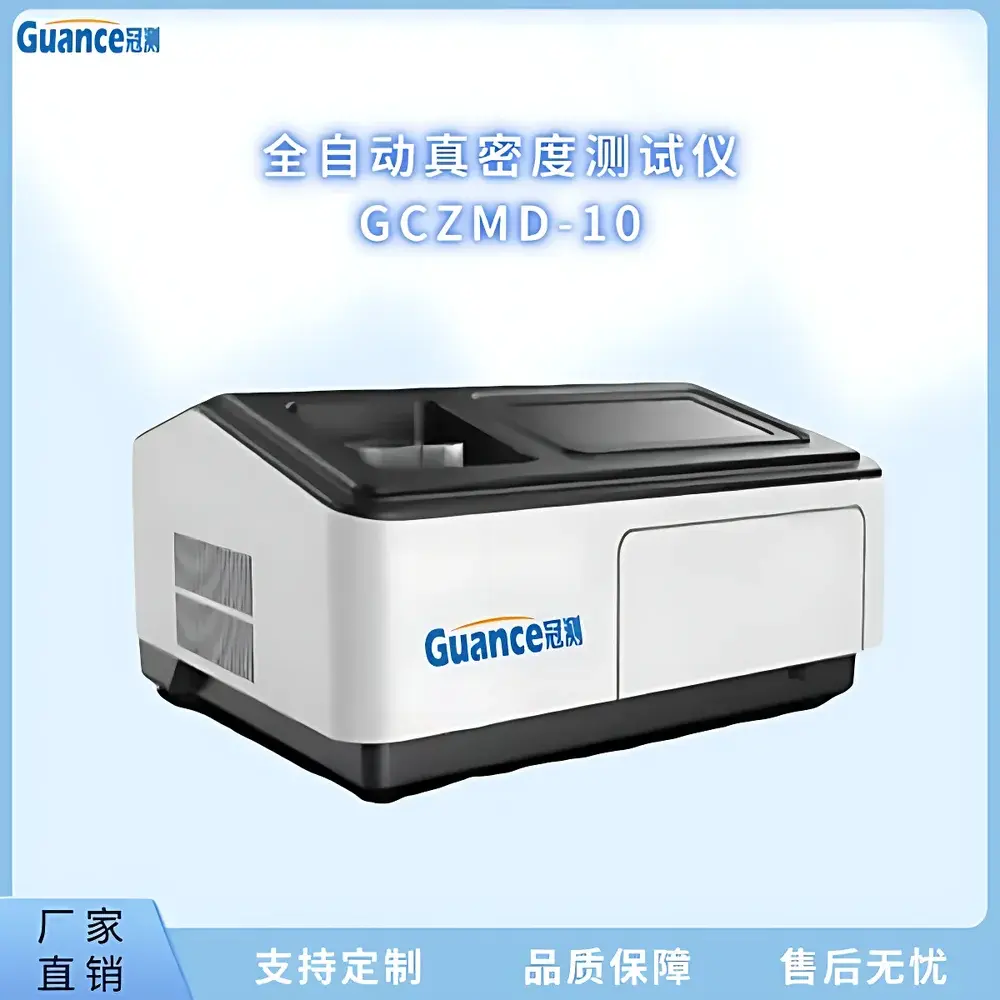
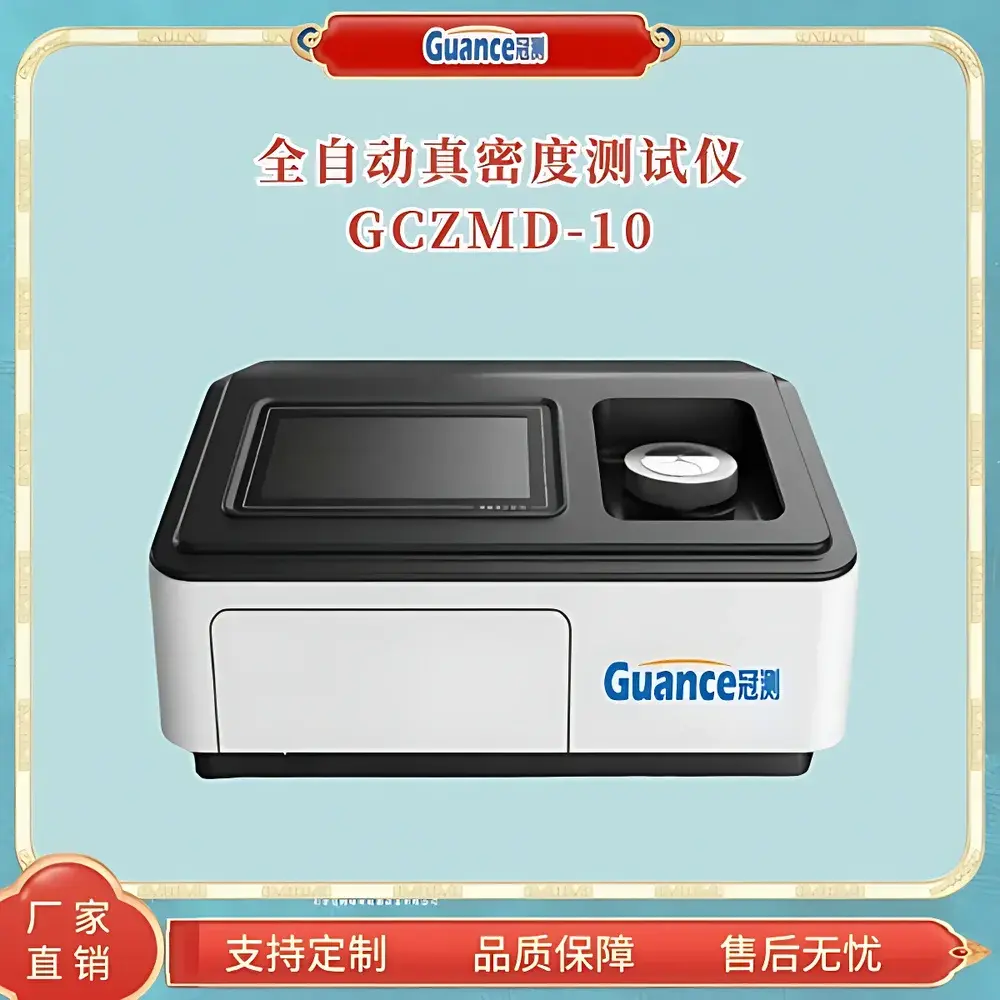
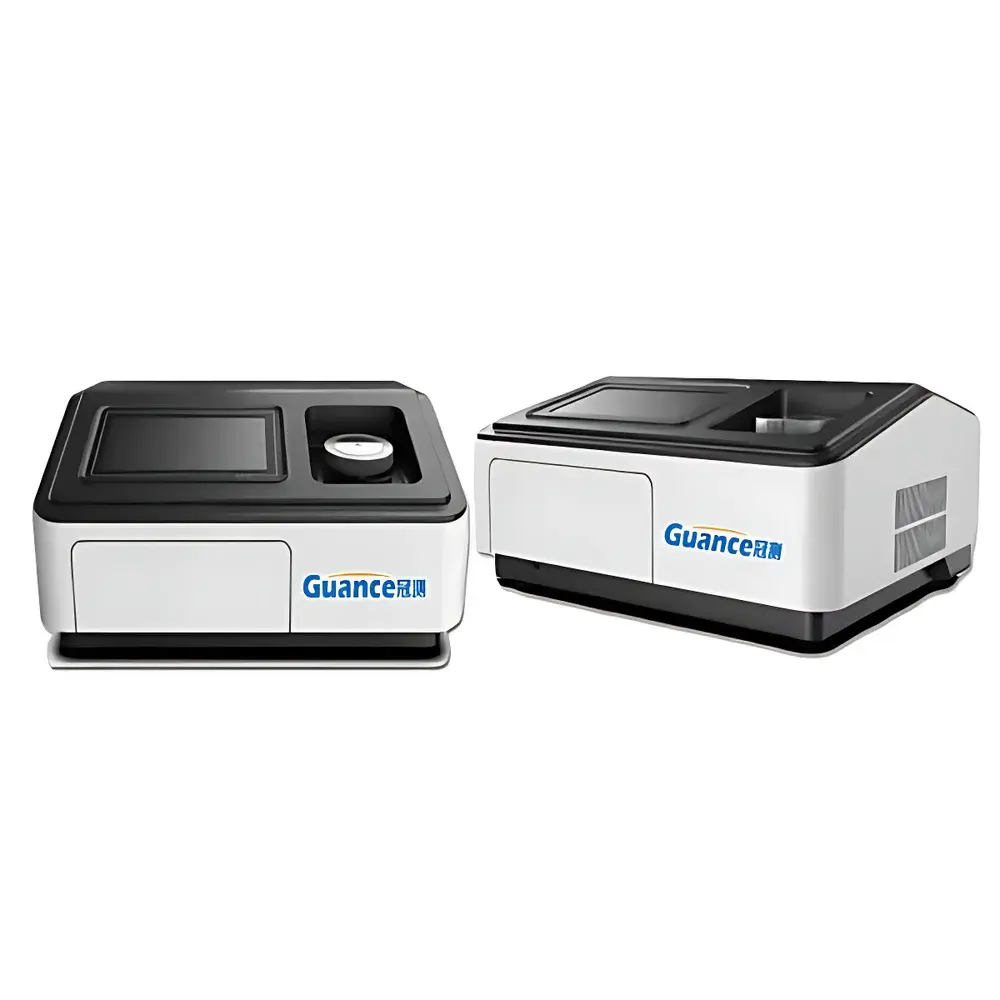
GuanCe Instruments GCZMD-10c Helium True Density Analyzer
| Brand | GuanCe Instruments |
|---|---|
| Origin | Beijing, China |
| Manufacturer Type | Authorized Distributor |
| Regional Category | Domestic (PRC) |
| Model | GCZMD-10c |
| Instrument Type | True Density Analyzer |
| Form Factor | Benchtop (Compact) |
| Sample Compatibility | Solids & Liquids |
| Density Range | 0–20 g/cm³ |
| Maximum Sample Mass | 5 g |
| Density Accuracy | ±0.1% (relative) |
| Display | High-Resolution TFT Touchscreen |
| Operating Temperature Range | 0–40 °C |
| Repeatability | ≤0.01 g/cm³ (RSD ≤0.1–0.3%) |
| Resolution | 0.01 g/cm³ |
| Minimum Sample Volume | 0.1 mL |
| Measurement Principle | Gas Expansion Displacement (Helium Pycnometry) |
| Test Time | ~4 min per cycle |
| Sample Chamber Volume | 10 mL ±0.2 mL |
| Working Pressure | 1.3 bar (max. 2.0 bar) |
| Recommended Analysis Gas | He (N₂ optional, requires calibration adjustment) |
| Pressure Control Valve | 154N-050A-C (U.S.-sourced) |
| Solenoid Valve | CFVB25-Z-O-B2C-3 (Japan-sourced) |
| Data Interface | RS485, RJ45 Ethernet, USB Host (U-disk storage), Built-in Thermal Printer (TMS variant) |
| Input Method | Capacitive Touchscreen with Handwriting Support |
| ADC Resolution | 24-bit |
| Power Supply | AC 220 V / 50 Hz |
| Rated Power | 28 W |
| Dimensions (W×D×H) | 410 × 320 × 155 mm |
| Net Weight | 4.6 kg |
| Calibration Standards Supplied | PVC, Al, Cu reference materials |
| Software Architecture | Embedded C-based real-time OS with scriptable workflow engine |
Overview
The GuanCe Instruments GCZMD-10c Helium True Density Analyzer is a benchtop pycnometer engineered for high-reproducibility determination of true (skeletal) density of solid and liquid samples using helium gas expansion displacement—based on the ideal gas law (PV = nRT) and Archimedes’ principle. Unlike bulk or apparent density measurements, this instrument quantifies the volume occupied exclusively by the solid matrix or liquid phase, excluding interstitial voids, pores, or entrapped air. It achieves this by precisely measuring the pressure differential induced when a known mass of sample displaces helium within a thermally stabilized, calibrated reference chamber. The system operates at controlled isothermal conditions (0–40 °C ambient), minimizing thermal drift and ensuring compliance with ASTM D5550, ISO 12154, and USP guidelines for true density characterization in regulated R&D and QC environments.
Key Features
- Integrated modular architecture: Co-located solenoid valves (Japan-sourced CFVB25-Z-O-B2C-3), pressure transducers, and 10 mL sample chamber minimize dead volume and enhance sealing integrity.
- Thermal field uniformity: Tubeless, monolithic sensor module design eliminates gas path thermal gradients; chamber temperature equilibrates rapidly with ambient, ensuring stable PV measurements.
- Intelligent pressure regulation: Adaptive algorithm compensates for upstream cylinder pressure fluctuations; flow control maintains consistent helium delivery across repeated cycles.
- Script-driven operation: Advanced users may modify test protocols via embedded C-based scripting interface—enabling custom pressurization sequences, dwell times, purge cycles, and multi-step calibration routines.
- High-fidelity data acquisition: 24-bit analog-to-digital conversion ensures sub-millibar pressure resolution and long-term measurement stability.
- Built-in traceability: Factory-supplied certified reference materials (PVC, aluminum, copper) support on-site verification and GLP-compliant recalibration.
- Comprehensive I/O: RS485 Modbus RTU, 10/100 Mbps Ethernet (RJ45), USB host port for U-disk logging, and integrated thermal printer (TMS model) with automated report generation including sample ID, timestamp, operator tag, and statistical summary (mean, SD, RSD).
Sample Compatibility & Compliance
The GCZMD-10c accommodates granular, powdered, irregularly shaped, and low-viscosity liquid specimens—from catalyst pellets and ceramic powders to pharmaceutical excipients and battery electrode slurries. Its 10 mL chamber accepts samples as small as 0.1 mL (liquids) or 0.1 g (dense solids), enabling efficient use of scarce R&D materials. All wetted components are inert to helium and nitrogen; optional N₂ operation is supported with user-defined correction factors. The instrument meets electromagnetic compatibility (EMC) requirements per IEC 61326-1 and safety standards IEC 61010-1. Its firmware supports audit-trail-enabled operation (optional configuration), aligning with FDA 21 CFR Part 11 expectations for electronic records in GMP-regulated labs.
Software & Data Management
Embedded firmware features a responsive capacitive touchscreen UI with handwriting input support and contextual soft-keys. Real-time pressure curves, temperature logs, and step-by-step status indicators guide operators through each phase: evacuation, helium dosing, equilibration, measurement, and purge. All raw sensor data—including absolute pressure (mbar), chamber temperature (°C), and elapsed time—are timestamped and stored internally or exported directly to USB drives in CSV format. Network-connected units allow remote monitoring via standard HTTP/JSON API or integration into LIMS via Modbus TCP. Electronic signatures, user access levels (admin/operator), and configurable auto-backup intervals further support ALCOA+ data integrity principles.
Applications
This analyzer serves critical roles in materials science, catalysis, pharmaceutical development, and advanced manufacturing. Typical use cases include: quantifying pore-free density of sintered ceramics and metal injection molded (MIM) parts; verifying batch consistency of activated carbon, zeolites, and MOFs; assessing compaction density of tablet granules pre- and post-compression; characterizing density gradients in layered battery electrodes; determining skeletal density of aerogels and foams; and validating density specifications for nuclear fuel pellets, refractory oxides, and semiconductor precursors. Its speed (~4 min/cycle), low sample consumption, and helium’s superior penetration into sub-nanometer pores make it especially valuable for quality control laboratories requiring rapid turnaround without sacrificing metrological rigor.
FAQ
What gases can be used for analysis?
Helium is the default and recommended analysis gas due to its small kinetic diameter (2.6 Å), enabling full intraparticle pore access in microporous and mesoporous materials. Nitrogen may be substituted upon request, but requires empirical correction for incomplete pore filling and surface adsorption effects.
Is the instrument compliant with regulatory standards for pharmaceutical testing?
Yes—the GCZMD-10c supports GLP/GMP workflows when configured with audit trail, electronic signature, and role-based access control. Its measurement uncertainty profile satisfies USP and EP 2.2.5 requirements for true density determination of drug substances and excipients.
Can the system be integrated into an existing laboratory network?
Absolutely. Standard Ethernet (RJ45) and RS485 interfaces enable seamless connection to LIMS, SCADA, or MES platforms using Modbus TCP/RTU or custom RESTful APIs.
How often does calibration need to be performed?
Initial calibration is performed at factory using NIST-traceable reference standards. Field verification is recommended before each analytical campaign using supplied PVC/Al/Cu check standards; full recalibration is advised annually or after major maintenance.
Does the instrument require external gas supply regulation?
No—integrated pressure regulation (1.3 bar operating, up to 2.0 bar max) eliminates need for external regulators. A standard helium cylinder with dual-stage regulator (output ≤3 bar) is sufficient for continuous operation.
Related Products



