
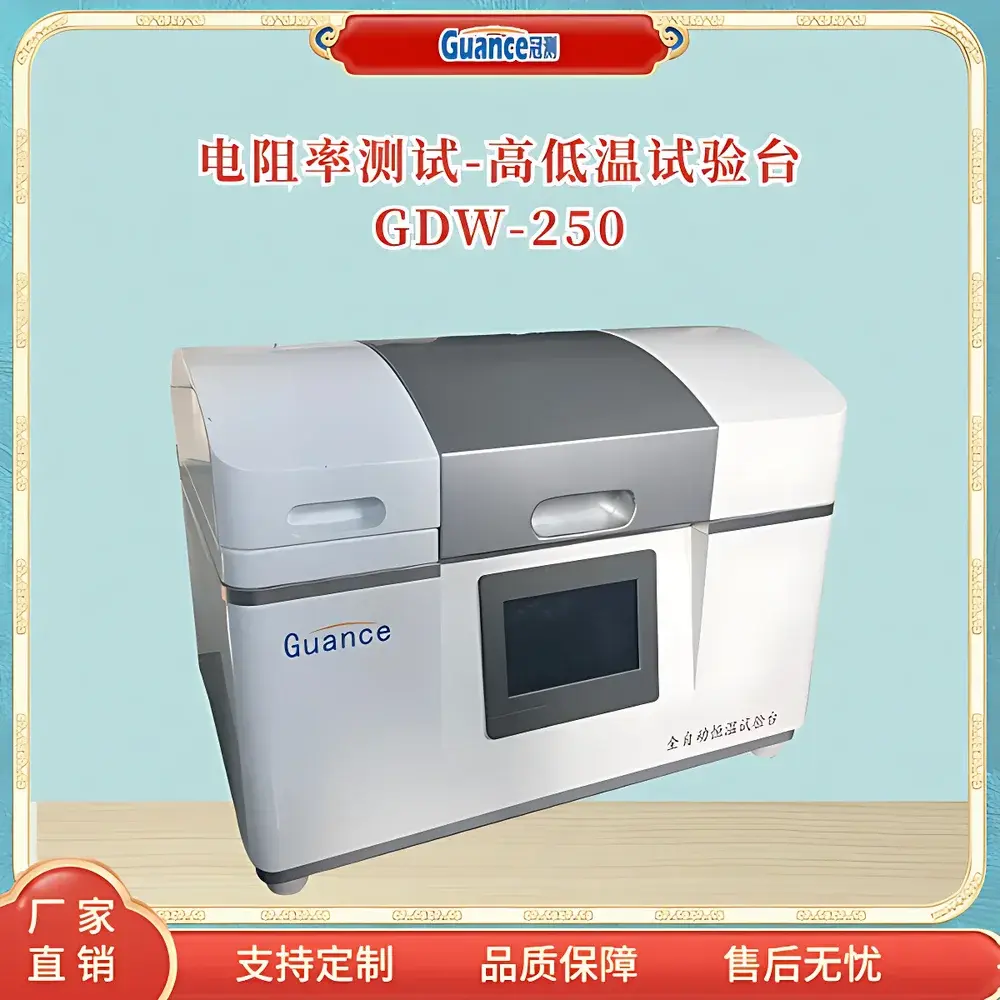
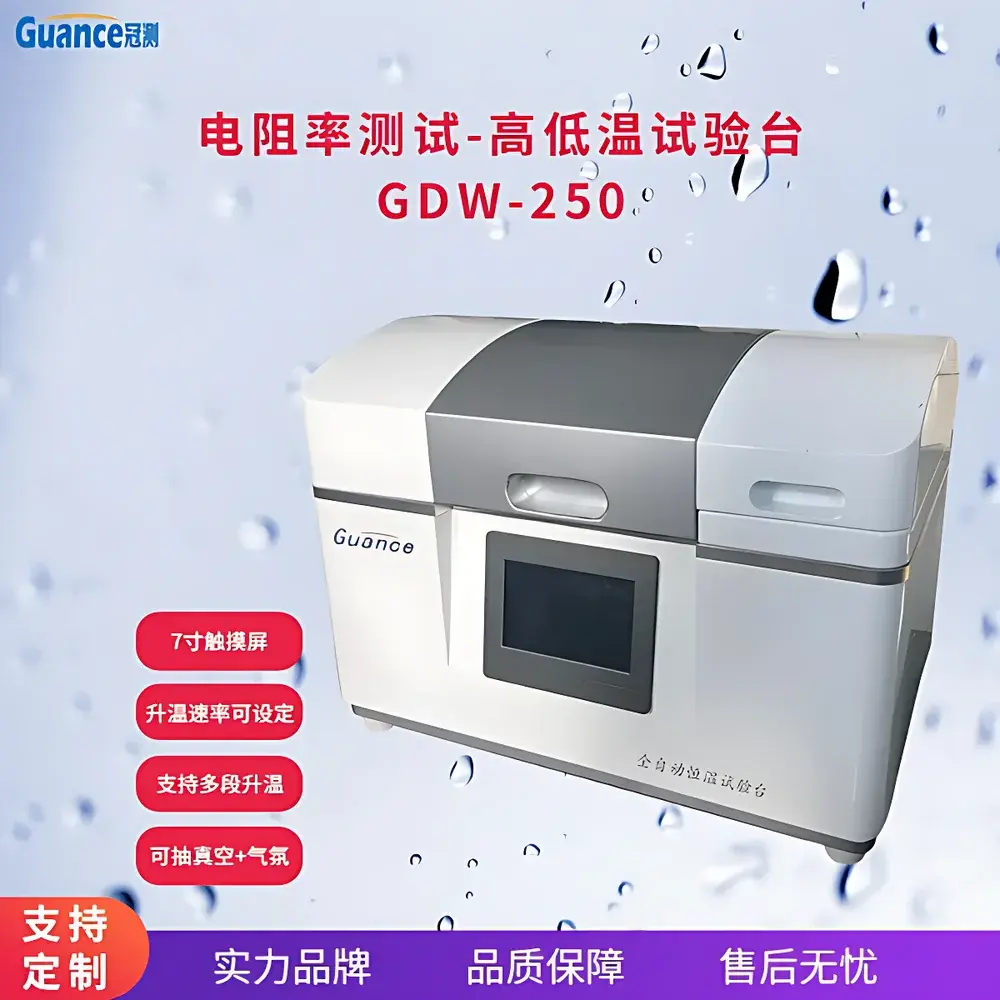
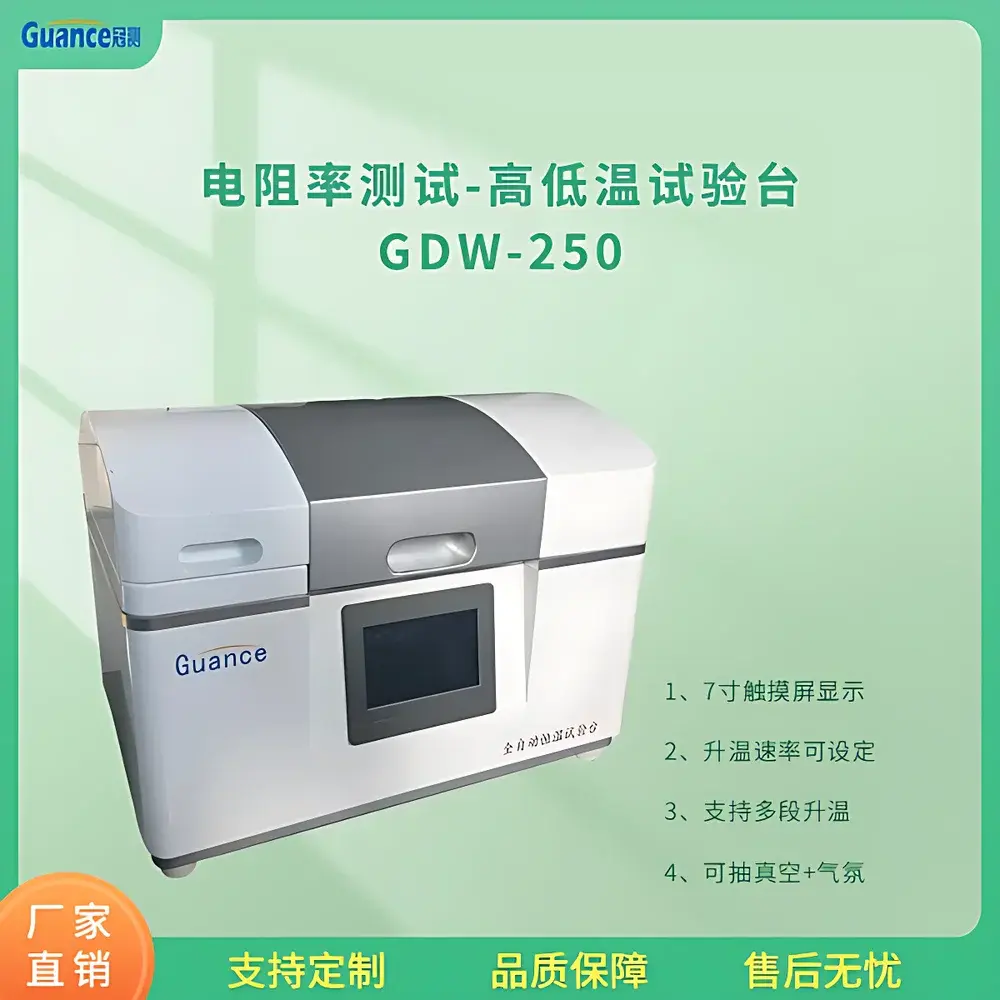
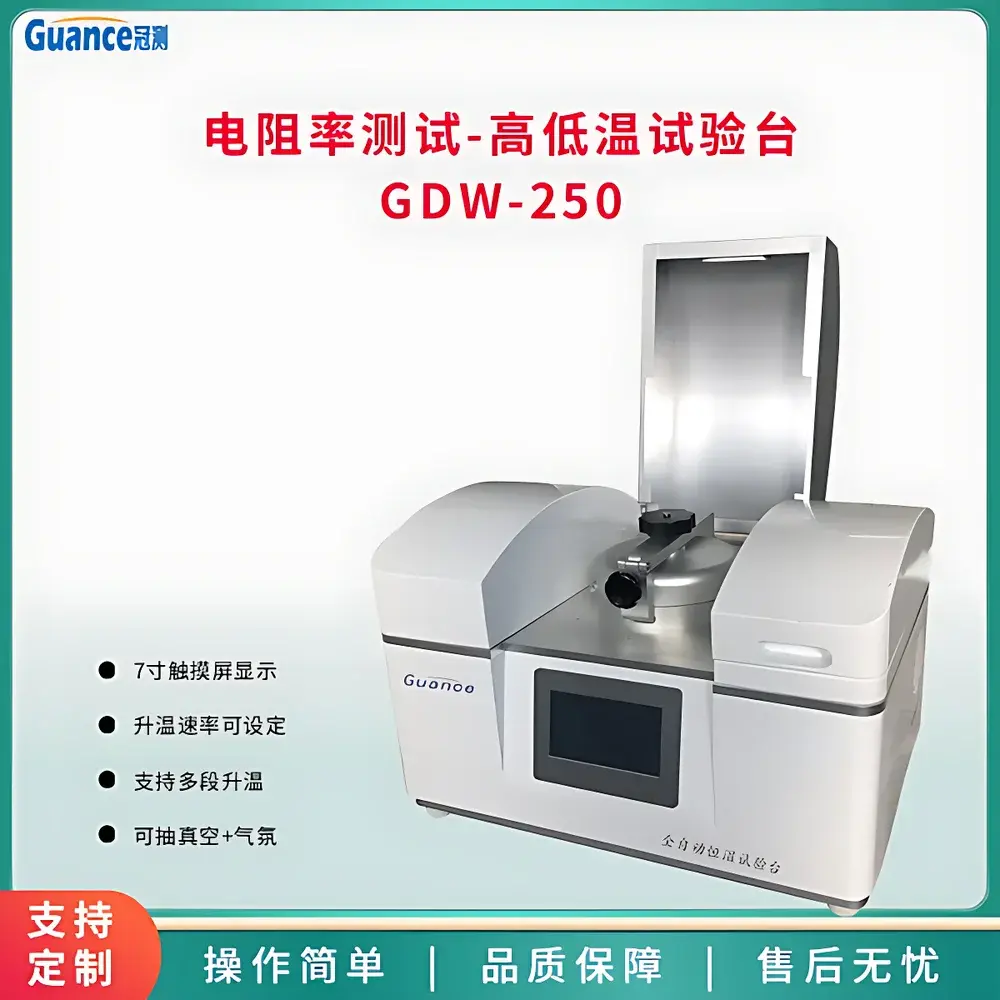
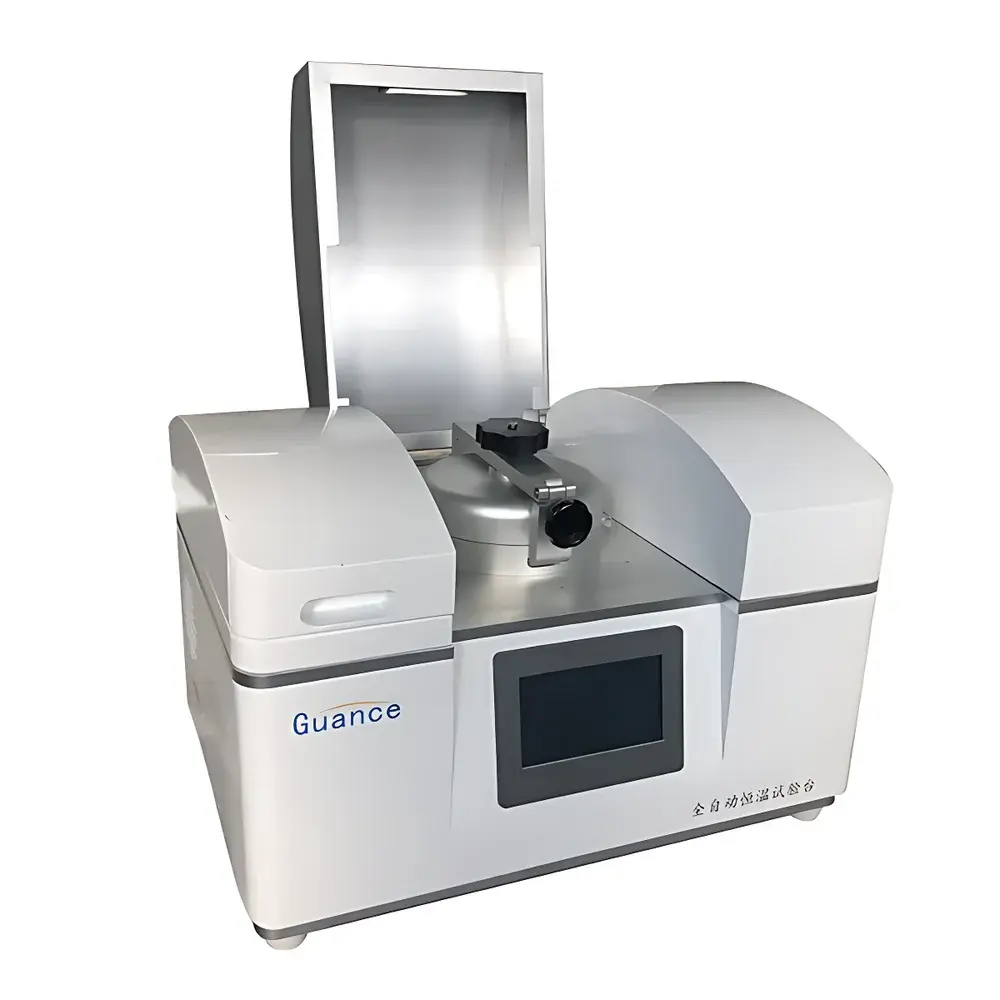
GuanCe Instruments GDW-250D High-Temperature Resistivity and Dielectric Constant Measurement System
| Brand | GuanCe Instruments |
|---|---|
| Origin | Beijing, China |
| Manufacturer Type | Authorized Distributor |
| Country of Origin | China |
| Model | GDW-250D |
| Price | USD 1,800 (FOB Beijing) |
| Temperature Range | Ambient to 250 °C |
| Sample Chamber Dimensions | 600 mm (L) × 400 mm (W) × 400 mm (H) |
| Enclosure Material | Powder-Coated Steel |
| Input Power | 220 V AC, 50 Hz, Three-Phase |
| Operating Humidity | <50 % RH |
| Ambient Temp | 22–27 °C |
| Compressed Air Supply | 0.5 MPa (clean, oil-free) |
| Positive-Pressure Purge Air | 0.05 MPa (explosion-proof inert gas optional) |
Overview
The GuanCe Instruments GDW-250D High-Temperature Resistivity and Dielectric Constant Measurement System is an integrated thermal–electrical characterization platform engineered for precision evaluation of bulk electrical properties under controlled elevated temperatures. It operates on the principle of guarded two-terminal or four-terminal DC resistivity measurement combined with low-frequency impedance spectroscopy (typically 10 Hz–1 MHz) to determine volume resistivity (ρ), surface resistivity (σ), and complex permittivity (ε* = ε′ − jε″) across a continuous temperature range from ambient up to 250 °C. The system comprises a thermally insulated chamber with programmable PID-controlled heating, a configurable electrode fixture set (including parallel-plate, interdigitated, and coaxial geometries), and a modular interface compatible with third-party LCR meters, high-resistance meters (e.g., Keithley 6517B), or impedance analyzers. Designed for materials R&D and quality control laboratories, it supports standardized testing per ASTM D257 (DC resistance of insulating materials), ASTM D150 (dielectric constant and dissipation factor), and IEC 60250—enabling reproducible data acquisition under GLP-compliant conditions.
Key Features
- Programmable temperature ramping with user-defined heating rates (0.1–10 °C/min) and soak stabilization
- Electrically isolated, guarded electrode fixtures to minimize leakage current and stray capacitance
- Modular test head design accommodating custom sample holders (standard dimensions: Ø25–50 mm, thickness ≤15 mm)
- Dual-mode operation: DC resistivity (10⁴–10¹⁶ Ω·cm) and AC dielectric spectroscopy (10 Hz–1 MHz)
- Real-time synchronized acquisition of resistivity/permittivity vs. temperature, displayed as dual-axis plots
- Integrated environmental purge capability: clean compressed air (0.5 MPa) and positive-pressure inert gas (0.05 MPa) for oxidation-sensitive or explosive-atmosphere testing
- Powder-coated steel enclosure with thermal shielding, compliant with IP20 industrial safety rating
Sample Compatibility & Compliance
The GDW-250D accommodates solid dielectric and semiconducting specimens including ceramics, polymers, composites, thin films (with substrate isolation), and sintered oxides. Samples must be electrically stable at elevated temperatures and mechanically compatible with standard electrode contact geometry. The system supports compliance with ASTM D257 (insulation resistance), ASTM D150 (dielectric constant and loss tangent), ISO 3915 (resistivity of conductive plastics), and IEC 60250 (determination of permittivity). All software-generated reports include timestamped metadata, operator ID, calibration traceability, and audit-ready export formats (CSV, XLSX, PDF) aligned with FDA 21 CFR Part 11 requirements for electronic records.
Software & Data Management
The embedded Windows-based control software provides full instrument orchestration via USB or Ethernet. Users configure test protocols—including voltage sweep (1–1000 V DC or AC RMS), dwell time per temperature step, electrode area input, and guard ring activation. Raw data streams are logged at ≥10 Hz resolution with automatic temperature synchronization. Post-acquisition tools enable derivative analysis (dρ/dT, dε′/dT), Arrhenius fitting for activation energy calculation, and Cole–Cole plot generation. Data exports retain full metadata hierarchy and support integration into LIMS environments via ODBC drivers. Audit trails record all parameter changes, manual overrides, and report generation events—ensuring full traceability for ISO/IEC 17025 accreditation.
Applications
- Thermal stability assessment of polymer electrolytes for solid-state batteries
- Activation energy determination of ion conduction in ceramic dielectrics (e.g., BaTiO₃, Al₂O₃)
- High-temperature aging studies of encapsulation materials in power electronics
- Quality verification of aerospace-grade polyimide films under thermal cycling
- Correlation of microstructural evolution (via XRD/TGA) with dielectric relaxation behavior
- Validation of coating integrity on metallic substrates under thermal stress
FAQ
What temperature uniformity can be achieved within the test chamber?
The chamber maintains ±1.5 °C spatial uniformity across the central 100 mm³ volume at 250 °C, verified by calibrated thermocouple mapping per ASTM E220.
Is the system compatible with external impedance analyzers?
Yes—the GDW-250D provides standardized BNC and triaxial breakout interfaces, supporting direct integration with Keysight E4990A, Solartron 1260, or Novocontrol Alpha-A analyzers.
Does the software support automated compliance reporting per ASTM standards?
The report generator includes preconfigured templates for ASTM D257 and D150, auto-populating pass/fail flags based on user-defined acceptance criteria and uncertainty budgets.
What maintenance is required for long-term calibration stability?
Annual verification using NIST-traceable reference resistors (10⁶–10¹² Ω) and dielectric standards (e.g., fused quartz, sapphire) is recommended; no field recalibration tools are required.
Can the system operate in inert atmosphere without positive-pressure purge?
Yes—purge mode is optional; the chamber seals to <1×10⁻³ mbar leak rate, enabling static vacuum or passive gas fill configurations.



