
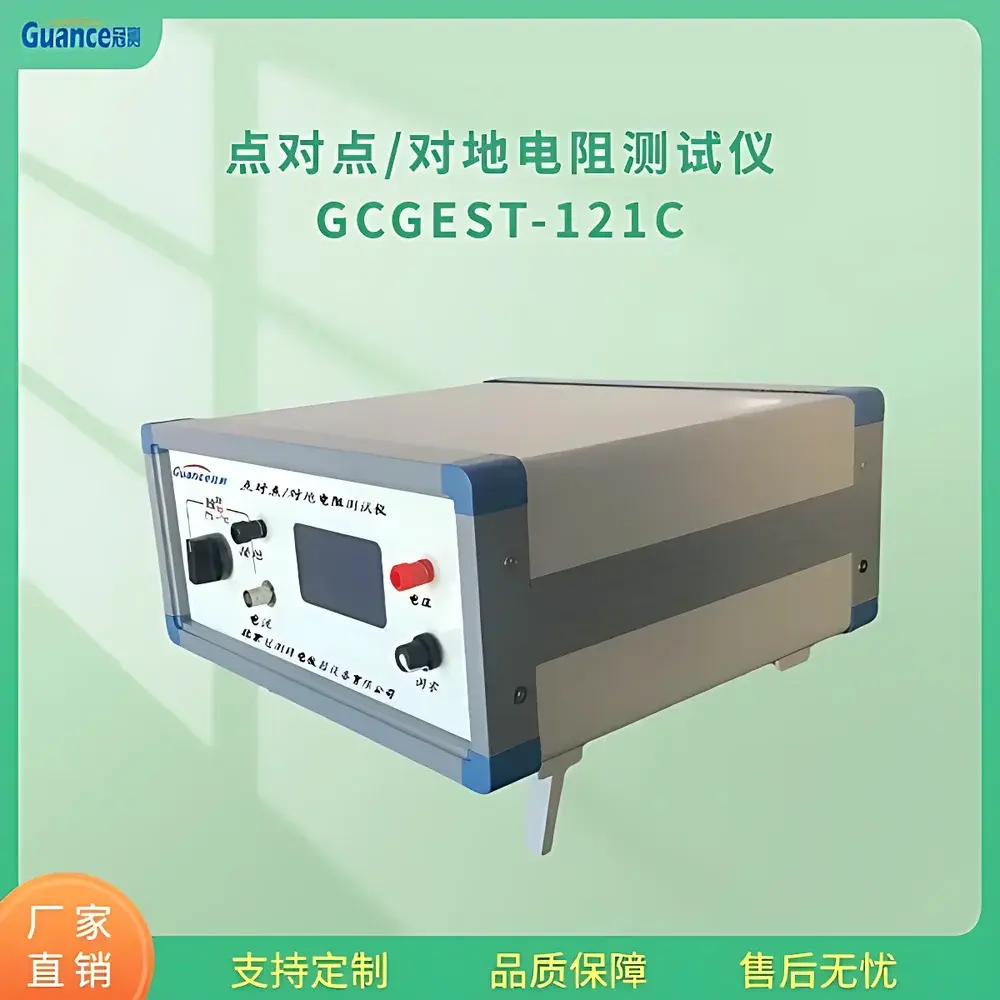

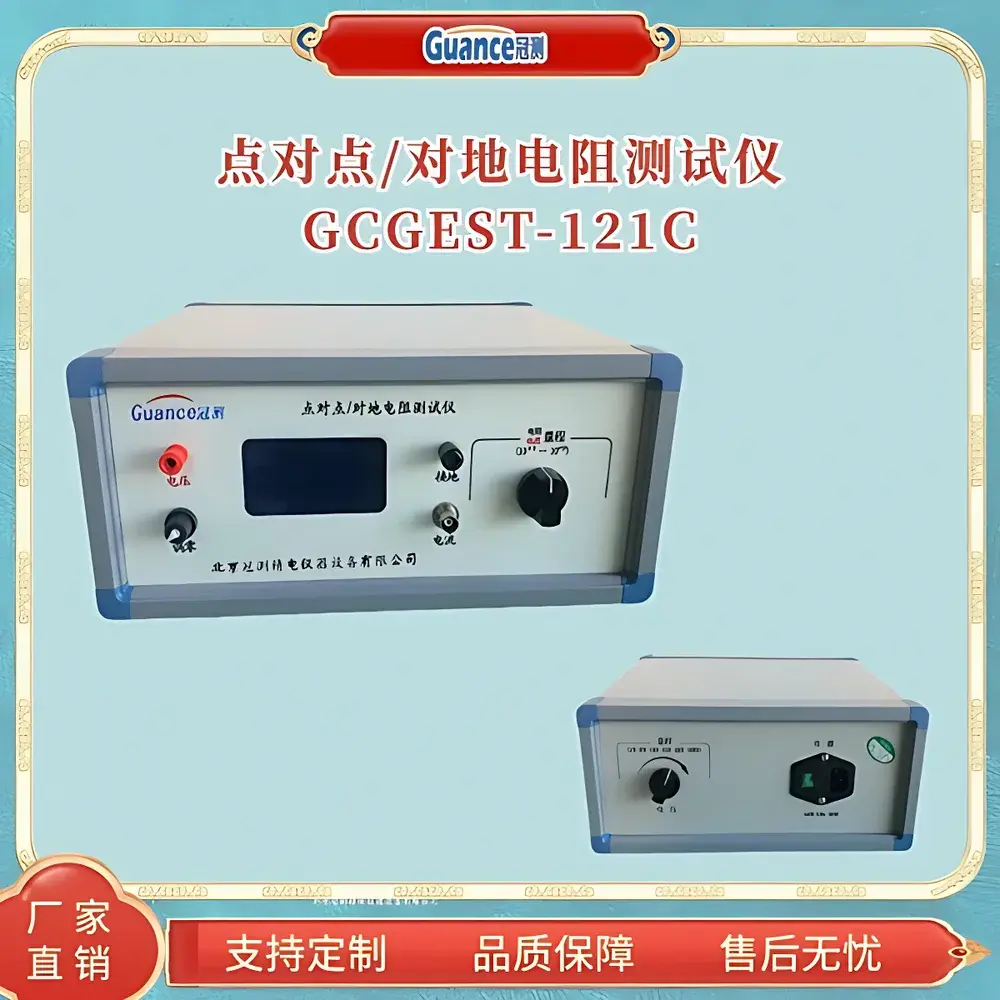
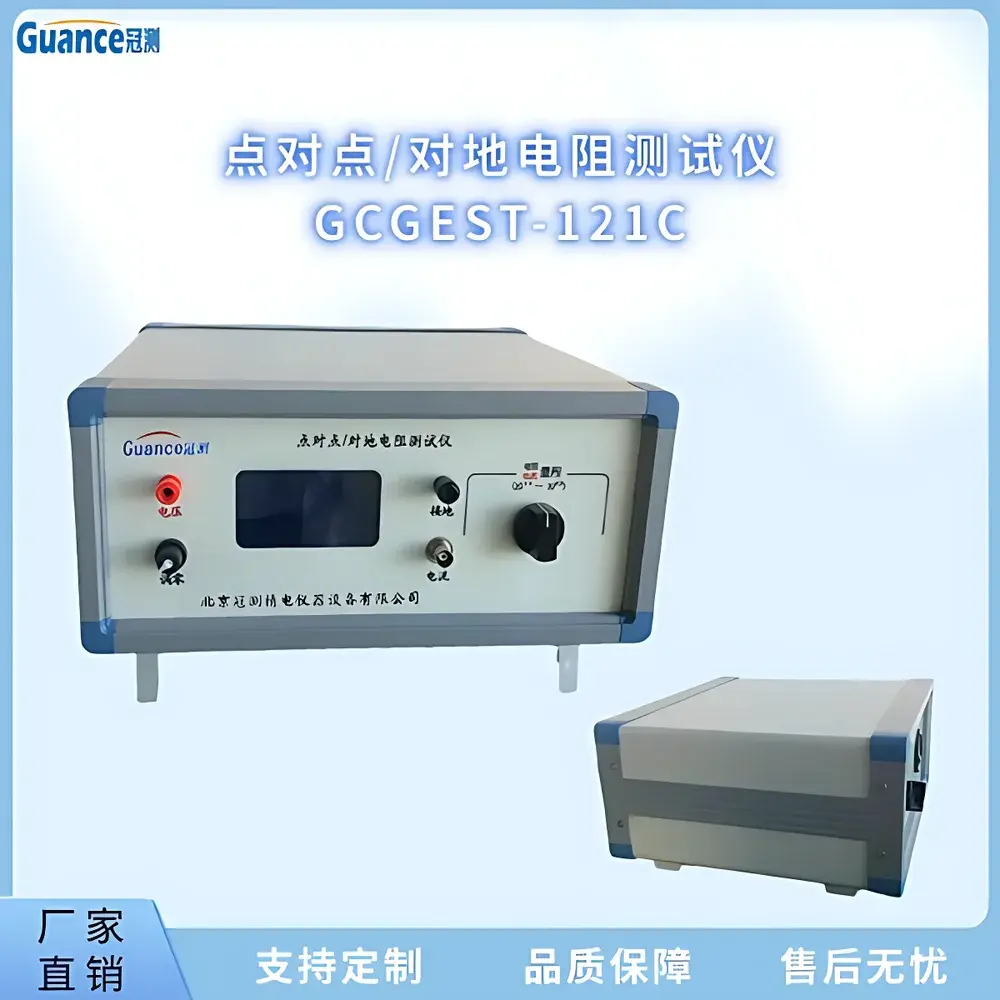
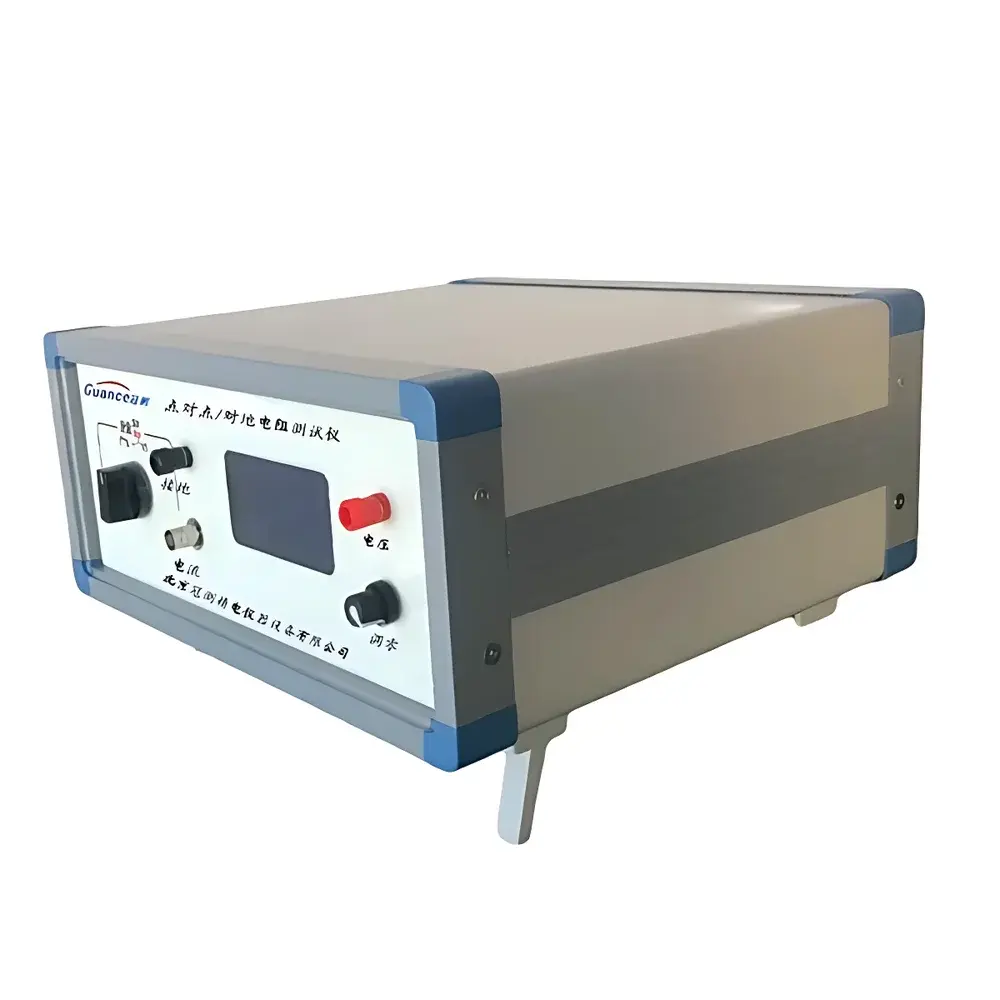
GuanCe Instruments GCGEST-121C Point-to-Point & Ground Resistance Tester for ESD Flooring Materials
| Brand | GuanCe Instruments |
|---|---|
| Origin | Beijing, China |
| Manufacturer Type | Authorized Distributor |
| Country of Origin | Domestic (China) |
| Model | GCGEST-121C+ |
| Pricing | Upon Request |
| Resistance Range | 1×10⁴ Ω to 1×10¹⁸ Ω |
| Current Range | 2×10⁻⁴ A to 1×10⁻¹⁶ A |
| Test Voltages | 10 V, 50 V, 100 V, 250 V, 500 V, 1000 V |
| Accuracy | ±1% (≤1×10¹⁰ Ω), ±5–10% (>1×10¹⁰ Ω) |
| Display | Dual-line LCD (simultaneous V, R, I) |
| Power Supply | 220 V AC / 50 Hz |
| Power Consumption | 100 W |
| Dimensions (L×W×H) | 300 mm × 300 mm × 150 mm |
| Weight | ~5 kg |
| Standard Electrode | 2.5 kg, 63 mm diameter |
| Compliance | SJ/T 11294–2018 Annex A (ESD Floor Coating Testing) |
Overview
The GuanCe Instruments GCGEST-121C Point-to-Point & Ground Resistance Tester is a precision electrometric instrument engineered for quantitative evaluation of electrostatic dissipation performance in conductive and static-dissipative flooring systems—specifically formulated for compliance verification with SJ/T 11294–2018, the Chinese national standard for ESD floor coatings. Unlike conventional high-resistance meters relying on fixed-voltage analog measurement and nonlinear scale interpretation, the GCGEST-121C implements a true four-terminal, real-time dual-parameter acquisition architecture: it simultaneously measures applied test voltage (V) and resulting current (I) across the specimen, then computes resistance (R = V/I) via embedded high-stability analog-to-digital conversion and digital signal processing. This method eliminates scale nonlinearity, mitigates source voltage drift effects, and ensures stable, repeatable readings across its full 14-decade resistance range—from 10⁴ Ω (conductive regime) to 10¹⁸ Ω (insulative regime)—with no manual range scaling or coefficient correction required.
Key Features
- True simultaneous voltage/current measurement architecture enabling direct digital resistance readout across all six selectable test voltages (10 V, 50 V, 100 V, 250 V, 500 V, 1000 V)
- Extended resistance measurement range: 1×10⁴ Ω to 1×10¹⁸ Ω, covering conductive, dissipative, and insulative material classifications per ANSI/ESD S20.20 and IEC 61340-5-1
- Ultra-low current detection capability down to 1×10⁻¹⁶ A, supporting high-impedance characterization of polymer-based floor coatings and underlayment systems
- Dual-line LCD display showing real-time voltage, resistance, and current values without mode switching or manual calculation
- Integrated safety interlock: shielded test chamber automatically de-energizes upon lid opening, meeting Class I electrical safety requirements per GB 4793.1–2007 (equivalent to IEC 61010-1)
- Compact benchtop form factor (300 × 300 × 150 mm) with ergonomic electrode handling—standard 63 mm diameter, 2.5 kg stainless-steel electrodes conforming to SJ/T 11294–2018 Annex A geometry specifications
Sample Compatibility & Compliance
The GCGEST-121C is validated for testing cured epoxy, polyurethane, and conductive cementitious floor coatings, as well as finished installations including personnel grounding paths (shoe/floor/ground system resistance) and human body voltage decay assessment. Its electrode configuration and test protocol align explicitly with SJ/T 11294–2018 Annex A “Electrostatic Performance Test Methods” for point-to-point resistance (Rtt), point-to-ground resistance (Rtg), and system resistance (Rsg). While not certified to ISO/IEC 17025, the instrument supports laboratory quality management systems requiring documented traceability: all test parameters (voltage, integration time, electrode pressure, ambient temperature/humidity logging) are manually recordable for GLP-compliant reporting. It is routinely deployed in QC labs serving semiconductor cleanroom contractors, pharmaceutical facility builders, and data center infrastructure providers where adherence to ESD control plans per ANSI/ESD S20.20 or IEC 61340-5-1 is mandatory.
Software & Data Management
The GCGEST-121C operates as a standalone hardware platform with no bundled PC software or USB connectivity. All measurement data must be recorded manually or integrated into existing LIMS/QMS workflows via operator transcription. However, its deterministic digital output, stable zero-drift baseline (<0.5% 24-hour drift at 100 V), and consistent repeatability (±0.8% RSD for repeated Rtg measurements on identical epoxy samples) enable robust audit readiness. Laboratories implementing FDA 21 CFR Part 11 or ISO 13485 may augment this unit with external electronic notebooks or validated spreadsheet templates to satisfy electronic record integrity requirements—including user authentication, change tracking, and timestamped result archiving.
Applications
- Pre-installation qualification of ESD floor coating batches per SJ/T 11294–2018 Clause 5.3
- Post-cure verification of surface resistivity and volume resistivity on installed floors
- Validation of grounding continuity between floor, grounding grid, and building earth reference
- Periodic maintenance auditing of ESD-safe workstations in electronics assembly and microfabrication environments
- Root-cause analysis of charge retention anomalies in controlled environments (e.g., persistent static shocks despite grounding)
- Supporting ISO 14644-1 classified cleanroom commissioning reports requiring ESD parameter documentation
FAQ
Does the GCGEST-121C support automated data export or RS-232/USB communication?
No. The instrument provides only local LCD readout and requires manual data recording.
Can it measure surface resistivity (ρs) directly, or is conversion required?
It measures resistance (ohms); surface resistivity (Ω/sq) requires geometric correction using electrode spacing and diameter per SJ/T 11294–2018 Annex A equations.
Is calibration traceable to national standards?
The unit ships with a manufacturer’s calibration certificate; end-user labs must establish internal calibration against NIST-traceable high-resistance standards (e.g., Keysight B2987A) per their QMS schedule.
What environmental conditions affect measurement accuracy?
Relative humidity below 30% RH or above 70% RH, and temperatures outside 15–30°C, may alter coating conductivity—SJ/T 11294–2018 mandates conditioning at 23±2°C / 50±5% RH for 24 hours prior to testing.
How frequently should electrode cleaning and contact verification be performed?
Electrodes must be cleaned with isopropyl alcohol before each test series, and contact resistance verified daily using a short-circuit jig to ensure <1 Ω inter-electrode path integrity.



