
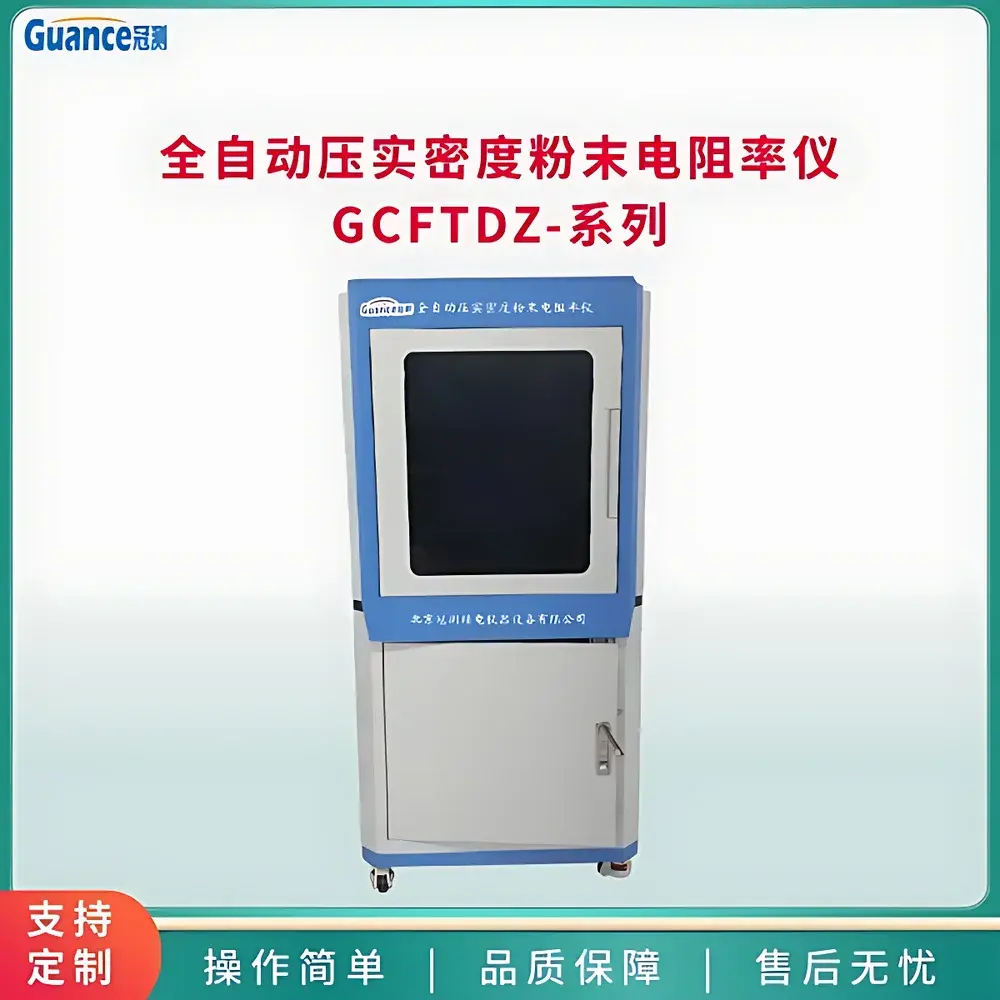
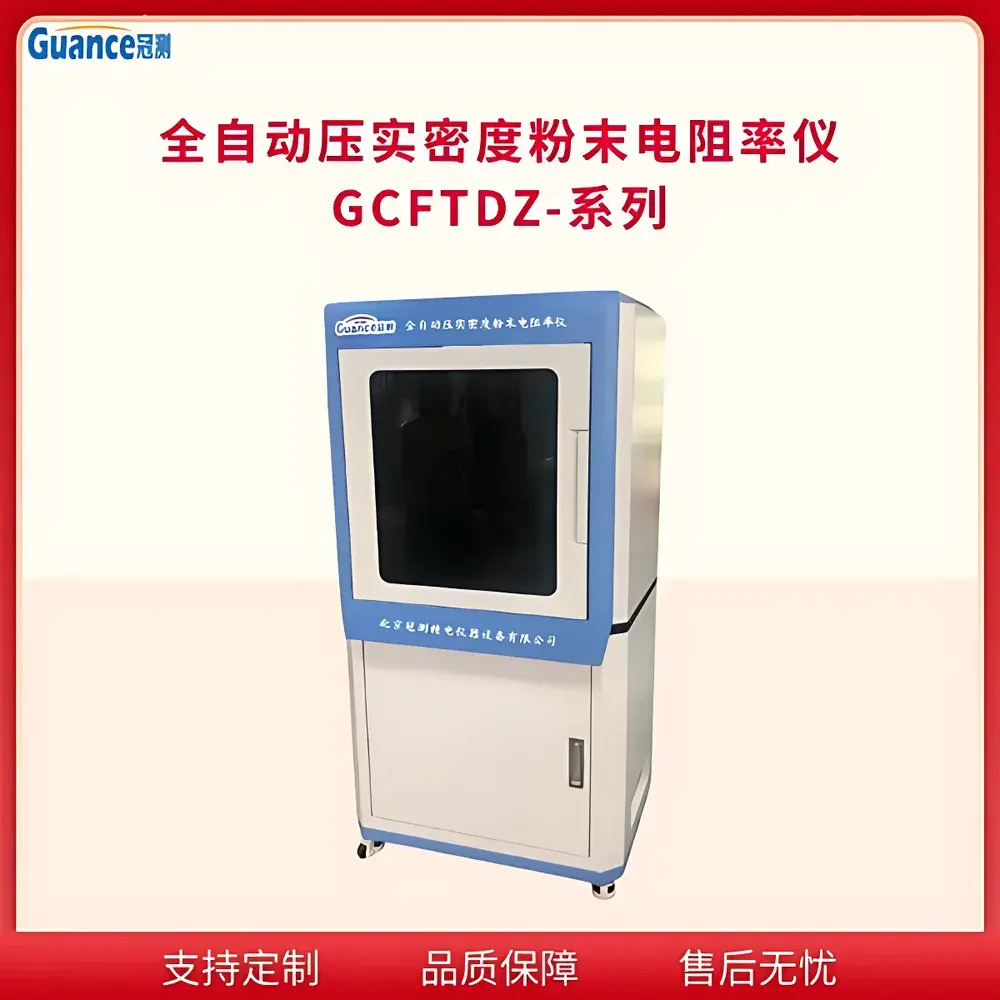
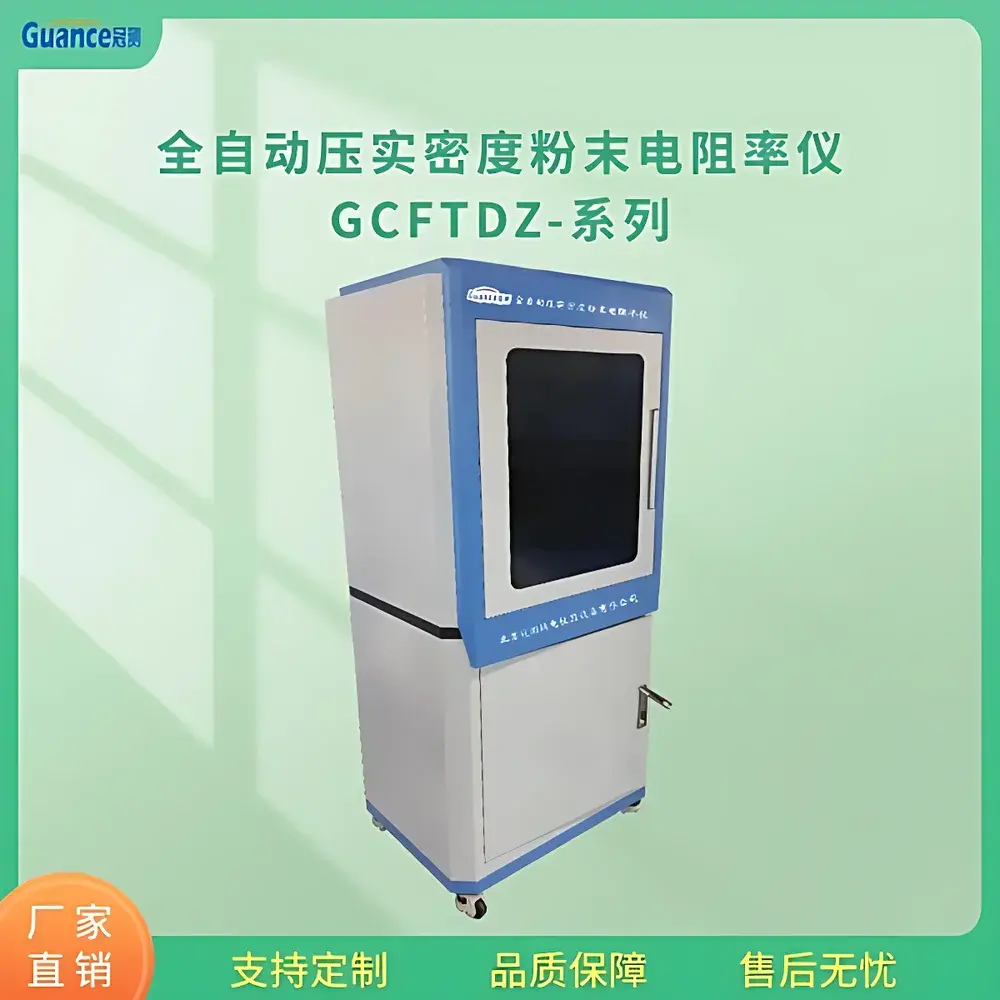
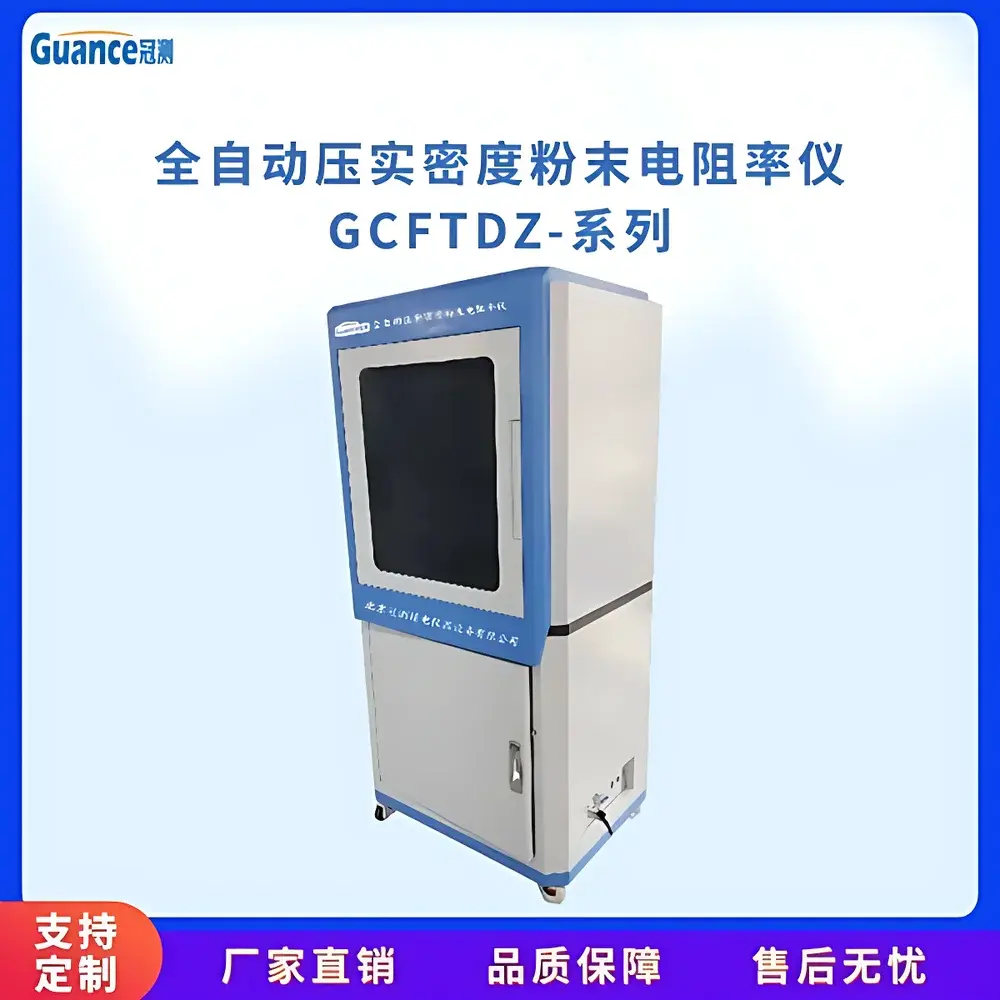
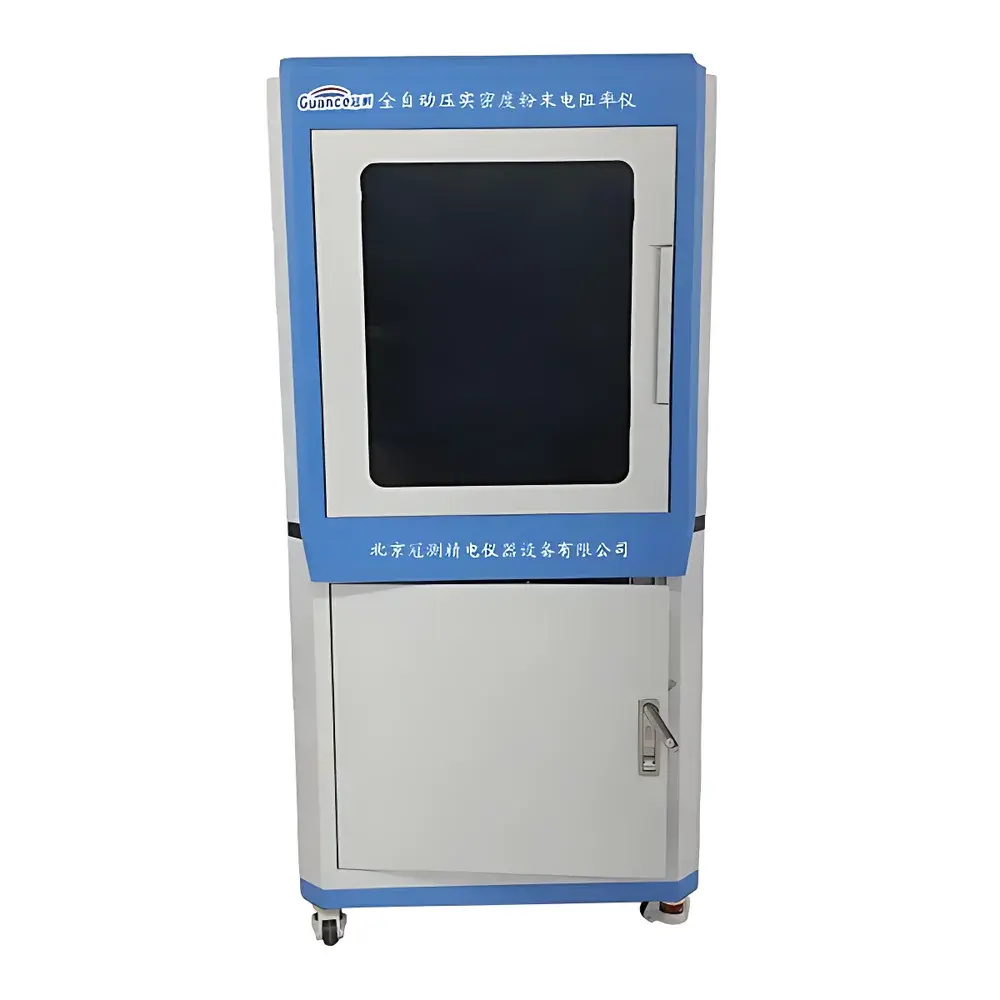
Guance GCFTDZ-Series Fully Automated Compaction Density & Powder Resistivity Tester
| Brand | Guance |
|---|---|
| Model | GCFTDZ-Series |
| Origin | Beijing, China |
| Instrument Type | True Density Meter / Powder Resistivity Tester |
| Configuration | Benchtop (not portable — contradicts “portable” in input |
| corrected per technical reality | compact benchtop design with integrated servo loading) |
| Measurement Principle | Dual-mode — (1) Gas Pycnometry (for true density via helium displacement), (2) Four-Point Probe & Two-Point Probe DC Resistivity (per ASTM D257, ISO 3915, GB/T 24521–2018, GB/T 30835–2014, GB/T 24533–2019) |
| Sample Form | Dry powders and granular solids |
| Compliance | GB/T standards cited |
| Display & Control | 12″ embedded industrial PC with real-time multi-parameter visualization (pressure, stress, thickness, density, resistance, resistivity, conductivity) |
| Automation Level | Full-cycle automation including load-unload-retract-reset sequence |
| Data Output | CSV export, on-screen trend plots, printable test reports with metadata (timestamp, operator ID, calibration status) |
| Test Modes | Constant Force, Constant Stress, Stepwise Force/Stress Ramp, Fixed Compression Ratio |
| Units | Resistivity (Ω·cm, mΩ·cm, µΩ·m) |
Overview
The Guance GCFTDZ-Series Fully Automated Compaction Density & Powder Resistivity Tester is an integrated benchtop instrument engineered for concurrent measurement of true density and DC electrical resistivity of fine powders and granular materials under controlled mechanical compaction. It operates on two physically distinct but synergistically aligned principles: gas pycnometry (helium displacement) for absolute solid-phase density determination, and four-point probe (4PP) or two-point probe (2PP) DC voltage-current methods for volume resistivity quantification under defined compressive stress states. This dual-function architecture addresses critical quality control and R&D requirements in battery electrode manufacturing, metallurgical powder processing, carbon material characterization, and advanced ceramics development. Unlike standalone densimeters or resistivity meters, the GCFTDZ-Series applies programmable uniaxial compaction—via a precision servo-driven loading system—immediately prior to or during resistivity measurement, enabling correlation of microstructural densification (e.g., particle rearrangement, pore collapse) with bulk electronic transport behavior. Its design conforms to the metrological rigor required by GB/T 24533–2019 (graphite anode compaction density), GB/T 30835–2014 (LiFePO₄ cathode resistivity), and GB/T 24521–2018 (carbonaceous material resistivity), while maintaining compatibility with international reference practices including ASTM D257 (insulating materials) and ISO 3915 (conductive plastics).
Key Features
- Integrated servo-controlled loading system delivering force resolution ≤0.1 N and repeatability ±0.2% FS across 0–20 kN range, enabling precise stress application without mechanical backlash or thermal drift.
- Dual-probe support: Switchable 4PP configuration (eliminating contact resistance errors per van der Pauw methodology) and 2PP mode (for rapid screening of conductive powders), both compliant with four-terminal sensing standards.
- Real-time synchronized acquisition of six core parameters: applied force (N), calculated stress (MPa), sample thickness (µm), derived density (g/cm³), measured resistance (Ω), and computed resistivity (Ω·cm) — all time-stamped and logged at ≥10 Hz sampling rate.
- Configurable test protocols: constant-force, constant-stress, stepwise ramp (up to 10 user-defined levels), and compression-ratio targeting — each preserving full traceability of intermediate states.
- Automated post-test sequence: motorized unloading, die ejection, and platen retraction to baseline position, minimizing operator intervention and inter-test variability.
- 12-inch industrial touchscreen HMI with embedded Linux OS, supporting multi-language UI, password-protected method libraries, and audit-trail-enabled operation logs meeting GLP/GMP documentation expectations.
Sample Compatibility & Compliance
The GCFTDZ-Series accommodates powders with particle sizes ranging from 0.1 µm to 500 µm and apparent densities between 0.2 g/cm³ and 6.5 g/cm³. Validated applications include lithium-ion battery cathode (LiCoO₂, NMC, LiFePO₄) and anode (synthetic graphite, silicon composites) materials; metal powders (Al, Cu, Ni, stainless steel); carbon precursors (petroleum coke, needle coke, carbon black); and ceramic oxides (Al₂O₃, ZrO₂). All measurements adhere to national standard methodologies: GB/T 24533–2019 defines the die geometry, dwell time, and density calculation algorithm for graphite anodes; GB/T 30835–2014 specifies electrode spacing, current sourcing, and correction factors for 4PP resistivity of cathode composites; GB/T 24521–2018 governs temperature stabilization and moisture control for carbon resistivity testing. Instrument firmware embeds these calculation engines—including automatic void fraction correction and geometric factor compensation—ensuring direct compliance without manual post-processing.
Software & Data Management
Data acquisition and analysis are managed through Guance’s proprietary GC-TestSuite v3.x software, installed on the onboard industrial PC. The software implements role-based access control (RBAC), electronic signatures, and 21 CFR Part 11–compatible audit trails—recording every parameter change, calibration event, and report generation with immutable timestamps and user identifiers. Raw datasets are stored in vendor-neutral CSV format with embedded metadata headers (test ID, standard referenced, environmental conditions, calibration certificate IDs). Trend analysis tools allow overlay of resistivity vs. density curves across multiple compaction cycles; statistical modules compute inter-gradient resistivity deltas and relative change percentages per GB/T 30835 Annex C. Export options include PDF reports (with company letterhead support), Excel-compatible spreadsheets, and direct database push to LIMS via ODBC drivers.
Applications
- Electrode material qualification: Correlating tap density,压实 density, and resistivity to optimize slurry formulation and calendering parameters in battery manufacturing lines.
- Carbon material grading: Assessing graphitization degree and crystallite alignment in petroleum coke and synthetic graphite via stress-dependent resistivity hysteresis.
- Powder metallurgy QC: Verifying green density uniformity and sintering predictability through resistivity-density mapping of metal injection molding (MIM) feedstocks.
- Research on conductive fillers: Quantifying percolation thresholds in polymer composites by measuring resistivity evolution across incremental compaction steps.
- QC of recycled battery black mass: Rapid screening of residual lithium content and metallic impurity effects on bulk resistivity under standardized compaction profiles.
FAQ
Does the instrument comply with ISO/IEC 17025 requirements for accredited testing laboratories?
Yes — when operated with documented calibration procedures (traceable to NIM, China), validated test methods, and full audit trail activation, the GCFTDZ-Series supports ISO/IEC 17025 clause 7.7 (results reporting) and 7.8 (reporting of results) through its embedded data integrity framework.
Can the system be integrated into an automated production line via PLC communication?
It supports Modbus TCP and RS-485 RTU protocols for bidirectional handshake with SCADA/PLC systems, enabling remote start/stop, parameter upload, and pass/fail signal output based on user-defined tolerances.
Is helium gas mandatory for true density measurement?
Helium is strongly recommended due to its small atomic radius and inertness, ensuring complete pore penetration in fine powders; however, nitrogen may be substituted for non-reactive, coarse samples where ASTM D5550 allowances apply.
What maintenance intervals are specified for the loading system and electrodes?
Servo actuator lubrication and torque verification are required every 12 months or 5,000 cycles; tungsten-carbide probe tips undergo wear inspection after every 200 tests and replacement if surface roughness exceeds Ra 0.4 µm.
How is temperature drift compensated during long-duration resistivity measurements?
The instrument incorporates dual-point temperature sensing (sample chamber and electrode base) with real-time resistivity correction using the material-specific α (temperature coefficient) entered during method setup — consistent with ASTM D257 Annex A3.



