
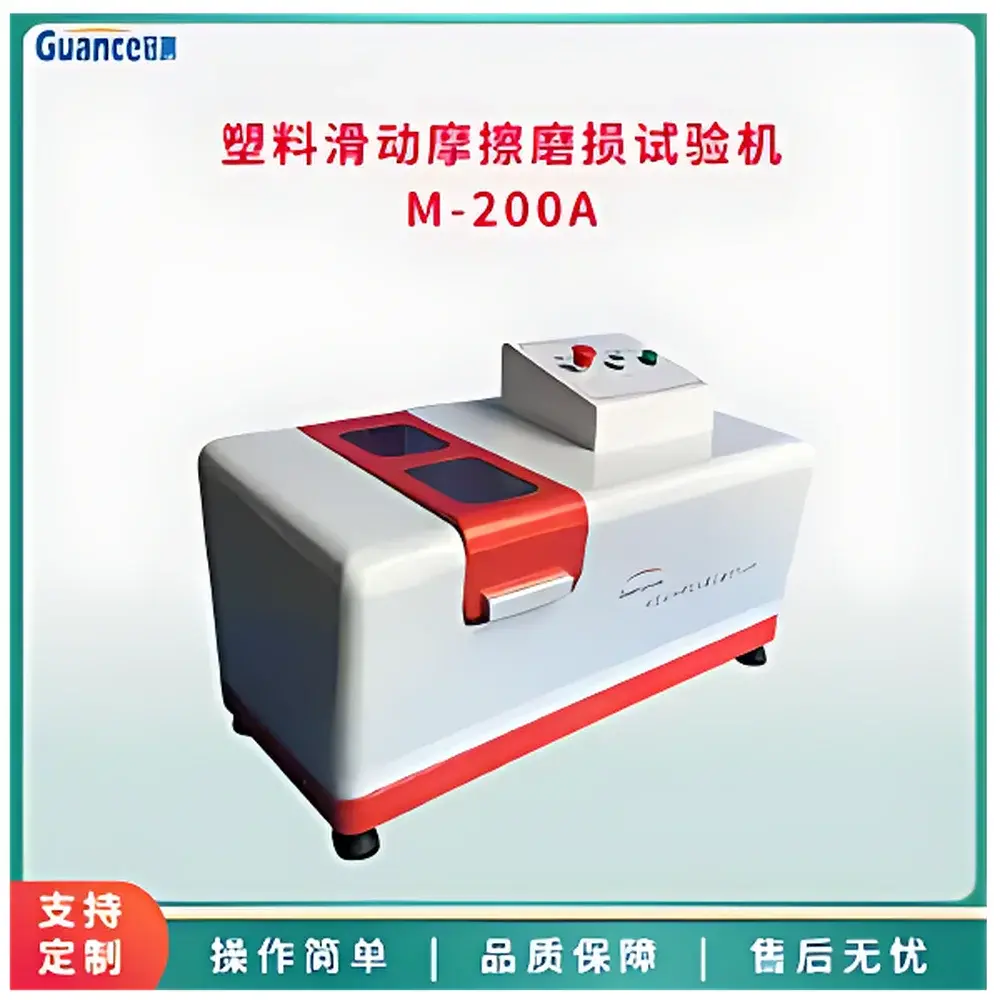
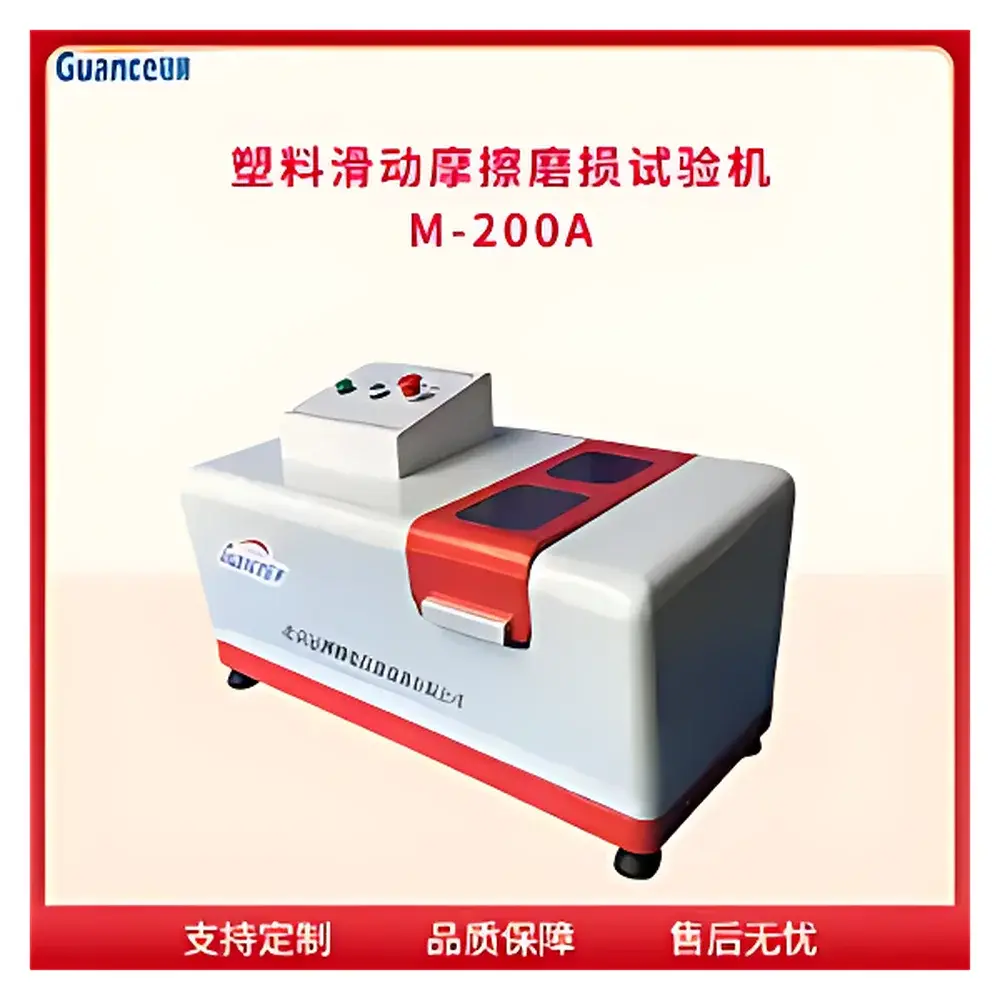
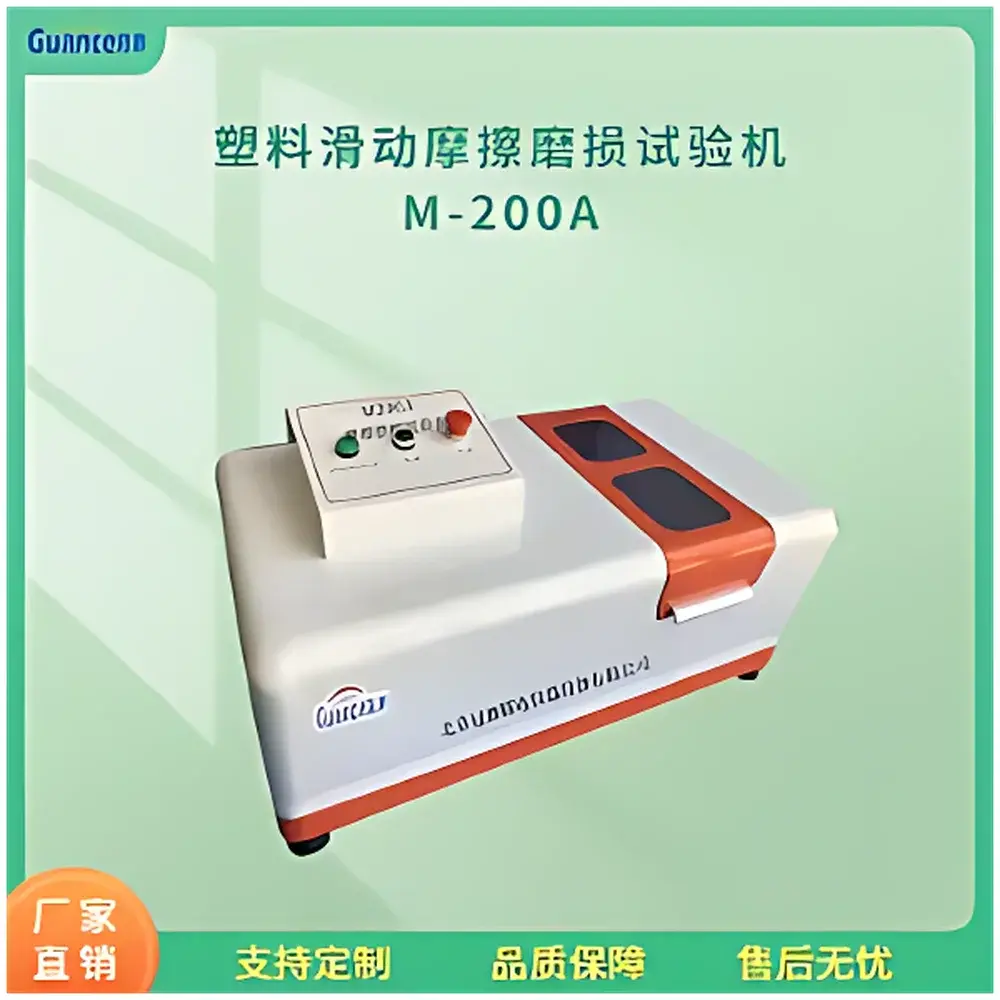
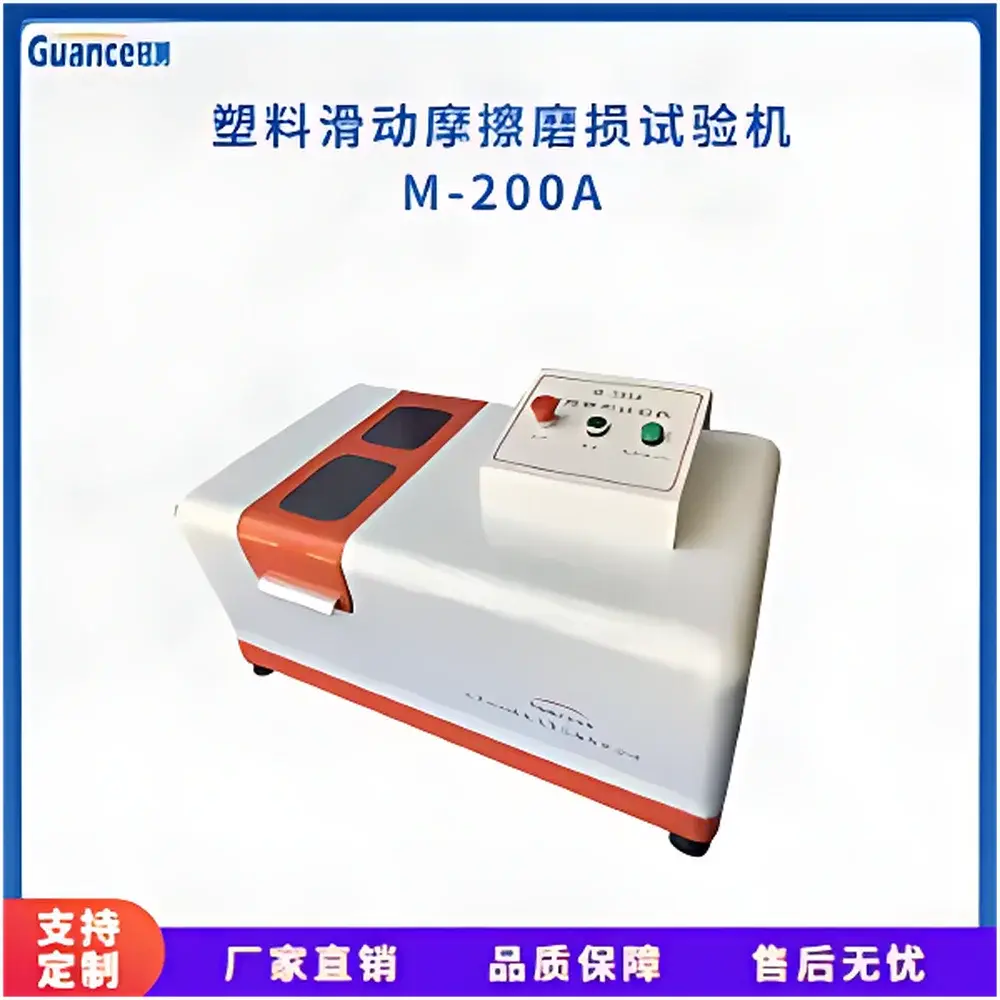
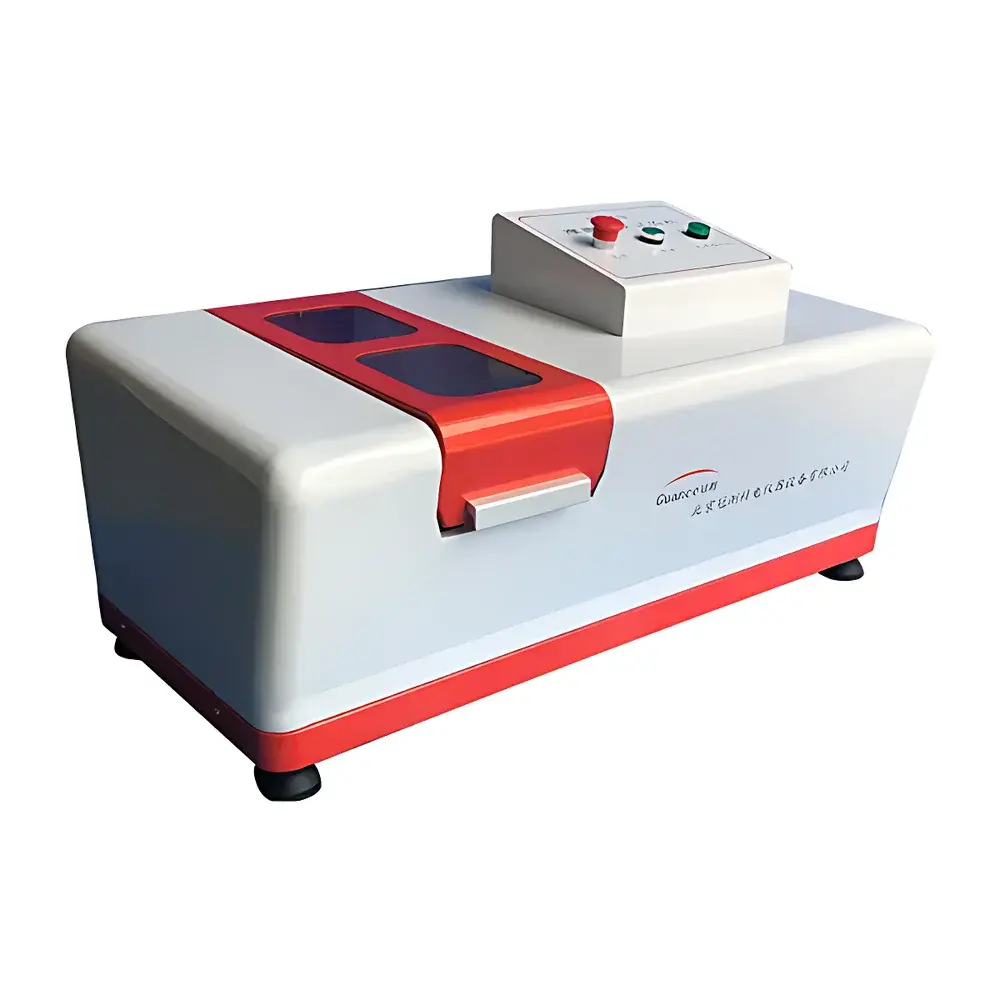
GuanCe Instruments M-200 Sliding Friction and Wear Tester
| Brand | GuanCe Instruments |
|---|---|
| Origin | Beijing, China |
| Model | M-200 |
| Instrument Type | Coefficient of Friction Tester |
| Maximum Friction Torque | 0–4 N·m |
| Friction Torque Resolution | 1% FS |
| Load Capacity | 196 N (±0.1%, upgradable to 392 N) |
| Rotational Speed Range | 0–200 rpm (adjustable) |
| Specimen Dimensions | 30 mm × 7 mm × 6 mm |
| Friction Counter Accuracy | ±1 s |
| Load Accuracy | ±0.5% |
| Speed Accuracy | ±1% |
| Torque Measurement Accuracy | ±1% FS |
| Friction Ring | Ø40 mm × 10 mm, 45# steel, hardened to HRC 40–45, surface roughness Ra ≤ 3.2 µm, concentricity < 0.01 mm |
| Operating Temperature Range | Ambient to 80 °C |
Overview
The GuanCe Instruments M-200 Sliding Friction and Wear Tester is a microcomputer-controlled tribological testing system engineered for precise evaluation of sliding friction behavior and wear resistance in polymeric, elastomeric, graphite-based, and composite materials. It operates on the principle of controlled rotary sliding contact between a standardized flat specimen and a rotating cylindrical counterface (friction ring), enabling quantitative measurement of dynamic friction torque, coefficient of friction (COF), and cumulative wear under defined normal load, speed, and environmental conditions. Designed in strict accordance with GB/T 3960–1983 (Plastic Sliding Friction and Wear Test Method) and GB/T 9141.8–1999 (Sliding Friction Coefficient Test for Flexible Graphite Sheets), the M-200 supports standardized, repeatable, and traceable tribological characterization required for R&D validation, quality assurance, and regulatory documentation in materials science laboratories.
Key Features
- Microprocessor-based closed-loop control system with real-time data acquisition and synchronized display of torque, time, rotational speed, and cumulative test cycles
- Adjustable rotational speed range from 0 to 200 rpm with ±1% speed accuracy and programmable dwell/timing profiles
- Precision mechanical loading system supporting nominal 196 N (20 kgf) load with ±0.5% accuracy; extendable to 392 N (40 kgf) via modular weight stacking (1 × 4 kg + 4 × 1 kg calibrated masses)
- High-stiffness friction ring assembly: Ø40 mm × 10 mm, manufactured from quenched & tempered 45# steel (HRC 40–45), ground to concentricity < 0.01 mm and surface finish Ra ≤ 3.2 µm (equivalent to ▽8)
- Digital torque transducer with full-scale range of 0–4 N·m and ±1% FS linearity and repeatability
- Integrated color thermal printer for immediate generation of compliant test reports—including time-torque curves, tabulated COF values, wear volume estimates, and metadata (test date, operator ID, specimen ID, standard reference)
- Intuitive Windows-compatible software interface supporting user-defined test protocols, multi-step load/speed sequences, and automatic pass/fail flagging against preset COF or wear thresholds
Sample Compatibility & Compliance
The M-200 accommodates rectangular specimens measuring 30 mm × 7 mm × 6 mm—optimized for rigid thermoplastics (e.g., POM, PA6, PTFE), vulcanized rubbers (NR, SBR, EPDM), flexible graphite sheets, and fiber-reinforced composites. Its mechanical architecture ensures consistent contact geometry and minimal edge effects during sliding. The system satisfies essential metrological requirements for ISO/IEC 17025-accredited testing laboratories and aligns with methodological frameworks referenced in ASTM D3702 (Standard Test Method for Coefficient of Friction of Plastics), ASTM G99 (Standard Test Method for Wear Testing with a Pin-on-Disk Apparatus), and ISO 8295 (Plastics — Determination of the Coefficient of Friction). While not inherently GLP/GMP-certified, its audit-ready data logging—complete with operator timestamps, parameter change logs, and electronic signature fields—facilitates integration into FDA 21 CFR Part 11-compliant workflows when deployed with validated software and procedural controls.
Software & Data Management
The embedded control software provides dual-mode operation: manual single-run mode for rapid screening and automated batch mode for unattended multi-specimen testing. All raw sensor outputs (torque, rotation count, elapsed time) are sampled at ≥10 Hz and stored with millisecond timestamp resolution. Export formats include CSV (for statistical analysis in MATLAB, JMP, or Minitab) and PDF (with embedded graphics and compliance headers). Audit trails record every parameter modification, calibration event, and report generation action—including user login ID and system clock synchronization status. Optional firmware upgrades support enhanced data encryption and networked instrument monitoring via Ethernet or RS-232 interfaces.
Applications
- Comparative assessment of lubricant additives in polymer matrices under dry or boundary-lubricated sliding conditions
- Screening of wear-resistant fillers (e.g., MoS₂, graphene, aramid fibers) in thermoplastic composites
- Quality control of graphite sealing gaskets per GB/T 9141 series specifications
- Validation of tribological performance for medical-grade polymers (e.g., UHMWPE acetabular liners) under simulated physiological loads
- Accelerated aging studies correlating COF drift and mass loss with thermal exposure up to 80 °C
- Supporting failure analysis of automotive bushings, conveyor rollers, and gear housing materials
FAQ
What standards does the M-200 directly support?
It is fully configured to execute GB/T 3960–1983 and GB/T 9141.8–1999. With minor fixture adaptation, it can also implement ASTM D3702, ASTM G99, and ISO 8295 methodologies.
Can the M-200 operate above ambient temperature?
Yes—the chamber and drive assembly are rated for continuous operation up to 80 °C. For elevated-temperature testing beyond this limit, external environmental chambers must be integrated.
Is the torque transducer factory-calibrated?
All units ship with NIST-traceable calibration certificates covering the full 0–4 N·m range. Annual recalibration is recommended per ISO/IEC 17025 guidelines.
Does the system support automated wear depth measurement?
No—wear volume is derived indirectly from mass loss (via analytical balance) or dimensional change (via optical profilometry post-test). The M-200 does not include in situ profilometry or laser displacement sensors.
What maintenance intervals are advised?
Lubrication of the main shaft bearing and inspection of friction ring surface integrity are recommended every 200 operational hours. Load cell zero-point verification should be performed before each test session.



