
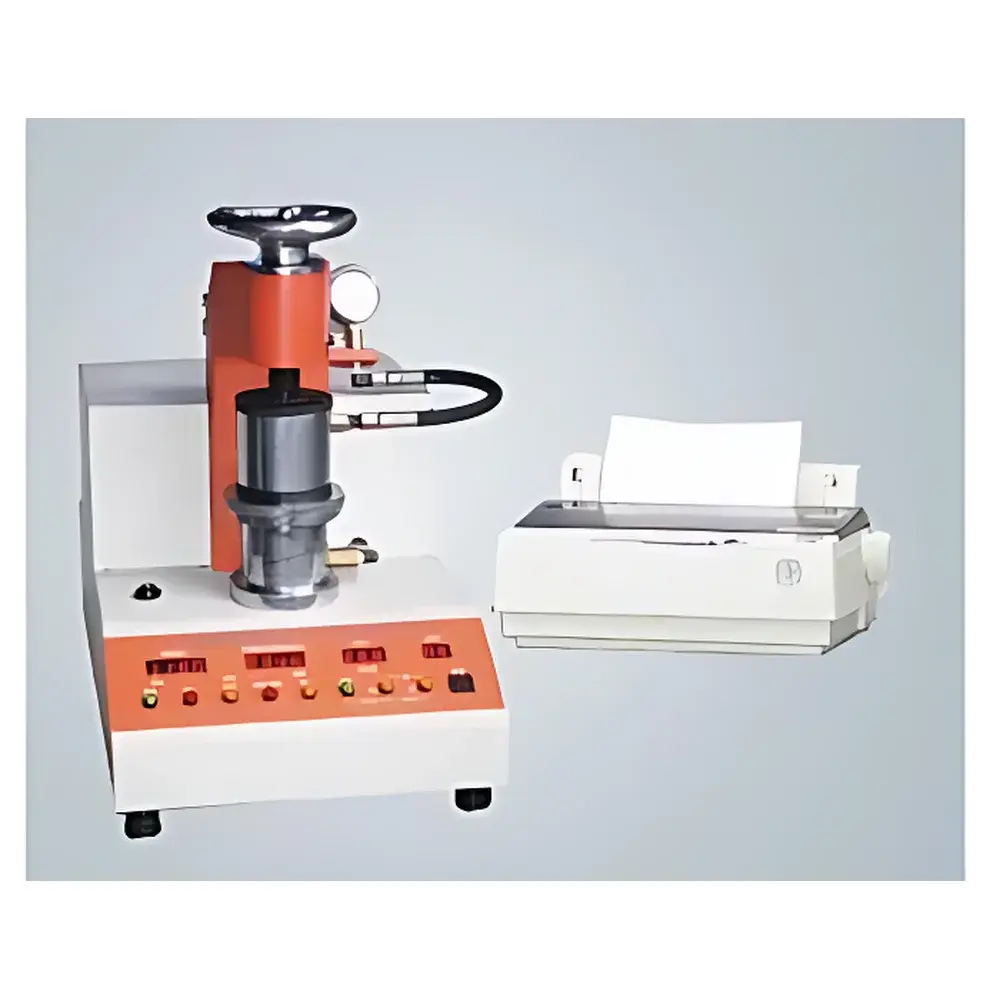
Fangyuan YG032D Digital Fabric Burst Strength Tester
| Brand | Fangyuan |
|---|---|
| Model | YG032D |
| Sample Clamp Inner Diameter | φ30.5 ± 0.05 mm |
| Diaphragm Outer Diameter | φ80 × 0.9 ± 1 mm |
| Burst Strength Range | 0–6 MPa |
| Burst Strength Resolution | 0.002 MPa |
| Burst Strength Accuracy | ≤ ±1% |
| Expansion Distance Range | 0.1–35 mm |
| Expansion Distance Accuracy | ±0.1 mm |
| Burst Time Range | 0.1–99.9 s |
| Hydraulic Pressure Rate | 10–150 mL/min |
| Hydraulic Fluid | 85% glycerol (glycerin) |
| Power Supply | AC 220 V, 50 Hz, 500 W |
| Dimensions (L×W×H) | 525 × 280 × 590 mm |
| Weight | ~50 kg |
Overview
The Fangyuan YG032D Digital Fabric Burst Strength Tester is a precision hydraulic pressure-based instrument engineered for the quantitative evaluation of burst resistance and expansion displacement in planar flexible materials. It operates on the diaphragm bulge method—where a standardized circular specimen is clamped over an elastic rubber diaphragm, and hydraulic pressure is applied beneath the diaphragm until specimen rupture occurs. The system continuously records both the peak bursting pressure (in MPa) and the corresponding radial expansion distance (in mm) at failure, enabling full compliance with internationally recognized textile mechanical testing protocols. Designed for laboratory-grade repeatability and long-term stability, the YG032D meets the physical and metrological requirements of GB/T 7742–1987, FZ/T 60019–1994 (Method A), FZ/T 01030 (Method B), ASTM D3786–2001, and JIS L 1018.6.17—making it suitable for quality control laboratories, R&D centers, and third-party certification facilities operating under ISO/IEC 17025 or GMP-aligned textile testing workflows.
Key Features
- Industrial-grade 16-bit microcontroller (Mitsubishi architecture) ensures deterministic real-time control, electromagnetic noise immunity, and stable signal acquisition across extended test cycles.
- Precision-machined sample holder with fixed inner clamp diameter of φ30.5 ± 0.05 mm—strictly aligned to ISO and ASTM specimen area specifications for consistent stress distribution.
- Imported high-elasticity nitrile rubber diaphragms (φ80 × 0.9 ± 1 mm) rated for ≥50 valid burst cycles per membrane, minimizing inter-test variability and consumable cost.
- Dual-parameter digital measurement: simultaneous capture of burst pressure (0–6 MPa, resolution 0.002 MPa, accuracy ≤±1%) and expansion displacement (0.1–35 mm, resolution 0.1 mm).
- Adjustable hydraulic pressurization rate (10–150 mL/min) enables method-specific ramp profiles—critical for comparative studies across fiber composition, weave architecture, and finishing treatments.
- Integrated thermal-stable glycerol (85% aqueous solution) hydraulic medium eliminates air entrainment, vapor lock, and viscosity drift across ambient temperature ranges (10–30°C).
- Onboard thermal printer (PT-MT300K) provides immediate hard-copy output of test reports—including date/time stamp, operator ID, sample ID, burst pressure, expansion distance, and burst time—supporting GLP documentation practices.
Sample Compatibility & Compliance
The YG032D accommodates woven fabrics, knits, nonwovens, coated textiles, technical geotextiles, synthetic leathers, and paper-based laminates—provided specimens meet minimum tensile integrity thresholds to prevent slippage or premature edge failure. All test configurations adhere to the geometric and procedural constraints defined in GB/T 7742–1987 (equivalent to ISO 13938-1), ASTM D3786–2001 (Standard Test Method for Bursting Strength of Textiles—Diaphragm Method), and JIS L 1018.6.17. For regulatory submissions, raw data files and printed reports are traceable to instrument serial number, calibration certificate (valid per ISO 9001 internal audit schedule), and user-defined test parameters—enabling alignment with FDA 21 CFR Part 11 electronic record requirements when paired with secure lab network storage.
Software & Data Management
While the YG032D operates as a standalone benchtop instrument with embedded firmware, its analog/digital hybrid architecture supports optional RS-232 or USB-to-serial interface modules (sold separately) for integration into centralized LIMS environments. Exported ASCII-formatted data includes timestamped columns for pressure (MPa), displacement (mm), elapsed time (s), and status flags (e.g., “rupture_detected”, “diaphragm_limit_exceeded”). Calibration coefficients are stored in non-volatile memory and require password-protected access for modification—ensuring audit trail integrity during ISO 17025 accreditation audits.
Applications
- Quality assurance of apparel and home textile fabrics against contractual burst strength thresholds (e.g., >2.5 MPa for outerwear membranes).
- Evaluation of hydroentangled nonwovens used in medical gowns and surgical drapes per ASTM F1670/F1671 barrier performance correlation studies.
- Comparative analysis of coating adhesion durability in laminated technical textiles under cyclic hydraulic loading.
- Validation of seam integrity in stretch-knit activewear using Method B (membrane-supported top-break configuration) per FZ/T 01030.
- Pre-certification testing for OEKO-TEX® Standard 100 Class II and III product categories where mechanical robustness directly impacts chemical migration risk.
FAQ
What hydraulic fluid is required, and why is 85% glycerol specified?
The instrument requires aqueous glycerol (85% v/v) to ensure optimal viscosity-temperature stability (dynamic viscosity ≈ 500–600 cP at 23°C), low vapor pressure, and non-corrosive compatibility with stainless steel and nitrile components. Higher concentrations risk crystallization; lower concentrations increase compressibility and measurement hysteresis.
Is periodic calibration mandatory, and what standards apply?
Yes. Annual calibration against NIST-traceable dead-weight pressure standards (Class 0.1 or better) is recommended per ISO/IEC 17025 Clause 6.5. Calibration certificates must document zero-point drift, linearity deviation across 0–6 MPa, and diaphragm deflection repeatability at 10%, 50%, and 90% FS.
Can the YG032D be used for wet-state testing?
Yes—provided specimens are preconditioned per ISO 139 (standard atmosphere: 20°C ± 2°C, 65% RH ± 4%) and tested within 30 minutes of removal from conditioning chamber. Wet-state protocols require separate diaphragm validation per ASTM D5034 Annex A1.
Does the instrument support automated pass/fail judgment based on user-defined limits?
No—the YG032D outputs raw measurement values only. Pass/fail logic must be implemented externally via spreadsheet templates or LIMS rule engines using exported ASCII data.
What maintenance intervals are recommended for the rubber diaphragm and hydraulic system?
Diaphragms should be inspected visually before each test series for microcracks or permanent set; replacement is mandatory after 50 bursts or upon any visible deformation. Hydraulic fluid must be replaced every 12 months or after 500 test cycles, with full system purge and vacuum-degassing prior to refill.





