
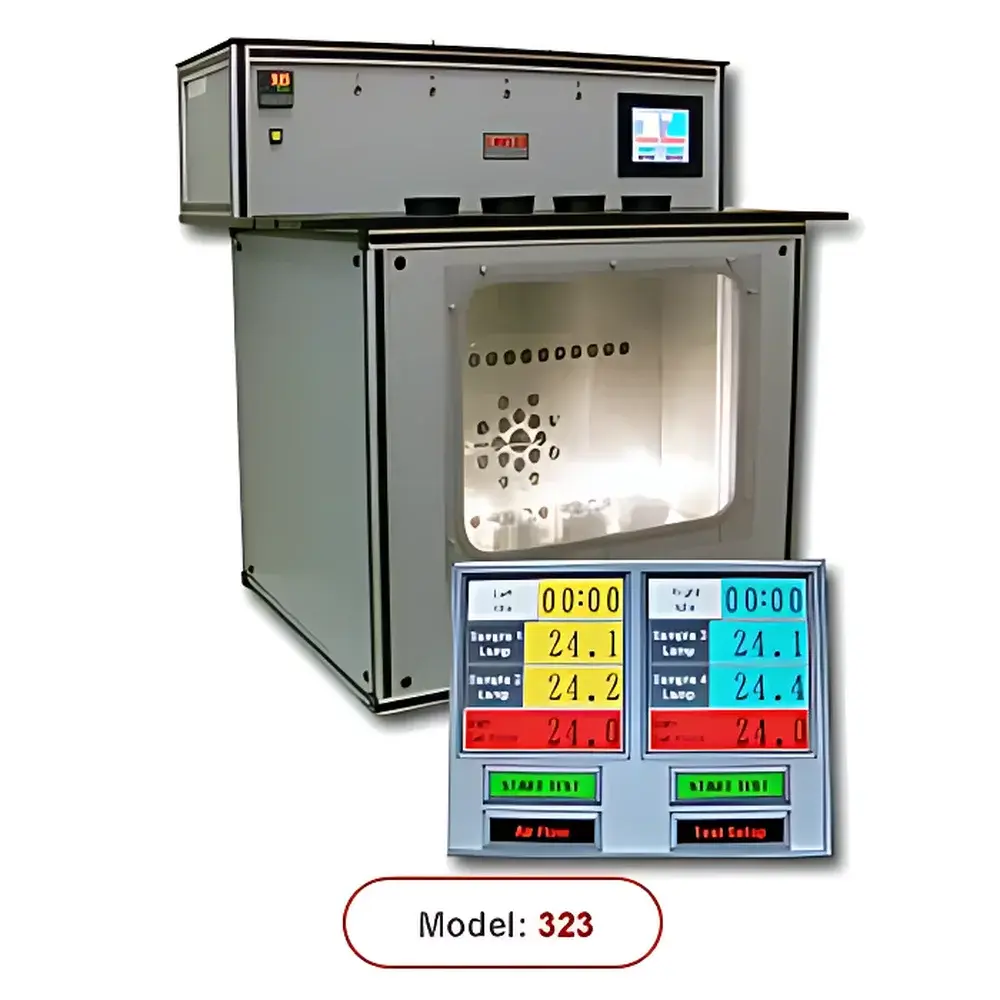
Lawler Model 323 Air-Bath Lubricating Oil Foam Testing Instrument
| Brand | Lawler |
|---|---|
| Origin | USA |
| Model | 323 |
| Temperature Range | 24–150 °C |
| Temperature Stability | ±0.5 °C |
| Temperature Resolution | 0.1 °C |
| Test Positions | 4 |
| Air Flow Control | Dual digital mass flow meters (94 ± 5 mL/min and 200 ± 5 mL/min) |
| Compliance | ASTM D892, ASTM D6082, SH/T 0722–2002 |
| Heating Method | Forced-air bath with independent digital sample temperature probes |
| Interface | Touchscreen LCD controller |
| Viewing Window | Large optical-grade front window |
Overview
The Lawler Model 323 Air-Bath Lubricating Oil Foam Testing Instrument is a precision-engineered system designed for the quantitative evaluation of foaming tendency and foam stability in lubricating oils and related petroleum-based fluids. It operates on the principle of controlled air sparging into heated oil samples under standardized thermal and flow conditions, followed by visual or semi-automated assessment of foam volume and collapse behavior over defined time intervals. This methodology directly implements the physical test protocols specified in ASTM D892 (Standard Test Method for Foaming Characteristics of Lubricating Oils) and ASTM D6082 (Standard Test Method for Foaming Characteristics of Engine Oils at High Temperature), as well as the Chinese national standard SH/T 0722–2002 for high-temperature (150 °C) foam testing. Unlike traditional liquid-bath systems, the Model 323 employs a forced-air thermal environment—eliminating risks associated with silicone oil degradation, leakage, fire hazard, and potential contamination of test specimens—thereby enhancing operational safety, method fidelity, and long-term reproducibility.
Key Features
- Four independent test stations housed within a single compact air-bath enclosure, enabling parallel execution of replicate or multi-sample evaluations per ASTM sequence.
- Digital PID temperature control with 0.1 °C resolution and verified stability of ±0.5 °C across the full operating range (24–150 °C), ensuring strict adherence to thermal requirements of D892 and D6082.
- Integrated dual digital mass flow controllers calibrated for precise delivery of 94 ± 5 mL/min (for Sequence I) and 200 ± 5 mL/min (for Sequences II and III), traceable to NIST standards.
- Four individual RTD-based digital temperature probes—one per test cylinder—providing real-time, in-situ monitoring of sample temperature independent of ambient bath setpoint.
- Touchscreen LCD interface supporting intuitive selection of test method, temperature setpoint, airflow mode, and timer configuration; all parameters are stored in non-volatile memory for audit-ready recall.
- Optically clear, thermally insulated front viewing window with anti-fog coating permits unobstructed visual observation of foam formation, height, and drainage kinetics without opening the chamber.
- Self-contained air supply manifold with integrated filtration and pressure regulation—no external compressed air source required beyond standard shop air (6–8 bar).
Sample Compatibility & Compliance
The Model 323 accommodates standard ASTM D892/D6082 glass cylinders (1 L capacity, nominal dimensions 95 mm ID × 305 mm height) and supports all common lubricant types, including mineral oils, synthetic hydrocarbons (PAOs), ester-based formulations, and additive-treated engine oils. Its design conforms fully to the dimensional, thermal, and procedural specifications outlined in ASTM D892 (including Sequence I at 24 °C, Sequence II at 93.5 °C, and Sequence III at 150 °C) and ASTM D6082 (high-temperature sequence at 150 °C). The instrument meets essential requirements for GLP-compliant laboratories, including parameter logging, operator identification fields, and timestamped test records. While not inherently 21 CFR Part 11 compliant, its data output architecture supports integration with validated LIMS or ELN platforms for electronic record retention and audit trail generation.
Software & Data Management
The onboard firmware enables storage of up to 200 complete test logs—including setpoints, actual temperatures, airflow values, start/stop timestamps, and user annotations—with export capability via USB flash drive in CSV format. No proprietary software installation is required for basic operation; however, optional PC-based data aggregation tools are available for trend analysis, SPC charting, and report generation aligned with internal QA/QC workflows. All calibration events (temperature sensor verification, flow meter validation) are logged with date, technician ID, and reference standard traceability—supporting ISO/IEC 17025 documentation needs.
Applications
- Quality control of finished lubricants prior to release, verifying conformance to OEM foam specifications (e.g., GM dexos®, Ford WSS-M2C945-A, API SP).
- R&D screening of antifoam additive packages during formulation development.
- Stability assessment of oils subjected to thermal aging, oxidation, or shear stress in bench-scale simulations.
- Root-cause analysis of field-reported foaming issues in hydraulic, turbine, and compressor systems.
- Regulatory submission support for lubricant registrations requiring documented ASTM D892/D6082 test data.
FAQ
Does the Model 323 require external compressed air?
No—it includes an integrated air compressor and conditioning system capable of delivering stable, oil-free air at the required flow rates and pressures.
Can it perform both ASTM D892 and D6082 sequences automatically?
Yes—the touchscreen interface allows pre-selection of either method, and the dual-flow architecture automatically configures the correct airflow setting and timing protocol.
Is calibration traceable to national standards?
Temperature sensors are calibrated against NIST-traceable references; flow meters are factory-calibrated using primary gravimetric standards and include certificate-of-calibration documentation.
What maintenance is required for routine operation?
Daily visual inspection of air filters and cylinder cleanliness; quarterly verification of temperature uniformity across all four positions; annual recalibration recommended per ISO/IEC 17025 guidelines.
Are replacement parts and service support available internationally?
Yes—Lawler maintains an authorized distributor network with technical support centers in North America, Europe, and Asia-Pacific regions; spare parts inventory is held regionally for lead times under 5 business days.




