
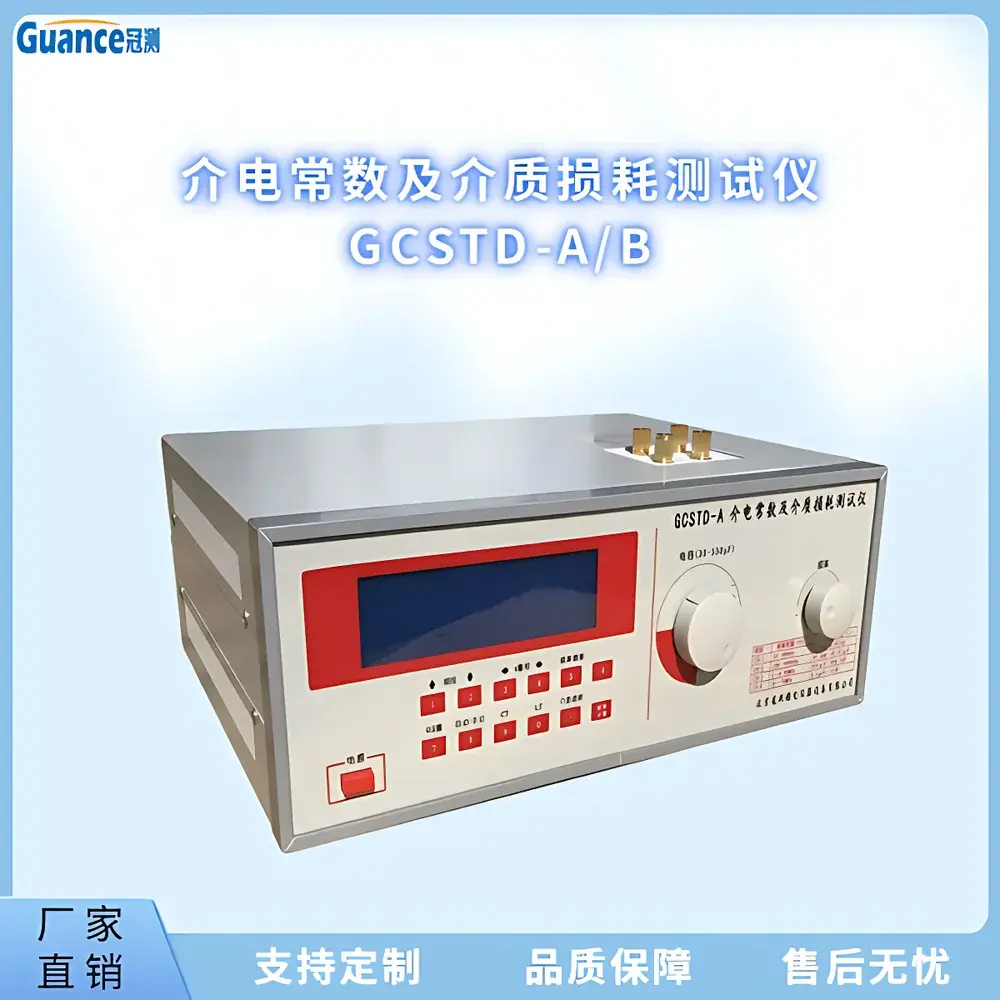
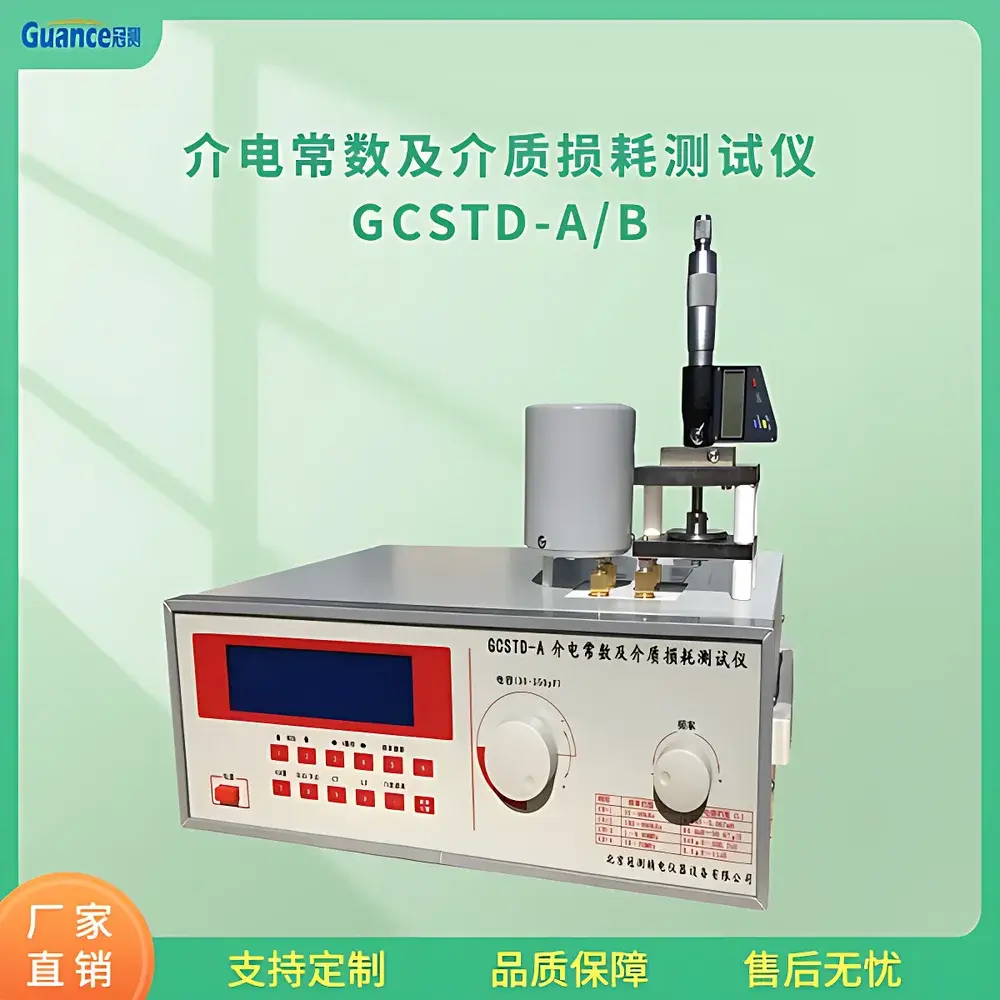
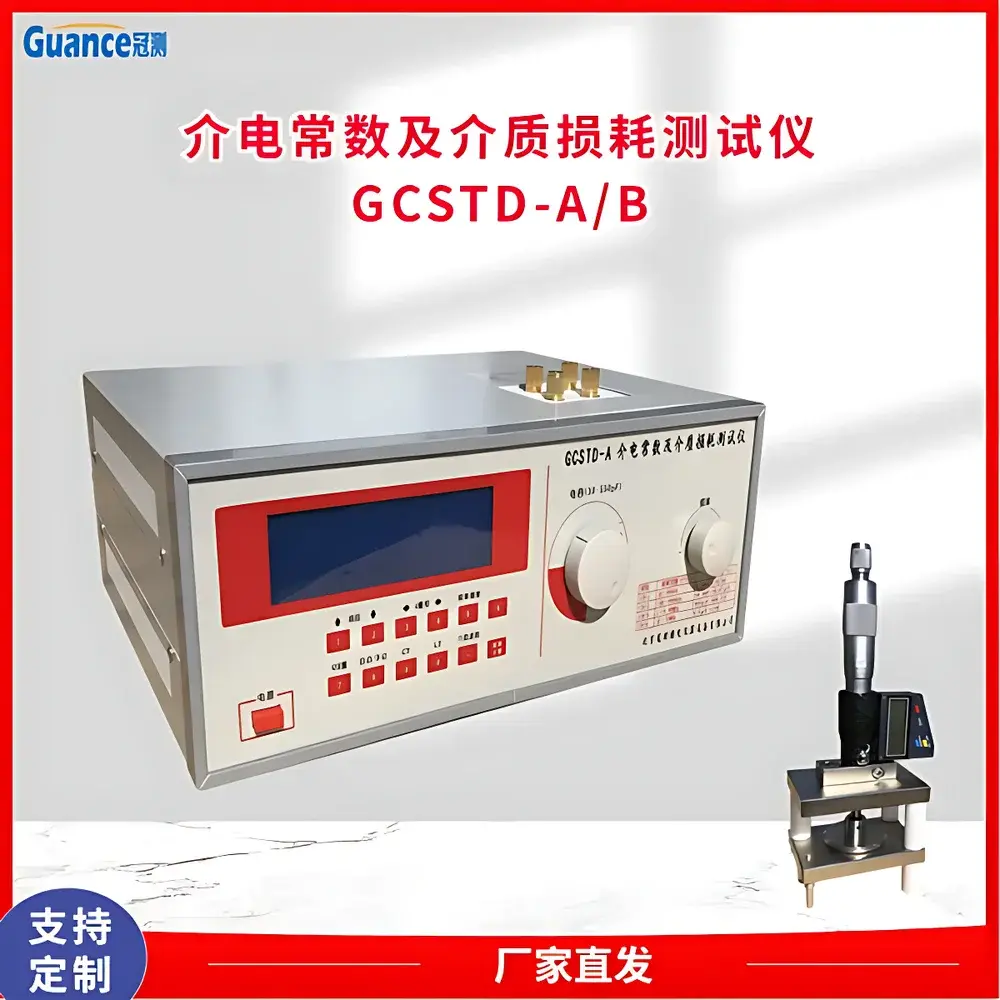
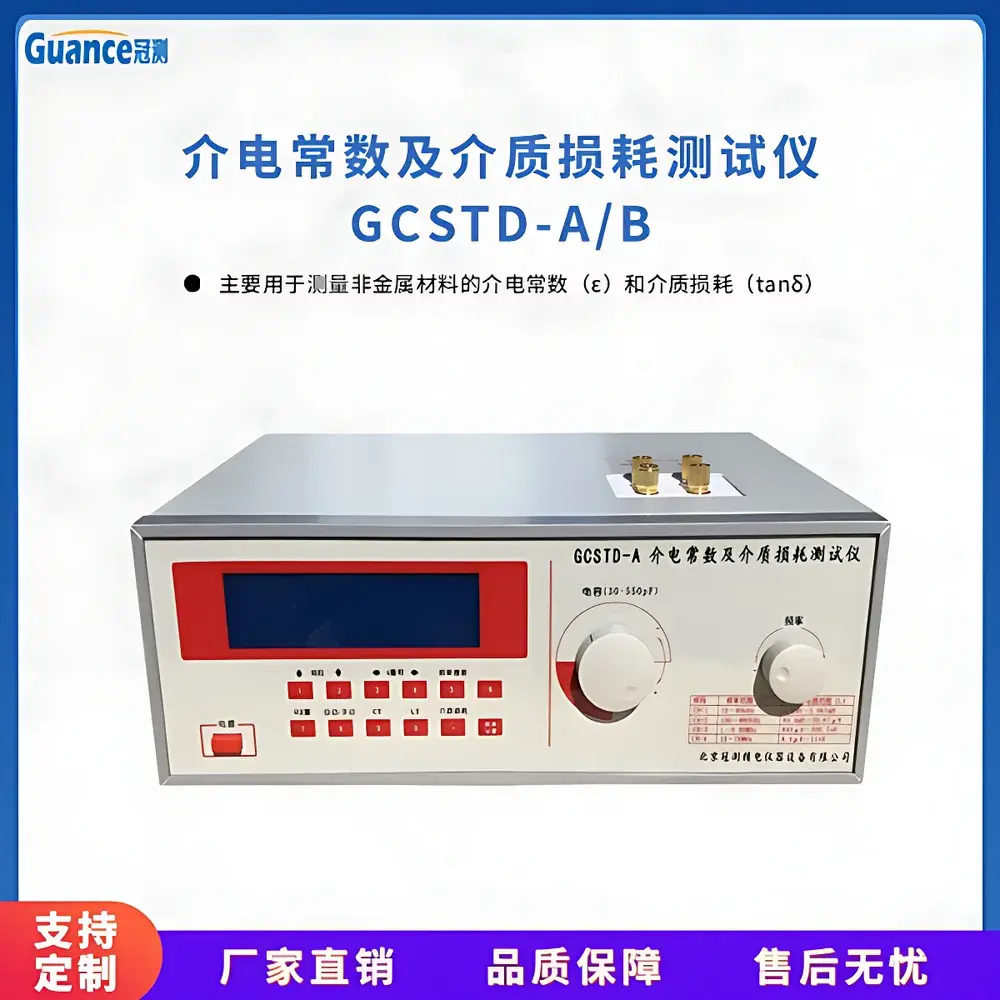
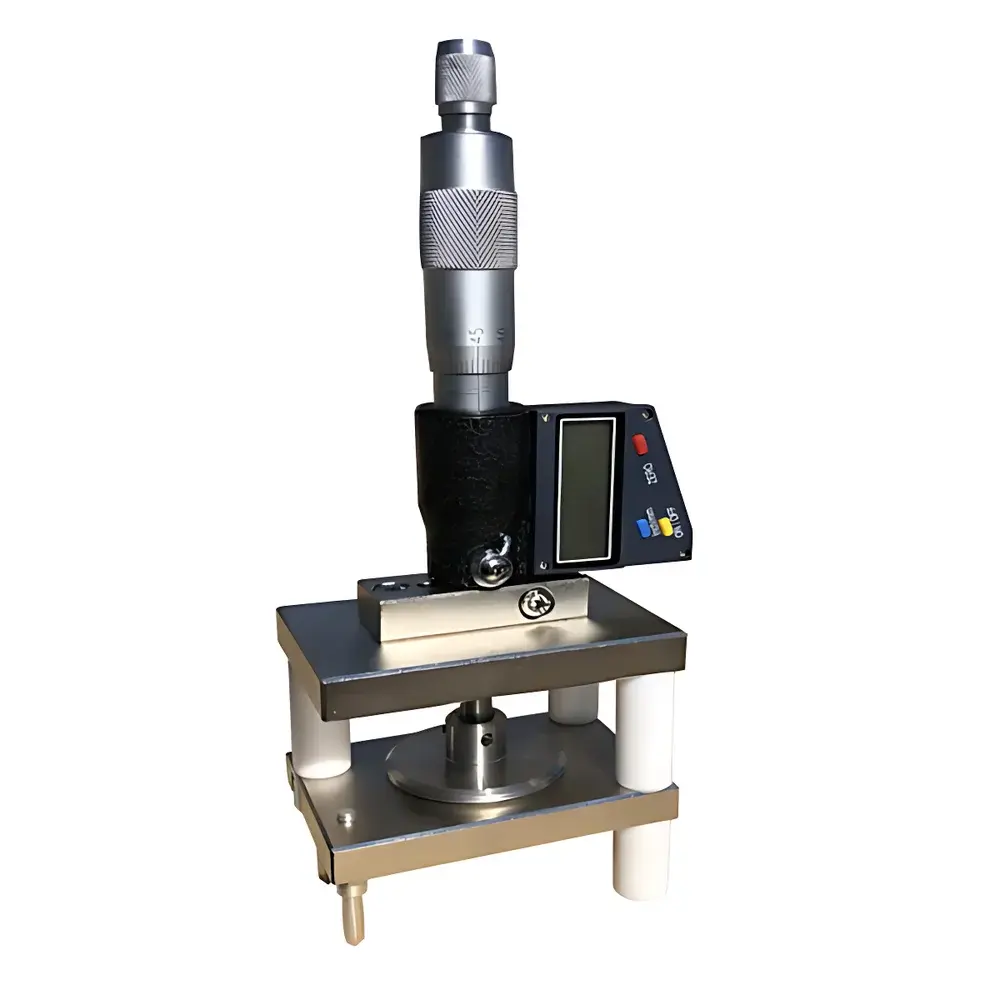
Guance Instruments GCSTD-AB4 Low-Frequency Dielectric Constant and Loss Tangent Analyzer
| Brand | Guance Instruments |
|---|---|
| Origin | Beijing, China |
| Manufacturer Type | Authorized Distributor |
| Country of Origin | China |
| Model | GCSTD-AB4 |
| Price | USD 1,890 (FOB Beijing) |
| Frequency Range | 10 kHz – 1 MHz (low-frequency band, compliant with GB/T 1409–2006 & ASTM D150) |
| Measurement Parameters | Relative Permittivity (εᵣ), Dissipation Factor (tan δ) |
| Test Method | Automatic Resonant Frequency Sweep with Digital Frequency Locking |
| Electrode Configuration | Solid/liquid/powder-compatible parallel-plate electrodes (Φ38 mm measuring electrode |
| optional liquid cell | Φ48 mm × 7 mm depth) |
| Sample Thickness Range (solid) | 0.5–15 mm |
| Operating Temperature | 0–40 °C |
| Humidity Limit | <80% RH |
| Power Supply | 220 V ±10%, 50 Hz ±2.5 Hz |
| Power Consumption | ~25 W |
| Net Weight | 7 kg |
| Dimensions (L×W×H) | 380 × 280 × 132 mm |
Overview
The Guance Instruments GCSTD-AB4 is a precision low-frequency dielectric analyzer engineered for accurate, repeatable measurement of relative permittivity (εᵣ) and dissipation factor (tan δ) in non-conductive solid, liquid, and powdered dielectric materials. It operates on the principle of automatic resonant frequency sweep within the 10 kHz to 1 MHz range—covering industrial power frequency (50/60 Hz harmonics), audio frequencies, and lower RF bands—making it especially suited for characterizing insulating ceramics, polymer composites, transformer oils, rubber formulations, and electronic structural ceramics. Unlike broadband impedance analyzers or high-frequency network analyzers, the GCSTD-AB4 implements a digitally stabilized Q-meter architecture: it employs frequency digital locking, auto-resonance point detection, and programmable Q-range switching to minimize residual inductance in the tuning circuit and suppress amplitude drift. This ensures traceable, high-stability measurements under ambient lab conditions without requiring temperature-controlled enclosures or RF-shielded rooms.
Key Features
- Digital frequency-locking control system with automatic resonance search and standard test-point selection per GB/T 1409–2006 and ASTM D150
- Integrated microcontroller-based measurement core enabling real-time εᵣ and tan δ calculation with numerical display and data hold function
- Modular electrode platform supporting three sample forms: solid discs (Φ38 mm, thickness 0.5–15 mm), liquids (in optional Φ48 mm × 7 mm cup), and powders (using same electrode geometry with compaction fixture)
- Low-residual-inductance resonant bridge design, optimized to reduce parasitic phase error and improve tan δ resolution below 0.001
- Auto-ranging Q-value conversion and amplitude stabilization algorithm inherited from legacy Q-meter topology, ensuring consistent signal-to-noise ratio across frequency sweeps
- Compact benchtop form factor (380 × 280 × 132 mm), low power draw (~25 W), and compatibility with standard 220 V / 50 Hz laboratory mains supply
Sample Compatibility & Compliance
The GCSTD-AB4 accommodates standardized geometries defined in major national and international standards for dielectric characterization. Its Φ38 mm parallel-plate electrode conforms to the dimensional requirements specified in GB/T 1693–2007 (vulcanized rubber), GB/T 5594.4–1985 (electronic ceramic materials), and ASTM D150 Annex A1 (solid dielectrics). For liquid testing, the optional cylindrical cell (Φ48 mm inner diameter, 7 mm depth) satisfies GB/T 5654–2007 and IEC 60247 sampling volume criteria. The instrument supports full compliance workflows for quality control laboratories operating under GLP or ISO/IEC 17025 frameworks: all measurement parameters—including applied frequency, electrode spacing, ambient temperature, and humidity—are manually logged alongside results to support audit-ready reporting. While the GCSTD-AB4 does not include built-in 21 CFR Part 11-compliant electronic signatures, its deterministic measurement protocol and stable analog front-end enable straightforward integration into validated QC systems when paired with external LIMS or ELN platforms.
Software & Data Management
The GCSTD-AB4 operates as a standalone hardware instrument with no embedded operating system or proprietary software stack. All parameter configuration (e.g., frequency step size, dwell time, Q-range selection) is performed via front-panel membrane keys and rotary encoder. Measured values—εᵣ, tan δ, and resonant frequency—are displayed simultaneously on a dual-line LCD with 0.01-digit resolution. Raw data output is limited to manual transcription; however, the instrument includes a TTL-level serial interface (RS-232, 9600 bps, no parity) for optional connection to external PCs or PLCs. Users may develop lightweight acquisition scripts (e.g., Python with pySerial) to log timestamped readings into CSV or SQLite databases. This architecture prioritizes long-term operational reliability over feature-rich GUIs—eliminating firmware update dependencies, driver conflicts, or OS compatibility constraints common in PC-dependent instruments.
Applications
- Quality assurance of electrical porcelain and high-voltage insulator raw materials (e.g., alumina, steatite, cordierite) per GB/T 1409–2006
- R&D screening of polymer matrix composites for aerospace radomes and microwave substrates
- Batch verification of transformer oil aging status via tan δ trend analysis per GB/T 5654–2007
- Development of low-loss dielectric ceramics for MLCC and RF filter applications (aligned with GB/T 5594.4–1985)
- Teaching laboratories demonstrating fundamental relationships between molecular polarization mechanisms and macroscopic εᵣ/tan δ behavior
- Process validation of curing kinetics in thermosetting resins through time-resolved dielectric monitoring at fixed low frequencies
FAQ
What frequency range does the GCSTD-AB4 cover, and why is it classified as “low-frequency”?
The GCSTD-AB4 operates from 10 kHz to 1 MHz. It is designated “low-frequency” relative to microwave dielectric analyzers (>300 MHz) and vector network analyzers (GHz range); this band captures dominant dipolar and interfacial polarization responses in bulk insulators without significant radiation loss or skin-depth artifacts.
Can the instrument measure conductivity or resistivity directly?
No—it measures complex impedance magnitude and phase at resonance to derive εᵣ and tan δ. DC resistivity requires separate high-impedance electrometer testing per GB/T 1410; however, low-frequency AC conductivity can be estimated from ε″ = σ/(ωε₀) when tan δ and εᵣ are known.
Is calibration traceable to national standards?
The instrument includes factory calibration using NIST-traceable air-dielectric and certified ceramic reference standards. End users should perform periodic verification using supplied short/open/load calibration kits and documented procedures in the operator manual.
Does it support automated temperature-controlled testing?
No—the GCSTD-AB4 has no integrated thermal chamber or Peltier stage. For temperature-dependent studies, users must integrate external environmental chambers and manually record chamber temperature alongside each measurement.
How is electrode spacing controlled for solid samples?
Spacing is mechanically fixed by precision-ground spacers (included in standard solid夹具 kit). Thickness variation is accommodated by selecting appropriate spacer sets—no micrometer adjustment or motorized gap control is provided.



