
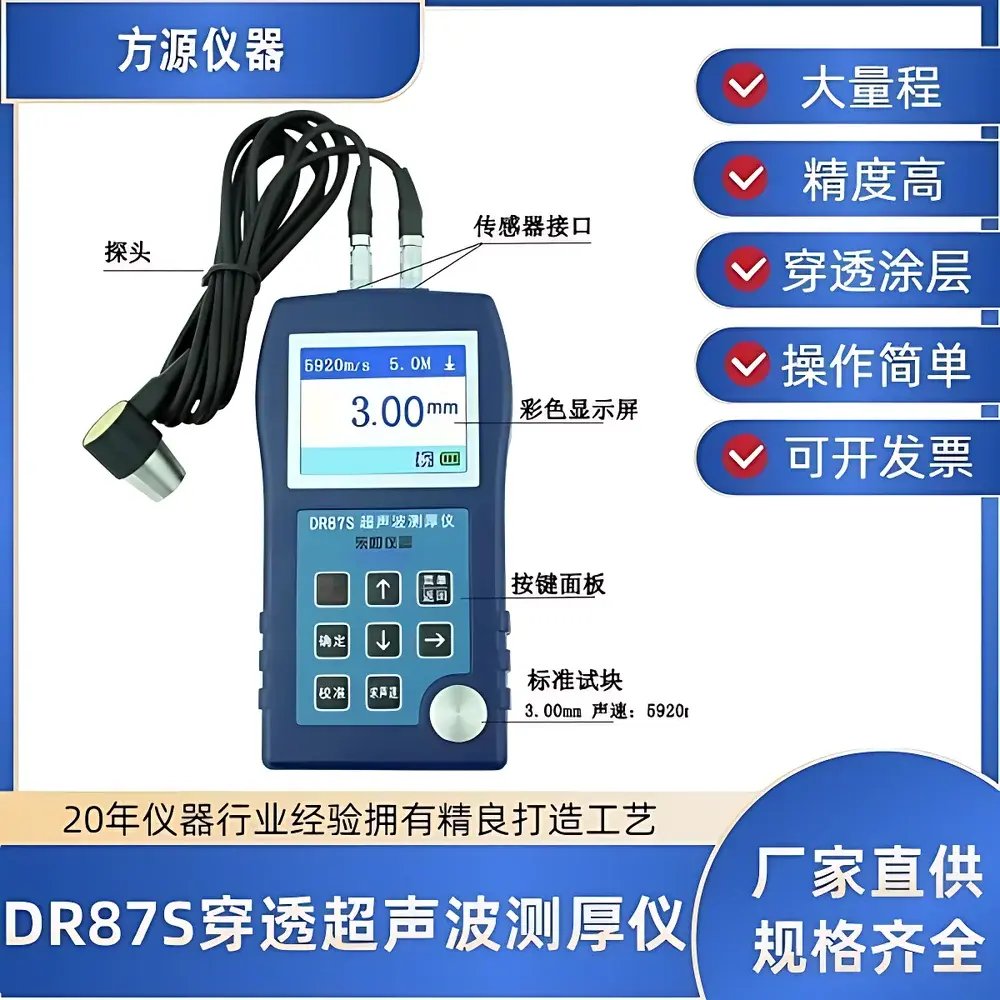
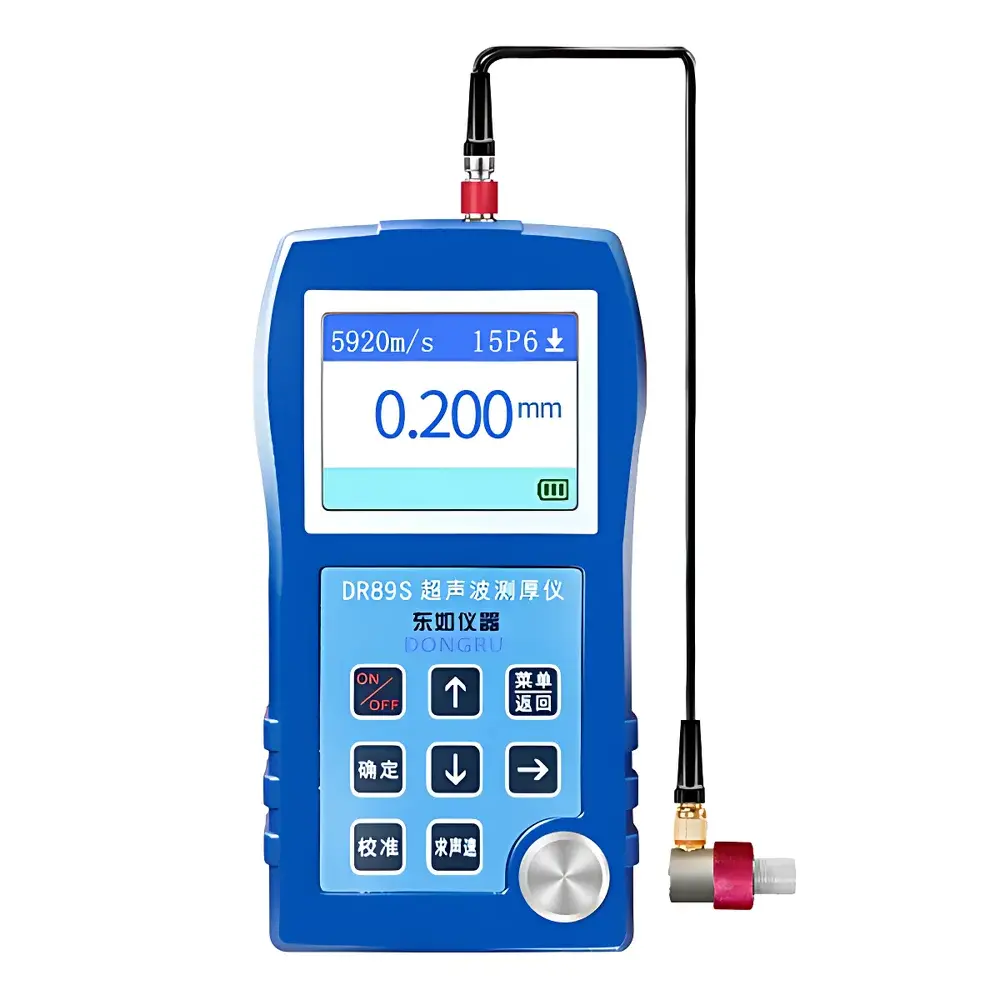
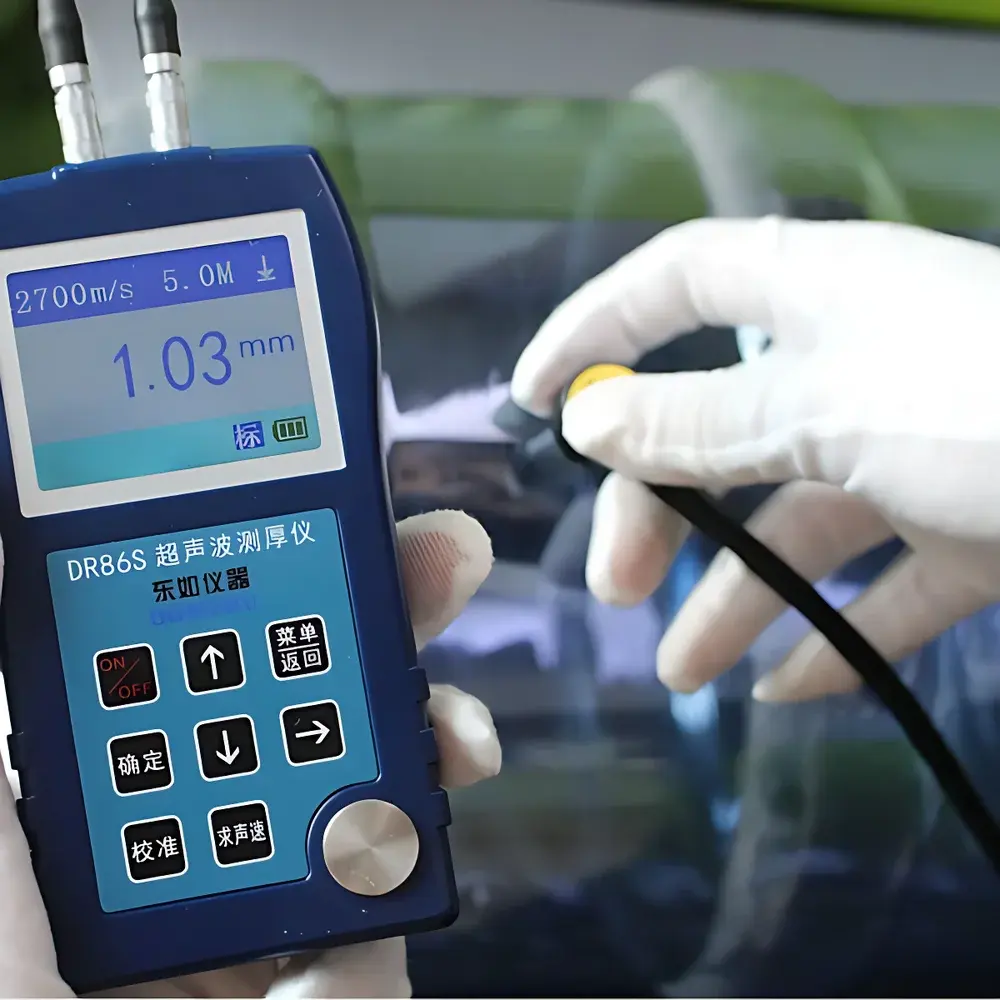
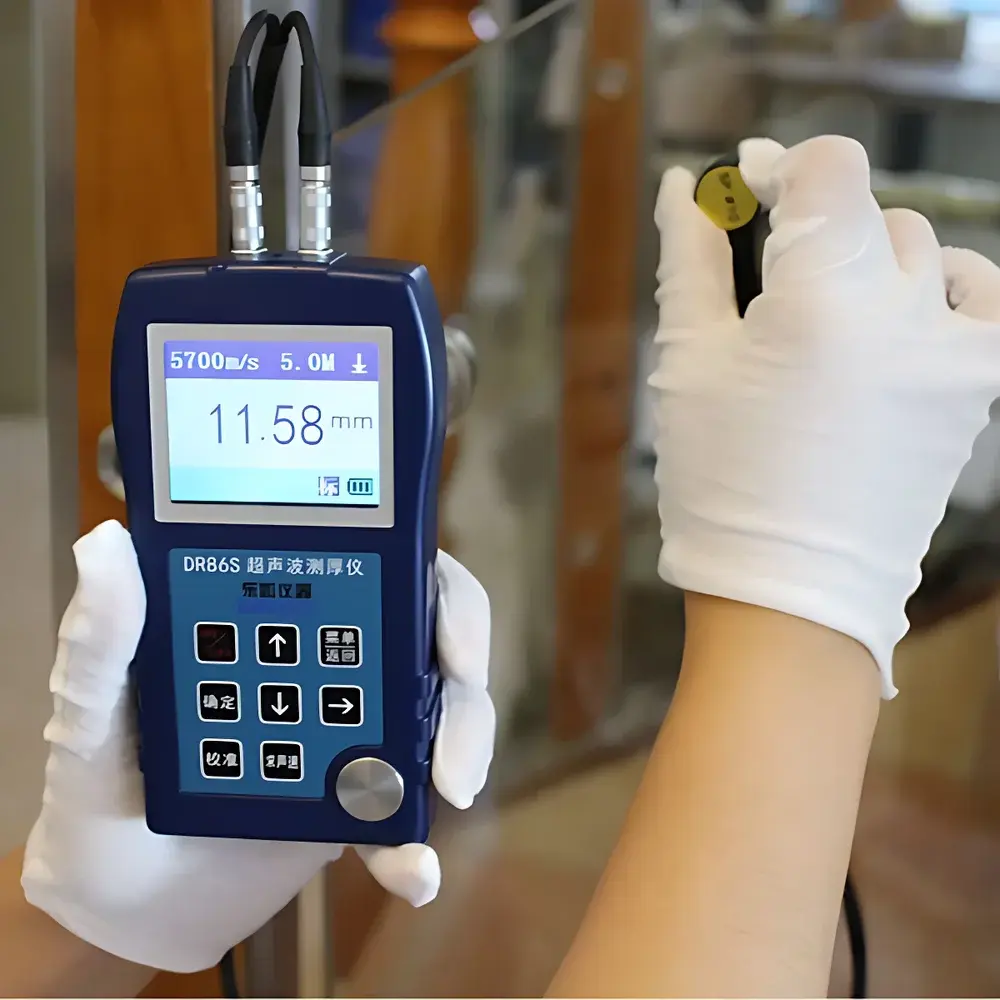
Fangyuan Instruments DR87S Coating-Penetrating Ultrasonic Thickness Gauge for Steel, Metals, Glass & Plastics
| Brand | Fangyuan Instruments |
|---|---|
| Origin | Guangdong, China |
| Model | DR87S Coating-Penetrating Ultrasonic Thickness Gauge |
| Measurement Range | 0.75–500 mm |
| Display Resolution | 0.01 mm |
| Thickness Measurement Accuracy | ±(0.5% H + 0.05) mm |
| Transducer Frequency | Dual-mode (typically 2–5 MHz for coated substrates) |
| Operating Temperature | 0–50 °C |
| Power Supply | 2 × AA alkaline or rechargeable batteries |
| Compliance | ISO 2400:2019 (Ultrasonic thickness measurement — Calibration and verification), ASTM E797/E797M-22 (Standard Practice for Measuring Thickness by Manual Ultrasonic Pulse-Echo Contact Method) |
Overview
The Fangyuan Instruments DR87S Coating-Penetrating Ultrasonic Thickness Gauge is an industrial-grade, dual-echo ultrasonic instrument engineered for non-destructive thickness measurement of solid materials—including ferrous and non-ferrous metals, glass, plastics, and ceramics—while retaining intact surface coatings such as paint, enamel, epoxy, or polymer layers. Unlike conventional single-echo gauges that require coating removal prior to measurement, the DR87S employs advanced time-of-flight differential analysis to isolate the back-wall echo from the substrate while suppressing interference from the front-surface coating interface. This capability is based on pulse-echo ultrasonic principles operating in the 2–5 MHz frequency range, optimized for acoustic impedance contrast between common coating systems (e.g., ~1.5–3.0 MRayl) and underlying substrates (e.g., steel: ~45 MRayl; aluminum: ~17 MRayl; acrylic: ~3.2 MRayl). The device is calibrated per ISO 2400:2019 and validated against reference standards traceable to NIM (China National Institute of Metrology), ensuring metrological integrity across its full 0.75–500 mm measurement span.
Key Features
- Dual-echo mode with automatic coating thickness compensation—eliminates need for surface preparation or coating removal
- High-resolution 0.01 mm display resolution with real-time waveform visualization on monochrome LCD screen
- Measurement accuracy of ±(0.5% H + 0.05) mm, verified across material groups using certified step wedges and clad reference blocks
- Programmable sound velocity library supporting >30 preloaded materials (e.g., carbon steel, stainless steel, aluminum, copper, PVC, PMMA, borosilicate glass)
- Auto-calibration function using zero-offset and two-point calibration routines compliant with ASTM E797-22 Annex A1
- Rugged IP65-rated housing with rubberized grip, designed for field use in manufacturing plants, pipeline maintenance, shipyards, and infrastructure inspection environments
- Battery life exceeding 100 hours under typical intermittent operation (2 × AA cells)
Sample Compatibility & Compliance
The DR87S is validated for use on flat or curved surfaces with minimum radius of curvature ≥25 mm (convex) and ≥50 mm (concave), provided couplant application is uniform. It supports measurement through coatings up to 3.0 mm thick (e.g., marine paints, thermal spray zinc, fusion-bonded epoxy), contingent upon consistent acoustic coupling and absence of delamination or micro-voids at the coating–substrate interface. Device firmware and calibration procedures conform to ISO/IEC 17025:2017 requirements for testing laboratories, and measurement records generated via optional data logging (see Software section) support GLP/GMP audit readiness. While not FDA 21 CFR Part 11–certified out-of-the-box, raw data export enables integration into validated QA/QC workflows where electronic record integrity is governed by site-specific SOPs.
Software & Data Management
The DR87S includes a built-in memory capable of storing up to 500 measurement records, each tagged with date/time stamp, material ID, sound velocity setting, and measurement mode (single/dual echo). Optional PC connectivity via USB-C enables bulk export of CSV-formatted datasets for statistical process control (SPC) analysis in Excel, Minitab, or custom LIMS platforms. Firmware updates are distributed via Fangyuan’s secure engineering portal and include revision-controlled changelogs aligned with ISO 9001:2015 design change management protocols. No proprietary cloud service or mandatory online registration is required for basic operation or calibration verification.
Applications
- In-service corrosion monitoring of pressure vessels, storage tanks, and piping systems without coating abatement
- Quality assurance of coated structural steel components during fabrication and post-painting inspection
- Thickness verification of laminated safety glass and automotive plastic body panels with OEM-applied protective films
- Non-destructive evaluation of castings, forgings, and extrusions where surface finish must remain unaltered
- Field validation of anodized aluminum cladding in architectural façade systems
- Research-grade dimensional stability assessment of polymer composites under thermal cycling conditions
FAQ
Does the DR87S require coupling gel for every measurement?
Yes—acoustic coupling is essential for reliable ultrasonic transmission. A water-based, non-corrosive couplant must be applied between transducer and surface; glycerin or specialized high-viscosity gels are recommended for vertical or overhead measurements.
Can the DR87S measure through rust or heavy scale?
No. Surface oxidation, pitting, or loose scale disrupts acoustic coupling and causes signal attenuation or false echoes. Light mill scale may be tolerated if tightly bonded and uniformly distributed, but mechanical cleaning is advised for critical applications.
Is velocity calibration required for each new material?
Yes—sound velocity varies significantly across materials and temperature. The DR87S requires either manual input of known velocity values or two-point calibration using reference standards of known thickness and composition.
What is the minimum measurable thickness with coating present?
0.75 mm substrate thickness is achievable when measuring through ≤1.0 mm of uniform, well-adhered coating on steel or aluminum, assuming optimal couplant and transducer alignment.
Does the device support external transducers?
No—the DR87S uses an integrated dual-element transducer optimized for coating-penetration mode. External probe compatibility is not supported in this model variant.



