
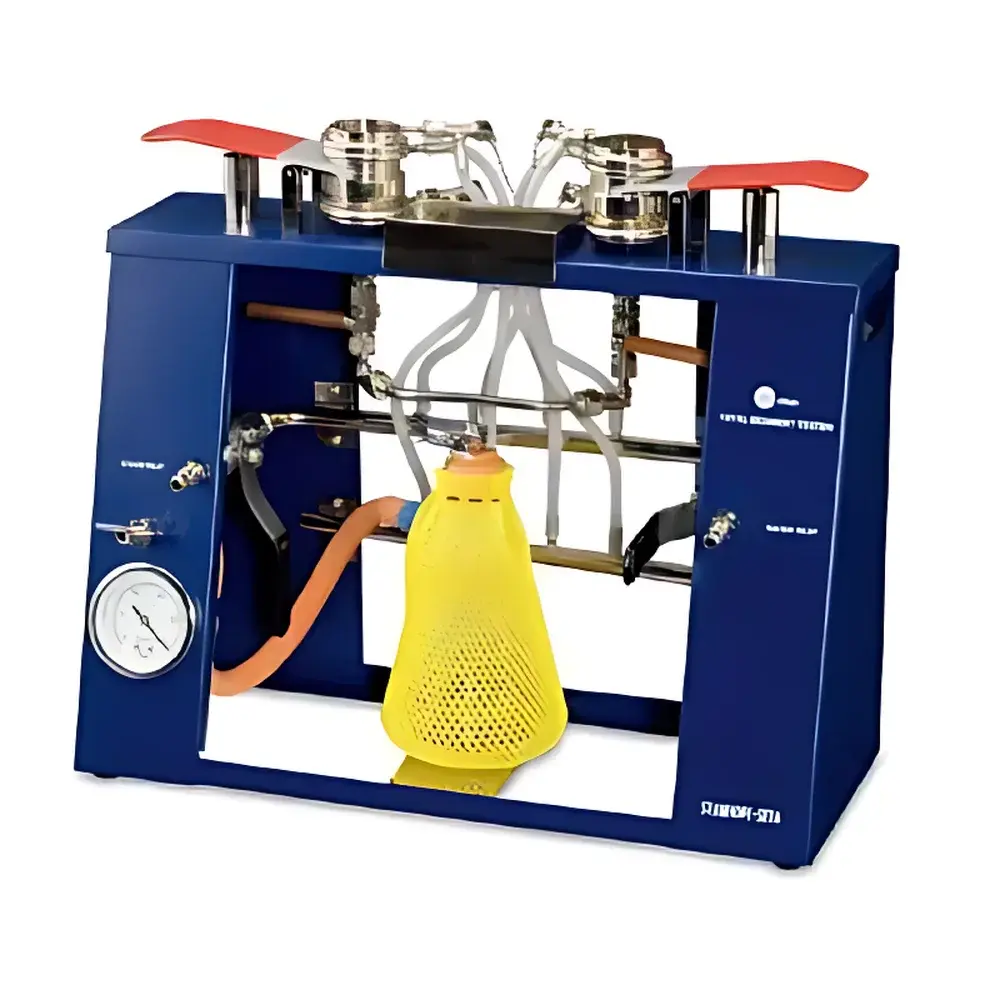
SETA Model 16120-2 Marine Residual Fuel Oil Sediment Analyzer
| Brand | SETA |
|---|---|
| Origin | United Kingdom |
| Model | 16120-2 |
| Standard Compliance | ASTM D4870, IP 375 (Procedure A), IP 390 (Procedure A), ISO 10307-1 & ISO 10307-2, BS 2000-375, NF M07-063, SH/T 0701, SH/T 0702 |
| Sample Mass | 10 g |
| Flask Capacity | 500 mL |
| Filter Paper Requirement | 2 sheets per test |
| Operating Temperature | 80 °C (sample heating), 100 °C (steam jacket) |
| Vacuum Pressure | 40 kPa |
| Cooling Water | Ambient temperature |
| Dimensions | 40 × 47 × 18 cm |
| Weight | 8 kg |
Overview
The SETA Model 16120-2 Marine Residual Fuel Oil Sediment Analyzer is a precision-engineered instrument designed specifically for quantitative determination of insoluble sediment in residual marine fuels—primarily heavy fuel oil (HFO), intermediate fuel oil (IFO), and blended bunker fuels. It operates on the principle of hot filtration under controlled vacuum and steam-jacketed thermal conditions, as defined by internationally harmonized standard methods including ASTM D4870, ISO 10307-1 and -2, and IP 375 (Procedure A). The analyzer quantifies sediment mass fraction (expressed as % m/m) by gravimetric analysis following solvent-assisted hot filtration at 80 °C—a temperature selected to maintain sample fluidity while minimizing thermal degradation or volatilization of volatile components. Its dual-test configuration enables parallel processing of two independent 10 g samples, improving laboratory throughput without compromising measurement integrity or inter-laboratory reproducibility.
Key Features
- Dual-position test chamber with independently controlled steam jackets ensures simultaneous, thermally stable operation at 100 °C for consistent solvent evaporation and filtration kinetics.
- Optimized for high-viscosity residual fuels: validated performance up to 130 mm²/s (cSt) at 80 °C, accommodating typical viscosity ranges encountered in ISO 8217 RMK/RML-grade bunker fuels.
- Integrated vacuum manifold regulated to 40 kPa (±1 kPa), providing precise suction control during hot filtration to prevent filter paper rupture or premature clogging.
- Gravimetric workflow compliant with ISO/IEC 17025 requirements: includes dedicated 500 mL waste flasks, pre-weighed ashless filter papers (two per test), and standardized drying/cooling protocols.
- Compact benchtop footprint (40 × 47 × 18 cm) and low mass (8 kg) facilitate integration into QC laboratories aboard shore-based terminals, classification society testing facilities, or shipboard survey labs with space constraints.
Sample Compatibility & Compliance
The SETA 16120-2 is validated for use with residual fuel oils meeting ISO 8217 specifications, including RMG, RMK, RMA, and RMB grades. It accommodates samples containing asphaltene aggregates, coke precursors, and inorganic particulates that precipitate upon thermal aging or storage. The method is explicitly referenced in IMO MARPOL Annex VI fuel verification protocols and is accepted by major classification societies (e.g., DNV, LR, ABS) for onboard fuel quality screening. All operational parameters—including steam temperature, vacuum level, filtration time, and post-filtration drying conditions—are traceable to ASTM D4870 and ISO 10307-2 Annex A. The instrument supports GLP-compliant documentation when paired with calibrated analytical balances and certified reference materials (CRMs) for sediment calibration.
Software & Data Management
The SETA 16120-2 is a manually operated, non-digital instrument; it does not incorporate embedded firmware or data logging software. However, its procedural design aligns fully with electronic laboratory notebook (ELN) and LIMS integration workflows. Users record raw mass values (pre- and post-filtration filter weights), environmental conditions (ambient temperature, barometric pressure), and operator identifiers directly into audit-trail-enabled systems. When used within FDA 21 CFR Part 11–compliant environments, all handwritten or digitally entered data must be accompanied by second-person verification and timestamped entries. Calibration of supporting equipment—including Class I analytical balances (ISO/IEC 17025 accredited) and vacuum gauges—must be maintained per documented SOPs.
Applications
- Pre-delivery verification of bunker fuel compliance with ISO 8217 sediment limits (≤0.10 % m/m for RMG 380; ≤0.50 % m/m for RMK 500).
- Root-cause analysis of fuel system fouling in auxiliary engines and boilers, correlating sediment content with filter plugging frequency and injector wear patterns.
- Monitoring sediment formation during long-term fuel storage, especially in tanks exposed to temperature cycling or water ingress.
- Supporting dispute resolution between fuel suppliers and vessel operators under BIMCO Fuel Quality Clause 2022.
- Research applications evaluating additive efficacy in stabilizing asphaltenes and inhibiting sediment generation during thermal stress.
FAQ
What standards does the SETA 16120-2 directly support?
ASTM D4870, ISO 10307-1 and -2, IP 375 (Procedure A), IP 390 (Procedure A), BS 2000-375, NF M07-063, SH/T 0701, and SH/T 0702.
Can the instrument test fuels with viscosity exceeding 130 mm²/s at 80 °C?
No—operation beyond 130 mm²/s may impair filtration efficiency and compromise result reproducibility; dilution with toluene or xylene is not permitted under the cited standards.
Is vacuum regulation automated or manual?
Vacuum is supplied via an external vacuum source (e.g., diaphragm pump) and regulated using a calibrated needle valve; no electronic pressure controller is integrated.
How is filter paper selection verified for compliance?
Ashless qualitative filter papers meeting Grade 40 or equivalent (retention ~8–10 µm) must be used; certificates of analysis confirming ash content <0.01 % m/m are required for GLP audits.
Does the unit include a drying oven or cooling desiccator?
No—the instrument provides only the hot filtration assembly; post-filtration drying and weighing must be performed in a certified laboratory oven and desiccator per ASTM D4870 Section 8.





