
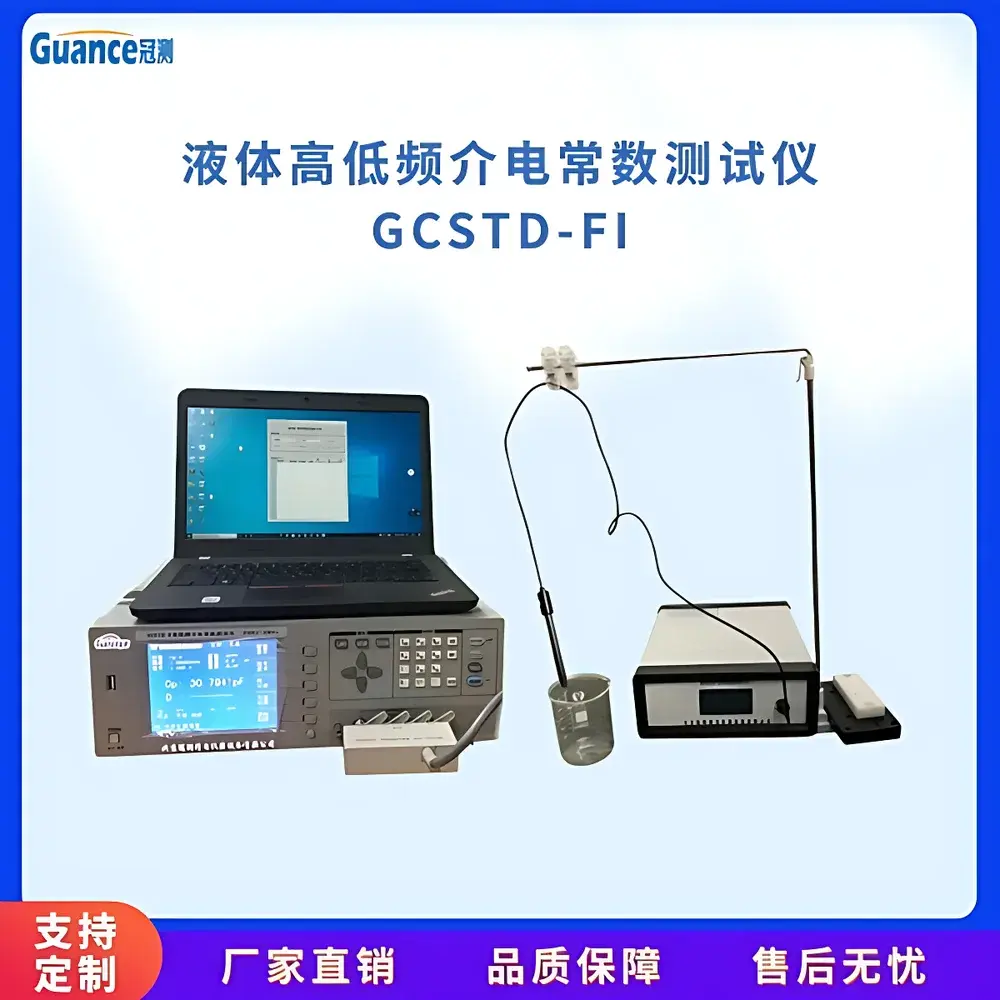
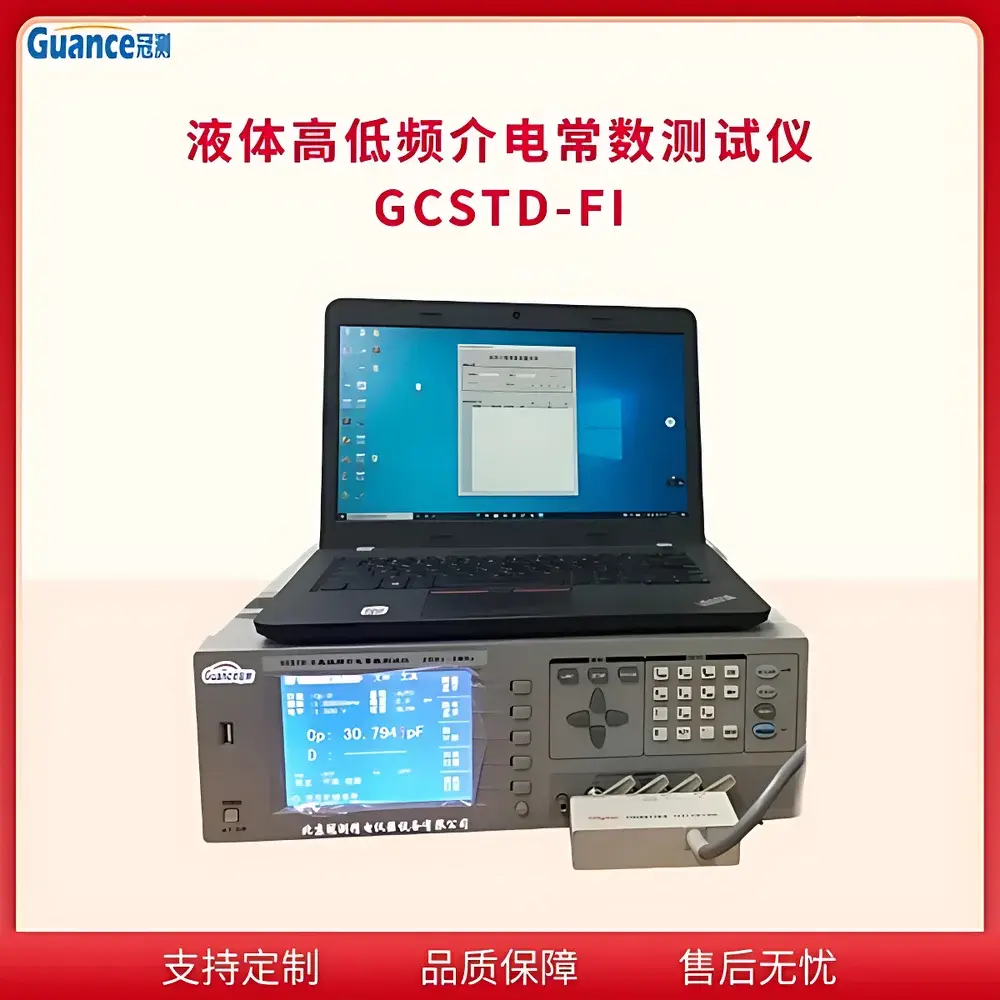
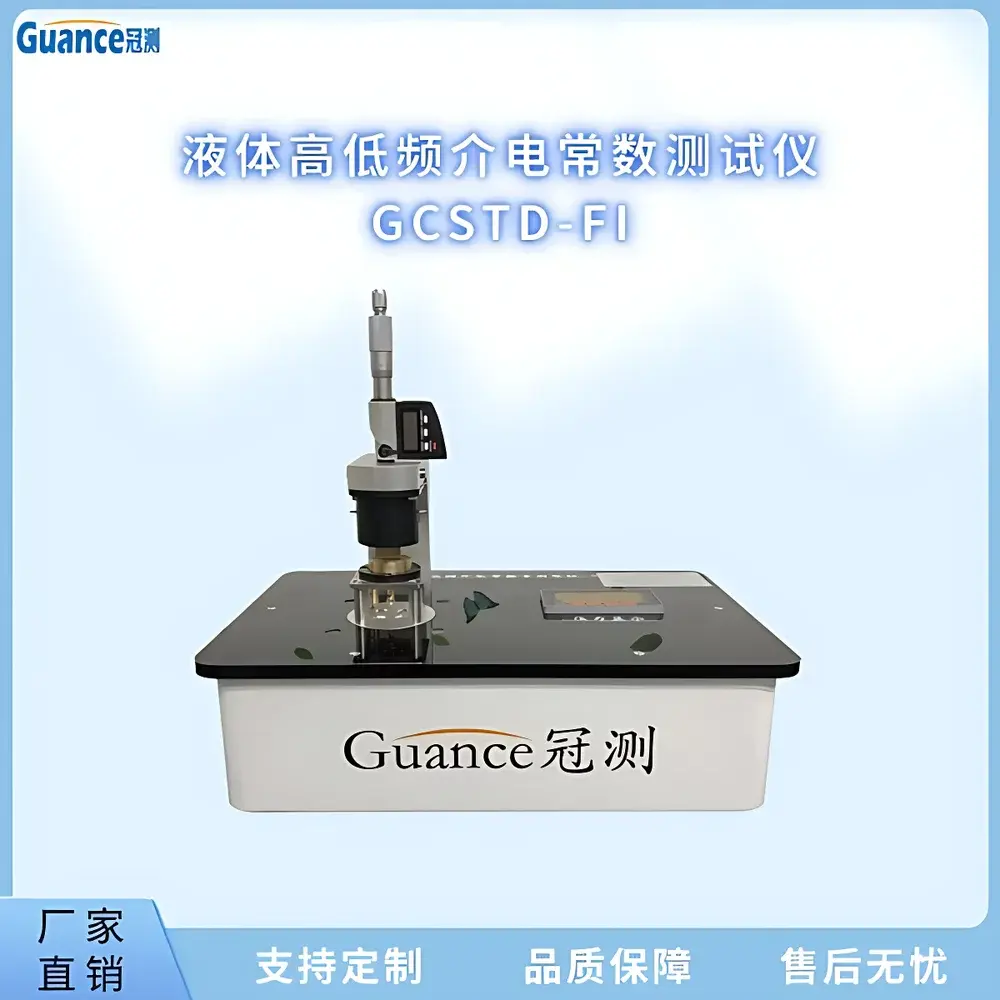
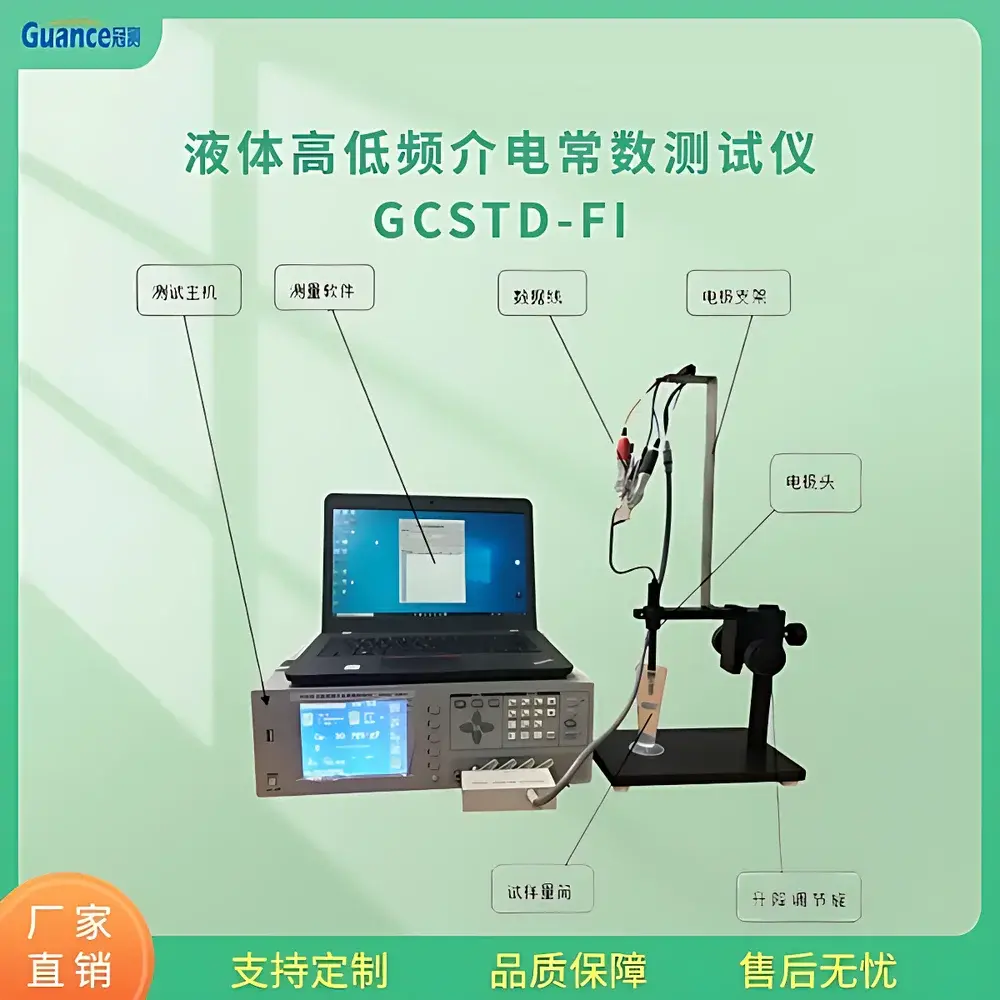
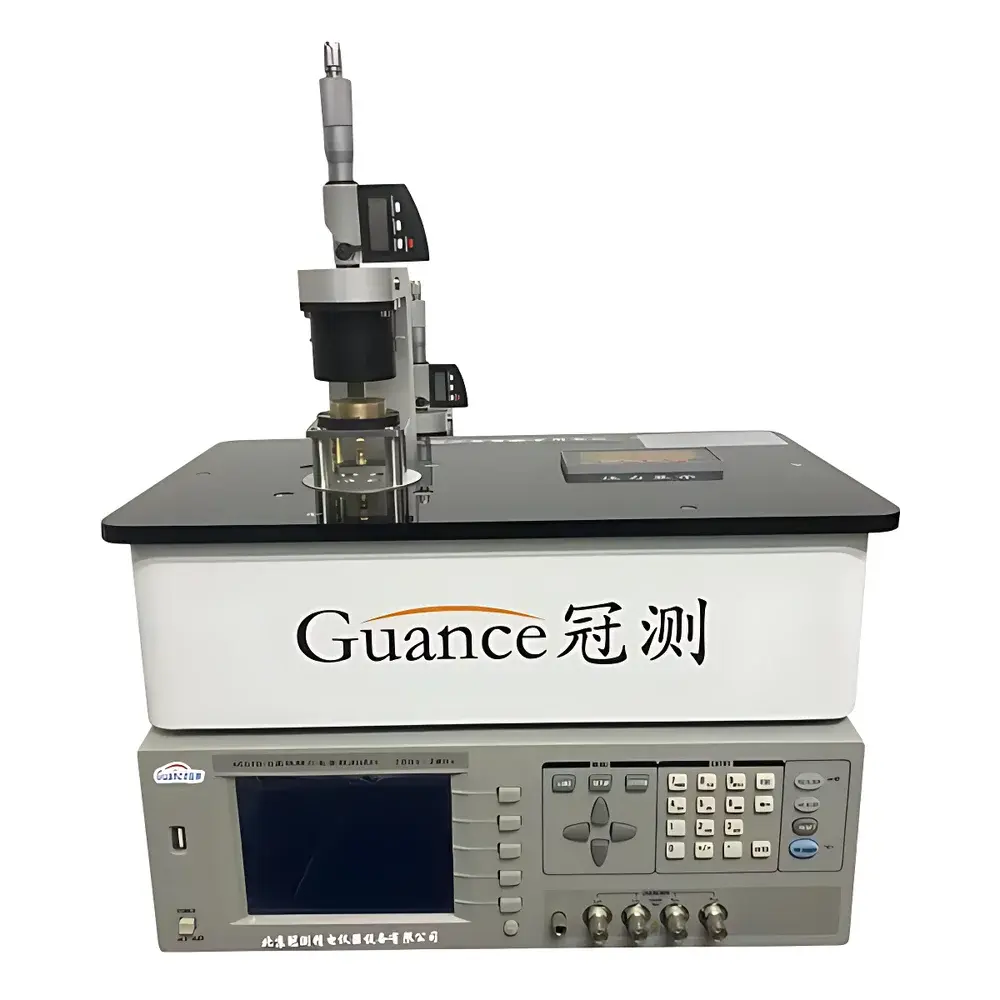
GuanCe GCSTD-FI.4 Liquid Broadband Dielectric Constant & Dissipation Factor Analyzer
| Brand | GuanCe |
|---|---|
| Origin | Beijing, China |
| Manufacturer Type | Authorized Distributor |
| Product Category | Domestic |
| Model | GCSTD-FI.4 |
| Price | USD 2,000 (FOB) |
| Measurement Principle | Two-Terminal Capacitance Bridge at Fixed 10 kHz |
| Electrode Type | Open-Geometry Cylindrical Stainless Steel (316 SS) |
| Frequency | 10 kHz Sine Wave |
| RMS Excitation Voltage | 7 V (Range 1–20), 0.7 V (Range 1–200) |
| Dielectric Constant Range | 1–20 and 1–200 |
| Accuracy | ±2% |
| Repeatability & Linearity | ±0.2% |
| Compliance | GB/T 1409–2006, GB/T 5654–2007, GB/T 21216–2007, GB/T 1693–2007, GB/T 5594.4–1985 |
Overview
The GuanCe GCSTD-FI.4 Liquid Broadband Dielectric Constant & Dissipation Factor Analyzer is a precision impedance-based instrument engineered for the standardized determination of relative permittivity (εr) and dielectric loss tangent (tan δ) in liquid insulating materials across two calibrated capacitance ranges. Operating at a fixed excitation frequency of 10 kHz using a stable sine-wave signal, the system implements a two-terminal capacitance bridge architecture with traceable calibration against NIST-traceable reference standards. Unlike broadband spectrometers or RF impedance analyzers, the GCSTD-FI.4 is purpose-built for routine QC/QA compliance testing in electrical insulation laboratories—particularly for transformer oils, silicone fluids, hydrocarbon solvents, and synthetic esters—where reproducible, standards-aligned measurements under controlled ambient conditions are required. Its design prioritizes mechanical stability, geometric fidelity of the electrode assembly, and immunity to parasitic stray capacitance—critical factors influencing measurement uncertainty in low-loss dielectric systems.
Key Features
- Open-geometry coaxial cylindrical electrode pair fabricated from ASTM A276 Grade 316 stainless steel, ensuring corrosion resistance and long-term dimensional stability.
- Precision-machined inter-electrode spacing maintained by six non-conductive nylon screws—no adhesives or thermal bonding used, eliminating drift from thermal expansion mismatch.
- Two selectable measurement ranges (1–20 and 1–200 εr) optimized for low- and high-permittivity liquids respectively, each with dedicated excitation voltage levels (7 V and 0.7 V RMS) to maintain optimal signal-to-noise ratio.
- Non-disassembly electrode design: geometric integrity is preserved by prohibiting disassembly; cleaning is performed only via solvent immersion and ultrasonic agitation.
- Compatible with common laboratory solvents—including acetone, ethanol, isopropanol, and chlorinated hydrocarbons—due to inert electrode construction (316 SS, PTFE-insulated terminals, nylon spacers).
- Integrated analog signal conditioning with temperature-compensated amplification to minimize drift during extended measurement cycles.
Sample Compatibility & Compliance
The GCSTD-FI.4 is validated for use with electrically insulating liquids meeting IEC 60296, ASTM D877, and GB/T 5654–2007 specifications. It supports measurement of mineral oils, polyalphaolefins (PAO), silicone oils, bio-based esters, and fluorinated fluids—provided samples are free of particulate contamination, water droplets, or conductive additives that would distort capacitive response. The instrument conforms to multiple national standards for dielectric characterization: GB/T 1409–2006 (capacitance and loss factor at power/audio frequencies), GB/T 21216–2007 (conductivity and capacitance-derived tan δ), GB/T 1693–2007 (rubber dielectrics), and GB/T 5594.4–1985 (ceramic dielectric loss). While not FDA 21 CFR Part 11–compliant out-of-the-box, its analog output interface allows integration into validated LIMS environments when paired with compliant data acquisition hardware and procedural controls.
Software & Data Management
The GCSTD-FI.4 operates as a standalone benchtop instrument with analog meter readout and manual range selection. No embedded firmware or digital display is included; all data acquisition is performed externally via calibrated voltmeters or digital multimeters connected to the instrument’s buffered analog output terminals. This architecture ensures electromagnetic compatibility in high-voltage test labs and eliminates software validation overhead. For GLP/GMP-regulated environments, users may document readings manually in bound logbooks or integrate the unit into automated test sequences using third-party DAQ systems (e.g., National Instruments USB-6211) with audit-trail-enabled software (e.g., LabVIEW with 21 CFR Part 11 add-ons). Calibration certificates include uncertainty budgets per ISO/IEC 17025 requirements and are issued annually upon traceable recalibration.
Applications
- Quality control of transformer and switchgear insulating oils per IEC 60429 and DL/T 995.
- Monitoring aging-induced polar compound formation in lubricants and dielectric coolants.
- Batch release testing of silicone-based heat transfer fluids in semiconductor manufacturing tools.
- R&D screening of bio-ester formulations for biodegradable transformer applications.
- Verification of moisture content correlation in hydrocarbon solvents using established εr–H2O calibration curves (per ASTM D923 Annex A2).
- Supporting ASTM D1169 conductivity measurements when used in tandem with resistivity cells.
FAQ
Can the electrode be disassembled for cleaning?
No. Disassembly will irreversibly alter inter-cylinder geometry and void calibration. Cleaning must be performed only via solvent immersion and ultrasonic agitation.
What is the recommended cleaning protocol for hydrocarbon samples?
Rinse with analytical-grade acetone or ethanol, followed by 5-minute ultrasonic treatment, then dry with oil-free compressed air.
Does the instrument support variable-frequency measurement?
No. It operates exclusively at 10 kHz, per GB/T 5654–2007 requirements for routine liquid insulation testing.
Is temperature control integrated?
No. Ambient temperature must be stabilized at 20 ± 2 °C per standard test methods; external thermostatic baths are required for temperature-dependent studies.
How often does the system require recalibration?
Annually—or after any physical impact to the electrode assembly—as verified against certified reference liquids (e.g., n-hexane εr = 1.88, methanol εr = 32.6 at 20 °C).



