
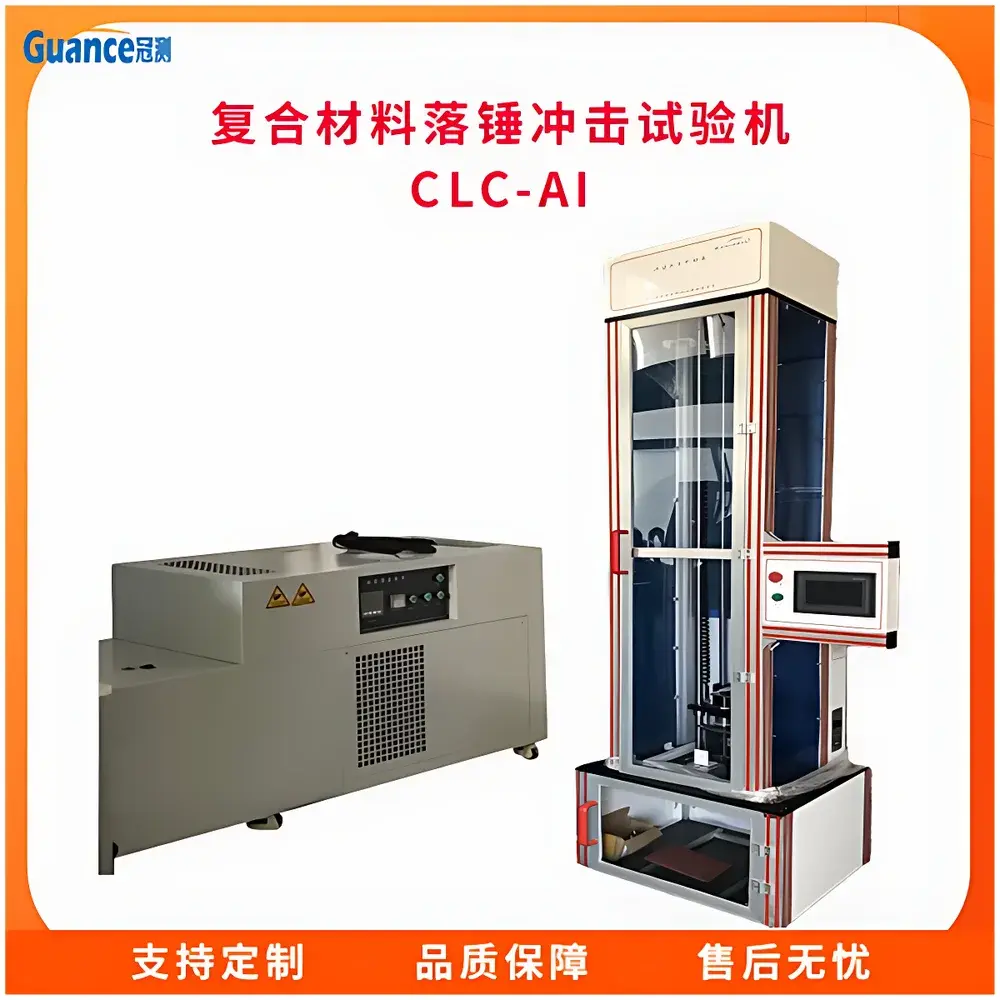
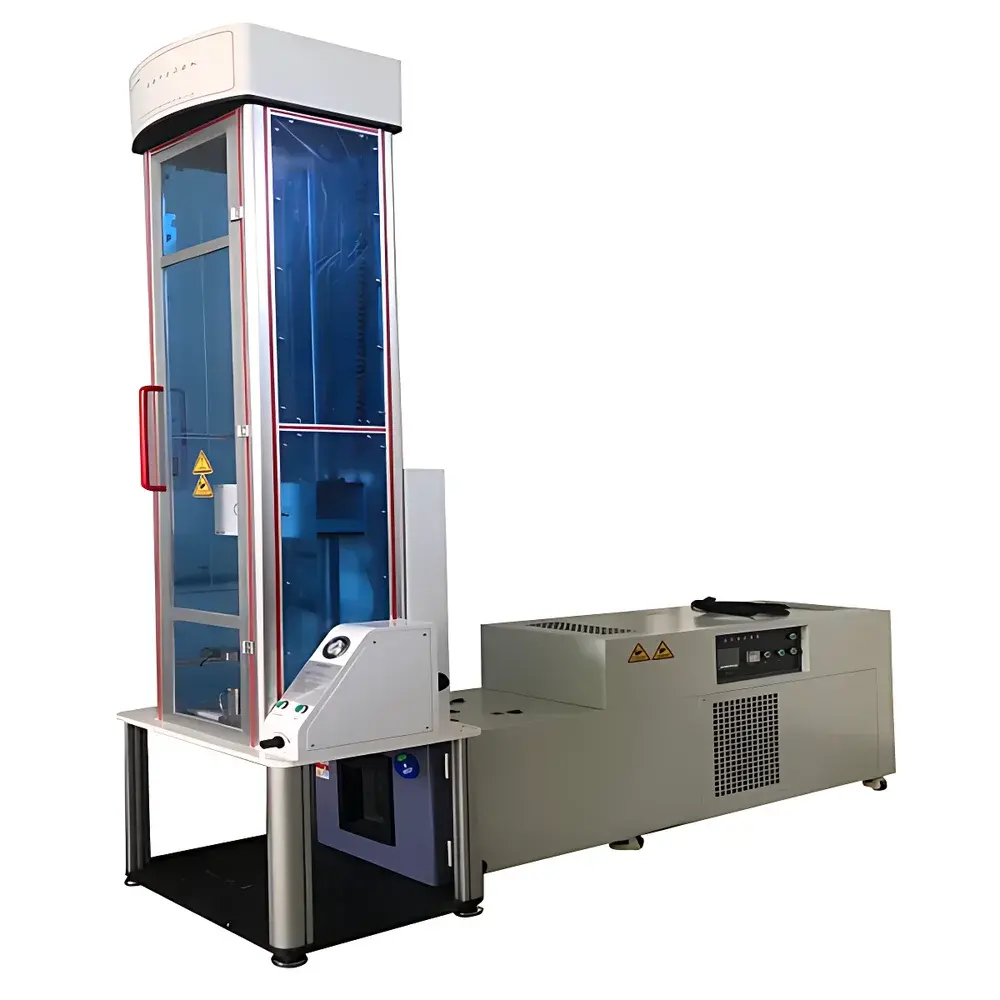
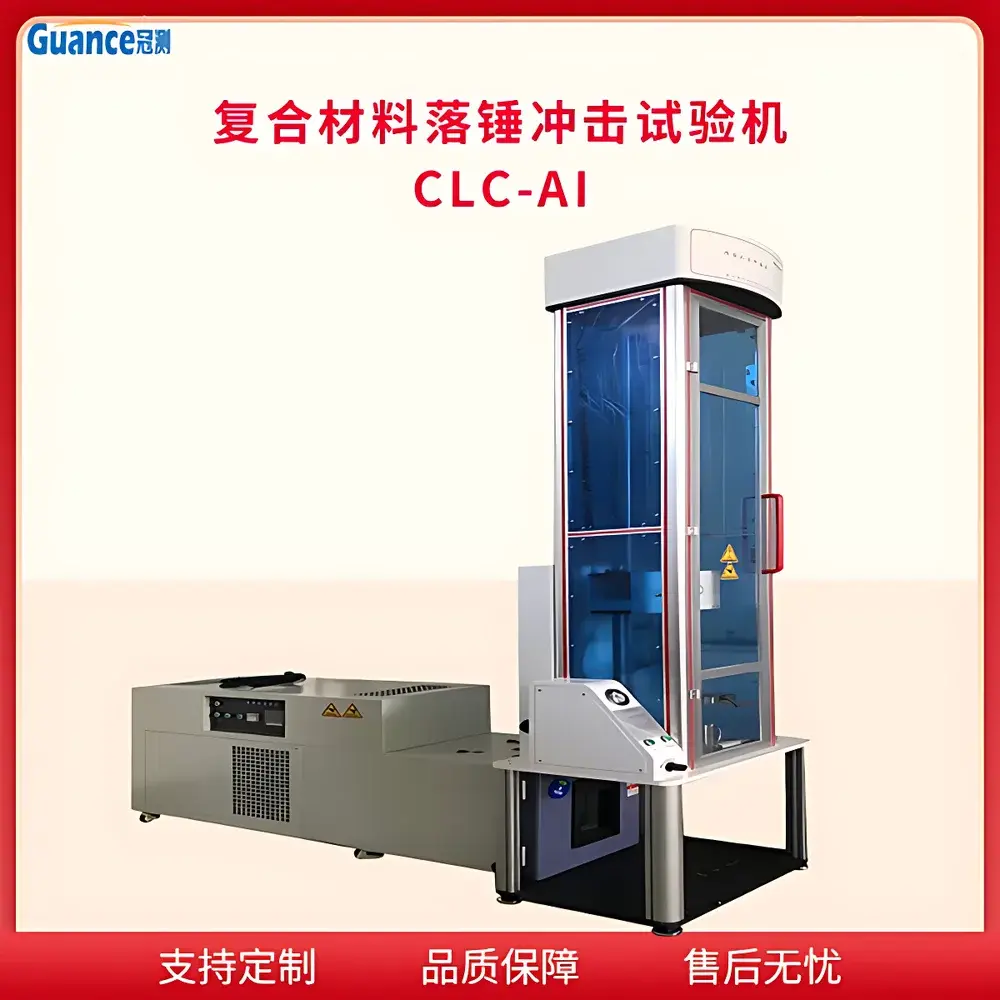
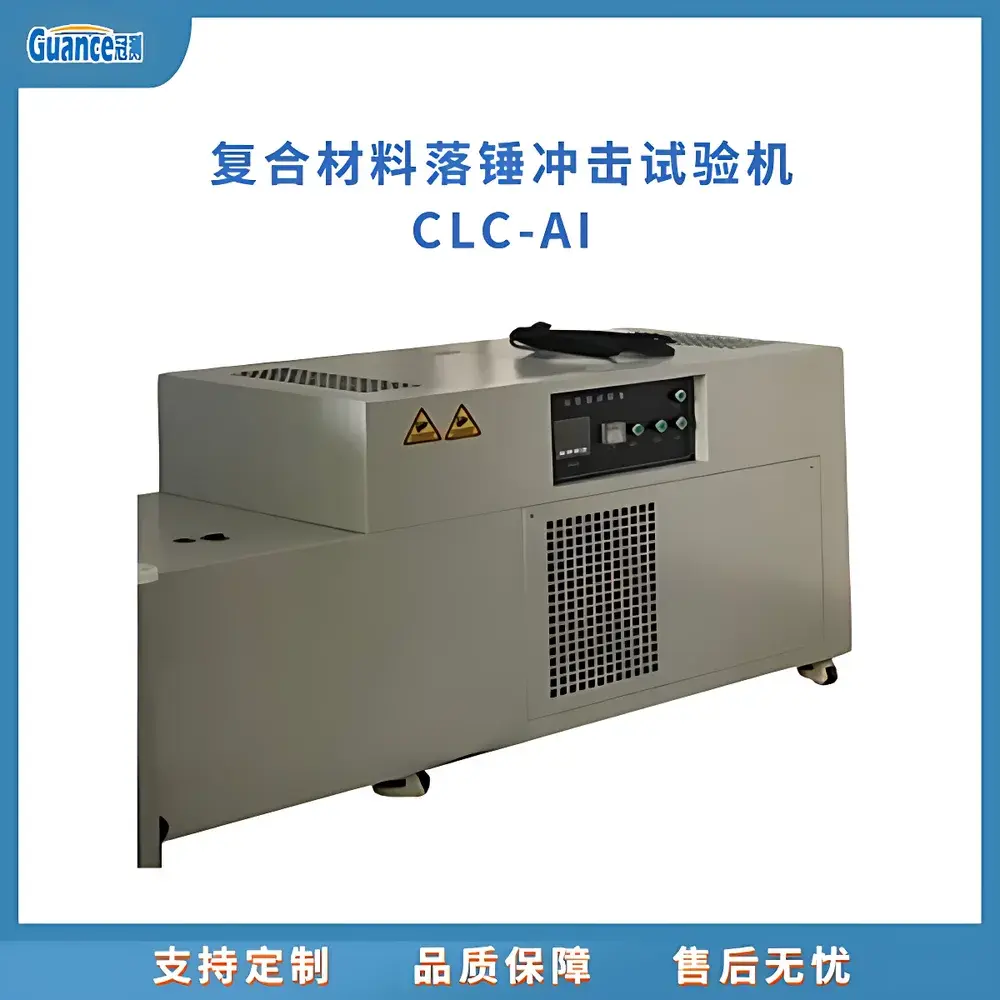
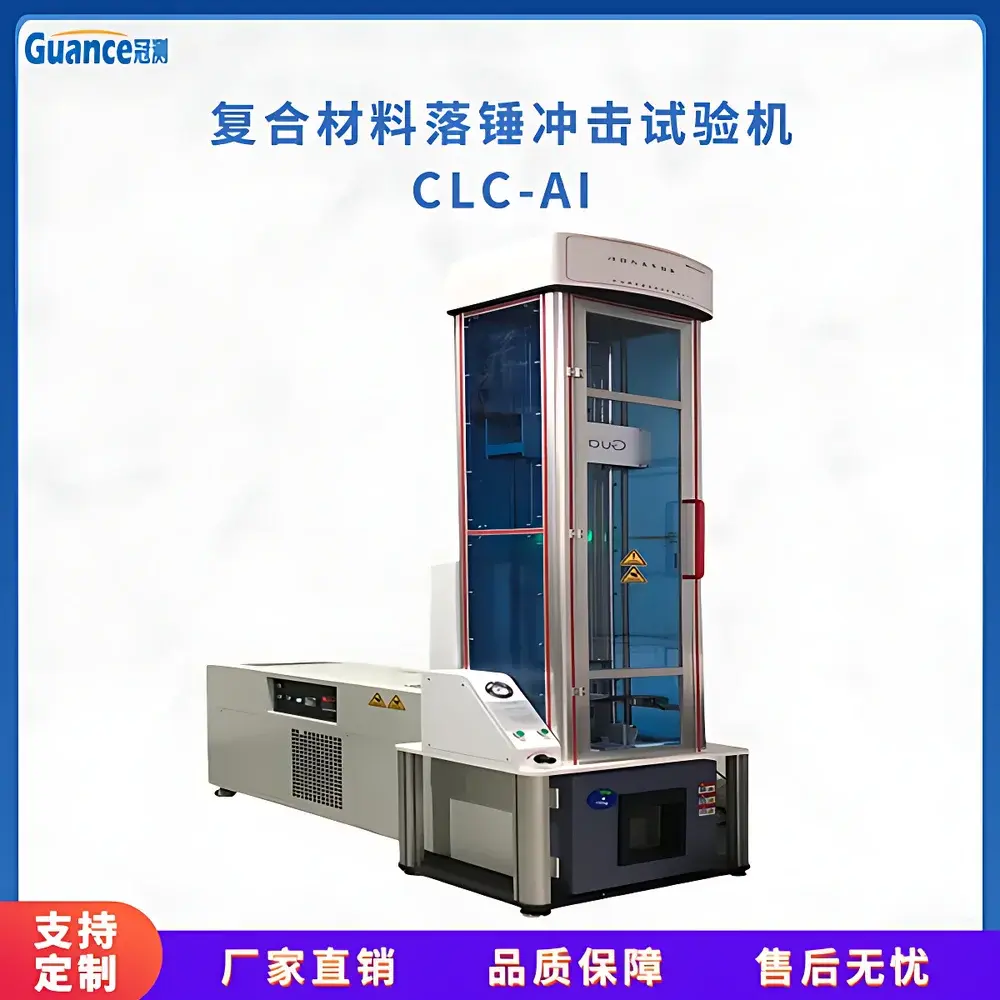
GuanCe CLC-AI Instrumented Drop-Weight Impact Tester for Composites
| Brand | GuanCe Instruments |
|---|---|
| Origin | Beijing, China |
| Manufacturer Type | Authorized Distributor |
| Country of Origin | China |
| Model | CLC-AI |
| Quotation | USD 4,200 (FOB Beijing) |
| Instrument Type | Drop-Weight Impact Tester |
| Impact Energy | 300 J |
| Impact Velocity | 25 m/s |
| Hammer Moment (Impact Constant) | 24 N·m |
| Load Cell Range | 300 kN |
| Maximum Lift Height | 1500 mm |
| Hammer Mass Options | 5 kg / 15 kg / 20 kg (customizable) |
| Effective Impact Height | 1500 mm |
| Dimensions (L×W×H) | 1200 × 700 × 2100 mm |
| Weight | 300 kg |
Overview
The GuanCe CLC-AI Instrumented Drop-Weight Impact Tester is an engineered solution for quantitative mechanical characterization of polymeric composites, fiber-reinforced laminates, and sandwich structures under dynamic impact loading. Based on the principle of instrumented drop-weight impact testing—where a guided hammer of known mass is released from a controlled height to strike a specimen—the system captures high-fidelity force-time, displacement-time, and velocity-time histories during impact events. Unlike conventional non-instrumented impact testers, the CLC-AI integrates a calibrated 300 kN piezoelectric load cell, high-speed optical velocity sensors, and synchronized data acquisition at ≥1 MHz sampling rate. This enables precise derivation of key energy partitioning parameters: incident kinetic energy, rebound kinetic energy, absorbed energy (Eabs), dissipated energy (Ediss), and damage initiation threshold. The test method aligns with fundamental fracture mechanics frameworks for rate-dependent material response, supporting both single-impact and sequential multi-impact protocols per standardized loading sequences.
Key Features
- Instrumented impact measurement with real-time acquisition of force, displacement, and velocity waveforms
- Motorized automatic hammer lifting, positioning, and release mechanism with programmable height control up to 1500 mm
- Dual-stage anti-rebound safety system to prevent secondary impact and ensure operator compliance with ISO 13849-1 Category 3 requirements
- Modular hammer assembly supporting interchangeable masses (5 kg, 15 kg, 20 kg) for adjustable impact energy scaling
- Integrated pneumatic sample clamping system with dual support fixtures (e.g., 100 mm × 100 mm and 150 mm × 150 mm span configurations)
- Rigid steel frame construction (300 kg total mass) with vibration-damped base and vertical guide columns ensuring ≤±0.3° alignment tolerance
- Pre-calibrated load cell traceable to CNAS-accredited metrology standards; resolution <0.1% FS
Sample Compatibility & Compliance
The CLC-AI accommodates flat composite specimens ranging from 5 mm to 25 mm in thickness and up to 200 mm × 200 mm in planar dimension. It supports standardized specimen geometries defined in ISO 3127 (plastics—impact resistance of rigid materials), ISO 6603-2 (determination of puncture impact behavior of plastics), ISO 7765-2 (impact resistance of plastic films), ISO 11343 (impact resistance of adhesives), ISO 8256 (tensile-impact testing), PREN 6038 (aerospace carbon-fiber laminates), DIN 53373 (impact testing of thermosetting resins), and multiple ASTM standards including D2444 (thermoplastic pipe), D3763 (high-speed puncture), D5628 (multi-impact fatigue), D7136 (compression-after-impact), and D7192 (open-hole compression after impact). All hardware and firmware comply with electromagnetic compatibility (EMC) per IEC 61326-1 and functional safety requirements per ISO 12100.
Software & Data Management
The proprietary GuanCe ImpactAnalysis v3.2 software provides full control of test execution, real-time waveform visualization, and post-test parametric extraction. It delivers automated calculation of maximum impact force (Fmax), peak deflection (δmax), time-to-Fmax, absorbed energy (Eabs = ½mvinc² − ½mvreb²), damage onset point (via first derivative inflection of force-displacement curve), and ductile-brittle transition indicators. Raw data exports are supported in ASCII (.txt), CSV, and universal binary formats compatible with MATLAB, Python (NumPy), and Minitab. Audit trail functionality meets GLP/GMP documentation requirements, including user login tracking, parameter change logs, and electronic signature support aligned with FDA 21 CFR Part 11 principles.
Applications
- Quantification of impact-induced delamination thresholds in CFRP and GFRP laminates
- Evaluation of matrix toughness enhancement via nano-additives (e.g., CNTs, graphene oxide)
- Correlation of absorbed energy with post-impact compressive strength (CAI) for aerospace qualification
- Multi-hit fatigue mapping for wind turbine blade material screening
- Validation of finite element models (e.g., LS-DYNA, Abaqus/Explicit) using experimentally derived force-time inputs
- Comparative assessment of toughening mechanisms across thermoset vs. thermoplastic composites
- Development of damage-tolerant architectures in automotive structural panels
FAQ
What standards does the CLC-AI fully support for composite impact testing?
The system is configured and validated for ISO 3127, ISO 6603-2, ISO 7765-2, ISO 11343, ISO 8256, PREN 6038, DIN 53373, ASTM D2444, D3763, D5628, D7136, and D7192.
Can the system perform sequential multi-impact tests with variable energy levels?
Yes—software-defined impact sequences allow programmable variation of drop height and hammer mass between impacts, with automated repositioning and data segmentation per impact event.
Is calibration documentation provided with the instrument?
Each unit ships with a factory calibration certificate for the load cell and velocity sensor, traceable to national metrology institutes (CNAS accreditation ID included).
What is the minimum detectable energy absorption resolution?
Based on 300 kN load cell sensitivity and 25 m/s velocity resolution, the system achieves ≤0.5 J effective energy resolution under standard 5 kg hammer conditions.
Does the system support integration with third-party DAQ or control platforms?
Yes—Ethernet-based TCP/IP API and LabVIEW-compatible drivers are available for OEM-level integration into larger test automation environments.



