
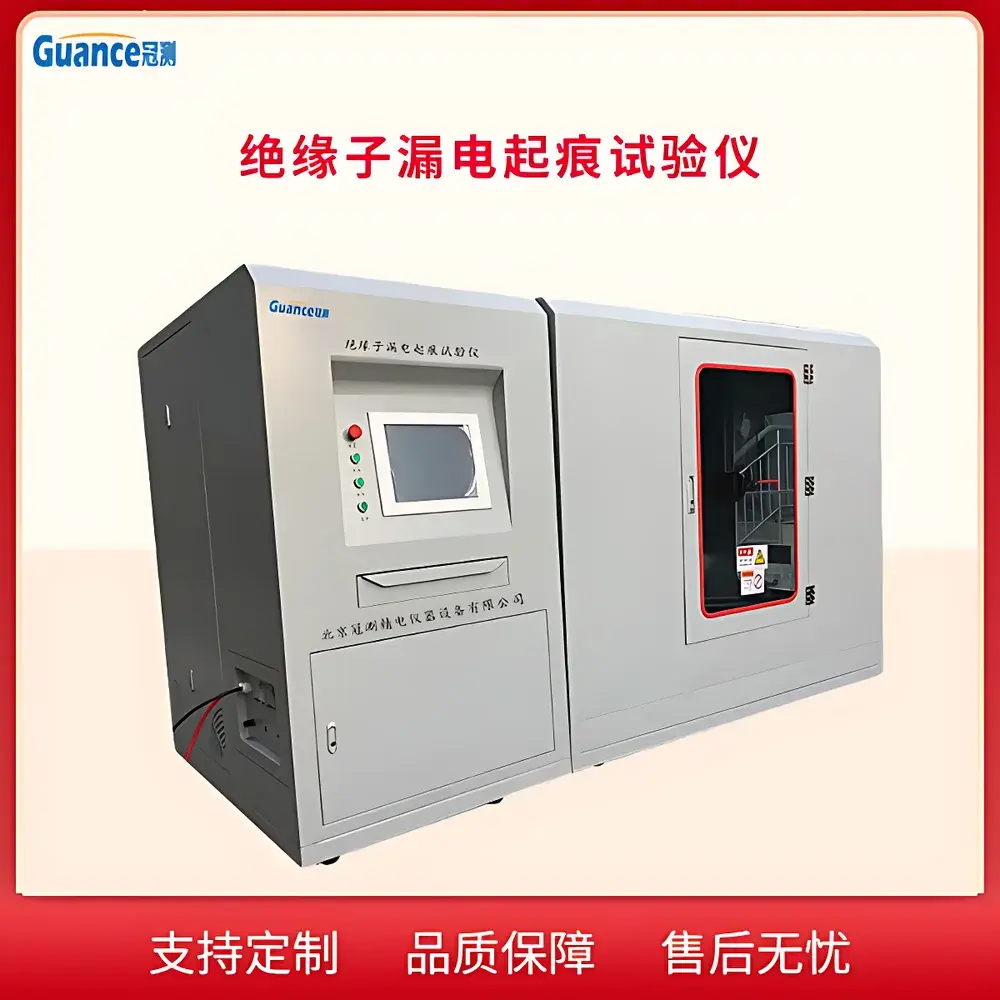
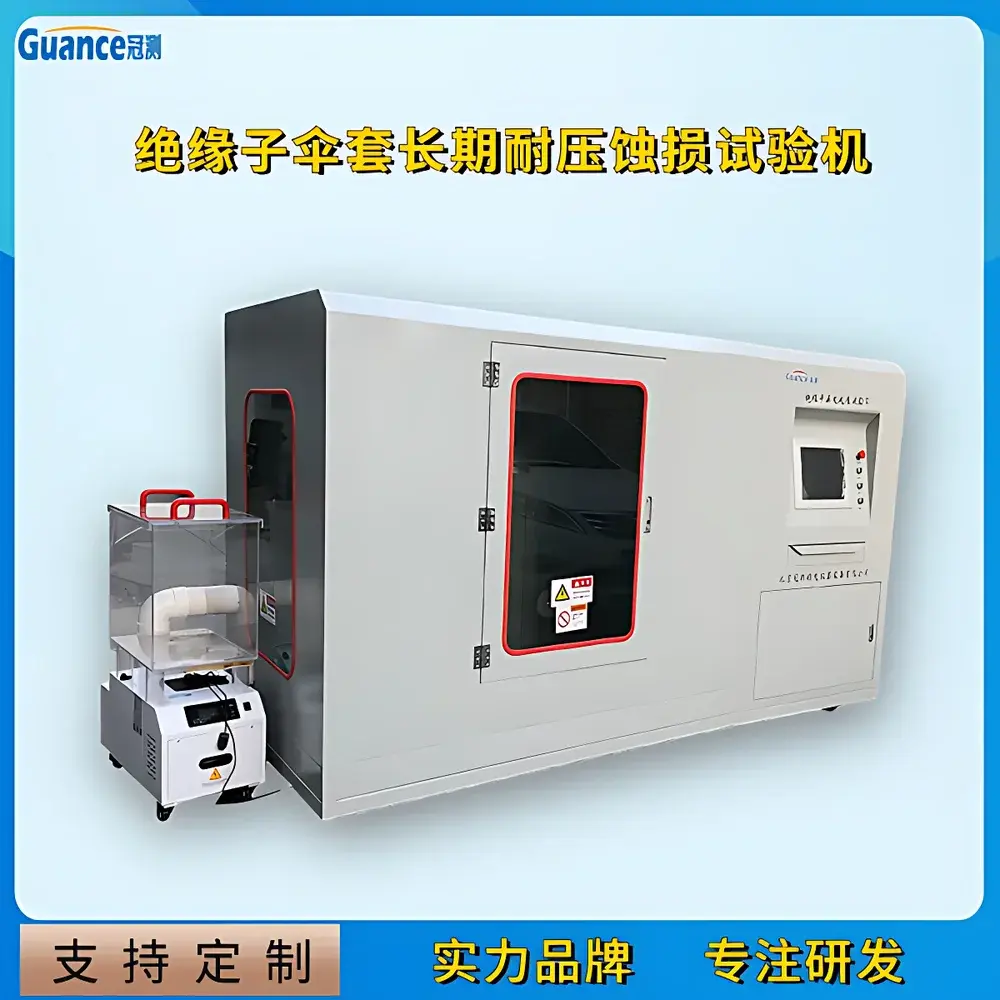
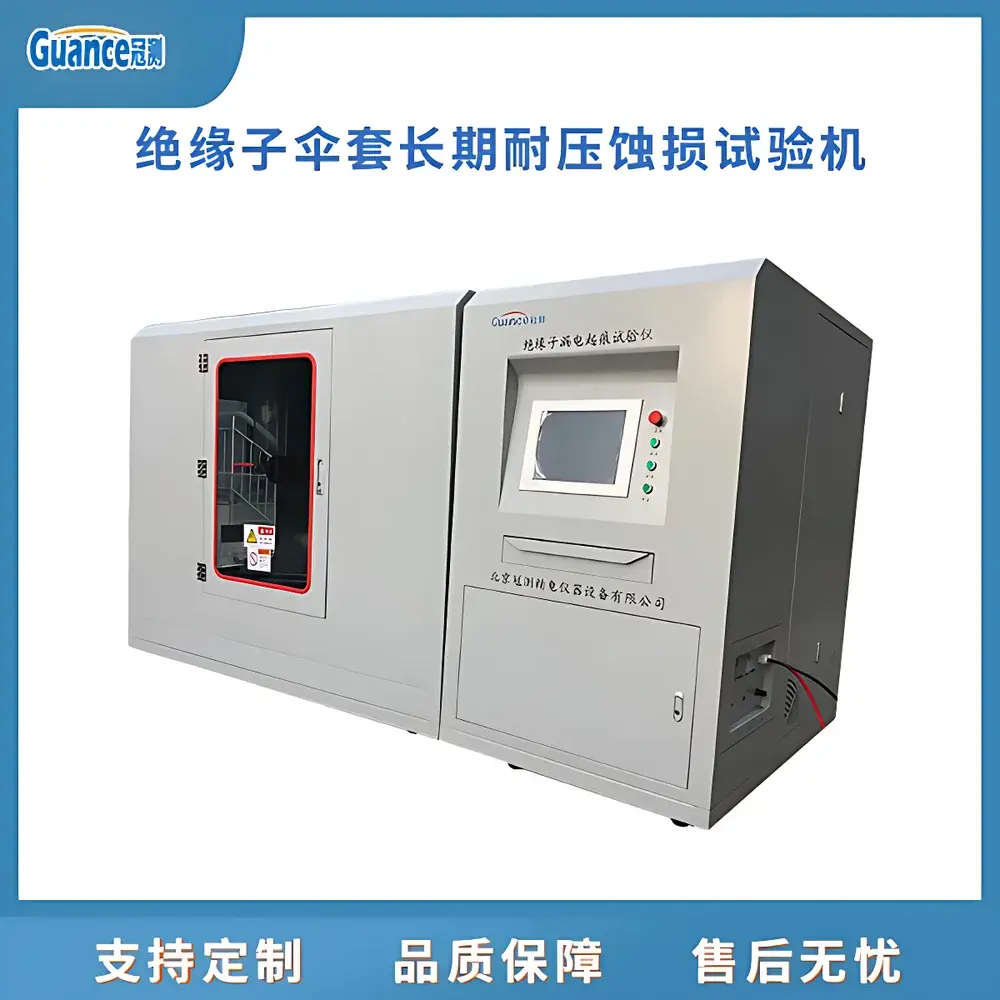
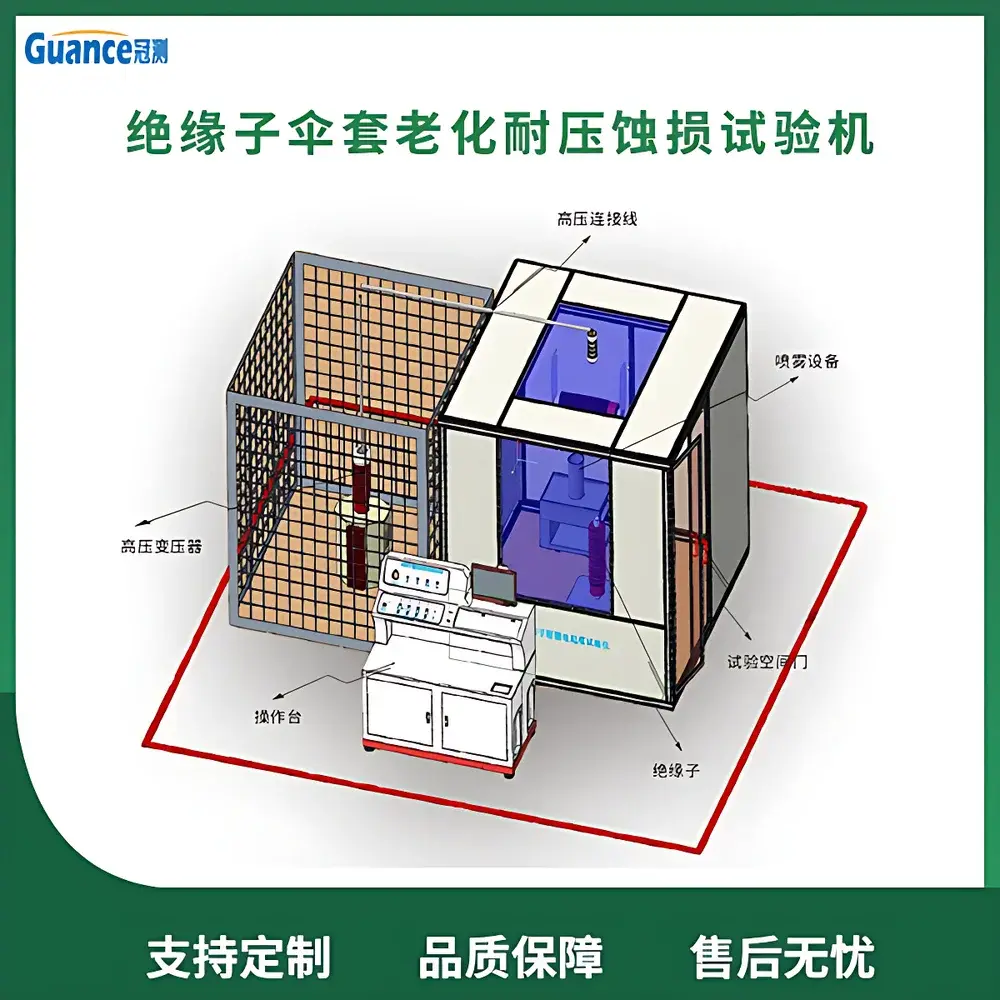
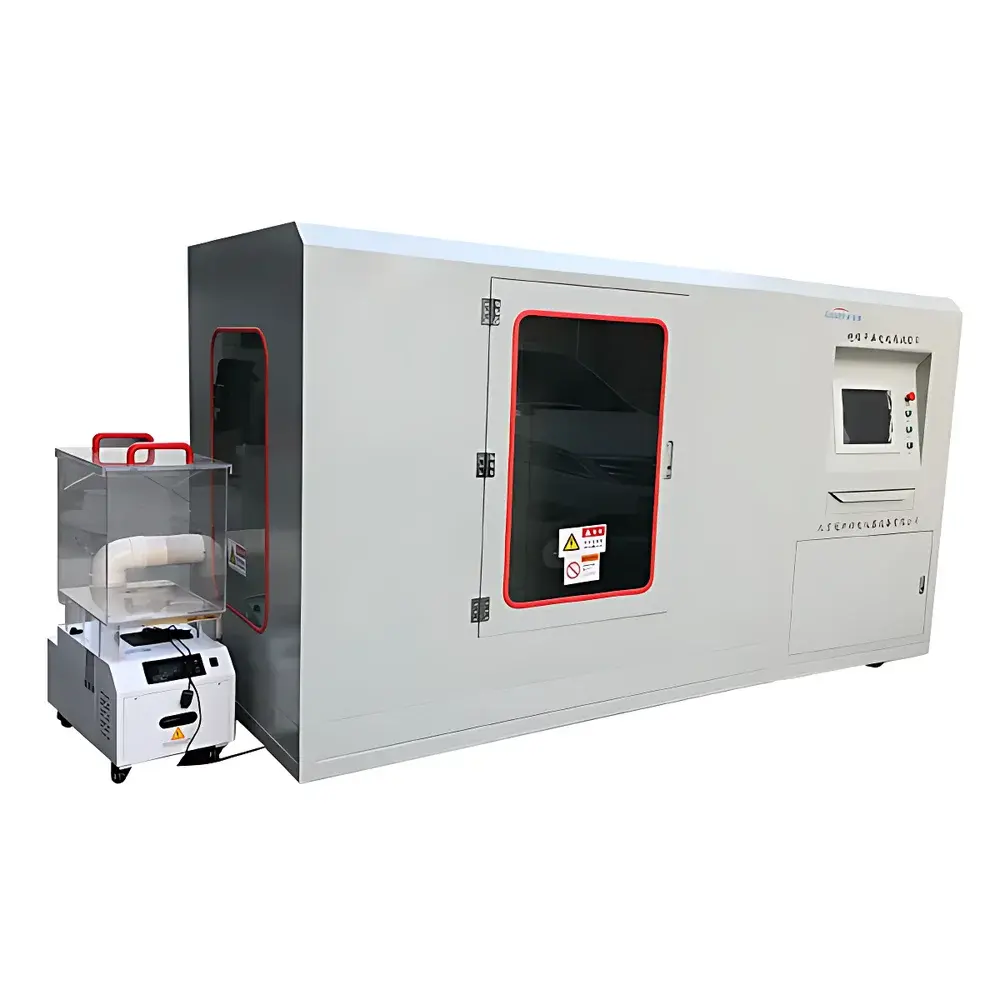
Guance Instruments NLD-AII1 Insulator Tracking & Erosion Salt Fog Test Chamber
| Brand | Guance Instruments |
|---|---|
| Origin | Beijing, China |
| Model | NLD-AII1 |
| Output Voltage Range | AC 0–50 kV / DC –50 to 0 kV (adjustable) |
| Electrical Capacity | 50 kVA |
| High-Voltage Side Output Current | ≥1 A |
| Voltage Test Accuracy | <2% |
| Current Measurement Accuracy | <1% |
| Salt Fog Deposition Rate | (0.4 ± 0.1) L/m³·h |
| 雾室 Volume | 4 m³ (L×W×H = 2000 × 1200 × 1700 mm) |
| 雾化 Particle Size | 5–10 µm |
| Spray Velocity at Specimen | 3 m/s |
| Specimen Spacing | >400 mm from ceiling and walls |
| Test Duration | 1000 h |
| Specimen Capacity | 1 horizontal + 1 vertical insulator |
| Control System | Embedded industrial computer |
| Dimensions (L×W×H) | 3400 × 1300 × 1800 mm |
| Weight | 300 kg |
| Compliance | GB/T 20142–2006, GB/T 22079–2008 |
Overview
The Guance Instruments NLD-AII1 Insulator Tracking & Erosion Salt Fog Test Chamber is a purpose-built environmental test system engineered for evaluating the long-term dielectric integrity and surface degradation resistance of high-voltage polymeric insulators under combined electrical stress and corrosive saline fog conditions. It operates on the principle of accelerated aging via simultaneous application of alternating or direct high voltage and controlled salt fog exposure in a sealed, temperature-stabilized chamber. Designed specifically for compliance with GB/T 20142–2006 (for overhead line post composite insulators rated above 1 kV AC) and GB/T 22079–2008 (for indoor/outdoor polymer insulators), the NLD-AII1 replicates field-relevant electrochemical erosion mechanisms—including surface tracking, dry-band arcing, and electrolytic corrosion—under standardized test durations up to 1000 hours. The system integrates a precision high-voltage source, ultrasonic salt fog generation, real-time electrical parameter monitoring, and embedded industrial control architecture to ensure reproducible, auditable test execution.
Key Features
- High-voltage generator with dual-mode output: AC 0–50 kV and DC –50 to 0 kV, continuously adjustable with <2% voltage measurement accuracy and <1% current measurement accuracy
- Ultrasonic fogging system delivering uniform NaCl-based saline mist at precisely regulated deposition rate of (0.4 ± 0.1) L/m³·h and particle size distribution of 5–10 µm
- Controlled spray velocity of 3 m/s at specimen location, ensuring consistent wetting and ion deposition across insulator surfaces
- Robust 4 m³ fog chamber (2000 × 1200 × 1700 mm) constructed with corrosion-resistant materials and optimized internal airflow to minimize stratification and promote uniform fog distribution
- Embedded industrial computer control system supporting full test lifecycle management: start/pause/resume with cumulative time logging, real-time voltage/current curve plotting, overcurrent protection with user-defined thresholds, and automatic high-voltage shutdown upon door interlock activation
- Comprehensive safety architecture including mechanical limit switches, zero-voltage reset on door opening, and integrated overcurrent and thermal overload protection
Sample Compatibility & Compliance
The NLD-AII1 accommodates two standard insulator specimens per test cycle—one mounted horizontally and one vertically—each positioned with ≥400 mm clearance from chamber walls and ceiling to ensure unimpeded fog circulation and eliminate edge-effect artifacts. Specimens must conform to IEC 60587 or GB/T 20142/GB/T 22079 dimensional and material specifications. The system supports both ceramic and polymeric (silicone rubber, EPDM) insulator types used in transmission and distribution networks. All operational parameters—including voltage ramp rates, dwell times, fog concentration, and ambient temperature—are configurable to align with national and international standards. While primarily validated against Chinese national standards, its test methodology is technically compatible with ASTM D2303 (electrical endurance of insulating materials) and IEC 60587 (tracking and erosion resistance of electrical insulating materials) when adapted with appropriate procedural documentation.
Software & Data Management
The embedded control software provides traceable, GLP-aligned data handling capabilities. Real-time oscillographic plots of applied voltage and leakage current are rendered continuously during operation. All measured parameters—including instantaneous voltage, current, elapsed time, and system status flags—are timestamped and stored in non-volatile memory. Historical test records are searchable by date, specimen ID, or operator. Electronic reports are generated in PDF format with embedded metadata (test standard reference, calibration dates, operator name, chamber conditions). Raw data exports are supported via USB interface in CSV format for external statistical analysis or integration into laboratory information management systems (LIMS). Audit trails record all user actions—including parameter modifications, pause/resume events, and calibration adjustments—satisfying basic requirements for ISO/IEC 17025 and FDA 21 CFR Part 11 compliant environments when deployed with appropriate organizational SOPs.
Applications
- Evaluation of tracking and erosion resistance of silicone rubber and ethylene propylene diene monomer (EPDM) composite insulators for high-voltage transmission lines
- Comparative qualification testing of new polymer formulations or manufacturing process changes under standardized saline fog stress
- Root cause analysis of field failures involving insulator flashover, surface carbonization, or hydrophobicity loss
- Supporting type testing and routine quality assurance for insulator manufacturers seeking GB/T certification
- Research into electrodynamics of dry-band formation, leakage current harmonics, and partial discharge inception under humid saline conditions
FAQ
What standards does the NLD-AII1 comply with?
The system is designed and validated for GB/T 20142–2006 and GB/T 22079–2008. Its operational principles align with IEC 60587 and ASTM D2303 when configured per respective test protocols.
Can the test be paused and resumed without losing accumulated runtime?
Yes—the embedded controller maintains cumulative elapsed time across pause/resume cycles, preserving test continuity and data integrity for multi-day 1000-hour evaluations.
Is the salt fog concentration automatically maintained during extended tests?
The ultrasonic雾化器 delivers stable雾化 output; however, periodic manual verification of NaCl solution concentration and reservoir level is required per GB/T 22079 Annex B to ensure sustained deposition rate accuracy.
What safety interlocks are implemented?
Door-activated high-voltage cutoff with automatic zero-voltage reset, overcurrent tripping with adjustable threshold, and thermal overload protection on the 50 kVA transformer bank.
Does the system support remote monitoring or network connectivity?
The base configuration includes local HMI and USB data export. Optional Ethernet or RS-485 interfaces can be integrated for SCADA or centralized lab network integration upon request.



