
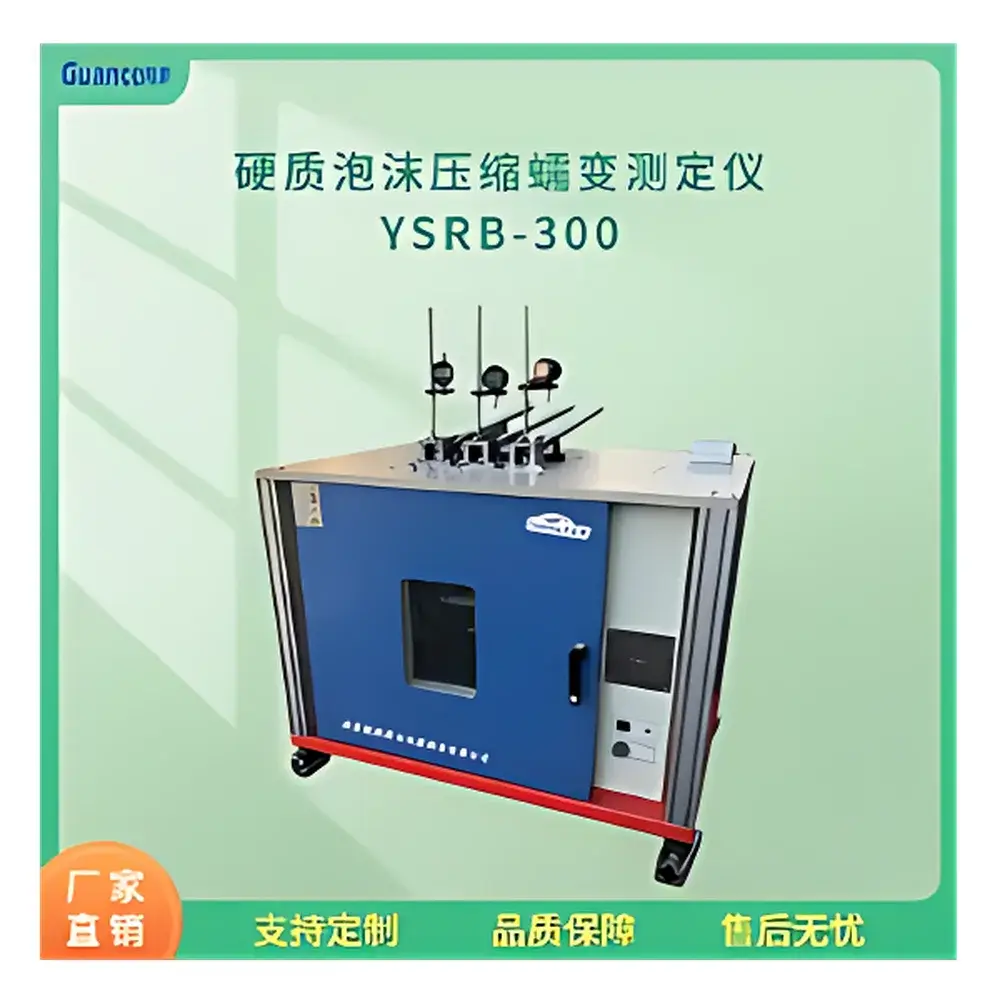
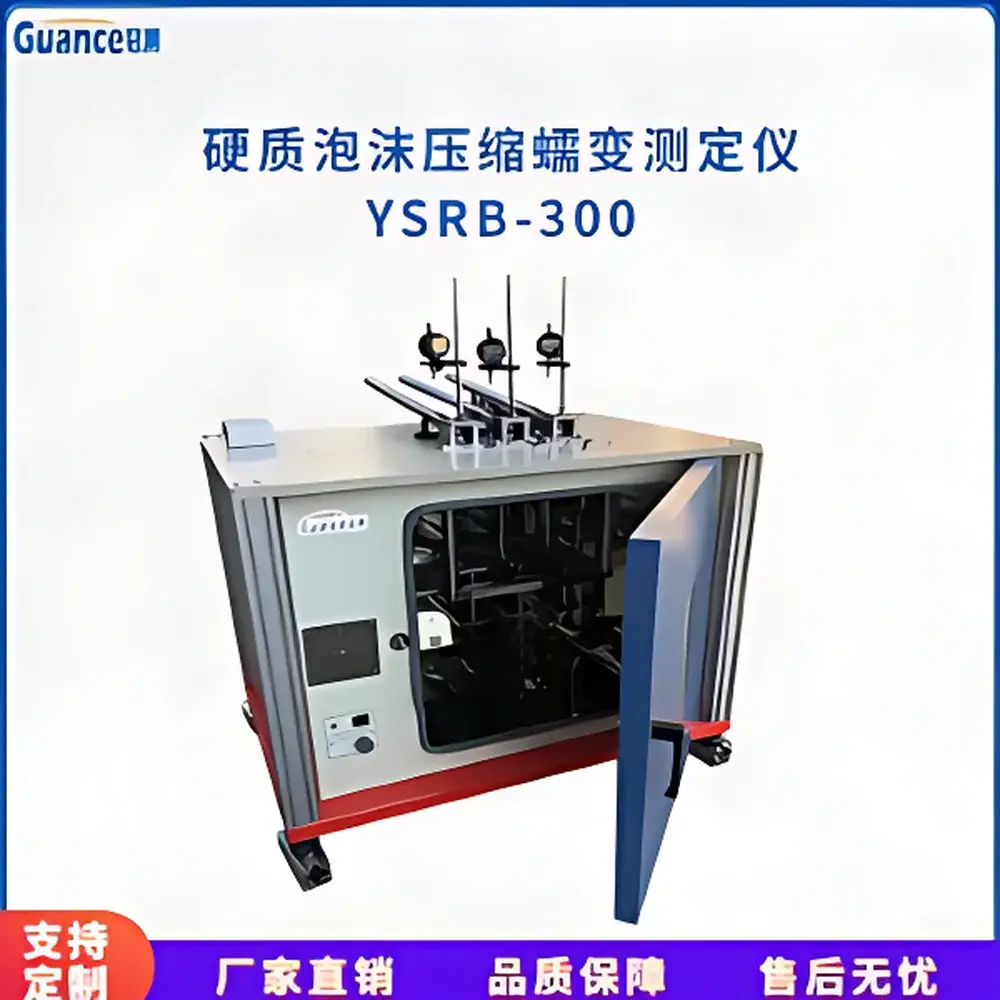
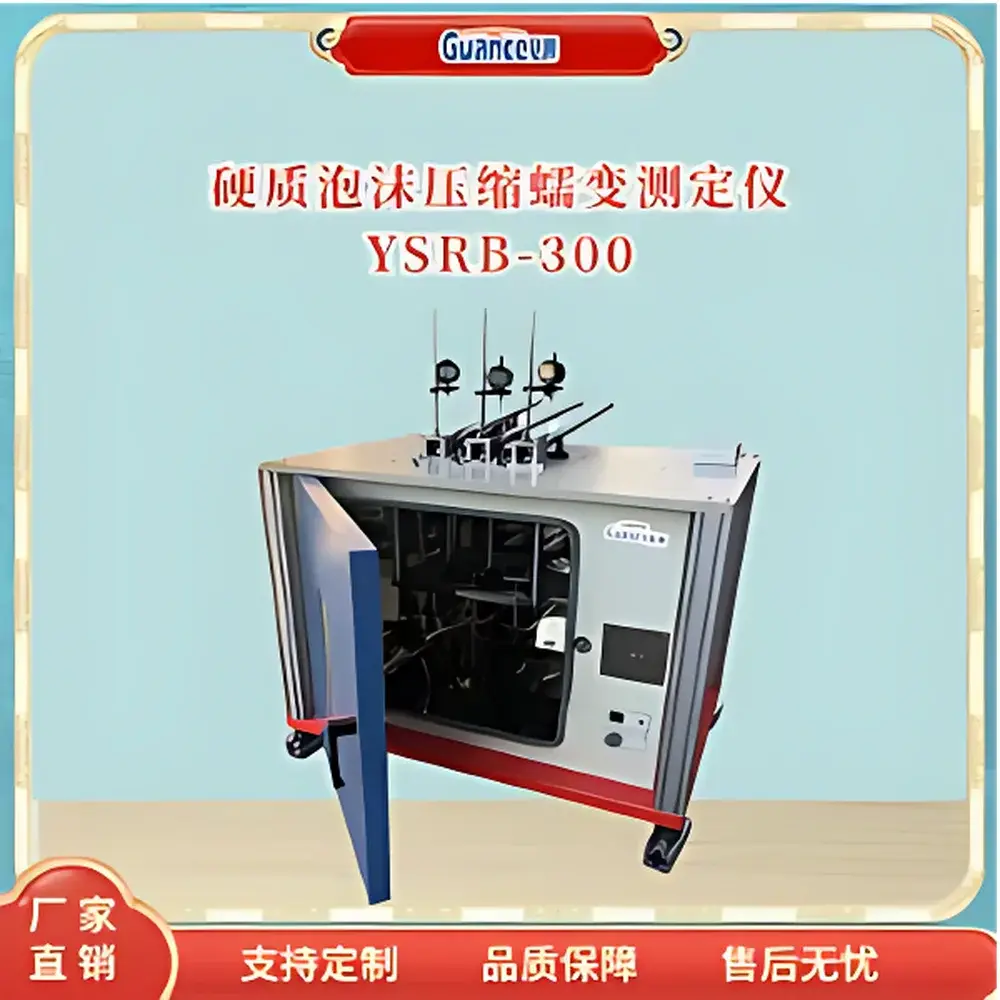
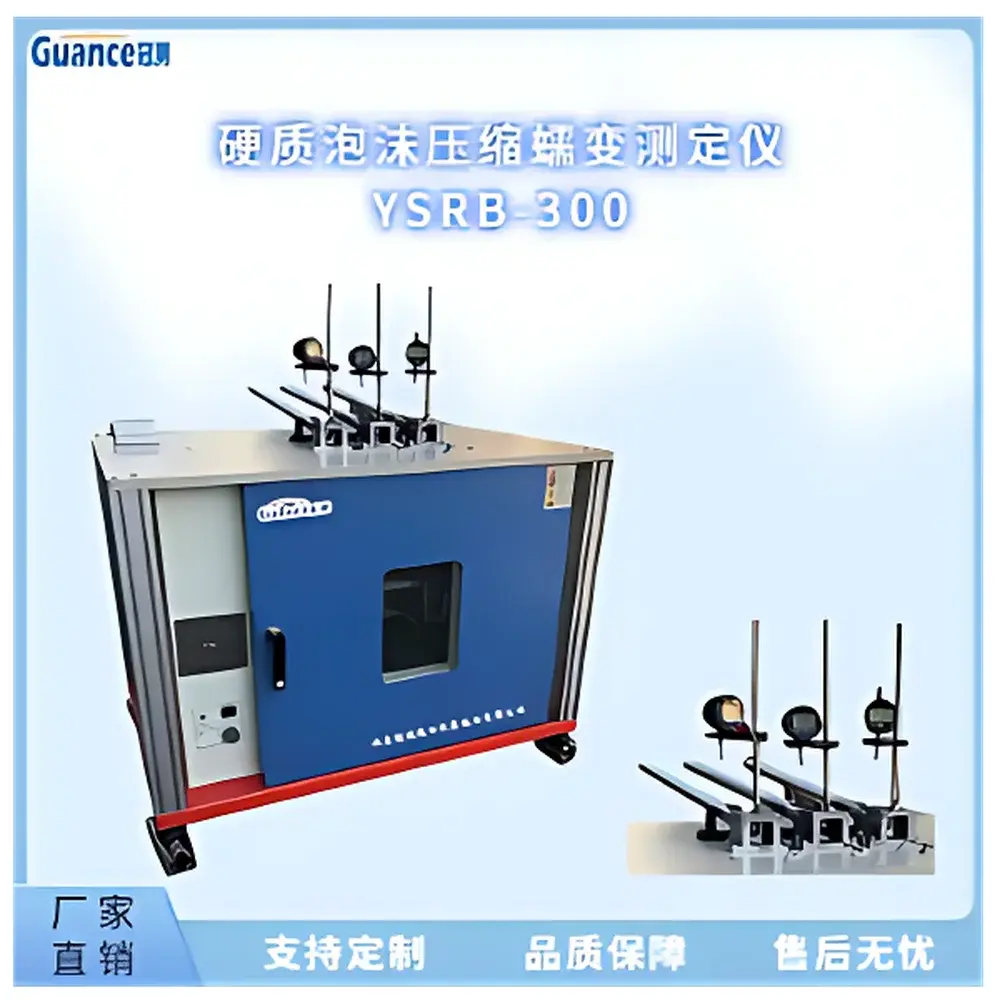
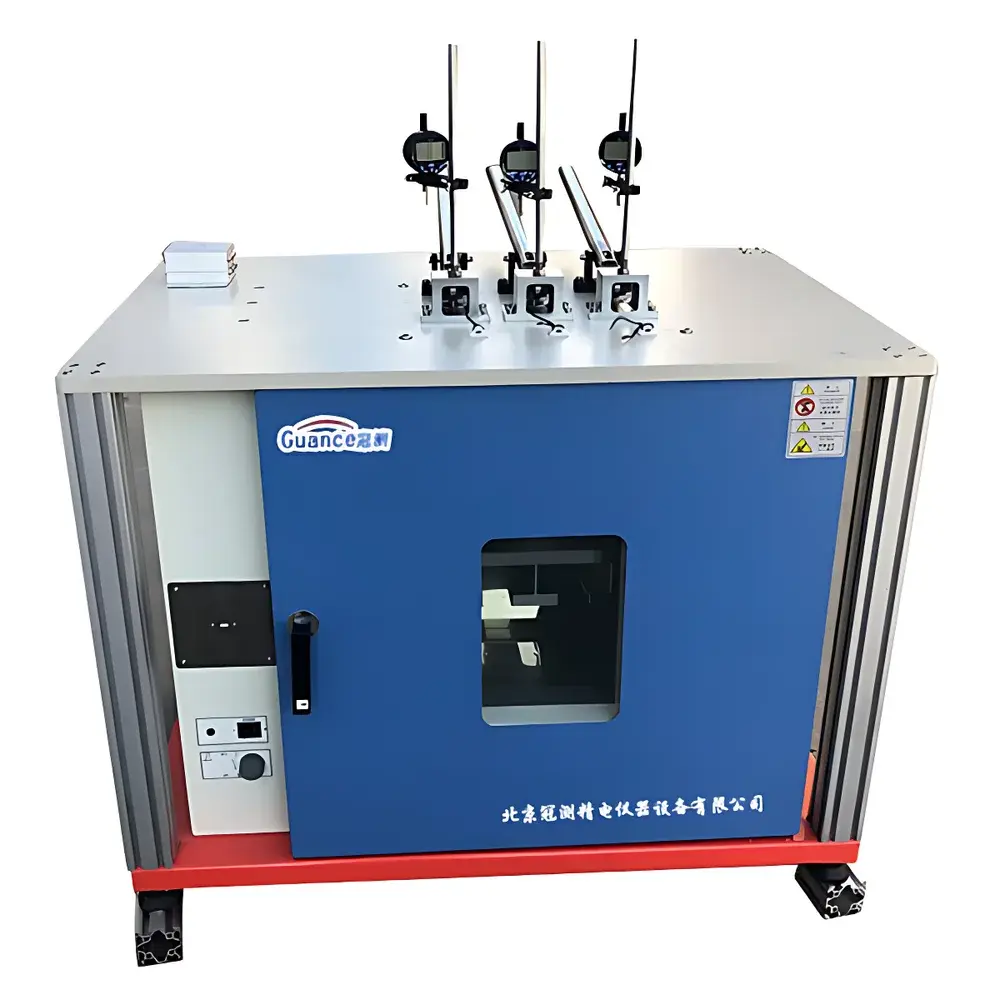
GuanCe Instruments YSRB-300B Hard Foam Compression Creep Testing Machine
| Brand | GuanCe Instruments |
|---|---|
| Origin | Beijing, China |
| Manufacturer Type | Authorized Distributor |
| Country of Origin | China |
| Model | YSRB-300B |
| Instrument Type | Electromechanical |
| Maximum Test Load | 100 N |
| Max Plunger Stroke | 180 mm |
| Overall Dimensions (L×W×H) | 1850 × 1580 × 1230 mm |
| Net Weight | 50 kg |
| Heating Method | Air-bath |
| Temperature Range | Ambient to 300 °C |
| Temperature Stability | ±2 °C |
| Heating Rate Options | 50 ±3 °C/h or 10 ±2 °C/12 min |
| Temperature Resolution | 0.1 °C |
| Deformation Measurement Accuracy | ±0.002 mm |
| Specimen Dimensions | 50 × 50 × 50 mm or 40 × 40 × 20 mm |
| Compression Platen Size | 50 × 50 mm (triple station) |
| Recommended Stress Range | 0–1 MPa |
| Heating Chamber Volume | 350 × 400 × 400 mm |
| Lever Load Amplification Ratio | 1:32 |
| Test Modes | Compression (lever-weight loading), Bending (direct-weight loading) |
| Standard Compliance | GB/T 20672–2006, DIN 53424 |
Overview
The GuanCe Instruments YSRB-300B Hard Foam Compression Creep Testing Machine is a precision electromechanical system engineered for standardized evaluation of time-dependent compressive deformation in rigid cellular plastics under sustained mechanical load and elevated temperature conditions. It operates on the fundamental principle of controlled uniaxial compression creep testing, where a constant compressive stress is applied to a conditioned specimen within a thermally stabilized air-bath chamber, and dimensional change is measured continuously over time—typically ranging from hours to thousands of hours—according to ISO 844, ASTM D2990, and GB/T 20672–2006 protocols. Unlike generic universal testers, the YSRB-300B integrates dedicated thermal management, high-resolution displacement transduction, and multi-channel synchronized data acquisition to meet the stringent requirements of long-term creep compliance testing for insulation foams, structural sandwich cores, and automotive seating materials.
Key Features
- Triple independent test stations enable parallel creep evaluations under identical thermal and mechanical conditions—enhancing statistical robustness and throughput efficiency.
- Air-bath heating system with PID-controlled circulation ensures uniform thermal distribution across the 350 × 400 × 400 mm chamber; temperature stability maintained within ±2 °C over full 300 °C range.
- High-accuracy optical grating micrometer transducers deliver deformation resolution of ±0.002 mm, traceable to national metrological standards.
- Lever-based mechanical amplification (1:32 ratio) enables precise application of low-stress loads (0–1 MPa) using calibrated stainless-steel weights—eliminating electronic actuator drift during extended tests.
- Dual-mode loading architecture supports both compression (lever-assisted) and three-point bending configurations via interchangeable fixtures and dedicated load trains.
- Real-time color-coded curve visualization displays strain vs. time and temperature vs. time synchronously, with auto-saved raw data in CSV and proprietary binary formats.
Sample Compatibility & Compliance
The YSRB-300B accommodates standard specimen geometries defined in GB/T 20672–2006 (50 × 50 × 50 mm cubes) and DIN 53424 (40 × 40 × 20 mm prisms), with optional custom platens available for non-standard cross-sections up to 60 mm width. All test procedures align with internationally recognized methodologies: compression creep compliance per ISO 844 Annex C, stress relaxation behavior per ASTM D2990 Annex A3, and thermal dimensional stability per DIN 53424. The system’s mechanical loading design satisfies GLP audit requirements for manual weight-based force application—providing inherent traceability without reliance on force transducer calibration drift. Data acquisition firmware supports timestamped metadata logging required for FDA 21 CFR Part 11-compliant environments when paired with validated PC hardware and audit-trail-enabled software.
Software & Data Management
Embedded microcontroller firmware manages closed-loop temperature regulation, real-time displacement sampling at 1 Hz, and synchronized event tagging (e.g., load application, temperature setpoint achievement, termination criteria). Exported datasets include absolute displacement (µm), calculated strain (%), applied stress (MPa), chamber temperature (°C), and elapsed time (h:min:s). The included Windows-based analysis suite permits baseline correction, logarithmic time scaling, master curve construction via time–temperature superposition (TTS), and automated reporting per ISO 10360–7 geometric accuracy verification templates. All raw files are stored with immutable headers containing operator ID, calibration certificate IDs, and environmental ambient logs—enabling full retrospective traceability.
Applications
This system serves laboratories engaged in formulation development and quality assurance for polyisocyanurate (PIR), polyurethane (PUR), phenolic, and expanded polystyrene (EPS) foams used in building envelope systems, aerospace thermal insulation, railway interior panels, and cold-chain packaging. It quantifies critical performance parameters including: long-term compressive set recovery, temperature-dependent creep modulus reduction, onset of viscoelastic yielding under service temperatures, and comparative ranking of binder thermal stability. In R&D settings, it supports accelerated aging studies correlating short-term creep response with predicted 25-year service life per EN 13165 Annex E.
FAQ
What standards does the YSRB-300B directly support?
GB/T 20672–2006, DIN 53424, ISO 844, and ASTM D2990—covering compression creep, thermal dimensional stability, and stress relaxation in rigid cellular plastics.
Can the system perform both compression and bending tests simultaneously?
No—compression and bending modes require separate fixture installation and load train configuration; however, all three stations can be configured identically for replicate testing within one mode.
Is the deformation measurement system calibrated and traceable?
Yes—optical grating sensors are factory-calibrated against NIM (National Institute of Metrology, China) reference standards, with certificate of calibration supplied; users may perform field verification using certified gauge blocks.
Does the system meet regulatory requirements for pharmaceutical or medical device testing?
While not pre-validated for GMP environments, its mechanical loading architecture, audit-ready data export, and deterministic control logic make it suitable for IQ/OQ validation protocols under ISO 13485 or ICH Q5E frameworks.
What maintenance is required for long-term reliability?
Annual verification of temperature uniformity (per ASTM E220), periodic cleaning of air-circulation ducts, and biannual re-tensioning of lever linkages—documented in the provided Maintenance Logbook.



