
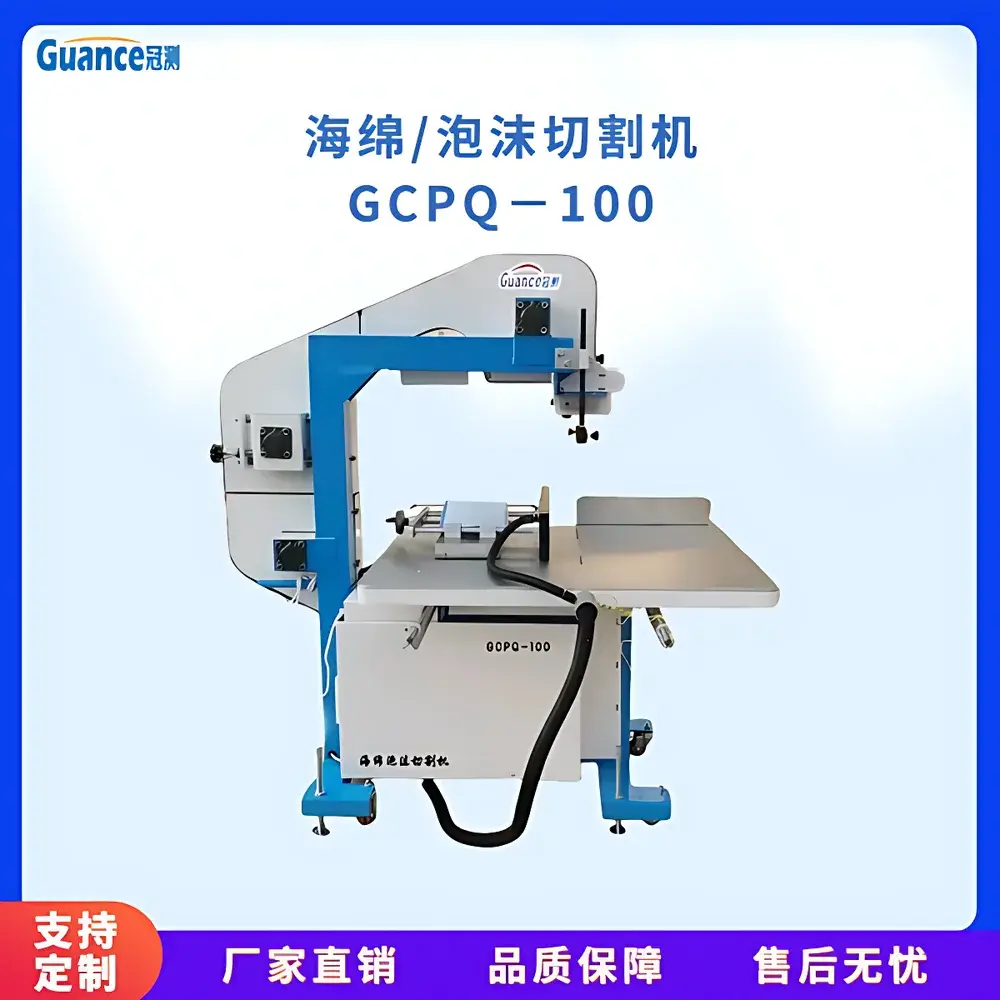
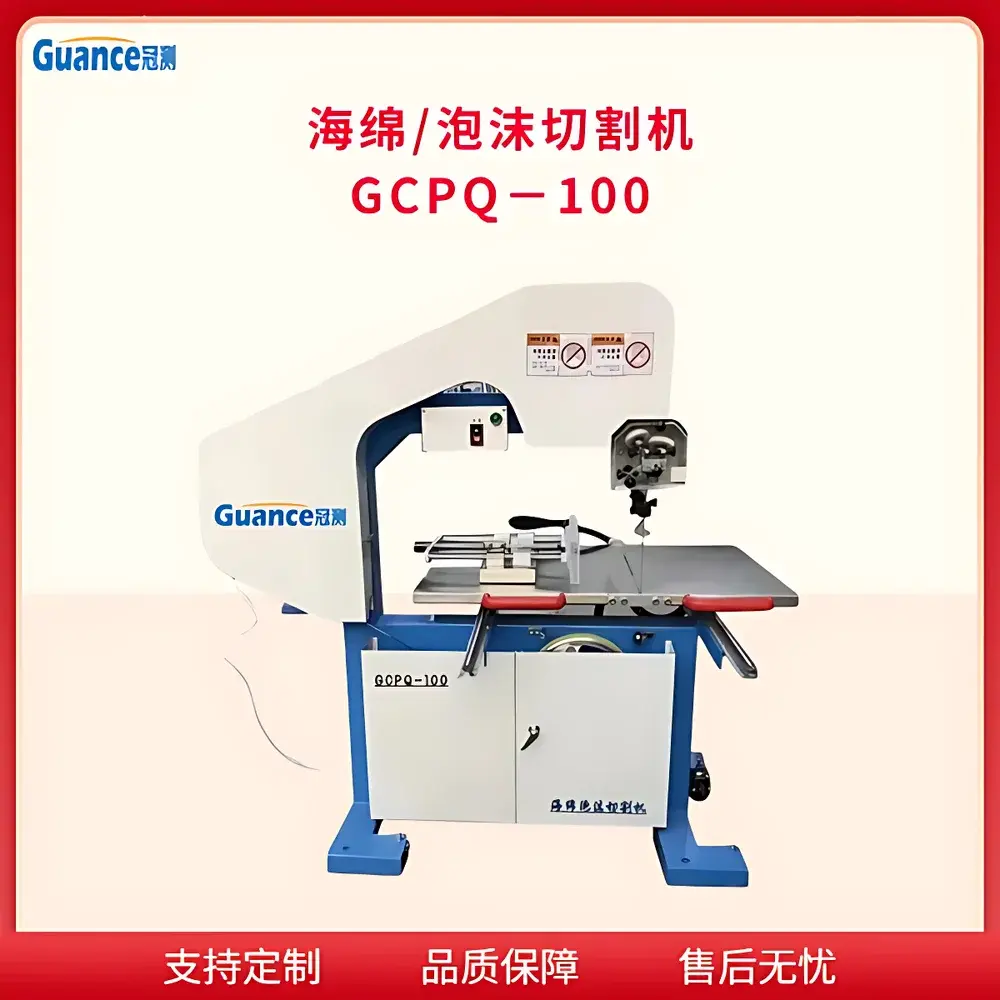
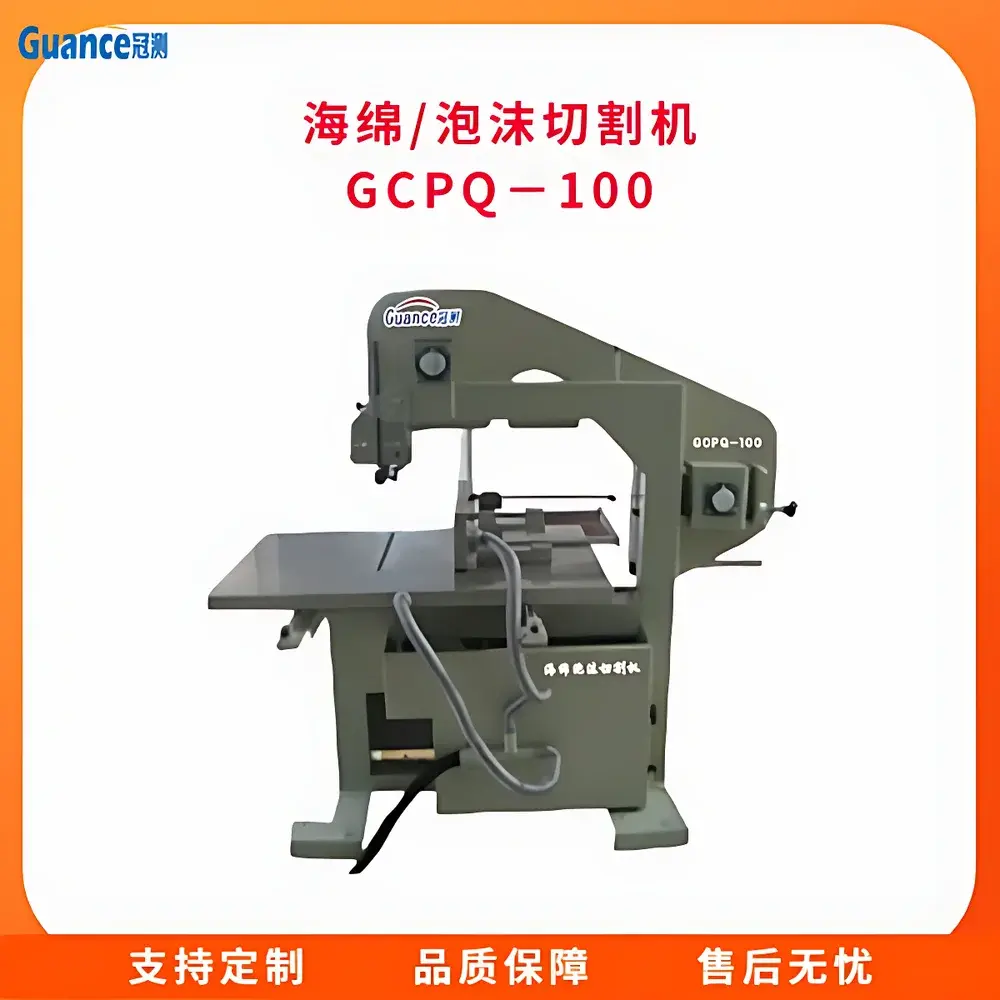
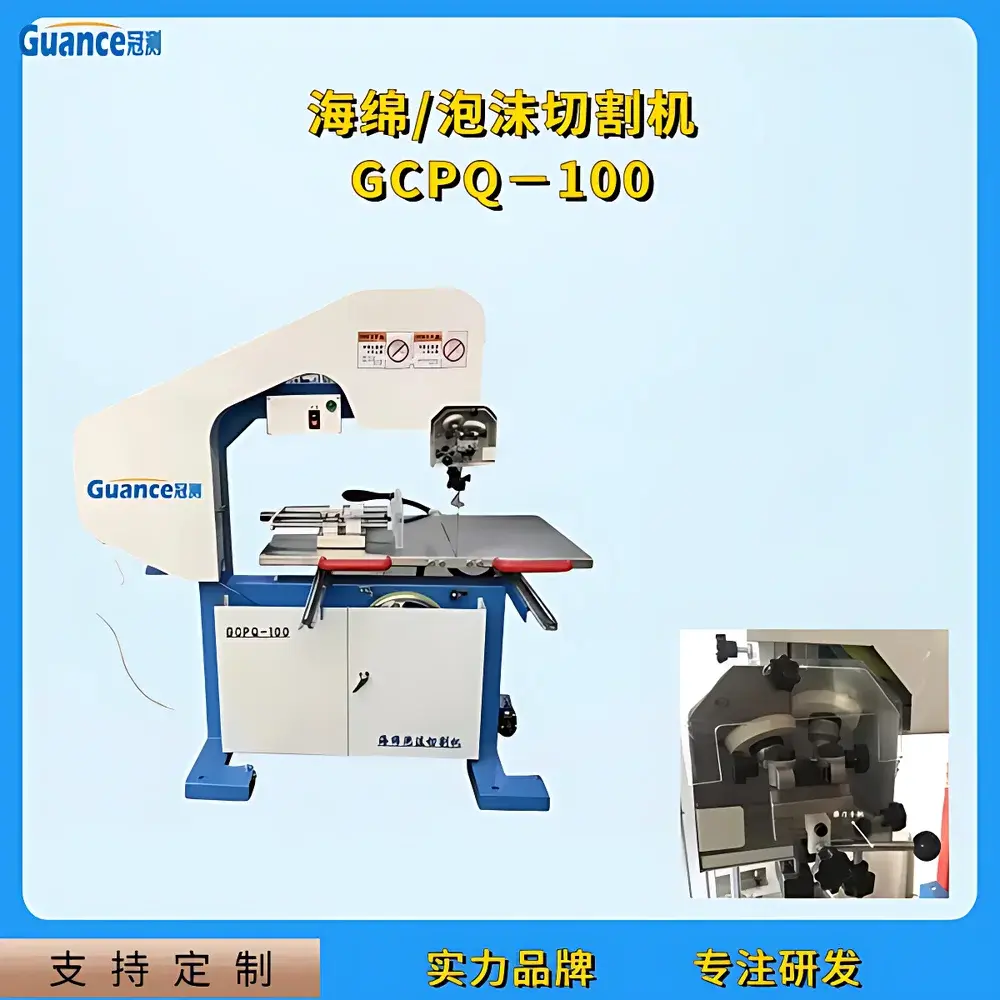
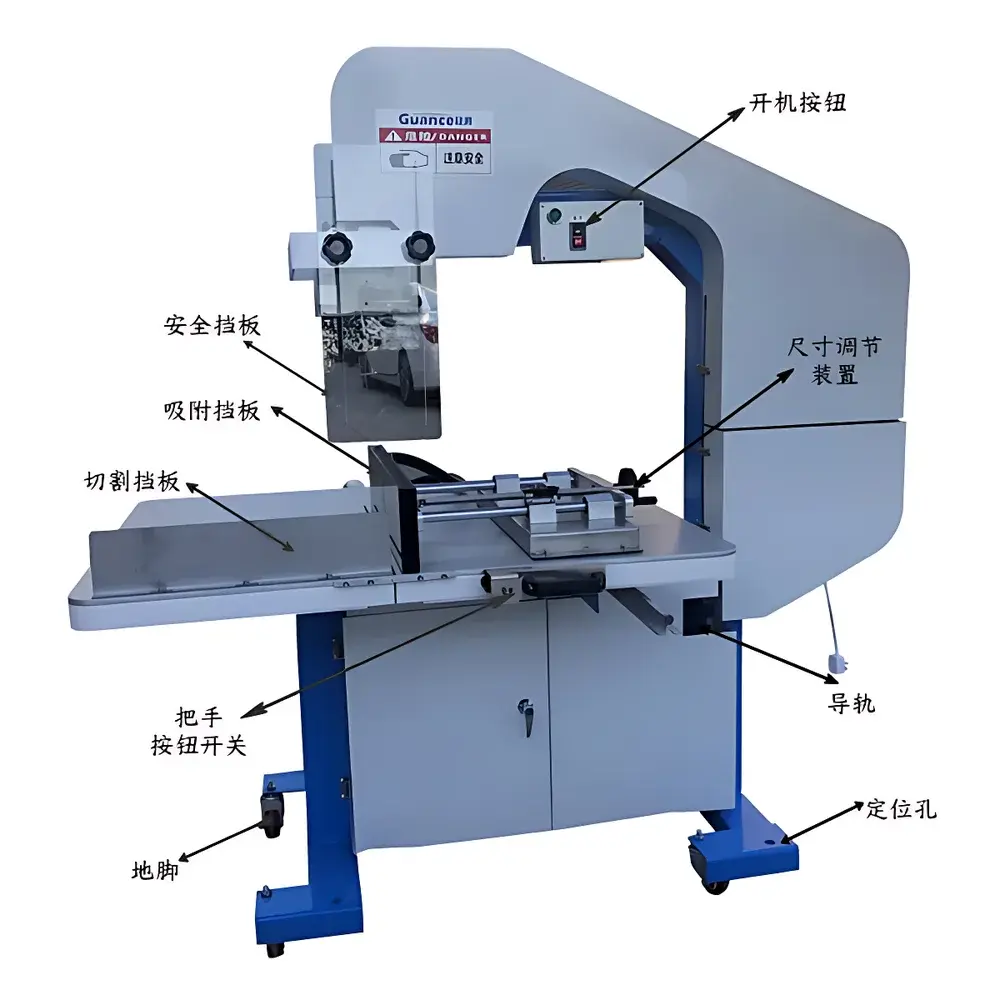
GuanCe Instruments GCPQ-100.4 Precision Foam Cutting Machine
| Brand | GuanCe Instruments |
|---|---|
| Origin | Beijing, China |
| Manufacturer Type | Authorized Distributor |
| Country of Origin | China |
| Model | GCPQ-100.4 |
| Instrument Category | Precision Cutting Machine |
| Digital Scale Resolution | 0.01 mm |
| Cutting Dimensional Accuracy | ±1 mm (material-dependent) |
| Worktable Dimensions | 1000 × 700 mm (customizable) |
| Worktable Material | Anodized Aluminum |
| Guard Material | Acrylic |
| Effective Travel Stroke | 500 mm |
| Maximum Cutting Thickness | 400 mm |
| Rated Voltage | 220 V / 50 Hz |
| Power Consumption | 1 kW |
| Blade Circumference | 3920 mm |
| Cutting Sample Size Range | 25 × 25 × 10 mm |
| Vacuum Fixturing | Integrated Negative-Pressure Adsorption System |
Overview
The GuanCe Instruments GCPQ-100.4 Precision Foam Cutting Machine is an engineered solution for standardized, repeatable sectioning of low-density polymeric cellular materials—primarily flexible and semi-rigid polyurethane (PU) foams, ethylene-vinyl acetate (EVA) sponges, expanded polystyrene (EPS), and cross-linked polyethylene (XLPE) foams. It operates on a continuous-band hot-wire cutting principle: a tensioned, electrically heated nichrome or stainless-steel wire traverses horizontally across a stabilized aluminum platform while the workpiece remains stationary or moves under vacuum-assisted fixation. This configuration eliminates mechanical compression deformation typical of blade-based systems, preserving foam cell structure integrity and minimizing thermal distortion at cut edges. Designed for laboratory-scale sample preparation in materials testing labs, quality control departments, and R&D centers, the GCPQ-100.4 supports compliance-driven workflows where dimensional consistency—particularly for ASTM D3574 (flexible cellular materials), ISO 1856 (foam compression testing), and GB/T 6342 (Chinese national standard for foam linear dimensions)—is critical to downstream mechanical characterization.
Key Features
- High-flatness anodized aluminum worktable (1000 × 700 mm base footprint, customizable) ensures uniform substrate support and minimizes localized deflection during vacuum fixation.
- Stepwise jog control interface enables precise incremental positioning of the cutting carriage; real-time start/stop functionality enhances operator safety and process repeatability.
- Multi-tier acrylic guard system complies with IEC 61000-6-2 (immunity) and IEC 61000-6-4 (emission) standards for lab equipment, reducing risk of accidental contact with the heated wire.
- Integrated digital caliper scale with 0.01 mm resolution provides traceable, on-machine dimensional verification prior to each cut—supporting GLP documentation requirements.
- On-board diamond-coated grinding assembly allows in-situ blade maintenance without disassembly, maintaining consistent wire tension and thermal profile over extended service intervals.
- Vacuum-based negative-pressure fixation system (rated suction ≥ -60 kPa) secures irregular or low-modulus foam specimens without surface indentation or lateral slippage.
- Damped carriage motion system—featuring elastomeric shock absorbers and low-backlash linear guides—reduces operational noise to ≤62 dB(A) at 1 m distance, meeting ISO 7779 acoustic emission guidelines for shared lab environments.
Sample Compatibility & Compliance
The GCPQ-100.4 accommodates a broad range of soft-to-medium density cellular polymers with densities from 10–120 kg/m³ and Shore 00 hardness values between 10–60. Compatible substrates include open-cell PU foams (e.g., automotive seating cores), closed-cell EVA midsoles, reticulated foams for filtration media, and biomedical-grade silicone sponge matrices. The machine does not support conductive or highly flammable foams (e.g., unmodified phenolic resins). All electrical components conform to GB 4793.1–2019 (equivalent to IEC 61010-1:2010) for safety in laboratory equipment. Vacuum pump and heating circuit are independently fused and thermally protected per UL 61010-1 Annex BB requirements.
Software & Data Management
The GCPQ-100.4 operates via embedded microcontroller firmware with no external PC dependency. All dimensional presets, jog step increments (0.1 mm / 1 mm / 10 mm), and voltage-controlled wire temperature profiles (range: 180–320 °C) are stored in non-volatile EEPROM with write-cycle logging. Audit trail functionality records timestamped parameter changes, operator ID inputs (via optional RFID badge reader integration), and error codes—including overtemperature events, vacuum loss alerts, and power interruption recovery states. Data export is supported via RS-232 serial port (ASCII protocol) for integration into LIMS platforms compliant with FDA 21 CFR Part 11 when paired with validated third-party middleware.
Applications
- Preparation of ASTM D3574-compliant test specimens for compression set, tensile strength, and resilience evaluation.
- Cutting of standardized blocks for ISO 845 density measurement and ISO 17259 acoustic absorption coefficient calibration.
- Sectioning of multi-layer composite foams (e.g., laminated acoustic insulation) with orthogonal alignment verification via integrated reference edge stops.
- Manufacturing of custom gasket blanks for sealing validation in HVAC and medical device packaging protocols.
- Routine QC slicing of production-run foam batches for visual defect mapping and thickness distribution analysis (Cp/Cpk reporting).
FAQ
What types of foam materials can be cut without thermal degradation?
Polyurethane, polyethylene, and ethylene-vinyl acetate foams with melting points above 180 °C are suitable. Avoid PVC-based or halogenated foams due to potential HCl off-gassing under localized heating.
Is the cutting accuracy verified and traceable to national standards?
Yes—the integrated digital scale is factory-calibrated against NIM-traceable gauge blocks (certificate included), and dimensional repeatability is validated per JJF 1001–2011 General Metrological Terminology.
Can the machine be integrated into an automated sample prep line?
The RS-232 interface supports Modbus RTU command sets for remote start/stop, position query, and error status polling—enabling PLC-level coordination with conveyor or robotic handling systems.
Does the vacuum system require external compressed air or a dedicated pump?
It includes a built-in oil-free diaphragm vacuum pump; no auxiliary infrastructure is required beyond standard 220 V / 50 Hz power.
What maintenance intervals are recommended for sustained accuracy?
Blade tension verification every 200 operating hours; vacuum filter replacement every 6 months; annual calibration of digital scale and thermal controller using certified reference instruments.



