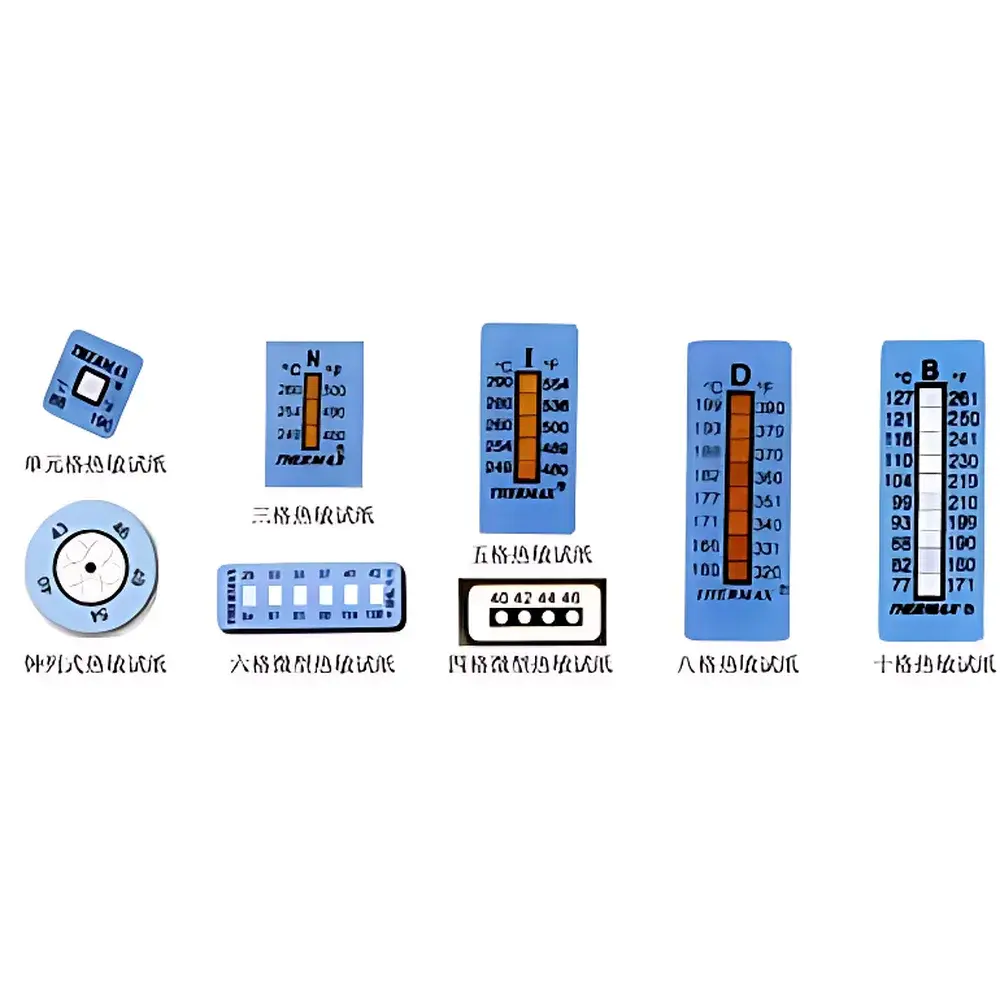
TMC Thermax Five-Point and Eight-Point Temperature-Sensitive Indicator Strips
| Origin | UK |
|---|---|
| Manufacturer Type | Authorized Distributor |
| Origin Category | Imported |
| Model | 5-Grid & 8-Grid Format |
| Pricing | Available Upon Request |
Overview
TMC Thermax temperature-sensitive indicator strips are irreversible, single-use thermal history recorders engineered for passive, non-electronic verification of peak exposure temperature. Based on proprietary thermochromic pigment technology, each strip integrates a linear array of discrete sensor elements—squares or dots—that undergo an irreversible color transition (typically to black) when exposed to their designated activation temperature. Once triggered, the change is permanent and unaffected by subsequent cooling, enabling unambiguous identification of the maximum temperature experienced by the surface to which the strip is affixed. Unlike continuous-reading sensors, Thermax strips provide cumulative thermal evidence without power, data loggers, or real-time monitoring—making them ideal for validation, quality assurance, and forensic thermal auditing across industrial, medical, and transportation environments.
Key Features
- Irreversible thermal indication: Each grid element activates at a precise, factory-calibrated temperature threshold; no reversion upon cooling ensures definitive thermal history capture.
- Dual-scale labeling: Simultaneous Celsius (°C) and Fahrenheit (°F) markings on every strip for global operational clarity and regulatory alignment.
- Robust environmental resistance: Certified oil-resistant and water-resistant surface coating ensures integrity in humid, greasy, or condensing conditions—critical for motor windings, transformer housings, and HVAC components.
- High accuracy specification: ±1 °C tolerance below 100 °C; ±1% of full-scale range above 100 °C—validated per ISO/IEC 17025 traceable calibration protocols.
- Self-adhesive vertical mounting: Pressure-sensitive acrylic adhesive enables rapid, bubble-free application on curved or vertical surfaces—including rotating shafts, PCB edges, and sterilization trays.
- Compliance-ready documentation: Manufactured under a quality management system certified to BS EN ISO 9001:2015; supporting audit trails for GLP, GMP, and FDA 21 CFR Part 11–aligned workflows where physical thermal evidence is required.
Sample Compatibility & Compliance
Thermax strips adhere reliably to metals (aluminum, stainless steel, copper), painted surfaces, plastics (ABS, polypropylene), ceramics, and laminated composites—without residue or surface damage upon removal. They are non-toxic, RoHS-compliant, and contain no hazardous substances per EU Directive 2002/95/EC. Their passive operation eliminates electromagnetic interference concerns, making them suitable for use near MRI suites, high-voltage switchgear, and avionics bays. The strips meet mechanical durability requirements outlined in IEC 60068-2-14 (thermal shock) and IEC 60068-2-78 (damp heat, cyclic), ensuring performance stability during transport and storage across -20 °C to +60 °C ambient conditions.
Software & Data Management
As analog, paper-based indicators, Thermax strips do not interface with software or digital systems. However, they integrate seamlessly into structured quality documentation frameworks: each strip batch is supplied with a Certificate of Conformance referencing ISO 9001 certification, lot-specific calibration data, and shelf-life information (typically 24 months from manufacture when stored at ≤25 °C and <60% RH). Photographs of activated strips—annotated with date, location, operator ID, and equipment serial number—are routinely accepted as objective evidence in internal audits, third-party certifications (e.g., ISO 13485 for medical device sterilization), and regulatory submissions (e.g., FDA Form 3602 for thermal validation of autoclave cycles).
Applications
- Electrical Infrastructure: Permanent attachment to stator windings, busbar joints, and transformer tap changers to detect localized overheating indicative of loose connections or insulation degradation.
- Automotive & Rail: Monitoring axle bearing temperatures during service trials; verifying brake rotor thermal limits during endurance testing; validating composite curing profiles in body-in-white assembly.
- Medical Device Sterilization: Placement inside instrument packs or sterilization trays to confirm attainment of minimum sterilant temperature (e.g., 134 °C for steam autoclaving per ISO 17665).
- Electronics Manufacturing: In-transit thermal monitoring of sensitive components (e.g., MEMS sensors, lithium battery modules) to enforce cold-chain compliance and prevent latent thermal damage.
- Industrial Coating & Adhesive Curing: Direct application on substrates prior to oven curing—validating that critical glass-transition or cross-linking temperatures (e.g., 180 °C for epoxy powder coatings) were uniformly achieved.
FAQ
Are Thermax strips reusable?
No. The thermochromic reaction is chemically irreversible; each strip provides a single-use record of peak temperature exposure.
Can these strips be used in vacuum or inert gas environments?
Yes—activation depends solely on conductive/convective heating of the substrate; no atmospheric oxygen or moisture is required for function.
What is the shelf life, and how should unused strips be stored?
24 months from date of manufacture when stored sealed in original packaging at ≤25 °C and relative humidity <60%. Exposure to UV light or elevated ambient temperatures accelerates baseline drift.
Do Thermax strips comply with FDA or EU MDR requirements for medical device validation?
While not medical devices themselves, they are widely accepted as objective thermal evidence in FDA-submitted sterilization validations and EU MDR Annex I §11.6-compliant processes when used within a documented, controlled procedure.
Is calibration traceable to NIST or UKAS standards?
Batch-specific calibration reports are provided, traceable to UKAS-accredited laboratories operating under ISO/IEC 17025. Individual strip recalibration is neither feasible nor intended per design.