
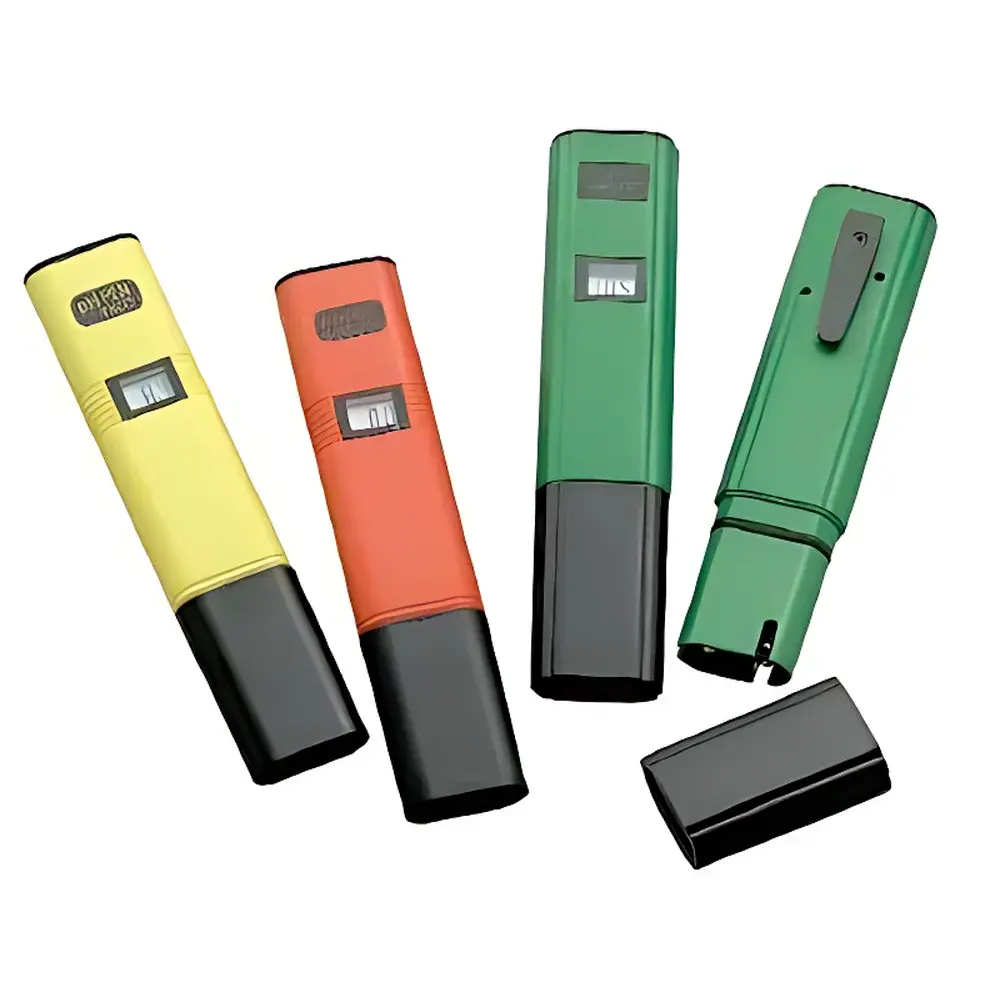
JENCO 610/620D/650 Portable Pen-Type pH Meter
| Brand | JENCO |
|---|---|
| Origin | USA |
| Model Series | 610 / 620D / 650 |
| Measurement Range | 0.0–14.0 pH, ±999 mV (620D & 650) |
| Resolution | 0.1 pH (all models), 1 mV (620D & 650) |
| Accuracy | ±0.2 pH (610), ±0.1 pH (620D), ±0.2% ±1 mV (620D & 650) |
| Automatic Temperature Compensation (ATC) | 0–60 °C (620D only) |
| Calibration | Single-point (610 & 650), Two-point (620D) |
| Operating Temperature | 0–50 °C |
| Battery Life | ~1000 h (610), ~400 h (620D & 650) |
| Power | 4 × 1.5 V button cells (LR44 or equivalent) |
| Dimensions | 150 × 32 × 15 mm (L × W × H) |
Overview
The JENCO 610/620D/650 series represents a family of compact, handheld pen-type pH meters engineered for rapid, field-ready acid-base measurements in aqueous solutions. These instruments operate on the fundamental principle of potentiometric measurement: a pH-sensitive glass electrode generates a voltage potential relative to a built-in reference electrode, which is linearly correlated to hydrogen ion activity via the Nernst equation (−59.16 mV/pH unit at 25 °C). Designed for simplicity and robustness, each model integrates a sealed, non-refillable combination electrode directly into the pen-shaped housing—eliminating external cables, junction clogging risks, and calibration drift associated with modular systems. While not intended for high-precision laboratory metrology, the series meets functional accuracy requirements for routine quality checks, process spot-checks, and preliminary environmental screening where portability, speed, and cost-efficiency are prioritized over traceable uncertainty budgets.
Key Features
- True pen-form factor: All-in-one design with integrated electrode, display, and power supply—no external probes or connectors required.
- Real-time automatic temperature compensation (ATC) on the 620D model using a built-in thermistor, enabling pH correction across 0–60 °C without manual input.
- Optimized electrode geometry: Flat-surface glass membrane improves response time and stability in low-volume or viscous samples (e.g., gels, creams, food pastes).
- Backlit LCD display with large digits ensures readability under variable lighting conditions—including outdoor or industrial environments.
- Low-power architecture: Extended battery life (up to 1000 hours on 610) reduces operational downtime and total cost of ownership.
- IP67-rated housing (per JENCO specification): Dust-tight and water-resistant to 1 m for 30 minutes—suitable for wet-lab benches, production floors, and field sampling.
Sample Compatibility & Compliance
These meters are validated for use with aqueous, low-ionic-strength solutions typical in drinking water testing, hydroponics, aquarium management, food surface swabbing, and beverage QC. They are not recommended for strong acids/bases (>2 M), organic solvents, or highly turbid suspensions without filtration. The 620D’s two-point calibration capability supports ISO 8655-4 traceability workflows when paired with certified buffer standards (pH 4.01, 7.00, and 10.01 at 25 °C). While not 21 CFR Part 11 compliant out-of-the-box, audit-ready calibration logs can be manually recorded per GLP/GMP documentation protocols. Units comply with IEC 61010-1 for electrical safety and meet RoHS Directive 2011/65/EU material restrictions.
Software & Data Management
The JENCO 610/620D/650 series operates as standalone instruments with no embedded memory or USB/Bluetooth connectivity. All data must be manually transcribed for record retention—a design choice aligned with ISO/IEC 17025 Clause 7.7 (result reporting) and FDA guidance for simple field devices used in HACCP prerequisite programs. For regulated environments requiring electronic records, users may integrate these meters into broader QA systems via secondary logging tools (e.g., paper-based logbooks, LIMS-compatible mobile apps, or digital notebooks with timestamped photo capture of readings). Calibration verification intervals should follow internal SOPs—typically before each shift or after every 10 measurements, per ASTM D1293-22 recommendations for field pH monitoring.
Applications
- Drinking water and wastewater treatment: On-site verification of disinfection efficacy and corrosion control parameters.
- Food & beverage manufacturing: Batch pH checks during fermentation, sauce formulation, dairy processing, and shelf-life validation.
- Agriculture & horticulture: Soil extract analysis, nutrient solution monitoring in hydroponic systems, and compost maturity assessment.
- Education & training labs: Introductory electrochemistry demonstrations and student-led environmental sampling projects.
- Facility maintenance: Cooling tower water balance, boiler feedwater alkalinity screening, and cleaning-in-place (CIP) rinse validation.
FAQ
What is the recommended calibration frequency for routine use?
Calibrate prior to first use, after every 10 measurements, and whenever ambient temperature changes exceed ±5 °C—especially critical for the 610 and 650 models lacking ATC.
Can these meters measure pH in non-aqueous solvents?
No. The glass electrode requires hydration for stable potential development; use only in aqueous or >80% water-content solutions.
How do I verify electrode performance between calibrations?
Perform a “buffer check”: immerse in fresh pH 7.00 buffer and confirm reading falls within ±0.1 pH of nominal value; deviation exceeding this warrants recalibration or electrode replacement.
Are replacement electrodes available separately?
No—the electrode is permanently sealed within the pen body; units are designed for full-unit replacement after 12–18 months of typical use or upon visible electrode clouding/damage.
Does the 620D support slope calculation during two-point calibration?
Yes. The instrument automatically computes electrode slope (%Nernstian response) and displays it post-calibration—values between 95–105% indicate acceptable electrode health.






