
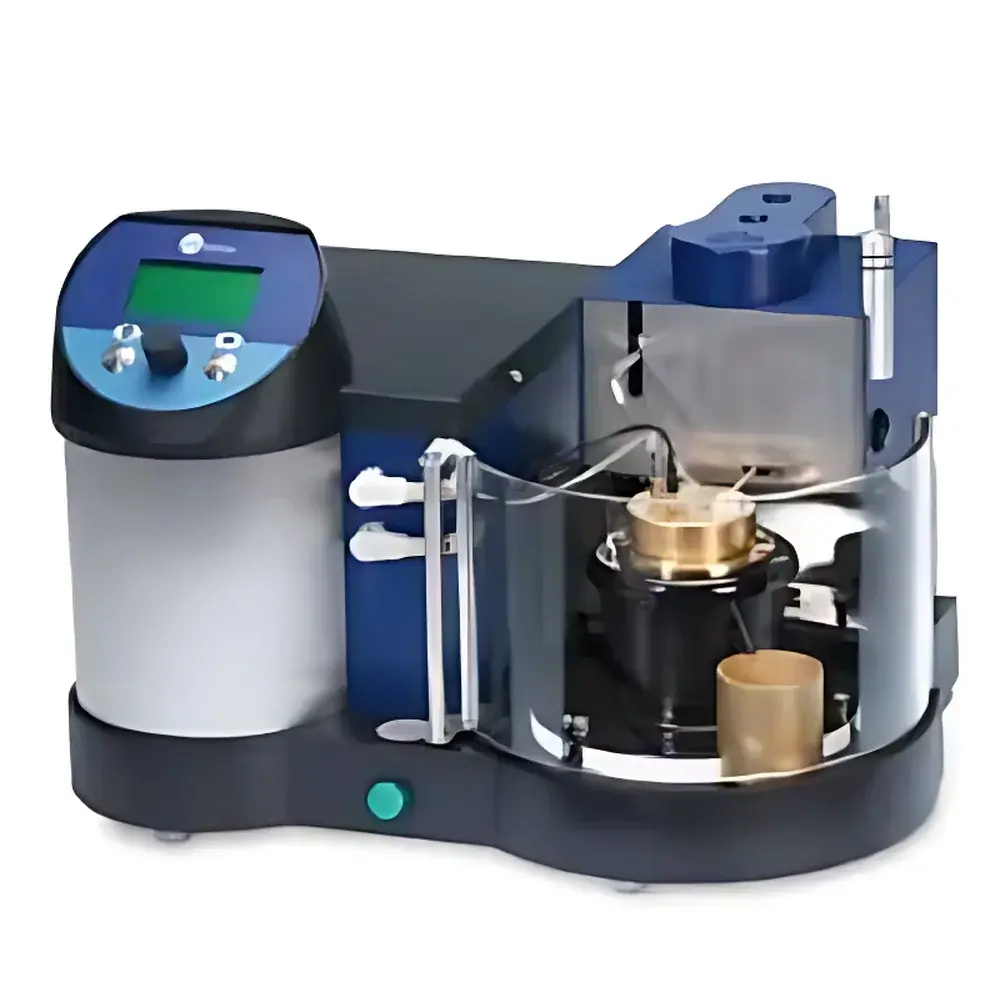
SETA 34400-0 MULTIFLASH Automated Tag Closed-Cup Flash Point Tester
| Brand | SETA |
|---|---|
| Origin | United Kingdom |
| Model | 34400-0 |
| Test Method | ASTM D56, D3934, D3941, E502 |
| Temperature Range | Ambient to 93 °C (standard), 5–93 °C (optional low-temperature configuration) |
| Heating System | Liquid-bath electric heating plate |
| Cooling Options | Fan-cooling (40 min cooldown), Compressed air or recirculating chiller (3 min cooldown, optional) |
| Ignition Sources | Selectable gas flame or electronic spark ignition |
| Temperature Sensor | Platinum resistance thermometer (Pt100) |
| Flash Detection | Ionization ring sensor |
| Stirring Speeds | 105 rpm and 250 rpm |
| Power Supply | 110/120 V or 220/240 V, 50/60 Hz |
| Power Consumption | 1 kW |
| Dimensions | 42 × 45 × 34 cm |
| Weight | 20 kg |
| Atmospheric Pressure Correction | Automatic |
| Data Storage | Last 5 test results retained internally |
| Compliance | Fully aligned with GLP/GMP data integrity expectations |
Overview
The SETA 34400-0 MULTIFLASH Automated Tag Closed-Cup Flash Point Tester is a precision-engineered instrument designed for fully automated flash point determination of volatile petroleum products, solvents, and industrial fluids using the standardized Tag closed-cup method. It operates on the fundamental principle of controlled heating in a sealed cup environment, where vapour concentration is incrementally increased until an ignitable mixture forms at the surface—detected via ionization current surge upon application of a calibrated ignition source. This thermodynamic equilibrium-based measurement conforms strictly to internationally recognized standards including ASTM D56, ISO 1516, and IP 304 (obs) Part 2, ensuring regulatory acceptability across global refining, quality control, transportation safety, and regulatory compliance laboratories.
Key Features
- Modular architecture built on the universal MULTIFLASH base unit—enables rapid field-swapping between Tag, Pensky-Martens, Abel, Cleveland Open Cup, and Small-Scale Equilibrium methods without recalibration or firmware changes
- True dual-mode operation: supports both rapid equilibrium and non-equilibrium test protocols per ASTM D56 requirements, with programmable ramp rates and dwell times
- Integrated Pt100 platinum resistance thermometer with traceable calibration and ±0.1 °C repeatability over full operating range
- Ionization ring detection system provides high signal-to-noise ratio and immunity to false positives from condensation or residue interference
- Intelligent atmospheric pressure compensation using built-in barometric sensor—applies real-time correction algorithms per ASTM E502 guidelines
- Dual stirring speeds (105 rpm for viscous samples, 250 rpm for low-viscosity liquids) ensure consistent vapour headspace development
- Flexible ignition selection: user-configurable gas flame (butane/propane) or electronic spark ignition—each validated for energy output consistency and flame geometry compliance
- Thermal management system includes fan-assisted cooling (40 min cycle) and optional compressed-air or recirculating chiller interface for sub-3-minute cooldown between tests
- Embedded safety interlocks: lid position monitoring, overtemperature cutoff, flame-out detection, and automatic power-down after completion
Sample Compatibility & Compliance
The SETA 34400-0 accommodates a broad spectrum of liquid hydrocarbon-based materials—from gasoline fractions and jet fuels to lubricating oils, biodiesel blends, and specialty solvents—with viscosity limits up to 150 cSt at 40 °C. Sample volume requirement is fixed at 70 mL, minimizing reagent consumption while maintaining statistical validity per ISO 1523 repeatability criteria. All mechanical and thermal processes are certified to meet CE marking requirements (2014/30/EU EMC Directive and 2014/35/EU Low Voltage Directive). Instrument design incorporates physical safeguards aligned with IEC 61010-1:2010 for laboratory electrical equipment, including double-insulated heating elements and grounded metal housing. Routine verification procedures support ISO/IEC 17025-compliant laboratory accreditation.
Software & Data Management
The onboard controller features a dedicated graphical interface with intuitive menu navigation, password-protected method editing, and timestamped result logging. Each test record includes ambient temperature, barometric pressure, sample ID, operator code, start/finish time, detected flash point, and pass/fail status relative to method-defined acceptance criteria. Internal memory retains the last five complete datasets with checksum validation. Export functionality supports USB-stick transfer of CSV-formatted reports compatible with LIMS integration. When deployed with optional PC-based MULTIFLASH Control Suite (v4.2+), the instrument supports full 21 CFR Part 11 compliance—including electronic signatures, audit trails with immutable timestamps, role-based access control, and secure data archiving. Raw sensor logs (temperature vs. time, ion current response) are accessible for root-cause analysis during method validation or troubleshooting.
Applications
This instrument serves critical functions in multiple operational domains: refinery QC labs performing incoming crude assay and finished product release testing; petrochemical R&D facilities evaluating formulation stability and volatility profiles; third-party certification bodies conducting ASTM/ISO conformance audits; and government agencies enforcing transport classification under UN TDG and ADR regulations. Its accuracy and reproducibility make it suitable for specification compliance testing per API RP 2542, EN 13851, and MIL-STD-1841B. The modular platform also enables cross-method correlation studies—for example, comparing Tag closed-cup results against Pensky-Martens (ASTM D93) for diesel fuel classification or evaluating flash point depression in ethanol-gasoline blends per ASTM D4815.
FAQ
Does the SETA 34400-0 require external calibration gases or reference standards for routine operation?
No. The instrument relies on NIST-traceable Pt100 temperature sensors and factory-characterized ionization detection electronics. Periodic verification using certified flash point reference standards (e.g., n-decane, iso-octane) is recommended per ASTM D613 and ISO Guide 80.
Can the system be integrated into an existing laboratory network for centralized data collection?
Yes—via optional Ethernet module (SETA part no. NET-01) supporting TCP/IP communication and MODBUS RTU protocol for SCADA or MES integration.
Is training provided for method setup and regulatory documentation generation?
SETA-certified application specialists deliver on-site or virtual training covering SOP development, IQ/OQ documentation templates, and 21 CFR Part 11 implementation guidance.
What maintenance intervals are recommended for long-term reliability?
Daily wipe-down of cup assembly and ion ring; quarterly inspection of stirrer seal and heater bath fluid level; annual verification of barometric sensor drift and ignition energy output.
How does the system handle samples with suspended particulates or high water content?
Samples must be filtered to ≤5 µm and dried to <0.05% vol water prior to testing. The instrument does not include inline filtration or dehydration—these steps remain user responsibilities per ASTM D56 Section 7.3.
Related Products







