
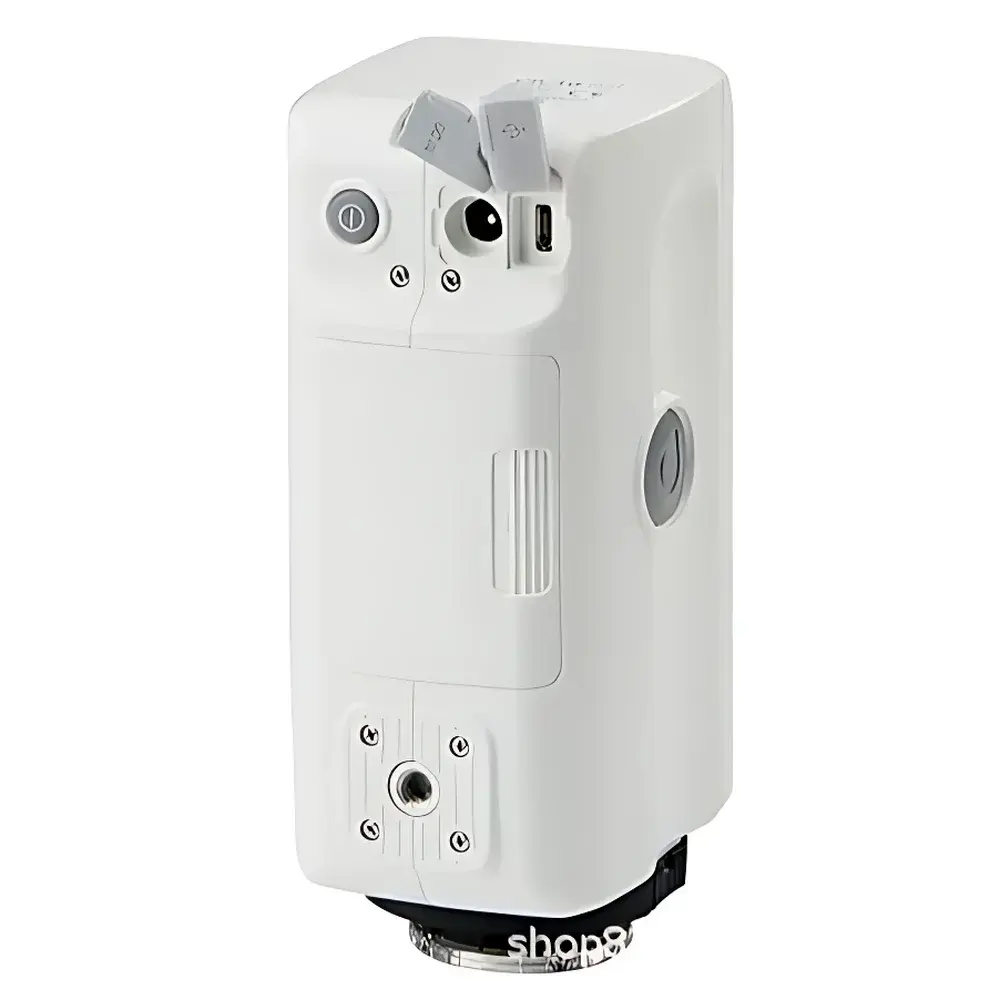
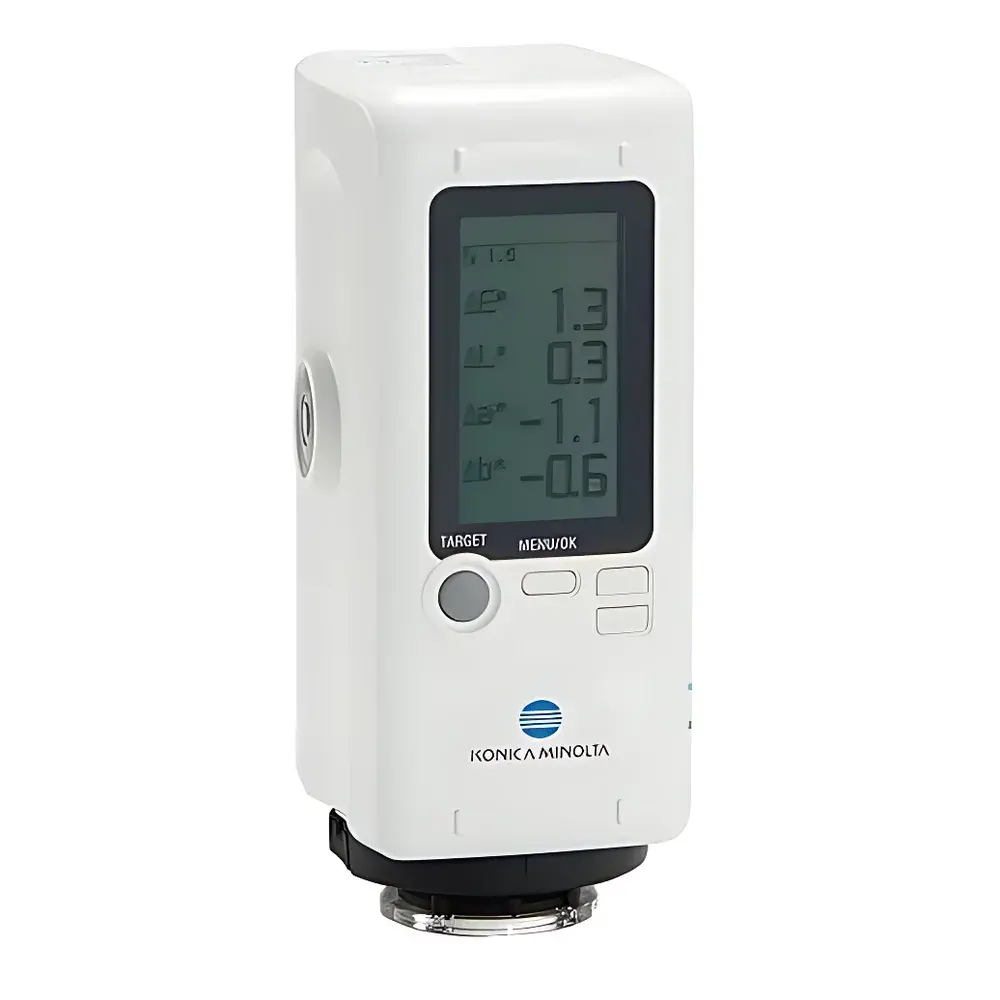
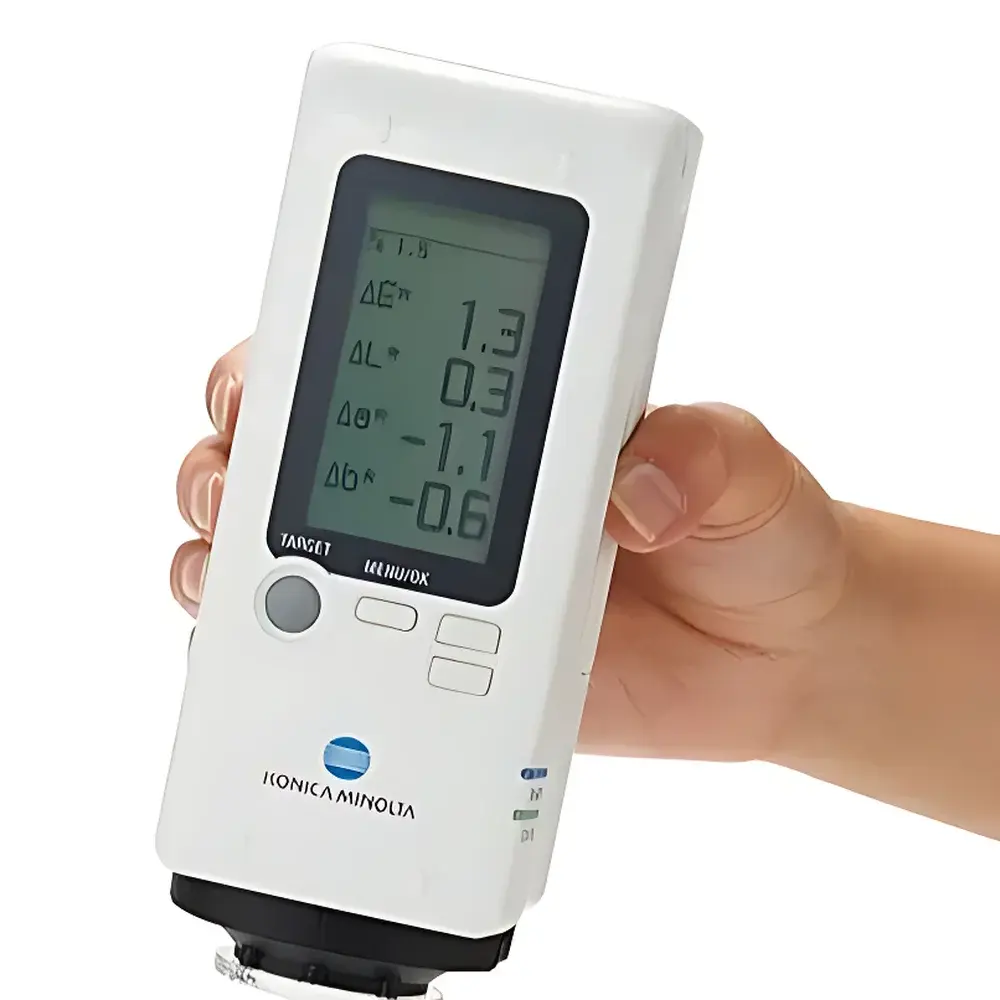
Konica Minolta CR-10 Plus Portable Color Difference Meter
| Brand | Konica Minolta |
|---|---|
| Origin | Japan |
| Model | CR-10 Plus |
| Instrument Type | Portable Spectrophotometric Colorimeter |
| Illumination/Viewing Geometry | 8°/d (including specular component) |
| Observer Angle | 10° |
| Illuminant | D65 |
| Measurement Aperture | Ø8 mm (MAV), optional Ø5 mm |
| Repeatability | σΔE*ab ≤ 0.1 (measured 30× on white calibration tile at 10 s intervals) |
| Measurement Time | ~1 s |
| Data Storage Capacity | Up to 1,000 sets (standard + sample data) |
| Display | ΔL*a*b*, ΔL*C*H*, ΔE*ab (CIE 1976) |
| Compliance | DIN 5033-7, JIS Z 8722 Condition d, ISO 7724-1, CIE No. 15, ASTM E1164 |
| Interface | USB 2.0 |
| Power | 4× AA alkaline/Ni-MH batteries, USB bus power, or optional AC adapter |
| Dimensions | 66 × 158 × 85 mm |
| Weight | 420 g (body only) |
| Operating Environment | 0–40°C, ≤85% RH (non-condensing at 35°C) |
| Storage Environment | −20–40°C, ≤85% RH |
| Supported Languages | English, Japanese, Simplified Chinese |
Overview
The Konica Minolta CR-10 Plus is a compact, handheld spectrophotometric color difference meter engineered for rapid, repeatable color evaluation in production environments, quality control labs, and field applications. It employs an 8°/diffuse (8°/d) illumination/viewing geometry — compliant with DIN 5033-7, JIS Z 8722 Condition d, ISO 7724-1, CIE Publication No. 15, and ASTM E1164 — ensuring compatibility with industry-standard colorimetric practices. The instrument utilizes a pulsed xenon lamp as its stable, short-duration light source, eliminating thermal drift and enabling consistent spectral output across thousands of measurements. Six silicon photodiodes capture reflectance data across the visible spectrum (approx. 400–700 nm), which is processed internally using CIE 1931 10° standard observer functions and D65 illuminant weighting. This architecture delivers L*a*b* and L*C*H* coordinates, along with ΔE*ab (CIE 1976) color difference values, directly on the integrated display — without requiring external software for basic operation.
Key Features
- Portable form factor (66 × 158 × 85 mm; 420 g body weight) optimized for ergonomic one-handed operation and on-site use.
- High repeatability performance: σΔE*ab ≤ 0.1 under standardized conditions (30 consecutive measurements on white calibration tile at 10-second intervals).
- Built-in memory stores up to 1,000 measurement records — including reference standards and sample data — enabling offline operation independent of PC connectivity.
- Real-time pass/fail assessment via visual indicators (LED color coding) and audible feedback (distinctive beeps), configurable per ΔE*ab, ΔL*a*b*, or ΔL*C*H* thresholds.
- Dual-aperture support: Standard 8 mm measuring area (MAV) with optional 5 mm aperture (CR-A87) for small-area or textured surface analysis.
- Multi-language UI (English, Japanese, Simplified Chinese) and intuitive menu navigation reduce operator training time and minimize input error.
- USB 2.0 interface enables bidirectional data transfer and firmware updates; compatible with Windows 7/8/8.1 Professional (32-/64-bit) systems.
Sample Compatibility & Compliance
The CR-10 Plus is validated for non-destructive reflectance measurement of flat, opaque, and uniformly diffusing surfaces — including painted metal, plastic housings, coated paper, textiles, and ceramic tiles. Its 8°/d optical configuration captures both diffuse and specular components, making it suitable for evaluating gloss-influenced materials where total appearance (color + sheen) must be assessed. The instrument meets metrological requirements defined in ISO 9001 (JQA-OMA15888) for design, manufacturing, calibration, and service of measuring instruments, and ISO 14001 (JQA-E-80027) for environmental management across its lifecycle. While not certified to FDA 21 CFR Part 11, its audit-ready data export capability (via bundled PC software) supports GLP/GMP-aligned documentation workflows when paired with controlled file handling procedures.
Software & Data Management
The CR-10 Plus operates autonomously but integrates seamlessly with Konica Minolta’s proprietary PC application (distributed separately) for advanced reporting and traceability. The software enables batch export of measurement history in CSV format, generation of statistical summaries (mean, min/max, SD), and side-by-side comparison of multiple samples against user-defined standards. All data transfers are timestamped and include instrument serial number, measurement date/time, aperture selection, and operator ID fields — facilitating traceability in regulated environments. The application supports multi-user profiles and configurable report templates compliant with internal QA protocols. No cloud synchronization or remote access functionality is implemented; all data remains local unless explicitly exported by authorized personnel.
Applications
- Automotive interior trim verification: Confirm color consistency across injection-molded dashboards, door panels, and seat fabrics.
- Printing and packaging QC: Monitor ink density and hue stability across CMYK process runs on corrugated board and flexible films.
- Plastics manufacturing: Validate masterbatch dispersion and detect batch-to-batch chromatic deviation prior to extrusion.
- Paint and coating formulation: Support lab-scale pigment matching and correlate instrumental readings with visual assessments under D65 lighting.
- Educational laboratories: Teach CIE color space fundamentals, metamerism, and the impact of geometric conditions on measured ΔE.
FAQ
Is the CR-10 Plus compliant with ISO/IEC 17025 for accredited calibration labs?
No — the CR-10 Plus is a production-grade colorimeter intended for routine QC, not metrological calibration. Accredited labs should use primary-standard spectroradiometers traceable to NIST or PTB for reference calibration.
Can the device measure transparent or translucent materials?
No — the CR-10 Plus is designed exclusively for reflective, opaque samples. Transmission or transmittance measurements require a dedicated transmission spectrophotometer with integrating sphere geometry.
Does the instrument support custom illuminants beyond D65?
No — D65 is fixed as the default illuminant per CIE 1964 10° observer definition. Custom illuminant modeling is not supported in firmware or PC software.
What is the recommended recalibration frequency?
Konica Minolta recommends daily zero and white calibration using supplied calibration tiles before first use and after any significant ambient temperature shift (>5°C). Annual factory recalibration is advised for traceable continuity.
Is battery life affected by USB-powered operation?
Yes — when powered via USB bus, internal battery drain is suspended, but continuous measurement may cause host system power management to suspend the port. Use of an externally powered USB hub or AC adapter is recommended for extended sessions.




