
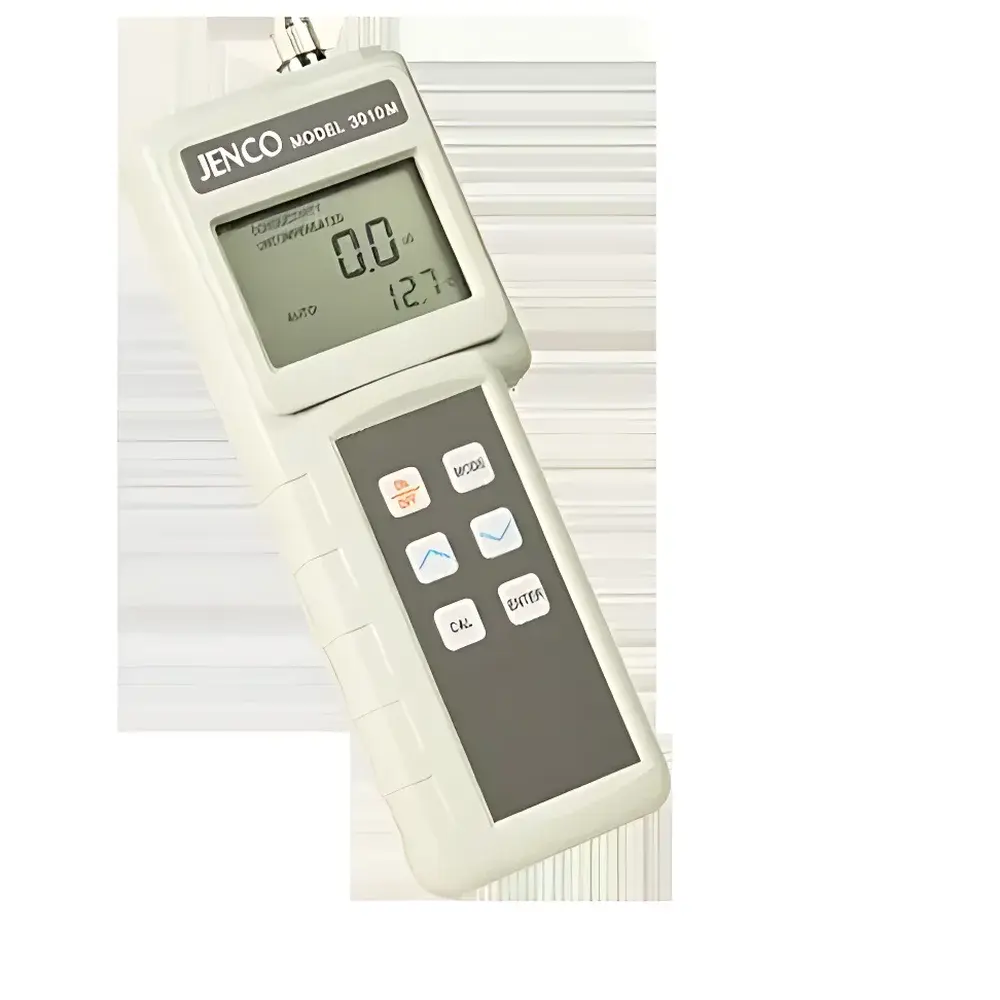
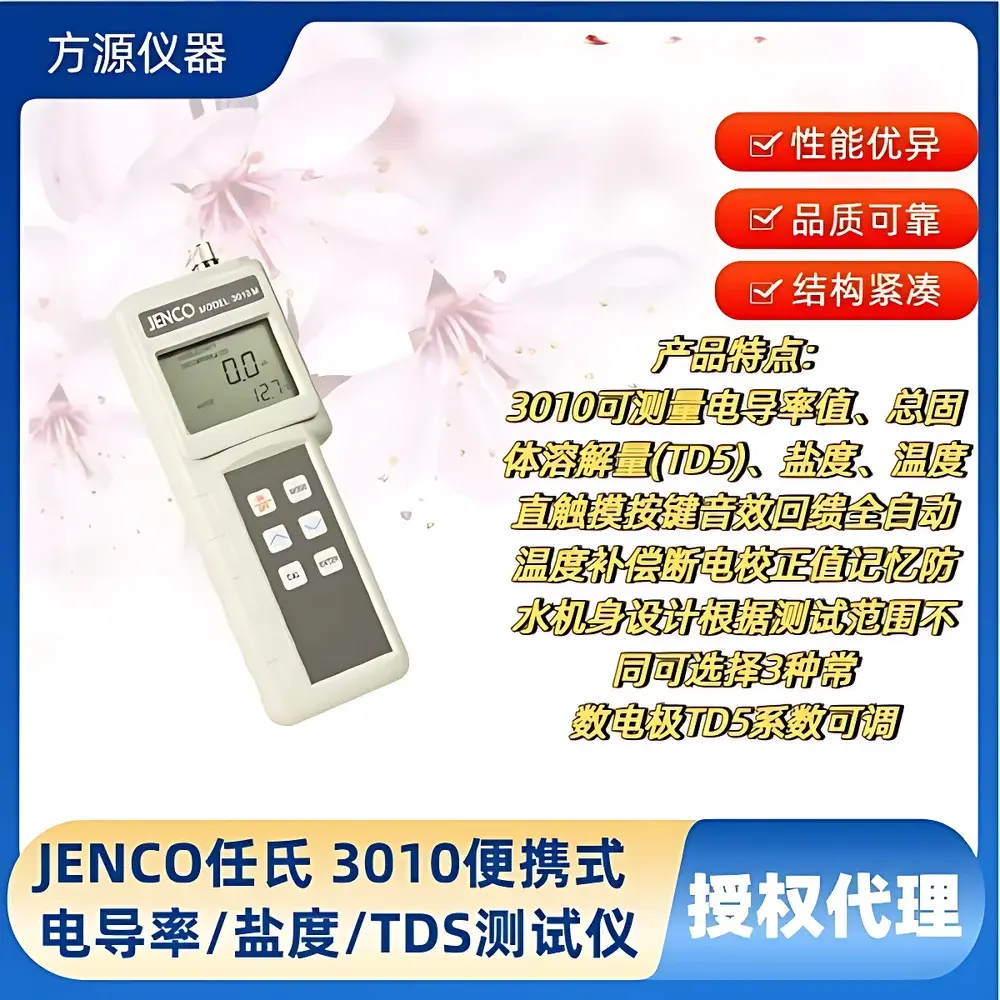
JENCO 3010M Portable Conductivity / TDS / Salinity / Temperature Meter
| Brand | JENCO |
|---|---|
| Origin | USA |
| Model | 3010M |
| Measurement Parameters | Conductivity, TDS, Salinity, Temperature |
| Portability | Handheld (Field-Portable) |
| Intended Use | Industrial Process Monitoring, Field Sampling, Lab Bench Support |
| Conductivity Range | 0–200 mS/cm |
| TDS Range | 0–100 g/L |
| Resistivity Range | 0–100 MΩ·cm |
| Temperature Range | 10–110 °C |
| Accuracy | ±0.5% of Full Scale |
| Minimum Resolution | 0.001 µS/cm |
| Electrode Constant Options | 0.1, 1.0, 10.0 cm⁻¹ |
| Temperature Compensation | Automatic (NTC 30 kΩ) |
| Enclosure Rating | IP67 (Waterproof) |
| Data Retention | Non-volatile memory retains calibration and settings after power loss |
Overview
The JENCO 3010M is a field-deployable, multi-parameter electrochemical meter engineered for reliable, real-time measurement of conductivity, total dissolved solids (TDS), salinity, and temperature in demanding industrial, environmental, and quality control applications. Based on the fundamental principle of conductometric measurement—where electrical current flow through an aqueous solution is proportional to ionic concentration—the 3010M employs a four-electrode or two-electrode cell architecture (depending on selected probe) to minimize polarization errors and ensure stable readings across wide dynamic ranges. Its design prioritizes operational robustness in non-laboratory environments: the instrument features an IP67-rated housing, sealed tactile membrane keypad with audible feedback, and automatic temperature compensation using a precision NTC thermistor (30 kΩ). Unlike benchtop-only meters, the 3010M bridges the gap between portability and metrological integrity—supporting routine verification in wastewater treatment plants, cooling tower management, desalination pre-screening, and raw material incoming inspection where traceable, repeatable conductivity data is required under variable ambient conditions.
Key Features
- Simultaneous display of conductivity (µS/cm, mS/cm), TDS (mg/L or g/L), salinity (ppt or %), and temperature (°C) on a high-contrast LCD with backlight
- Three selectable cell constants (0.1, 1.0, 10.0 cm⁻¹) to optimize resolution and accuracy across low-conductivity ultrapure water (e.g., pharmaceutical rinse water) and high-salinity brines (e.g., seawater or process effluents)
- Adjustable TDS conversion factor (0.4–1.0) to accommodate varying ionic composition—critical for compliance with ASTM D1125 and ISO 7888 methodologies
- Auto-ranging functionality eliminates manual range selection; full-scale accuracy of ±0.5% FS is maintained across all conductivity sub-ranges
- Non-volatile EEPROM stores up to three-point calibration coefficients, temperature compensation parameters, and user-defined TDS factors—even after battery replacement or extended power-off periods
- Integrated electrode diagnostics: real-time detection of open-circuit, short-circuit, and out-of-range impedance conditions to prevent erroneous reporting
Sample Compatibility & Compliance
The 3010M is validated for use with aqueous samples containing dissolved electrolytes—including tap water, surface water, industrial process streams, food-grade brines, and pharmaceutical preparation water (PW/WFI per USP ). It is not intended for non-aqueous solvents, highly viscous fluids (>50 cP), or suspensions with particulate loading >50 mg/L without prior filtration. The instrument conforms to IEC 61010-1:2010 safety requirements for electrical equipment used in measurement, control, and laboratory use. Its calibration traceability aligns with NIST-traceable standard solutions (e.g., KCl 0.01 mol/kg, 0.1 mol/kg), supporting GLP-compliant documentation workflows when paired with external logging software. While not FDA 21 CFR Part 11–certified as a standalone system, audit trails generated via optional PC interface comply with basic electronic record retention requirements under ISO/IEC 17025.
Software & Data Management
Data export is supported via USB-C interface to Windows-based PCs using JENCO’s free LogView Pro software (v3.2+), enabling time-stamped CSV export, calibration history archiving, and trend visualization. The software permits generation of calibration certificates compliant with ISO/IEC 17025 Annex A.3 and supports batch metadata tagging (operator ID, location, sample ID). No cloud synchronization or proprietary firmware updates are required—the device operates autonomously with firmware versioning visible in setup mode. All stored calibration points include date/time stamps and operator-entered reference values, satisfying minimum ALCOA+ data integrity criteria for non-GxP environments.
Applications
- Industrial process monitoring: continuous verification of boiler feedwater purity, reverse osmosis reject stream salinity, and electroplating bath conductivity
- Environmental fieldwork: rapid assessment of river, lake, and estuarine conductivity gradients correlated with nutrient loading or saltwater intrusion
- Food & beverage QA: inline verification of brine concentration during pickling, canning, or dairy processing
- Academic teaching labs: hands-on instruction in solution conductivity theory, Kohlrausch’s law, and temperature-dependent ion mobility
- HVAC system maintenance: detection of glycol concentration drift and corrosion inhibitor depletion in chilled water loops
FAQ
Does the 3010M support automatic temperature compensation across its full operating range?
Yes—it implements NTC 30 kΩ thermistor-based ATC from 10 to 110 °C, with compensation algorithm conforming to the DIN EN 27888 standard for conductivity correction.
Can I use the same electrode for both ultrapure water and seawater measurements?
No—electrode selection must match the expected conductivity range. A 0.1 cm⁻¹ cell is recommended for 100 mS/cm. Cross-range use degrades accuracy and risks polarization error.
Is calibration verification possible without standard solutions?
No—two-point or three-point calibration using certified KCl standards remains mandatory per ISO 5725 and ASTM D1125. The instrument does not support dry-calibration or zero-point offset alone.
What battery life can be expected during continuous field operation?
With alkaline AA batteries, typical runtime exceeds 200 hours under normal sampling intervals (one reading per 30 seconds); lithium AA batteries extend this to ~350 hours and improve low-temperature performance below 10 °C.
How is waterproofing verified for IP67 compliance?
Each unit undergoes immersion testing at 1 m depth for 30 minutes post-assembly. Sealing integrity is confirmed via helium leak detection at <1×10⁻⁶ mbar·L/s threshold, per IEC 60529 test protocol.





