
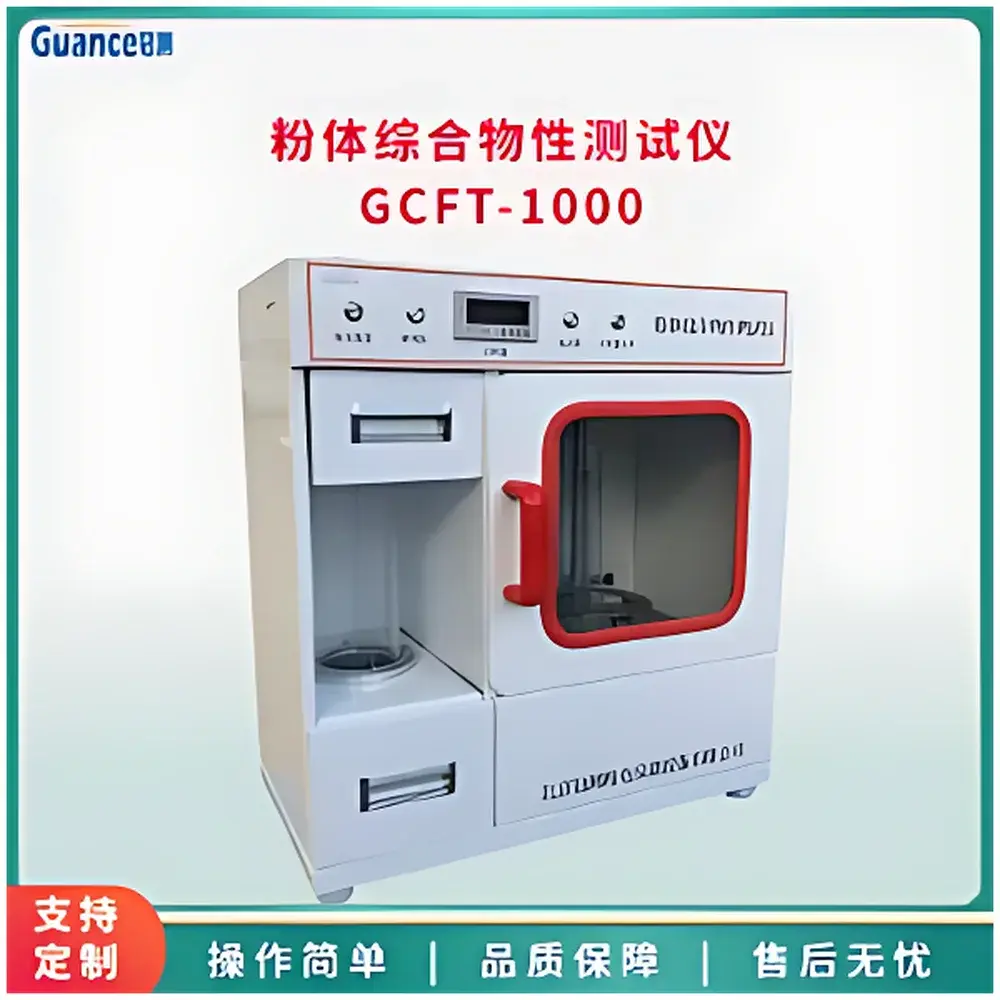
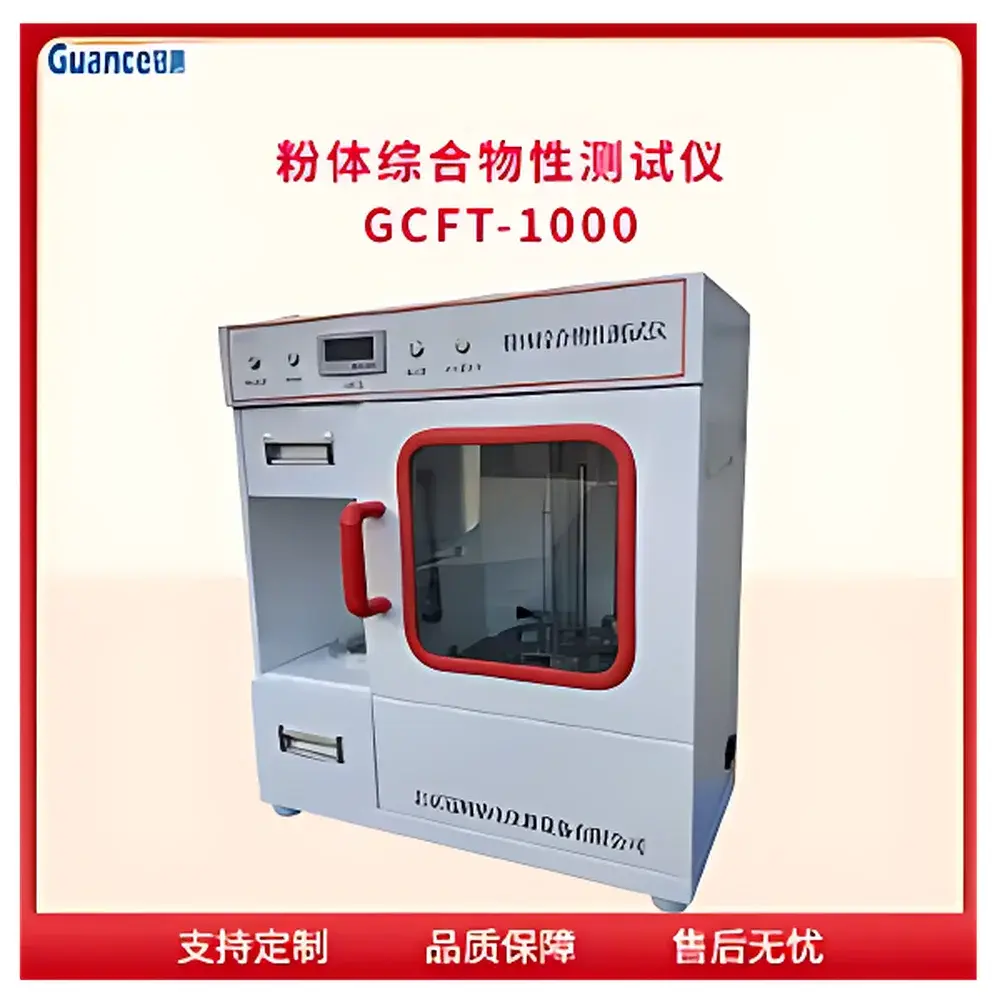
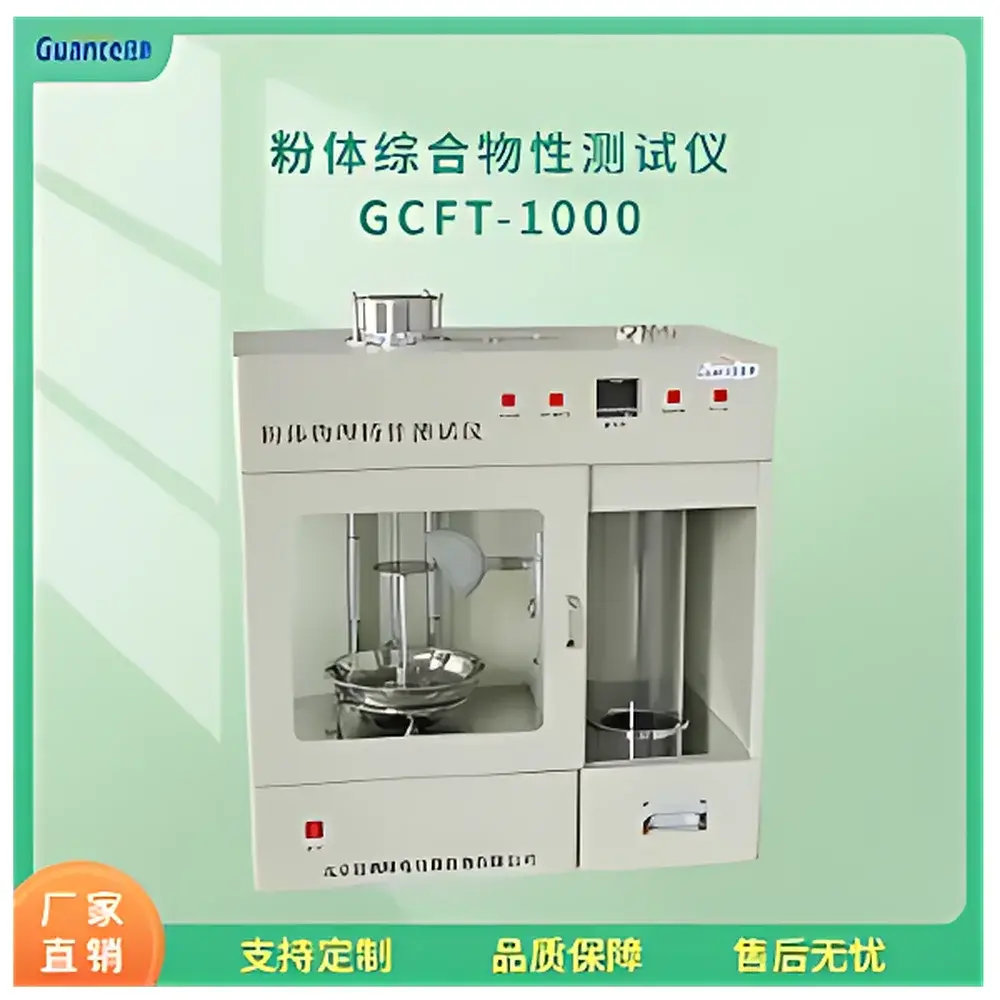
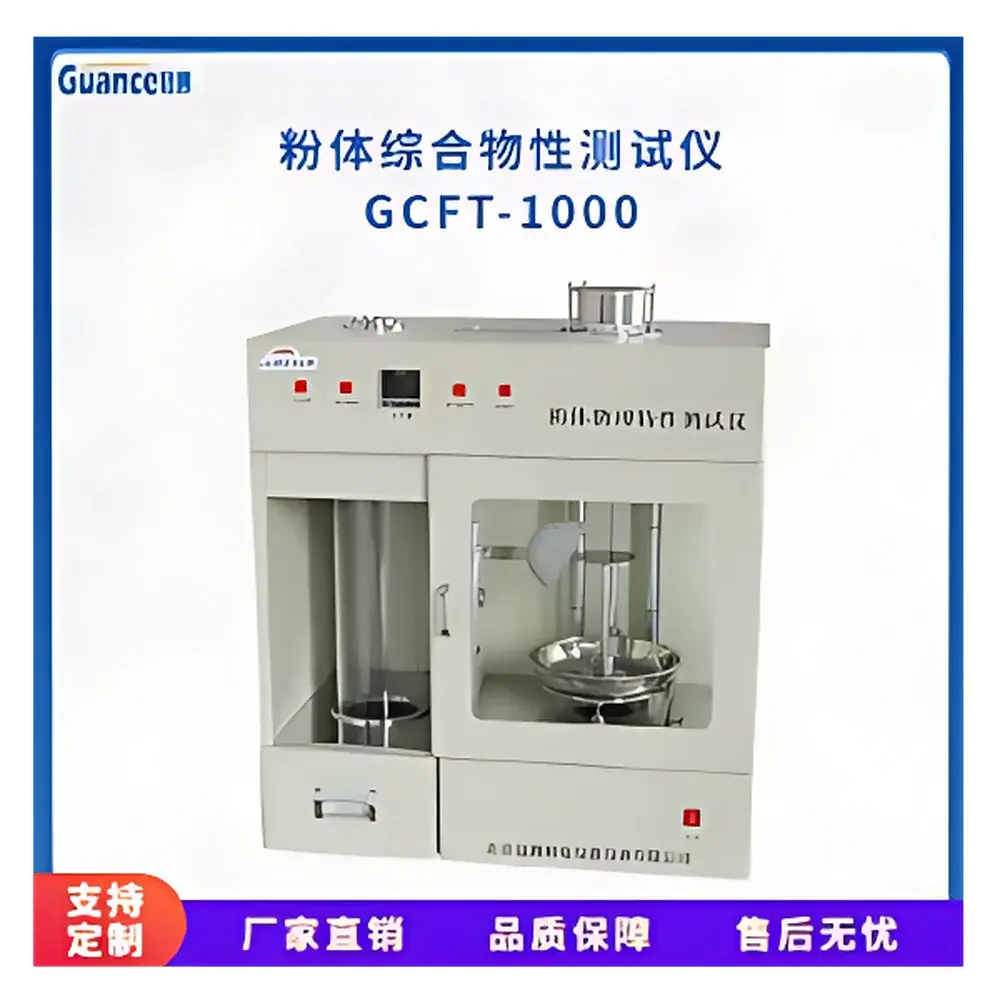
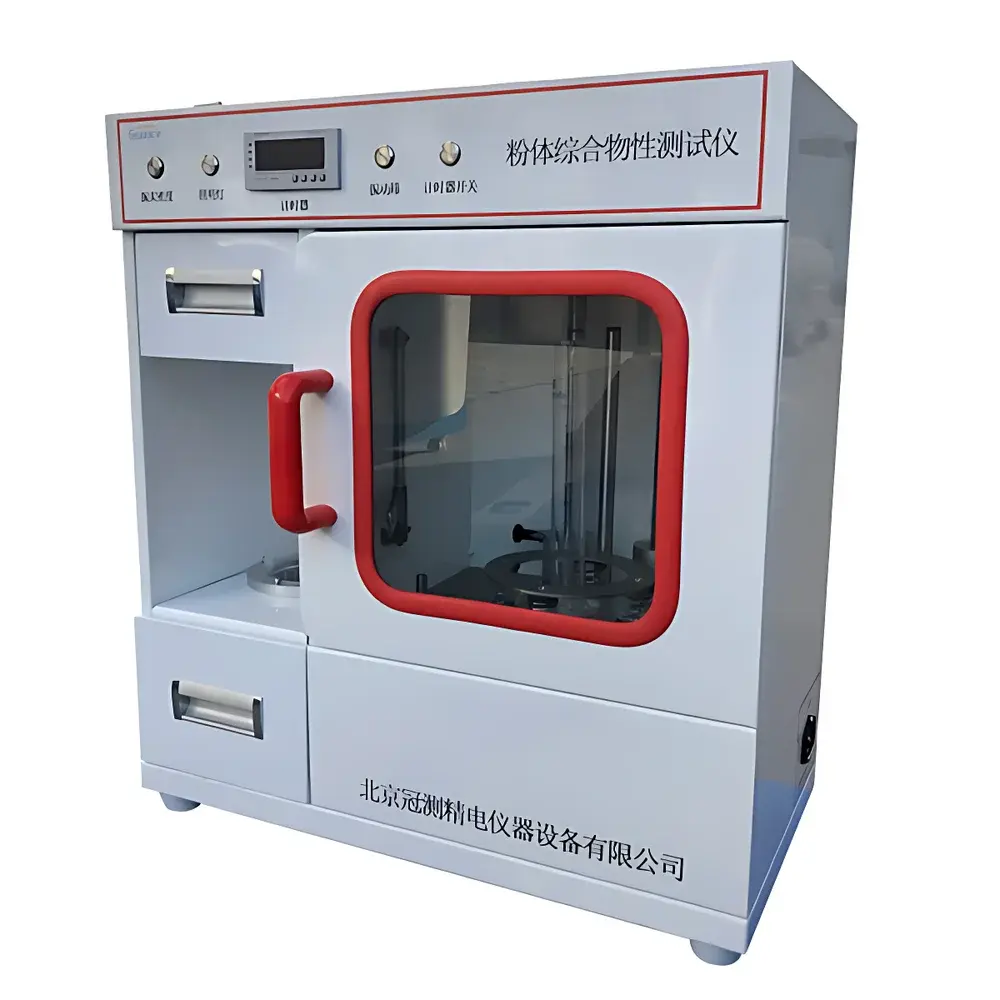
GuanCe GCFT-1000 Powder Flowability Tester
| Brand | GuanCe |
|---|---|
| Model | GCFT-1000 |
| Origin | Beijing, China |
| Power Rating | 500 W |
| Rated Voltage/Frequency | 220 V / 50 Hz |
| Tap Density Vibration Frequency | 300 taps/min |
| Compliance | GB/T 31057.2–2018, GB/T 31057.3–2018, ASTM D6393–2014, USP <616>, EP 20934, GB/T 1479.1–2011, GB/T 5162–2021, YB/T 16913–2008 |
Overview
The GuanCe GCFT-1000 Powder Flowability Tester is an engineered benchtop instrument designed for standardized quantification of bulk powder behavior under controlled mechanical stimulation. It operates on the principle of dynamic tap densification and gravitational flow characterization—core methodologies defined in international standards such as ASTM D6393 (Carr Indices), USP , and GB/T 31057.2–2018. The system measures fundamental powder physical properties including tap density, compressibility index (CI), Hausner ratio, angle of repose (via auxiliary funnel assembly), and flow rate—parameters critical to formulation development, process scale-up, and quality control in pharmaceuticals, metal additive manufacturing, battery cathode material production, and food ingredient processing. Its robust electromechanical architecture integrates a precision-timed tapping mechanism with stainless-steel sample holders and calibrated volumetric cylinders, ensuring reproducible compaction cycles across diverse particulate systems—from cohesive nanoscale oxides to free-flowing granules >500 µm.
Key Features
- Standard-compliant tap density measurement at fixed frequency (300 taps/min) per ASTM D6393 and GB/T 31057.2–2018, with programmable tap count (100–3000 cycles) and automatic endpoint detection
- Integrated digital timer with ±0.1 s resolution, synchronized with electromagnetic tapping actuator to eliminate human timing variability
- Corrosion-resistant 304 stainless-steel sample cup (standard volume: 25 mL or 100 mL, interchangeable) and funnel components compliant with USP dimensional tolerances
- Modular design supporting optional add-ons: angle-of-repose stand, flow-through orifice plate set (2.5 mm to 12.7 mm diameters), and volumetric density calibration kit traceable to NIM (China National Institute of Metrology)
- Compact footprint (W × D × H: 320 × 280 × 410 mm) with static-spray-coated steel enclosure for laboratory durability and ESD-safe operation
- Self-contained power supply (220 V / 50 Hz, 500 W max) meeting IEC 61000-4 EMC requirements for shared lab environments
Sample Compatibility & Compliance
The GCFT-1000 accommodates dry, non-hygroscopic powders and granules within the particle size range of 10 µm to 2 mm, provided they exhibit no significant electrostatic adhesion or moisture-induced caking. It supports minimum sample masses as low as 5 g for high-value APIs and up to 200 g for industrial catalyst batches. All test protocols align with regulatory expectations for data integrity: documentation of instrument qualification (IQ/OQ), user-defined test parameters (tap count, dwell time), and raw output (initial/final volumes) are retained for audit readiness. The system satisfies GLP-aligned workflow requirements through manual logbook integration and is compatible with 21 CFR Part 11–compliant electronic record systems when paired with validated third-party data capture software.
Software & Data Management
While the GCFT-1000 operates as a standalone hardware platform with front-panel digital display and tactile controls, it enables structured data export via RS-232 serial interface (optional USB-to-serial adapter). Test records—including tap sequence ID, start/end timestamps, initial/final volume readings, calculated Carr Index, Hausner Ratio, and % compressibility—are formatted as ASCII-delimited text files for import into LIMS, Excel, or statistical analysis packages (e.g., JMP, Minitab). Calibration certificates for volumetric cylinders and timing modules are supplied with NIST-traceable references, and routine operational checks (e.g., tap amplitude verification using laser displacement sensor) follow manufacturer-recommended SOPs aligned with ISO/IEC 17025 internal audit frameworks.
Applications
- Pharmaceutical solid dosage form development: correlation of flow indices with tablet press feedability and content uniformity risk assessment
- Metal powder qualification for binder jetting and laser powder bed fusion (LPBF): pre-sintering flow consistency screening per ASTM F3049
- Battery electrode slurry dry-powder preprocessing: evaluation of conductive carbon black–active material blends prior to mixing
- Food ingredient handling optimization: flow rate validation for free-flowing sugar, salt, or powdered dairy products in pneumatic conveying systems
- Research into cohesion mechanisms: comparative analysis of surface-treated vs. untreated silica nanoparticles using compressibility trend analysis
- QC release testing for excipients (e.g., microcrystalline cellulose, lactose monohydrate) against pharmacopoeial monographs (USP, EP, ChP)
FAQ
What standards does the GCFT-1000 directly support out-of-the-box?
It implements ASTM D6393, USP , EP 20934, GB/T 31057.2–2018, and GB/T 31057.3–2018 test sequences without firmware modification.
Is the instrument suitable for hygroscopic or electrostatically charged powders?
No—ambient humidity control (<40% RH) and grounding protocols are required; for such materials, complementary techniques (shear cell, dynamic powder rheometry) are recommended.
Can tap density data be exported to LIMS?
Yes, via ASCII-formatted serial output; full 21 CFR Part 11 compliance requires integration with validated third-party data acquisition software.
What maintenance is required for long-term accuracy?
Annual verification of tap amplitude (±0.1 mm tolerance), cylinder volume calibration, and timer synchronization against a certified stopwatch.
Does the system include certified reference materials?
Not included by default; however, NIST-traceable glass sphere standards (e.g., NIST SRM 1920a) may be used for method verification per ISO 13320 guidelines.



