
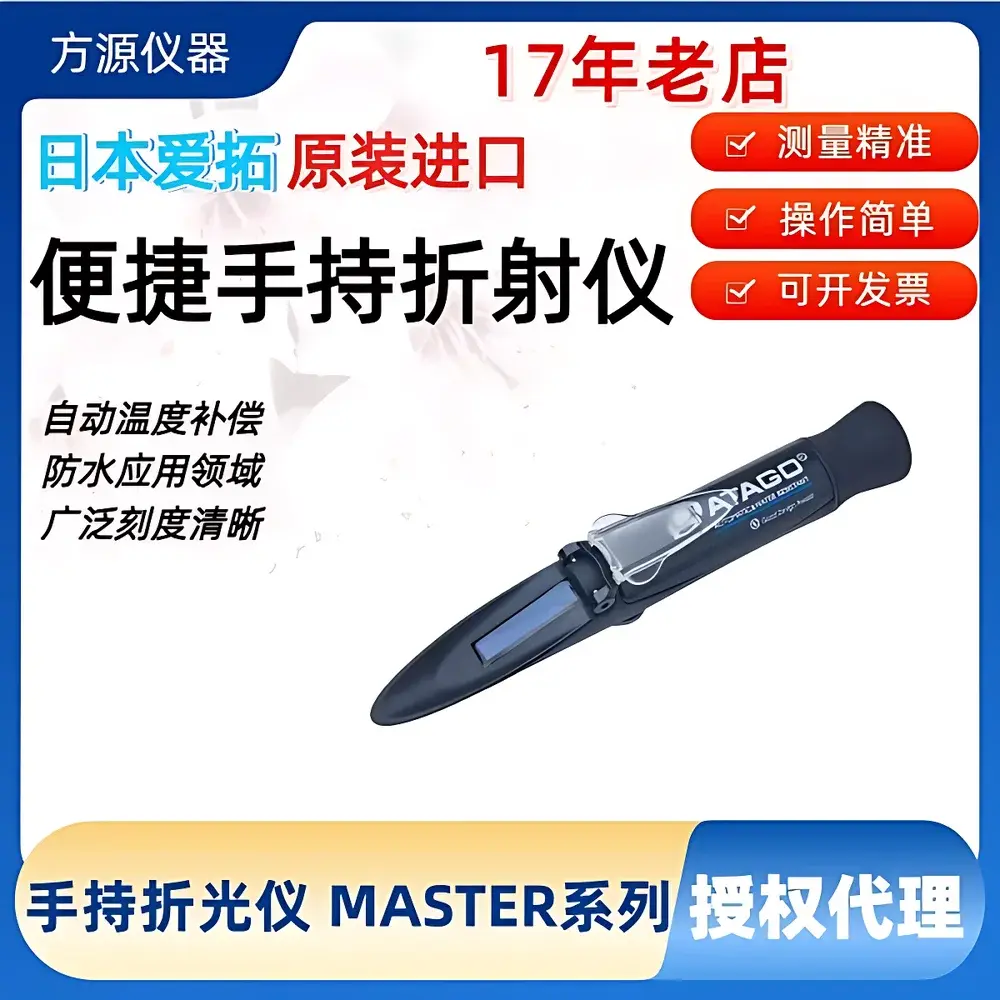
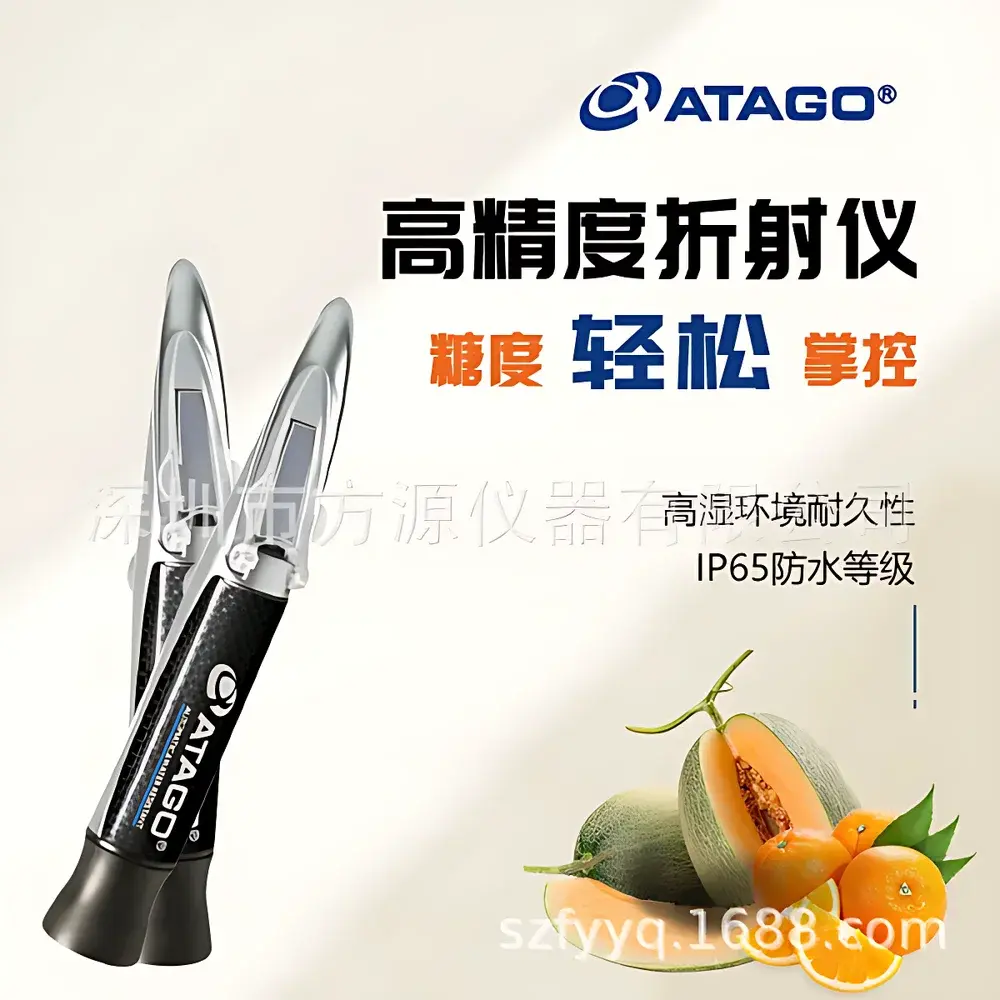
ATAGO MASTER Series Handheld Refractometer with Dedicated Scales
| Brand | ATAGO |
|---|---|
| Origin | Japan |
| Product Type | Handheld Refractometer |
| Model | MASTER Series |
| Display | Digital |
| Temperature Compensation | Automatic (ATC) |
| IP Rating | IP65 (excluding eyepiece) |
| Dimensions | 3.2 × 3.4 × 20.3 cm |
| Weight | 105 g |
| Accuracy | ±0.2% NaCl (10–30 °C) |
| Key Scales | NaCl 0.0–10.0% (MASTER-S10a), NaCl 0.0–28.0% (MASTER-S28a) |
| Minimum Scale Division | 0.1% (S10a), 0.2% (S28a) |
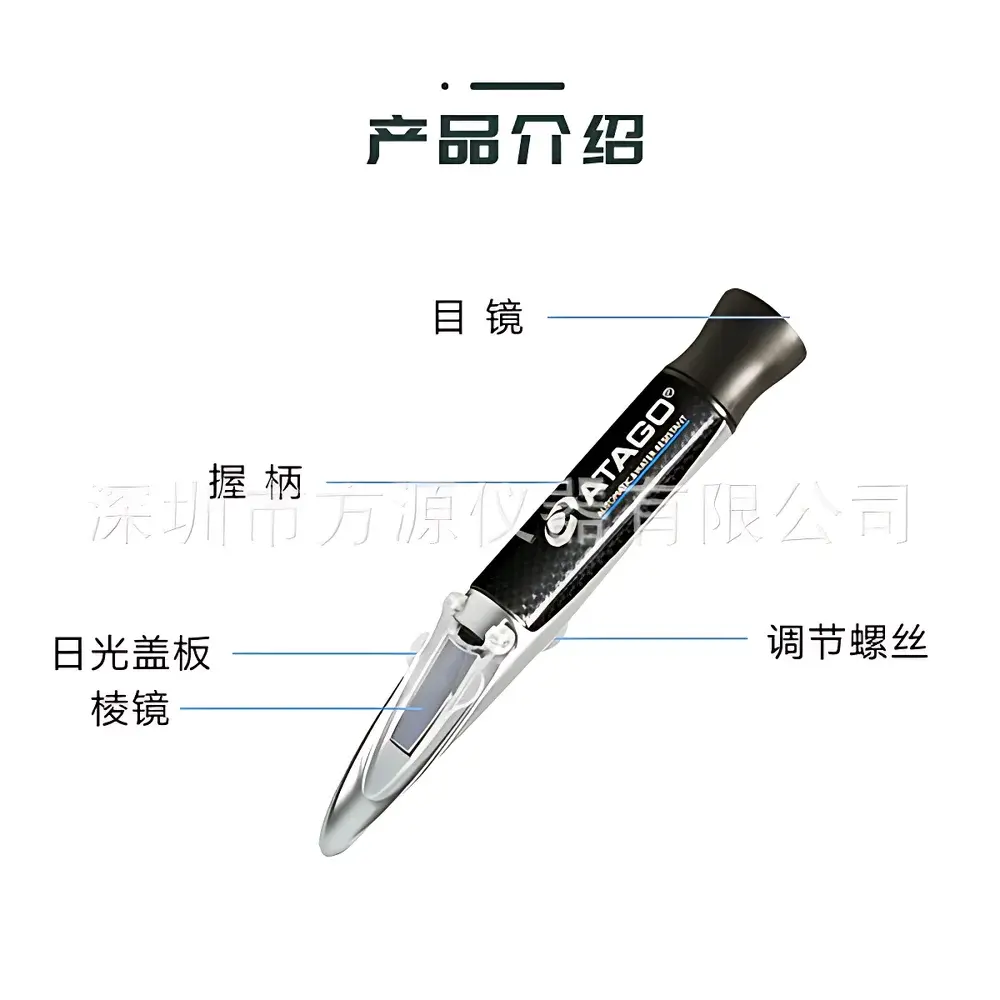
| Illumination Plate | RE-2471-56M (standard), RE-2391-59M (optional), Prism Cover for Micro-sampling: RE-2391-50M (excl. high-viscosity samples) |
Overview
The ATAGO MASTER Series Handheld Refractometer is an optical precision instrument engineered for rapid, field-deployable measurement of refractive index—converted to concentration units (e.g., % w/w NaCl) via calibrated scales. It operates on the principle of total internal reflection at the prism-sample interface: incident light undergoes critical angle shift proportional to the sample’s refractive index, which is optically projected onto a reticle scale and digitized via integrated photodiode array and microprocessor-based signal processing. Unlike benchtop Abbe refractometers, the MASTER Series incorporates Automatic Temperature Compensation (ATC) using a built-in thermistor network that dynamically corrects readings across 10–30 °C without external calibration or manual adjustment—ensuring metrological consistency in variable ambient conditions. Its compact, ergonomic design conforms to ISO 21748 and JIS K 0067 standards for portable refractometry, making it suitable for routine quality control in food processing, chemical manufacturing, water treatment, and laboratory support environments where portability, speed, and repeatability are critical.
Key Features
- True handheld form factor: 105 g weight and 20.3 cm length enable one-handed operation and extended field use without fatigue.
- Digital LCD display with backlight-independent daylight readability—optimized for industrial lighting conditions including direct sunlight (enhanced by integrated daylight plate).
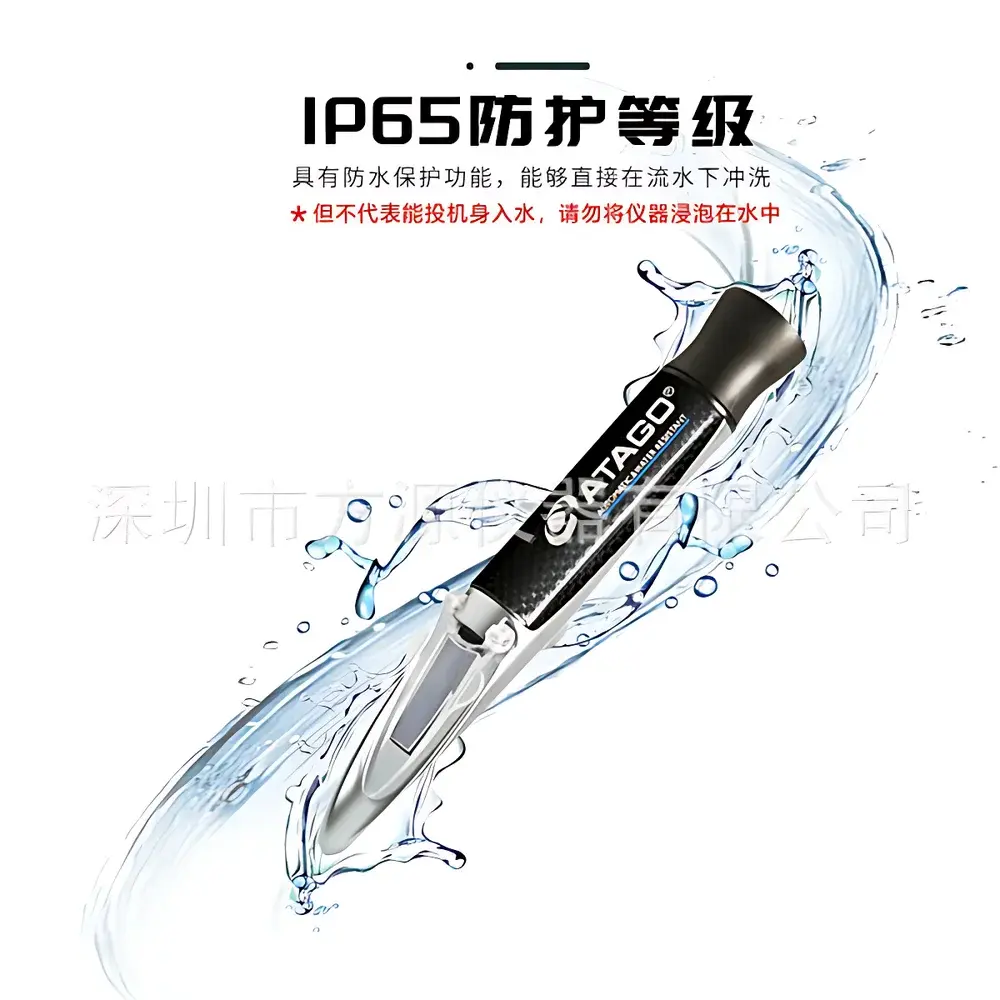
- IP65-rated housing (excluding eyepiece assembly): dust-tight and resistant to low-pressure water jets—validated per IEC 60529—supporting washdown-capable deployment in food & beverage production lines.
- ATC-enabled measurement engine: compensates for thermal expansion effects in both prism and sample phase, maintaining ±0.2% NaCl accuracy across the full 10–30 °C operational range.
- Interchangeable scale configurations: MASTER-S10a (0.0–10.0% NaCl, 0.1% resolution) and MASTER-S28a (0.0–28.0% NaCl, 0.2% resolution) allow application-specific optimization without hardware modification.
- Modular accessory ecosystem: includes standardized illumination plates (RE-2471-56M, RE-2391-59M) and micro-sampling prism covers (RE-2391-50M) for viscous or limited-volume samples—compatible across all MASTER models.
Sample Compatibility & Compliance
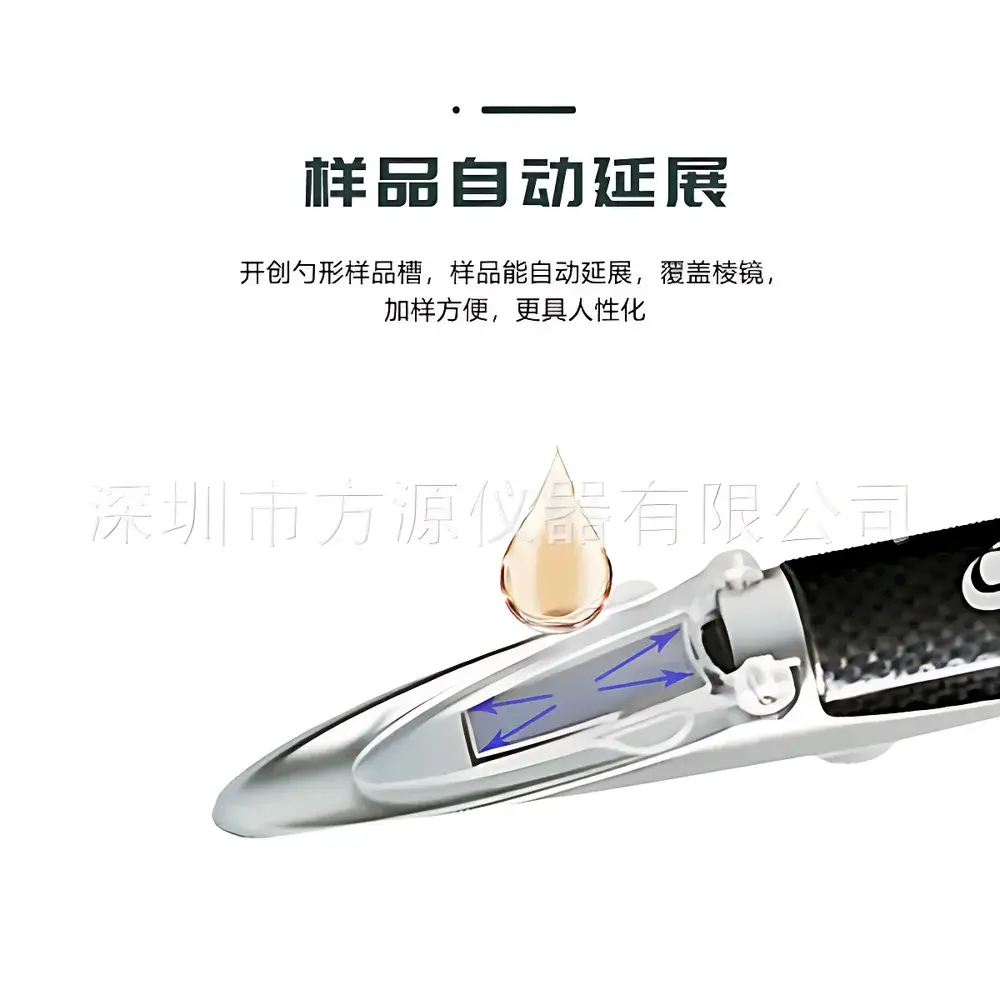
The MASTER Series accepts aqueous solutions with viscosity ≤ 500 mPa·s (e.g., brines, saline rinses, sugar syrups, cleaning agents, and process coolants). Samples must be homogeneous, free of suspended particulates, and applied as a thin, continuous film over the sapphire-coated measuring prism. It complies with ISO 21748:2017 (repeatability requirements for refractometric concentration determination) and supports GLP-aligned documentation when paired with ATAGO’s optional data logging accessories. While not FDA 21 CFR Part 11–compliant out-of-the-box (lacking audit trail and electronic signature functionality), its measurement traceability aligns with ISO/IEC 17025 requirements when used within validated SOPs and calibrated against NIST-traceable NaCl reference standards.
Software & Data Management
The MASTER Series is a standalone optical-electronic instrument with no embedded Bluetooth, USB, or Wi-Fi connectivity. All measurement data remains local to the device display; no firmware updates or software installation are required. For traceable recordkeeping, users may manually transcribe values into LIMS or QC databases. Optional accessories—including the ATAGO Data Logger Kit (sold separately)—enable analog voltage output (0–5 V DC) proportional to displayed concentration, facilitating integration with PLC-based monitoring systems or analog chart recorders. Calibration verification follows ATAGO-recommended protocol: daily zero-check with distilled water and periodic span verification using certified NaCl reference solutions (e.g., 5.00 ± 0.02% w/w).
Applications
- Food & Beverage: Rapid verification of brine concentration in pickling, salting, and curing processes; monitoring of salt content in sauces, dressings, and dairy brines.
- Industrial Cleaning: Quantification of alkaline or acidic detergent concentrations in CIP (Clean-in-Place) rinse validation and bath life extension protocols.
- Aquaculture & Hydroponics: Field assessment of salinity in recirculating aquaculture systems (RAS) and nutrient solution conductivity proxies.
- Automotive & Metalworking: Coolant concentration checks in machining fluids to ensure corrosion inhibition and thermal stability.
- Pharmaceutical Water Systems: Non-GMP-grade screening of purified water conductivity surrogates during pre-operational checks (not for USP compliance).
FAQ
Does the MASTER Series require battery replacement or charging?
No—the device is entirely passive and requires no power source. The digital display is driven solely by ambient light captured through the daylight plate and converted via photovoltaic cell array.
Can it measure non-aqueous liquids such as oils or ethanol solutions?
No. The MASTER Series is calibrated exclusively for aqueous NaCl solutions. Refractive index–concentration relationships differ significantly across solute-solvent systems; using it for non-NaCl or non-aqueous media introduces unquantified systematic error.
Is the prism surface scratch-resistant?
Yes—the measuring surface features a sapphire-hardened optical coating (Mohs hardness ≥9), providing robust resistance to abrasion from routine cleaning with lens tissue and mild detergent.
How often should calibration verification be performed?
ATAGO recommends verifying zero point with distilled water before each shift and performing full span check with certified reference standard at least once per day in regulated environments—or per internal SOP frequency in non-regulated settings.
What is the minimum sample volume required?
Approximately 0.3 mL is sufficient to fully cover the prism surface; the optional RE-2391-50M micro-prism cover reduces this to ~0.05 mL for high-value or viscous samples (excluding those >500 mPa·s).




