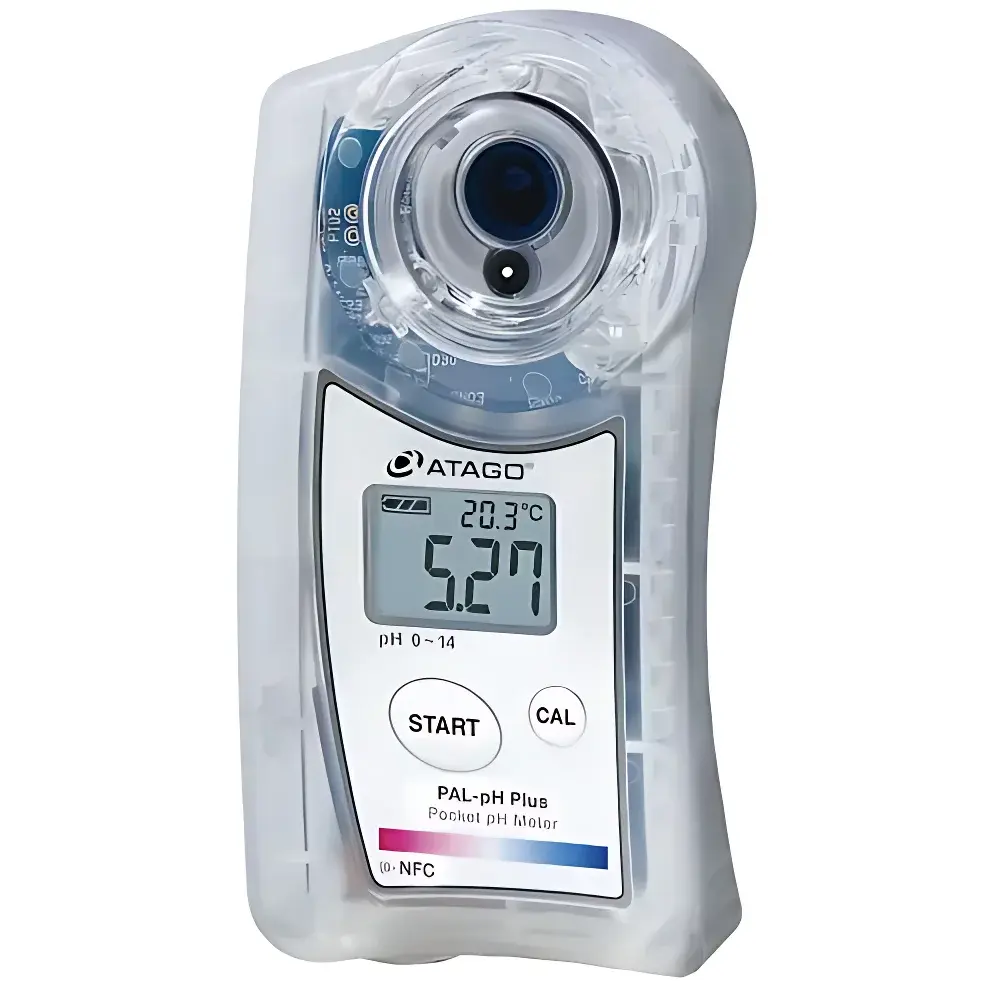
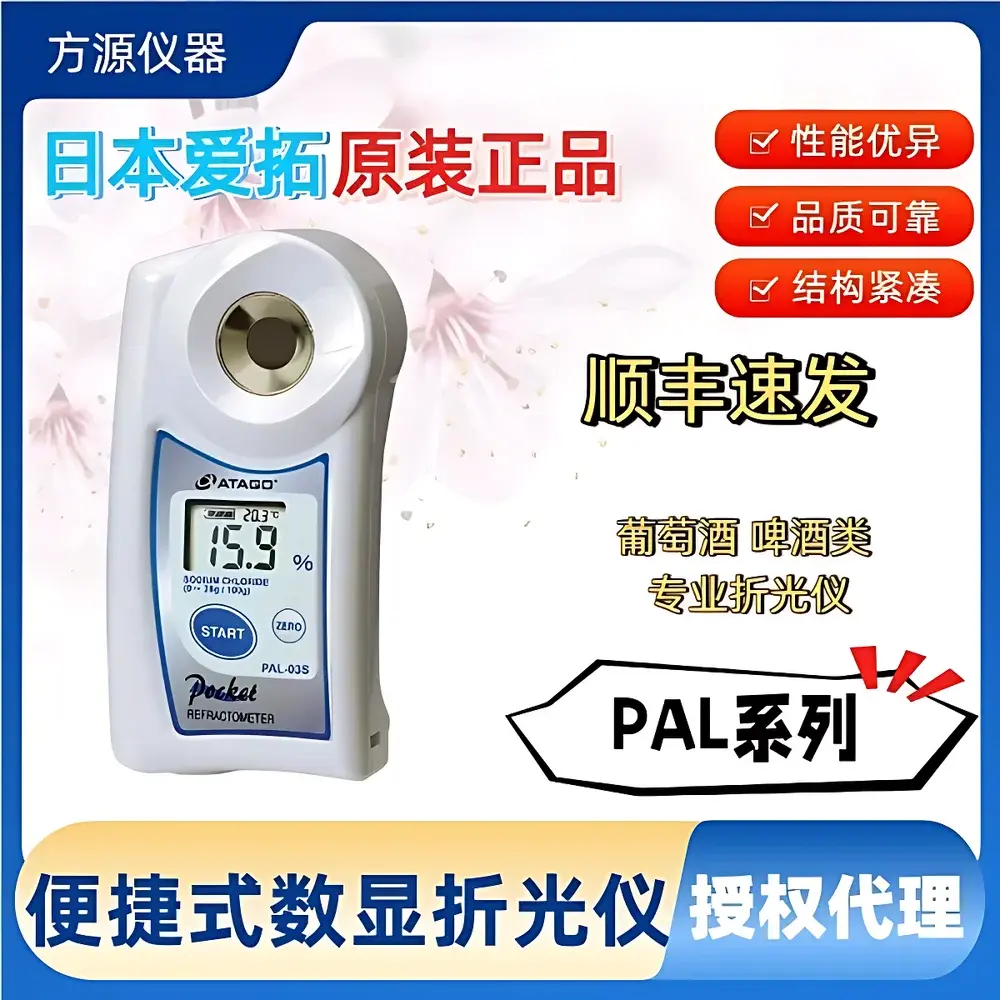
ATAGO PAL-79S Wine & Beer-Specific Digital Portable Refractometer
| Brand | ATAGO |
|---|---|
| Origin | Japan |
| Model | PAL-79S (T.A.1990) |
| Measurement Range | 0.0–45.0% w/w (Brix or alcohol-related scale) |
| Resolution | 0.2% |
| Accuracy | ±0.4% |
| Dimensions | Compact handheld form factor |
| Weight | 200 g |
| Compliance | Designed for beverage QC per ISO 2173, AOAC 932.12, and industry-specific fermentation standards |
Overview
The ATAGO PAL-79S is a dedicated digital portable refractometer engineered for rapid, on-site quantification of soluble solids and alcohol-related concentrations in wine, beer, and related fermented beverages. Operating on the principle of critical-angle refractometry, the instrument measures the refractive index of liquid samples and converts it to concentration values using pre-calibrated, application-specific algorithms—here optimized for T.A.1990 (Total Alcohol % v/v equivalent), a scale widely adopted in Japanese and Asian beverage quality control laboratories. Unlike generic Brix refractometers, the PAL-79S applies proprietary temperature-compensated optical calibration to minimize drift across ambient conditions (10–40 °C), ensuring consistent repeatability without manual correction. Its solid-state LED light source and sapphire prism deliver long-term optical stability, while the sealed optical path prevents contamination from volatile ethanol vapors or residual sugars—critical for high-throughput brewery or winery environments.
Key Features
- Application-specific optical calibration for wine and beer matrices, aligned with T.A.1990 standard (equivalent to % alcohol by volume in low-sugar, high-ethanol contexts)
- Automatic temperature compensation (ATC) across 10–40 °C, eliminating manual correction and reducing operator dependency
- Sapphire prism surface resistant to scratching, ethanol erosion, and organic residue buildup—designed for daily use in production labs and cellar floors
- Compact, ergonomic handheld design (200 g) with IP65-rated housing for splash resistance during line-side operation
- Backlit LCD display with clear numeric readout and unit indication; auto-power-off after 3 minutes to preserve battery life
- No reagents, no consumables—single-drop measurement requires only 0.3 mL sample volume, minimizing waste during batch verification
Sample Compatibility & Compliance
The PAL-79S is validated for use with clarified or filtered wine must, finished beer (including hazy IPA variants post-centrifugation), cider, sake, and low-viscosity distillate dilutions. It is not intended for undiluted spirits (>20% ABV), viscous syrups, or suspensions containing particulates >5 µm. Instrument performance conforms to ISO 2173:2003 (fruit juice and related products), AOAC Official Method 932.12 (refractometric determination of soluble solids), and supports GLP-aligned documentation when paired with ATAGO’s optional RS-232 data logging accessories. While not FDA 21 CFR Part 11–compliant as a standalone device, its measurement traceability aligns with internal QC protocols required under HACCP and ISO 22000 food safety management systems.
Software & Data Management
The PAL-79S operates as a stand-alone instrument with no embedded software or firmware update capability. However, it supports analog output via optional RS-232 interface (PAL-IF01 adapter), enabling direct integration into SCADA or MES platforms for automated data capture. When used with ATAGO’s free PAL-Link software (Windows-compatible), users can export timestamped measurement logs (.csv), generate batch reports, and apply basic statistical filters (e.g., mean, SD, max/min) for trend analysis across shifts. All exported data retain instrument ID, date/time stamp, and operator code fields—facilitating audit readiness during third-party GMP or ISO 9001 assessments.
Applications
- Real-time monitoring of alcohol content during fermentation termination in white wine and lager production
- Verification of final gravity and alcohol yield in craft brewing QA workflows
- Incoming inspection of grape must Brix-to-alcohol conversion estimates prior to inoculation
- Batch release testing for sake, chu-hi, and low-alcohol RTD beverages
- Calibration cross-check against densitometers or GC-based ethanol assays in accredited labs
- Field use by agronomists assessing ripeness in vineyard sampling programs
FAQ
What does “T.A.1990” represent on the PAL-79S display?
T.A.1990 refers to the Japanese Ministry of Agriculture, Forestry and Fisheries’ Technical Standard No. 1990, defining a refractive index–to–alcohol conversion algorithm specific to low-residue, fermented beverage matrices. It is not identical to standard %ABV calculated via distillation or GC.
Can the PAL-79S measure residual sugar in dry wine?
No. Due to overlapping refractive contributions from ethanol and residual glucose/fructose, the PAL-79S is not suitable for precise residual sugar quantification below 2.0 g/L. For that purpose, enzymatic assays or HPLC are recommended.
Is cleaning required between samples?
Yes. Wipe the prism surface with lens tissue and distilled water after each measurement; avoid alcohol-based cleaners which may degrade the anti-reflective coating over time.
Does this model support user-defined calibration?
No. The PAL-79S features factory-set, non-adjustable calibration per JIS Z 8015 and cannot be recalibrated in-field. Periodic verification with certified sucrose or ethanol reference standards is advised every 6 months.
How does it differ from the PAL-80S or PAL-Plato models?
The PAL-79S uses T.A.1990 scaling; PAL-80S employs T.A.1971 (older Japanese standard); PAL-Plato (model 4590) applies ASBC Plato-to-density conversion—each optimized for distinct regulatory or process contexts.
Related Products