
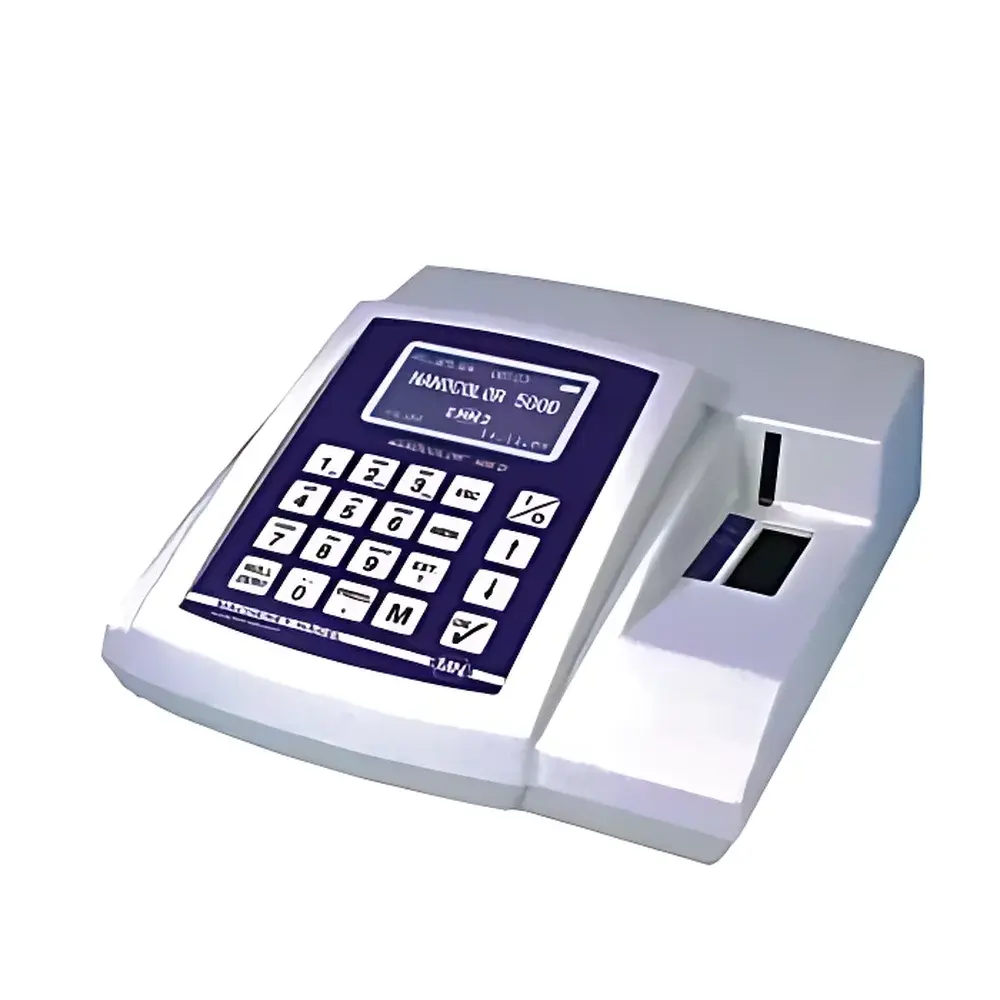
MN 500D Industrial Effluent Multi-Parameter Water Quality Analyzer
| Brand | MN |
|---|---|
| Origin | Germany |
| Manufacturer Type | Authorized Distributor |
| Origin Category | Imported |
| Model | 500D |
| Instrument Type | Laboratory & Field-Deployable Water Quality Analyzer |
| Detection Parameters | >100 parameters including heavy metals (e.g., Cr, Cd, Pb, Ni, Cu, Zn), nutrients (NO₃⁻, NO₂⁻, NH₄⁺, PO₄³⁻), organic indicators (COD, TOC, BOD surrogate), turbidity, chlorine species, pH (via optional electrode module), and colorimetric ions (Fe, Mn, Al, SiO₂) |
| Wavelength Range | 340–860 nm (10 fixed-band interference filters at 345/365/436/470/520/540/585/620/690/800 nm) |
| Wavelength Accuracy | ±2 nm |
| Spectral Bandwidth | 10–12 nm |
| Light Source | Tungsten halogen lamp |
| Detector | Silicon photodiode |
| Photometric Accuracy | ±1% FS |
| Drift Stability | <0.002 Abs/h |
| Sample Holders | 16-mm round cuvettes (NANOCOLOR® certified), plus 10-mm, 20-mm, and 50-mm rectangular cuvettes |
| Data Storage | 500 measurement records with GLP-compliant metadata (date/time, operator ID, method ID, calibration status) |
| Display | Graphic LCD (64 × 128 pixels), backlight, 10-language UI (English, German, French, Spanish, Italian, Portuguese, Dutch, Polish, Czech, Turkish) |
| Connectivity | USB 1.1 + bidirectional RS-232 |
| Power | AC 100–240 V, 50/60 Hz or internal rechargeable Li-ion battery (6 V, 3.2 Ah) |
| Dimensions | 227 × 282 × 105 mm |
| Weight | 2.4 kg |
Overview
The MN 500D Industrial Effluent Multi-Parameter Water Quality Analyzer is a CE-marked, microprocessor-controlled single-beam photometer engineered for high-reproducibility colorimetric and spectrophotometric analysis of complex industrial effluents, municipal wastewater, and surface waters. Operating on the principle of absorbance-based quantification per the Beer–Lambert law, it delivers trace-level detection of over 100 regulated and process-critical analytes—including toxic heavy metals (Cr⁶⁺, Cd²⁺, Pb²⁺, Ni²⁺, Cu²⁺, Zn²⁺), nitrogen and phosphorus compounds, oxidants/reductants, and organic load surrogates—across a calibrated spectral range of 340–860 nm. Its dual-use architecture supports both benchtop laboratory deployment and field-portable operation under ambient conditions (0–50 °C, ≤90% RH), making it suitable for compliance monitoring per ISO 7027 (turbidity), ISO 6060 (COD), ISO 11908 (nitrate), EPA Method 3500-Cu (copper), and DIN EN ISO 11908:2018. The instrument’s optical design employs a precision-filter wheel with ten narrowband interference filters, eliminating the need for monochromator alignment while ensuring long-term wavelength stability and inter-laboratory method transferability.
Key Features
- Automated wavelength selection via barcode recognition of NANOCOLOR® pre-filled reagent tubes—ensuring zero manual filter positioning error and full traceability to lot-specific calibration curves.
- Dual-cuvette compatibility: simultaneous support for standardized 16-mm round vials (ASTM D5116-compliant) and variable-pathlength rectangular cells (10/20/50 mm), enabling flexibility across low-concentration screening and high-turbidity sample matrices.
- Comprehensive method library: 100+ factory-preset analytical protocols aligned with ISO, DIN, and EPA standards; user-configurable storage for up to 99 custom test sequences with editable reaction kinetics, multi-point calibration, and extinction coefficient input.
- GLP-compliant data integrity: timestamped measurement logs include operator ID, method version, cuvette ID, blank reference, and calibration history—fully auditable for ISO/IEC 17025 and FDA 21 CFR Part 11 readiness when paired with validated PC software.
- Robust power architecture: switchable AC/DC operation with intelligent battery management, delivering ≥8 hours of continuous field use without performance degradation or thermal drift.
- Industrial-grade interface: tactile aluminum-foil membrane keypad, backlit graphic display with multilingual firmware, and dual serial interfaces (RS-232 + USB 1.1) for direct printer output or integration into LIMS environments.
Sample Compatibility & Compliance
The MN 500D accommodates raw, filtered, digested, and acid-preserved samples across diverse industrial sectors—including electroplating rinse streams, chemical manufacturing outfalls, food processing wastewater, and landfill leachate. Its optical path design minimizes scattering artifacts in turbid matrices through optimized detector geometry and dynamic blank compensation. All preprogrammed methods adhere to internationally recognized validation frameworks: heavy metal assays meet ISO 11908 and EPA 200.7 requirements for detection limits and spike recovery; nutrient tests conform to ISO 11908 (nitrate/nitrite), ISO 6878 (phosphate), and DIN 38405-D9 (ammonium). The analyzer is supplied with full Declaration of Conformity to EU Directive 2014/30/EU (EMC) and 2011/65/EU (RoHS), and its firmware architecture supports audit-ready electronic records compliant with GLP and GMP principles.
Software & Data Management
Data export and instrument configuration are managed via MN’s proprietary LabSoft™ PC application (Windows 10/11 compatible), which provides secure, encrypted two-way synchronization over USB or RS-232. LabSoft™ enables batch report generation (PDF/CSV), statistical trend analysis (RSD, confidence intervals), automated QC flagging (e.g., calibration drift >±0.005 Abs), and electronic signature workflows aligned with 21 CFR Part 11 Annex 11 expectations. Firmware updates—including new test methods, language packs, and regulatory adaptations—are distributed via password-protected download portals, with SHA-256 checksum verification and rollback capability. All stored measurements retain immutable metadata: date/time stamp (RTC-synchronized), operator code, method revision number, and instrument serial ID—enabling full chain-of-custody reconstruction during regulatory inspections.
Applications
- Regulatory discharge monitoring for ISO 14001-certified facilities verifying compliance with local effluent limits (e.g., Zn < 2 mg/L, Cr⁶⁺ < 0.1 mg/L).
- In-process control of wastewater treatment plants—tracking nitrification/denitrification efficiency via real-time NH₄⁺/NO₃⁻ ratio analysis.
- Source water vulnerability assessment in industrial catchments using multi-parameter fingerprinting (e.g., Fe/Mn/COD correlation).
- Contract laboratory accreditation support: method validation documentation, intermediate precision studies, and uncertainty budgeting per ISO/IEC 17025:2017 Clause 7.6.
- Field-based emergency response: rapid screening of heavy metal contamination following spill incidents using pre-calibrated NANOCOLOR® kits with onboard barcode authentication.
FAQ
Does the MN 500D require annual recalibration by an accredited service provider?
No—its self-diagnostic routines and factory-traceable filter wheel eliminate routine optical recalibration. However, users must perform daily blank verification and quarterly performance checks using NIST-traceable standard solutions per ISO/IEC 17025 Clause 6.5.
Can the instrument store custom calibration curves generated from in-house reference standards?
Yes—up to 99 user-defined methods support manual entry of slope/intercept values, polynomial fits, or multi-point non-linear calibrations with full metadata logging.
Is the battery pack replaceable in the field without tools?
Yes—the sealed Li-ion module is hot-swappable via a captive screw mechanism and carries CE-certified safety certification (UN38.3, IEC 62133).
Are NANOCOLOR® reagent kits included with the base instrument purchase?
No—reagents are sold separately as consumables. Each kit includes lot-specific calibration certificates, expiration tracking barcodes, and matrix-matched blanks for wastewater applications.
Does the RS-232 interface support Modbus RTU protocol for SCADA integration?
No—it implements standard ASCII command sets only. For industrial automation, a USB-to-Modbus gateway or LabSoft™ middleware is required.







