
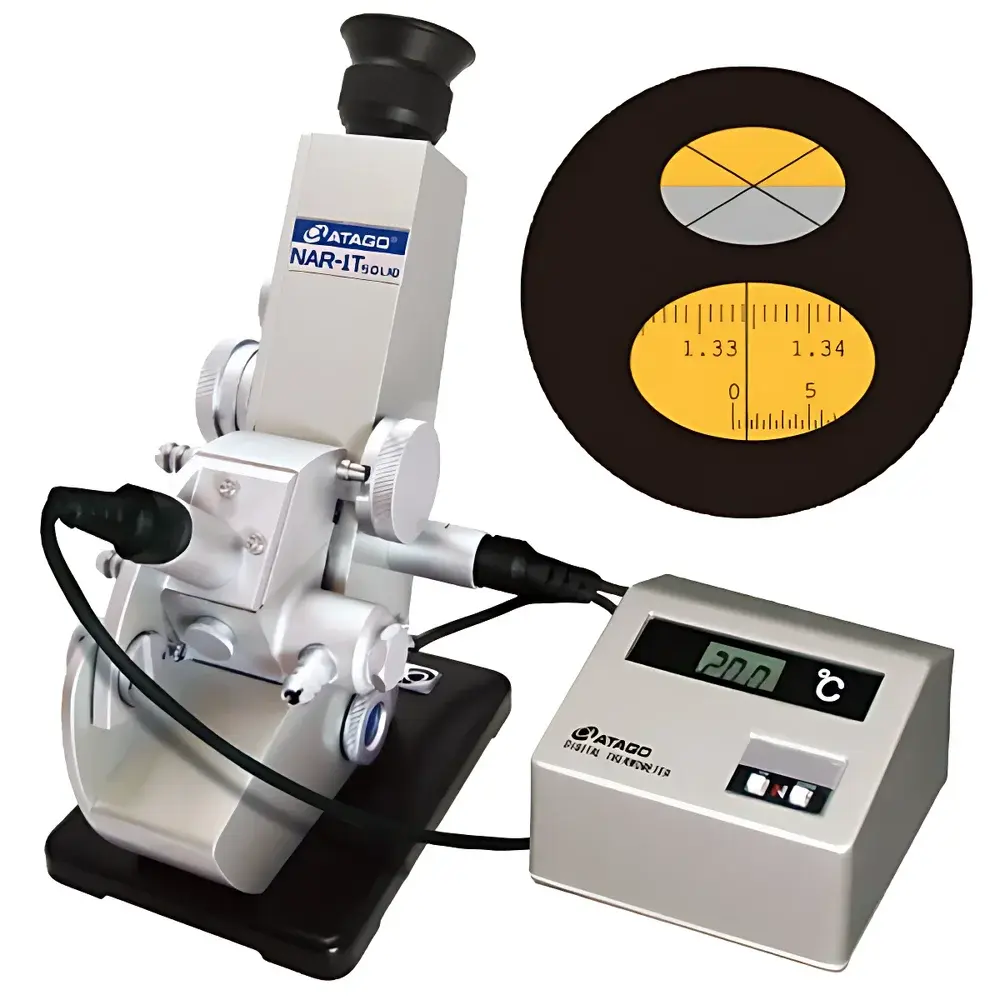
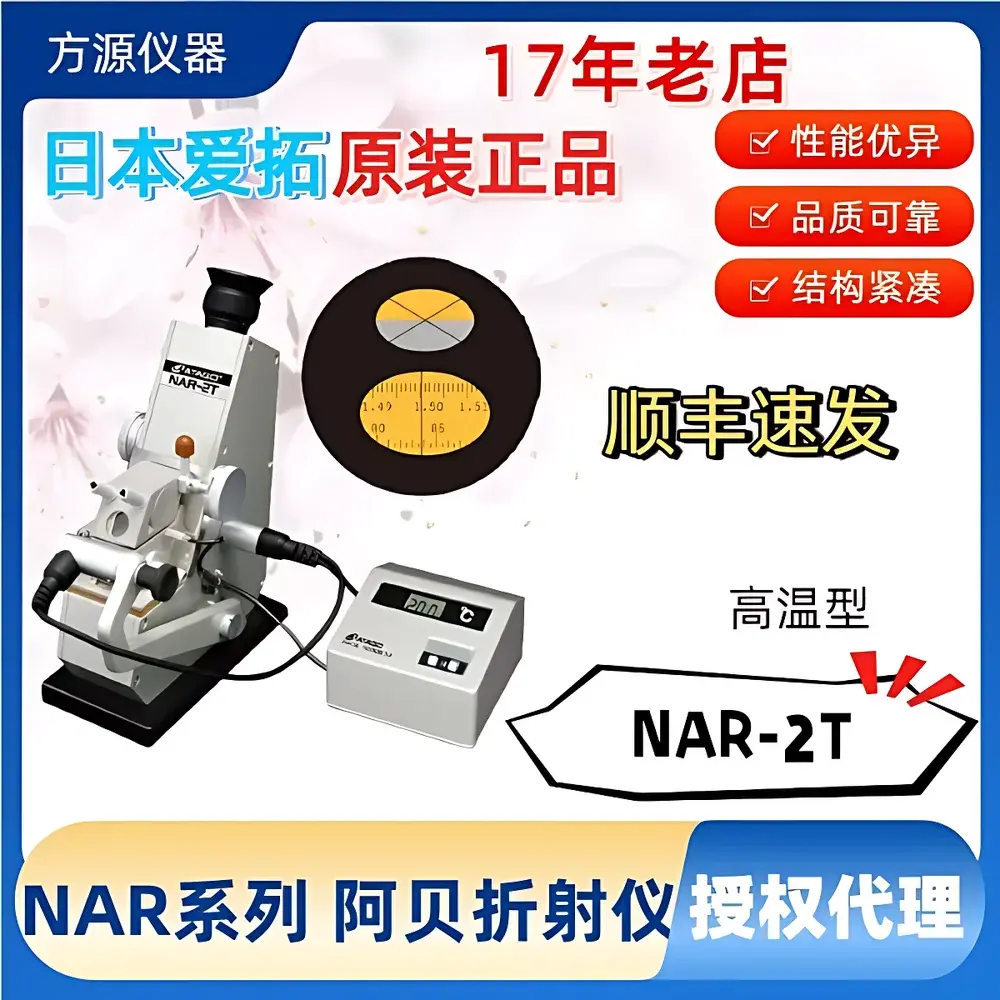
ATAGO NAR-2T Benchtop Digital Refractometer with Temperature Control
| Brand | ATAGO |
|---|---|
| Origin | Japan |
| Model | NAR-2T |
| Type | Benchtop Refractometer |
| Temperature Control | Yes |
| Digital Display | Yes |
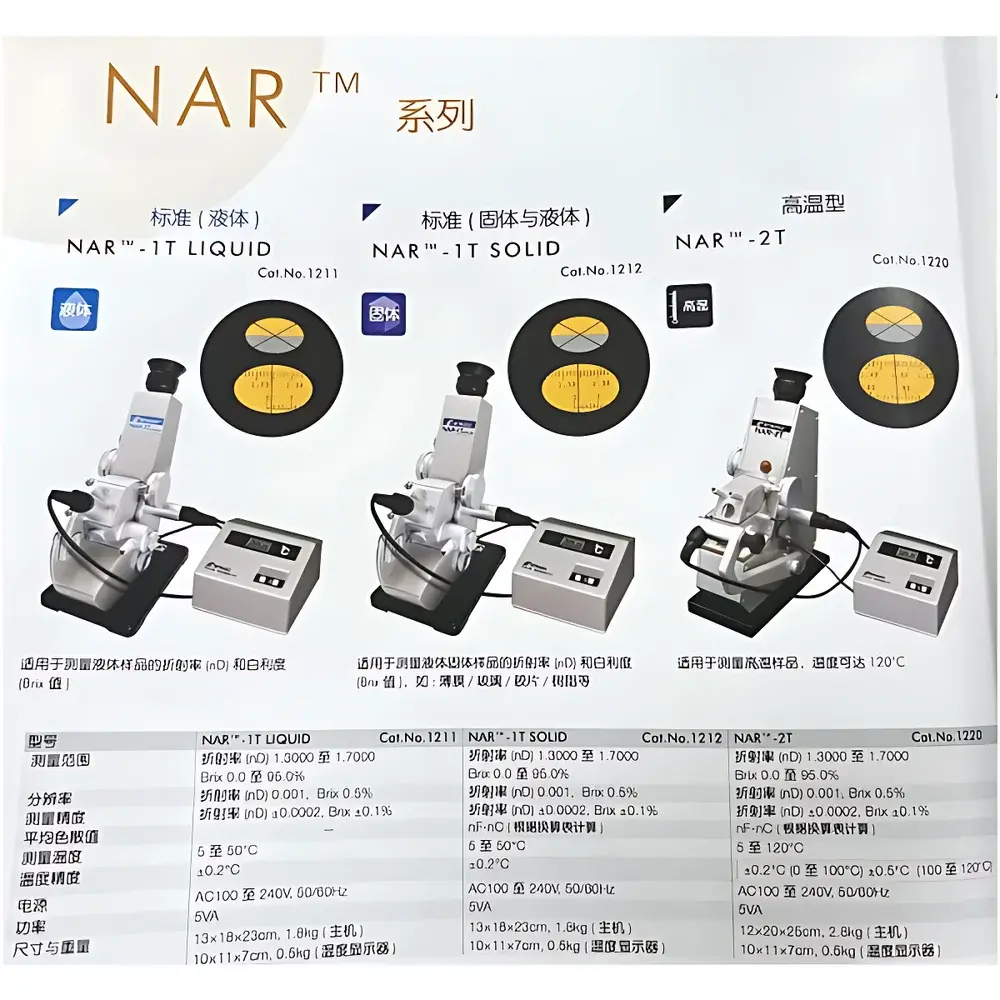
| Refractive Index (nD) Range | 1.3000–1.7000 |
| Brix Range | 0.0–95.0% |
| Refractive Index Resolution | 0.0001 |
| Brix Resolution | 0.1% |
| Refractive Index Accuracy | ±0.0002 |
| Brix Accuracy | ±0.1% |
| Temperature Range | 5–120°C |
| Temp. Accuracy | ±0.2°C (0–100°C), ±0.5°C (100–120°C) |
| Power Supply | AC 100–240 V, 50/60 Hz, 5 VA |
| Dimensions (Main Unit) | 12×20×25 cm |
| Weight (Main Unit) | 2.8 kg |
| Dimensions (Temp. Display Unit) | 10×11×7 cm |
| Weight (Temp. Display Unit) | 0.5 kg |
Overview
The ATAGO NAR-2T is a high-precision benchtop digital refractometer engineered for accurate, repeatable measurement of refractive index (nD) and Brix concentration in liquid and semi-solid samples under controlled thermal conditions. Based on the principle of total internal reflection at the prism-sample interface, the instrument determines nD by detecting the critical angle of light refraction—directly correlated to solute concentration and temperature-dependent optical density. Unlike handheld or analog units, the NAR-2T integrates active Peltier-based temperature control and real-time digital readout, eliminating manual calibration drift and operator-dependent interpretation. Its design conforms to international refractometric standards including ISO 21745:2021 (refractometry for sugar solutions), ASTM D1218 (refractive index of hydrocarbon liquids), and supports traceable QC workflows in regulated environments such as food & beverage QA, pharmaceutical excipient verification, and chemical formulation labs.
Key Features
- Peltier-controlled thermostatic sample stage enabling precise temperature regulation from 5°C to 120°C, with dual-zone accuracy: ±0.2°C (0–100°C) and ±0.5°C (100–120°C)
- High-resolution digital display showing both refractive index (nD) and Brix (%) simultaneously, with 0.0001 nD and 0.1% Brix resolution
- Calibration traceability via ATAGO-certified reference standards (e.g., distilled water at 20°C: nD = 1.3330; sucrose solution at 20°C: 10.00% Brix)
- Robust stainless-steel prism assembly with scratch-resistant sapphire coating, rated for repeated exposure to aggressive solvents, acids, and viscous media
- Integrated temperature monitoring with external sensor input and independent digital display unit for real-time thermal validation
- Compliance-ready architecture supporting GLP/GMP documentation: auto-log timestamped measurements, user ID tagging, and non-editable data export (CSV format)
Sample Compatibility & Compliance
The NAR-2T accommodates a broad spectrum of homogeneous liquid and semi-solid samples—including aqueous sugar solutions, glycerol-water mixtures, polymer emulsions, pharmaceutical syrups, fruit juices, and industrial coolants—provided they exhibit optical clarity at the measurement wavelength (589 nm sodium D-line). It is not intended for highly scattering, turbid, or strongly fluorescent matrices without prior filtration or dilution. For solid-phase characterization (e.g., thin films, optical resins), optional prism adapters enable surface contact measurement per ISO 489:2016. All operational parameters adhere to IEC 61010-1 safety requirements for laboratory electrical equipment. The instrument’s temperature-controlled measurement protocol satisfies USP and EP 2.2.12 refractometric testing guidelines for concentration verification in pharmacopeial applications.
Software & Data Management
While the NAR-2T operates as a standalone instrument, its RS-232 interface enables seamless integration with laboratory information management systems (LIMS) and enterprise quality databases. Measurement data—including nD, Brix, temperature, date/time stamp, operator ID, and instrument serial number—is output in ASCII format for direct ingestion into statistical process control (SPC) platforms. Optional ATAGO Data Manager software (v3.2+) provides audit-trail functionality compliant with FDA 21 CFR Part 11, including electronic signatures, role-based access control, and immutable record archiving. Raw data files retain metadata required for ISO/IEC 17025 accreditation audits.
Applications
- Food & Beverage: Brix quantification in fruit concentrates, honey, soft drink syrups, and dairy-based beverages for consistency control and labeling compliance
- Pharmaceuticals: Excipient concentration verification (e.g., dextrose, sorbitol, propylene glycol) in oral solutions and injectables per USP monographs
- Chemical Manufacturing: Monitoring glycol concentration in heat-transfer fluids, ethylene oxide/water ratios in sterilant formulations, and resin solids content
- Academic Research: Solvent purity assessment, polymer solution thermodynamics, and phase behavior studies requiring temperature-resolved refractive index profiling
- Quality Assurance Labs: Incoming raw material screening, in-process checks during blending operations, and final product release testing
FAQ
What is the maximum operating temperature for continuous measurement?
The NAR-2T supports sustained operation up to 120°C at the prism surface, with thermal stability maintained within ±0.5°C in the upper range.
Can the instrument measure non-aqueous solvents like ethanol or acetone?
Yes—provided the solvent is optically clear and does not chemically attack the sapphire-coated prism; ATAGO recommends verifying compatibility using Material Safety Data Sheets (MSDS) prior to routine use.
Is calibration verification required before each use?
Per ISO/IEC 17025 and internal QA protocols, daily calibration verification using certified reference standards is recommended; full recalibration is performed annually or after mechanical impact.
Does the NAR-2T support custom concentration scales beyond Brix?
Yes—the instrument allows user-defined conversion tables for NaCl (% w/w), alcohol (% v/v), or proprietary formulations, stored in non-volatile memory.
How is temperature uniformity ensured across the prism surface?
A microprocessor-controlled Peltier module, coupled with embedded platinum RTD sensors and closed-loop feedback, maintains spatial temperature deviation below ±0.1°C across the 25 mm² measurement area.




