
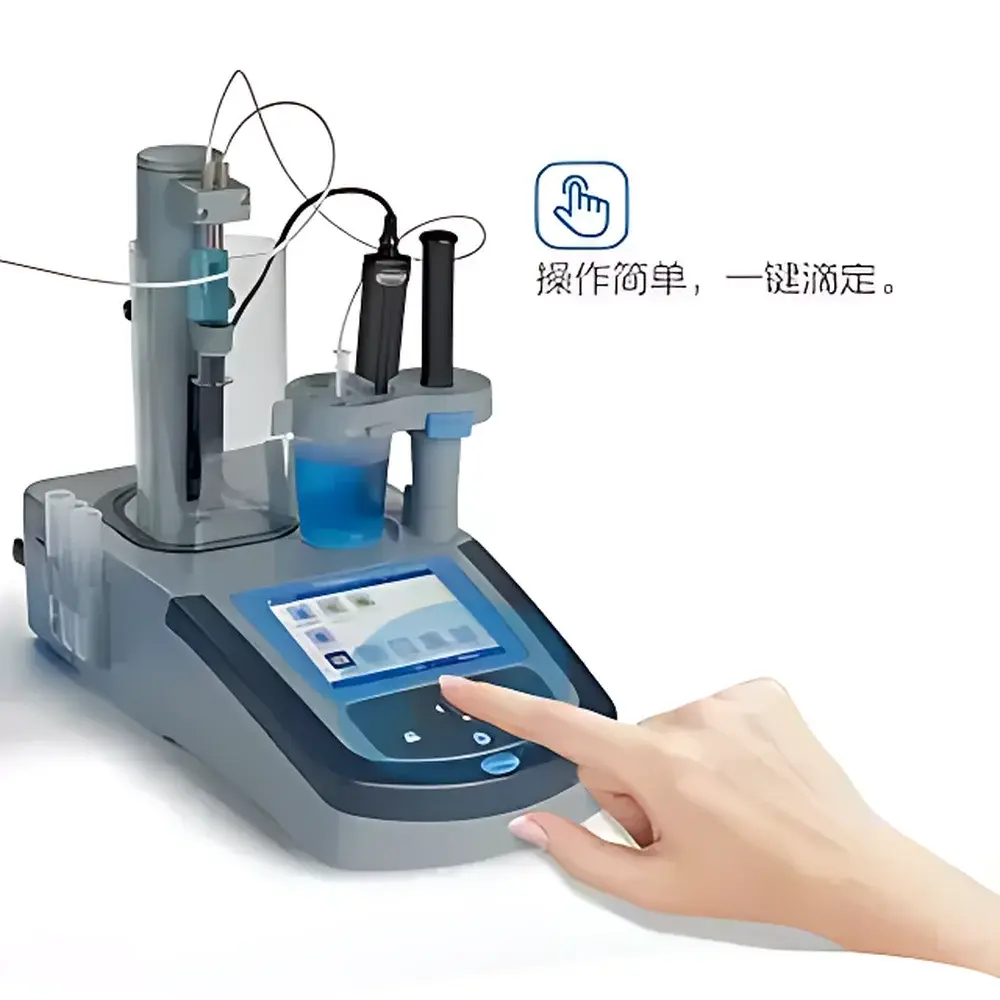
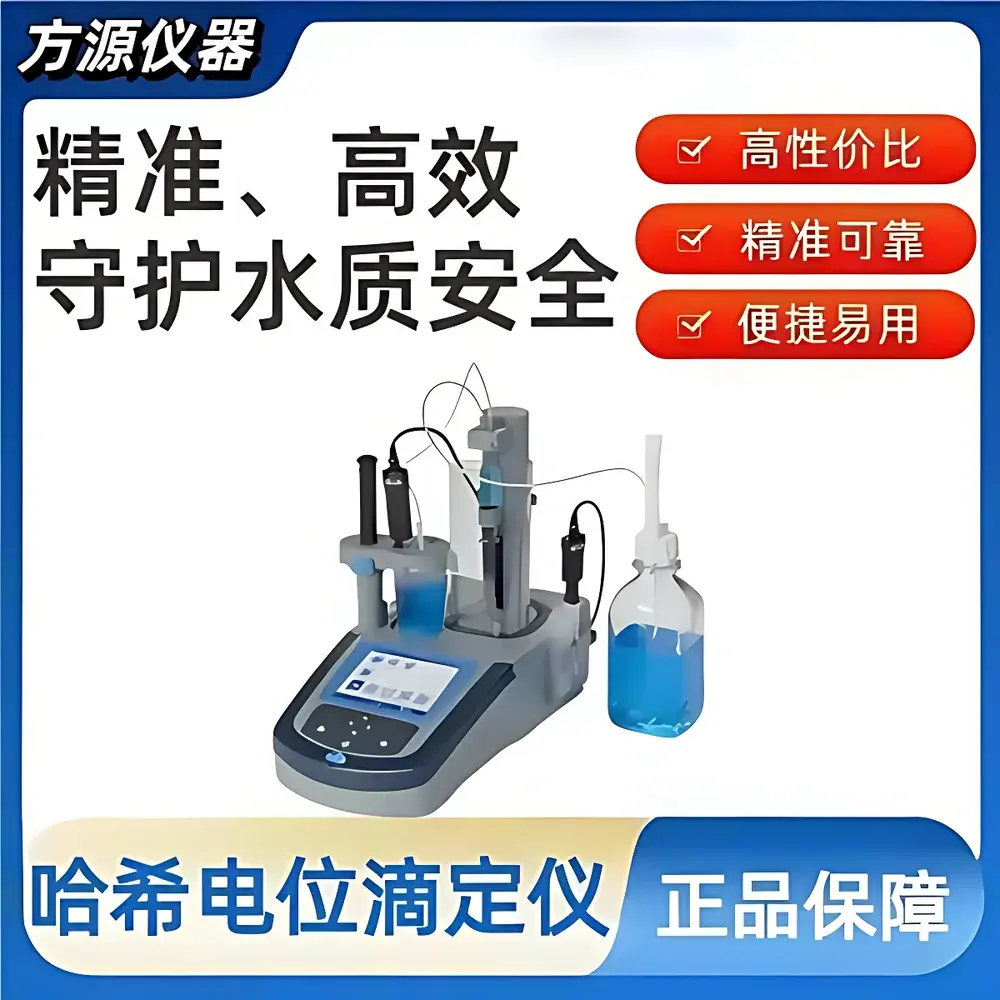
Hach TitraLab AT1000 Automatic Potentiometric Titrator
| Brand | Hach |
|---|---|
| Origin | USA |
| Model | AT1000 |
| Instrument Type | General-purpose Potentiometric Titrator |
| Titration Modes | Potentiometric (zero-current or controlled-current), Amperometric, Colorimetric |
| Measured Parameters | mV/pH, Conductivity, Temperature |
| Resolution | ±0.1 mV / ±0.001 pH |
| Conductivity | ±0.5% of reading |
| Temperature | ±0.3°C |
| Sample Holder | Integrated magnetic stirrer, max. 250 mL beaker |
| Electrode Inputs | Dual-channel, supports IntelliCAL digital electrodes (plug-and-play), analog electrodes, and colorimetric sensors |
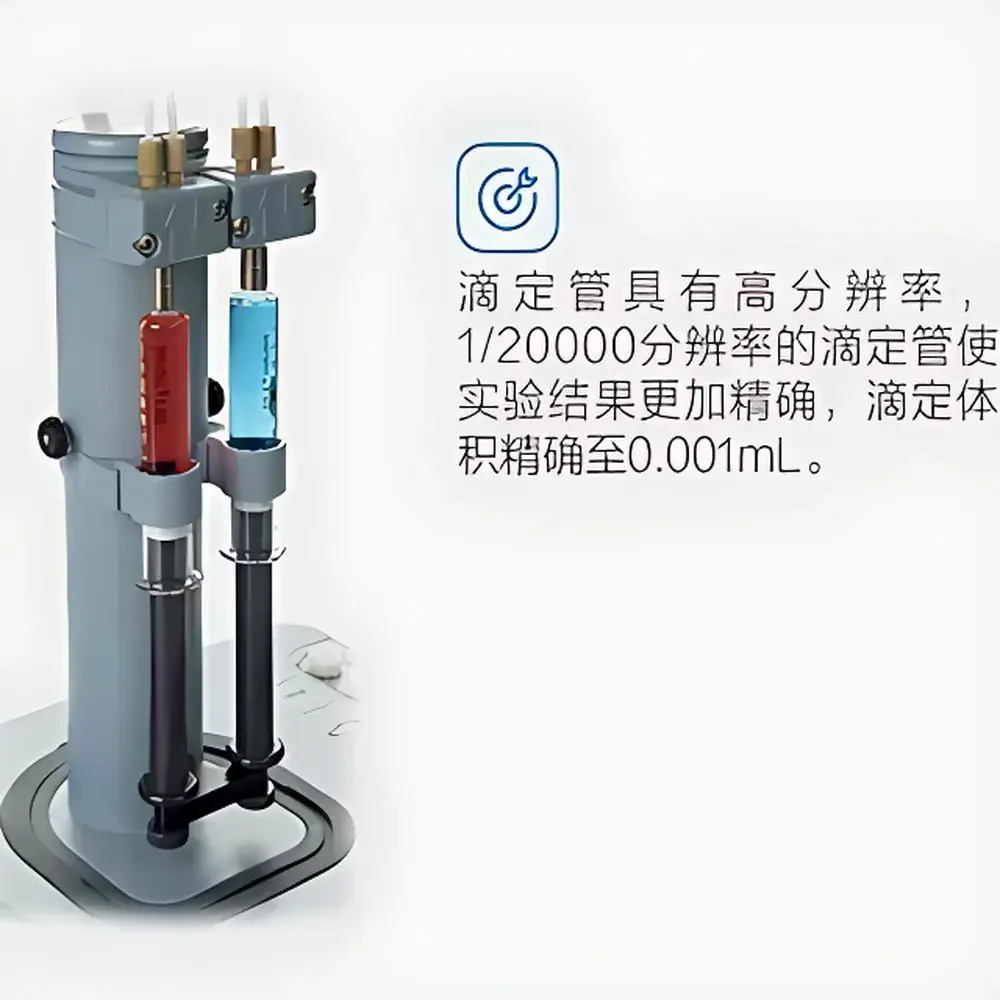
| Burette Capacity Options | 2.5 / 5 / 10 / 25 mL (ISO 8655-3 compliant) |
| Stepper Motor Resolution | 20,000 steps with microstepping (128 µsteps/step) |
| Calibration Modes | Electrode and titrant calibration (auto, fixed, custom |
| Calibration Reminders | User-definable intervals |
| Data Storage | Last 100 measurements (samples, blanks, QC standards) + last 10 calibrations, including timestamp, operator ID, sample ID |
| Data Export | USB drive, CSV format |
| Interface | Silicone keypad |
| Display | 5.7" color VGA touchscreen |
| Calibration Curve Display | Direct or derivative plots, electrode response curves |
| Software & Accessories | PC software (TitraWin), analytical balance interface, autosampler, barcode scanner, peristaltic pump, paddle stirrer |
| Maintenance Scheduler | Configurable user-defined schedule |
| Predefined Functions | Bubble purge, reagent pre-fill, replaceable burette and pump modules |
| Password Protection | Enabled, customizable |
| Languages | English, French, German, Italian, Spanish |
| Connectivity | 2× electrode ports, 2× USB, 1× RS-232, 1× Ethernet |
| Dimensions (H×W×D) | 220 × 400 × 360 mm |
| Weight | 4 kg |
| Power | 100–240 VAC, 50/60 Hz |
| Operating Environment | 15–35°C, 20–80% RH (non-condensing) |
| Storage Range | −5–40°C |
| Safety & EMC Compliance | IEC/EN 61010-1, IEC/EN 61326-1 |
| Application Library | Preloaded methods for water/wastewater (alkalinity, hardness, chlorine, FOS/TAC), food & beverage (total acidity, SO₂, salt), petrochemical (TAN, TBN, bromine number), environmental (AUTOCAT), and Karl Fischer moisture (KF1121 variant) |
Overview
The Hach TitraLab AT1000 Automatic Potentiometric Titrator is a modular, ISO-compliant benchtop titration platform engineered for precision, repeatability, and regulatory readiness in routine and method-critical laboratories. It operates on the fundamental principle of potentiometric endpoint detection—measuring potential difference across an ion-selective or redox-sensitive electrode pair as titrant is incrementally delivered—and extends functionality to amperometric and colorimetric titration modes via configurable sensor inputs. Designed for full traceability and audit compliance, the system meets essential requirements for GLP, GMP, and ISO/IEC 17025 environments through built-in electronic signatures, time-stamped data logging, and secure user access control. Its architecture supports both single- and dual-burette configurations (AT1102 through AT1222 models) and integrates seamlessly with Karl Fischer moisture analysis (KF1121 model), making it a unified solution for volumetric quantification across water quality, food safety, petrochemical, and environmental testing domains.
Key Features
- High-resolution titration control: 20,000-step stepper motor with 128 microsteps per step ensures sub-microliter delivery accuracy and reproducible endpoint determination.
- Dual-channel sensor interface: Simultaneous support for IntelliCAL digital electrodes (auto-ID and calibration memory), analog pH/conductivity/ISE probes, and colorimetric flow cells—eliminating manual configuration errors.
- Modular hardware design: Interchangeable burettes (2.5–25 mL, ISO 8655-3 certified) and integrated peristaltic pumps (0–2 units) allow field-upgradable adaptation to application complexity.
- Regulatory-ready data management: All measurements—including samples, blanks, QC standards, and calibrations—are stored with metadata (operator ID, sample ID, timestamp, method version) and exportable in CSV format via USB.
- Pre-validated application library: Over 20 preloaded, method-specific titration protocols—including ASTM D4377 (TAN), ISO 9964-1 (alkalinity), USP (chloride), and AOAC 973.10 (SO₂)—with editable parameters and real-time derivative curve visualization.
- Robust operational safeguards: Automated bubble purge, reagent pre-filling, and maintenance scheduling reduce operator dependency and minimize downtime.
Sample Compatibility & Compliance
The AT1000 accommodates standard laboratory glassware up to 250 mL and supports heterogeneous, turbid, or low-conductivity samples via adjustable stirring speed and optimized electrode positioning. Its dual-input architecture enables differential measurement setups—for instance, simultaneous pH and conductivity monitoring during alkalinity titrations—or redundant endpoint verification using orthogonal detection principles. The system complies with IEC/EN 61010-1 (safety) and IEC/EN 61326-1 (EMC), and its data structure aligns with FDA 21 CFR Part 11 requirements when used with TitraWin PC software (including electronic signatures, audit trails, and role-based permissions). Method validation documentation—including accuracy, precision, linearity, and robustness data—is available upon request for ISO 17025-accredited labs.
Software & Data Management
TitraWin PC software (optional) provides advanced method development, remote instrument control, and comprehensive report generation—including customizable PDF templates compliant with ISO/IEC 17025 clause 7.8.2. All onboard data are stored in non-volatile memory with automatic timestamping and operator authentication. The USB export function outputs raw and processed results in open CSV format, enabling direct import into LIMS or statistical analysis tools (e.g., JMP, Minitab). Audit trail functionality records all critical events—method edits, calibration changes, user logins, and data deletions—with immutable timestamps. Password protection supports multi-level access (Operator, Supervisor, Administrator), and calibration reminders trigger configurable notifications to ensure adherence to internal SOPs or external accreditation schedules.
Applications
The AT1000 delivers validated performance across regulated sectors: In water utilities, it executes EPA 310.1 (acid/base), ASTM D1067 (chloride), and ISO 9964-2 (hardness) methods with automated blank correction and matrix-matched calibration. For food and beverage labs, it performs AOAC 973.10 (free/total SO₂ in wine), AOAC 947.05 (titratable acidity), and ISO 15512 (salt content) with temperature-compensated endpoint detection. Petrochemical applications include ASTM D664 (TAN), D2896 (TBN), and D4739 (base number), where solvent compatibility and electrode stability are maintained via programmable rinse cycles and adaptive stirring profiles. Environmental labs deploy it for FOS/TAC ratio analysis in anaerobic digesters (VDI 4630) and AUTOCAT-based chlorine speciation per DIN EN ISO 7393-2.
FAQ
Is the AT1000 compatible with non-Hach electrodes?
Yes—the analog input channel accepts standard BNC or DIN connectors from third-party pH, ISE, or redox electrodes, provided they meet ±1 V output range and high-impedance compatibility.
Can method files be transferred between AT1000 units?
Yes—methods, calibration data, and user settings are exportable/importable via USB in encrypted .TML format, ensuring consistency across multi-instrument labs.
Does the system support GLP-compliant audit trails?
When paired with TitraWin software, it generates full electronic audit trails meeting GLP Annex 11 and 21 CFR Part 11 requirements—including who performed each action, when, and what was modified.
What maintenance is required for long-term accuracy?
Routine verification includes daily electrode calibration checks, weekly burette volume verification per ISO 8655-6, and quarterly pump tubing replacement—automatically tracked via the built-in maintenance scheduler.
How is temperature compensation handled during titration?
The integrated Pt1000 sensor continuously monitors sample temperature and applies Nernst equation corrections in real time for pH and ISE measurements, with user-selectable compensation algorithms (linear, polynomial, or none).



