
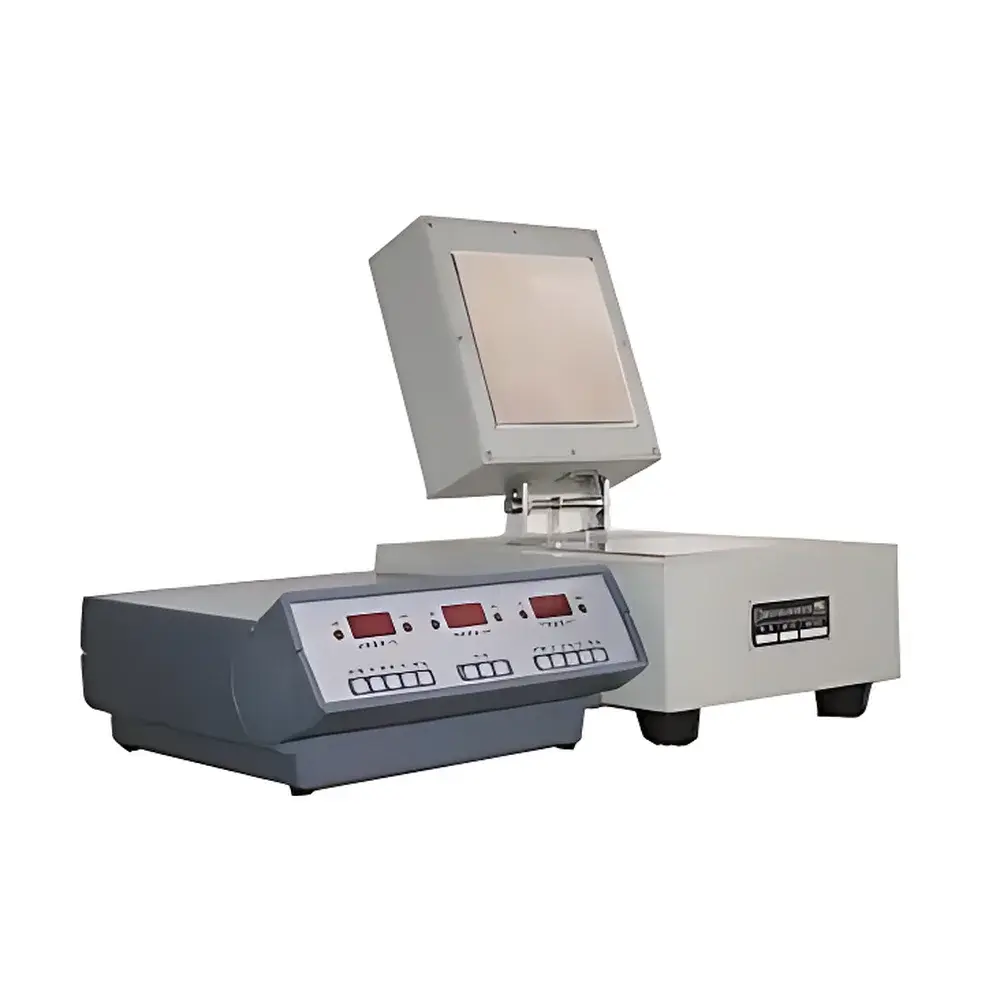
Fangyuan YG605 Hot Press Color Fastness Tester
| Brand | Fangyuan |
|---|---|
| Origin | Zhejiang, China |
| Model | YG605 |
| Heating Plate Dimensions | 45 × 110 mm (6 in × 6 in) |
| Test Pressure | 4 ± 1 kPa |
| Temperature Range | Ambient to 250 °C (±2 °C accuracy per platen) |
| Time Range | 0–999 s (±1 s accuracy) |
| Heating Modes | Single-sided (ironing), Dual-sided (sublimation) |
| Power Supply | AC 220 V, 50 Hz, 450 W |
| Net Weight | 20 kg |
| Controller | 16-bit industrial-grade microprocessor with PID temperature regulation |
| Sensor Type | Imported surface-mount temperature sensor |
| Compliance Standards | GB/T 5718, GB/T 6152, ISO 105-P01, ISO 105-X11, AATCC 114, AATCC 117, AATCC 133, JIS L 0850, JIS L 0879 |
Overview
The Fangyuan YG605 Hot Press Color Fastness Tester is a precision-engineered instrument designed for standardized evaluation of color fastness to hot pressing and sublimation in dyed and printed textile materials. It operates on the principle of controlled thermal compression—applying defined pressure and temperature to fabric specimens in contact with adjacent multifiber or single-fiber test fabrics (e.g., wool flannel, cotton adjacent fabric), followed by visual or instrumental assessment of color transfer (staining) and color change. The device supports dual operational modes: single-sided heating for ironing simulation (mimicking garment finishing conditions), and dual-sided heating for accelerated sublimation testing (critical for disperse-dyed polyester and blends). Its architecture conforms to the mechanical and thermodynamic requirements specified in major international textile testing standards, including ISO 105-P01 (color fastness to hot pressing), ISO 105-X11 (color fastness to sublimation), AATCC Test Method 133 (colorfastness to heat pressing), and GB/T 5718 (Chinese national standard for color fastness to hot pressing).
Key Features
- Independent dual-platen temperature control system with two high-accuracy surface-mounted sensors (±2 °C tolerance across 25–250 °C range), enabling precise replication of thermal profiles required by ISO and AATCC protocols.
- Digital PID (Proportional–Integral–Derivative) temperature regulation algorithm ensures minimal overshoot and stable thermal equilibrium during dwell periods—critical for inter-laboratory reproducibility.
- Programmable time control (0–999 seconds, ±1 second resolution) synchronized with pressure application, supporting both short-duration pressing (e.g., 15 s for garment care labeling) and extended sublimation cycles (e.g., 30–60 min per ISO 105-X11 Annex A).
- Uniform 4 ± 1 kPa compressive load applied via calibrated mechanical linkage—mechanically verified and traceable to SI units—to guarantee consistent contact interface between specimen and adjacent fabric.
- Industrial-grade 16-bit microcontroller platform with EMI-hardened circuitry, ensuring long-term stability in shared laboratory environments with variable electromagnetic loads.
- Modular heater configuration: electrically isolated upper and lower platens allow independent activation for ironing mode (upper platen only) or simultaneous dual-zone heating for sublimation mode (both platens active).
Sample Compatibility & Compliance
The YG605 accommodates standard textile test specimens measuring 40 mm × 100 mm, mounted between prescribed adjacent fabrics—including wool flannel (ISO 105-F9), multifiber fabric (ISO 105-F10), and cotton adjacent fabric (GB/T 7568.1). Its 45 mm × 110 mm heating surface matches the dimensional footprint mandated by ISO 105-P01 and AATCC 133. All mechanical, thermal, and temporal parameters are validated against reference calibration procedures outlined in ISO/IEC 17025-accredited laboratories. The instrument meets essential safety and electromagnetic compatibility requirements per IEC 61000-6-3 (EMI emission) and IEC 61000-6-2 (immunity), and its operational envelope complies with the thermal stability clauses of ASTM D3412 (for hot press apparatus verification).
Software & Data Management
The YG605 operates as a standalone hardware platform with embedded firmware—no external PC dependency required for routine operation. All test parameters (temperature setpoint, dwell time, pressure confirmation) are stored in non-volatile memory and recalled via front-panel keypad navigation. While the base unit does not include network connectivity or audit-trail functionality, its digital controller logs timestamped start/stop events and thermal deviation alerts—sufficient for GLP-compliant recordkeeping when paired with manual logbooks or LIMS-integrated documentation workflows. For laboratories requiring full 21 CFR Part 11 compliance, optional integration with third-party data acquisition systems (via RS-232 or analog voltage output) enables automated parameter logging, electronic signatures, and secure archival of raw thermal/time profiles.
Applications
- Evaluation of disperse dye migration resistance in polyester, nylon, and acetate textiles under thermal stress.
- Verification of color retention in digitally printed apparel subjected to heat-transfer lamination or steam ironing.
- Quality assurance testing for automotive interior fabrics exposed to elevated cabin temperatures.
- Development of heat-stable pigment systems for sportswear and functional textiles.
- Pre-shipment validation of color fastness for export-oriented textile mills targeting EU, US, and Japanese markets—where compliance with ISO 105-X11 or JIS L 0879 is contractually enforced.
- Supporting R&D in sustainable dyeing technologies, including low-impact dye fixation processes requiring post-treatment thermal stabilization.
FAQ
What standards does the YG605 support out-of-the-box?
The YG605 is pre-configured to meet the physical and procedural requirements of GB/T 5718, GB/T 6152, ISO 105-P01, ISO 105-X11, AATCC 114, AATCC 117, AATCC 133, JIS L 0850, and JIS L 0879.
Is dual-platen temperature monitoring independently certified?
Yes—each platen incorporates a calibrated surface temperature sensor traceable to NIST-equivalent national metrology institutes; calibration certificates are available upon request.
Can the YG605 be used for dry heat aging studies beyond color fastness?
While not intended as a general-purpose oven, its stable thermal environment and documented uniformity profile (±1.5 °C across active surface per ISO 105-P01 Annex B) permit limited use in comparative thermal degradation screening—provided specimens are evaluated using independent analytical methods (e.g., tensile strength loss, FTIR carbonyl index).
What maintenance intervals are recommended for long-term accuracy?
Annual verification of pressure loading (using calibrated load cell), biannual sensor calibration, and quarterly inspection of thermal insulation integrity (asbestos substitute boards) are advised per ISO/IEC 17025 maintenance guidelines.
Does the YG605 require exhaust ventilation during sublimation testing?
Yes—dual-sided heating at >180 °C may volatilize disperse dyes; operation within a fume hood or with dedicated ducted exhaust is mandatory for operator safety and chamber cleanliness.






