
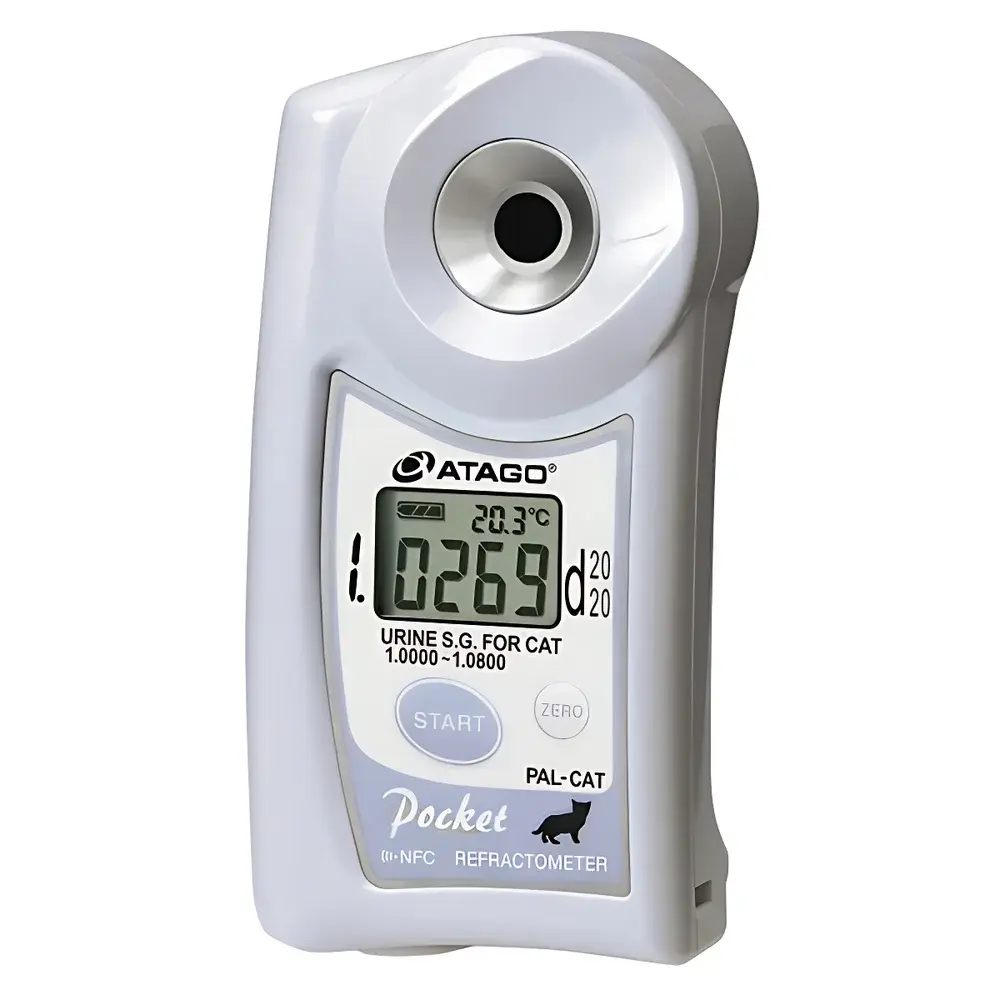
ATAGO PAL-CAT Digital Pocket Refractometer for Feline Urine Specific Gravity
| Brand | ATAGO |
|---|---|
| Origin | Japan |
| Model | PAL-CAT |
| Product Type | Handheld Refractometer |
| Temperature Control | Built-in Automatic Temperature Compensation (ATC) |
| Display | Digital LCD |
| Measurement Range | 1.0000–1.0800 (Urine Specific Gravity, S.G.) |
| Accuracy | ±0.0010 |
| Calibration Standard | Distilled Water at 20 °C (d₂₀) |
| Compliance | Designed per ISO 1042 and ASTM D1218 principles for refractive index-based specific gravity determination |
Overview
The ATAGO PAL-CAT is a dedicated handheld digital refractometer engineered specifically for rapid, on-site assessment of urine specific gravity (S.G.) in feline clinical practice. It operates on the fundamental optical principle of total internal reflection: as light passes through a urine sample placed on the prism surface, the critical angle of refraction shifts proportionally to the solution’s solute concentration—primarily electrolytes, urea, and creatinine. This shift is converted into a precise specific gravity reading calibrated exclusively for the physiological range observed in cats (1.0000–1.0800), eliminating interpolation errors common with general-purpose refractometers. The instrument integrates ATAGO’s proprietary Automatic Temperature Compensation (ATC) system, referenced to 20 °C, ensuring measurement stability across ambient conditions typical in veterinary examination rooms (10–30 °C). Its compact, ergonomic design supports single-handed operation and immediate result interpretation—critical during triage or routine wellness screening.
Key Features
- Dedicated feline urine scale: Factory-calibrated to the clinically relevant S.G. range of 1.0000–1.0800, aligned with veterinary diagnostic thresholds for renal concentrating ability and dehydration status.
- High-precision digital readout: 4-digit LCD display with ±0.0010 accuracy, enabling reliable detection of subtle changes—e.g., differentiating 1.015 from 1.016—essential for monitoring chronic kidney disease progression.
- Integrated ATC (Automatic Temperature Compensation): Compensates for sample temperature deviations without manual correction, conforming to ISO 1042 reference temperature conventions and reducing operator-dependent variability.
- Robust optical architecture: Sapphire-coated prism surface resists scratching and chemical degradation from repeated contact with urine samples and cleaning agents.
- Zero-point verification function: One-button START ZERO calibration check using distilled water (d₂₀), supporting daily QC verification prior to patient use.
- NFC-enabled data logging capability: Optional integration with ATAGO’s LogMaster software via near-field communication for timestamped, traceable measurement records—supporting GLP-aligned documentation workflows.
Sample Compatibility & Compliance
The PAL-CAT accepts 0.3 mL of uncentrifuged, room-temperature feline urine. No dilution or pretreatment is required. Its optical path length and prism geometry are optimized for low-volume, viscous biological fluids—minimizing evaporation artifacts and air bubble interference. The device complies with core metrological standards underpinning veterinary in vitro diagnostics: measurement traceability aligns with NIST-traceable refractive index references, and its performance validation methodology follows principles outlined in CLSI EP15-A3 for precision evaluation. While not an IVD-certified device per EU IVDR or FDA 510(k), it meets the functional requirements specified in AAHA Renal Disease Guidelines for point-of-care urine concentration assessment.
Software & Data Management
When paired with ATAGO’s LogMaster PC software (v3.2+), the PAL-CAT supports secure, audit-ready data export in CSV and PDF formats. Each recorded measurement includes instrument ID, date/time stamp, operator ID (via optional user login), and raw refractive index value alongside derived S.G. All entries are immutable post-recording, satisfying basic ALCOA+ criteria (Attributable, Legible, Contemporaneous, Original, Accurate). The NFC handshake enforces device-authenticated pairing, preventing unauthorized data injection. For practices operating under GLP or GCP frameworks, this configuration enables compliance with data integrity expectations in preclinical feline studies or multicenter clinical trials involving renal biomarkers.
Applications
- Routine wellness screening: Rapid S.G. assessment during annual exams to detect early-stage renal insufficiency before serum creatinine elevation.
- Acute dehydration evaluation: Differentiation between prerenal azotemia (S.G. >1.035) and renal failure (S.G. fixed near isotonicity, ~1.008–1.012).
- Monitoring response to fluid therapy: Serial measurements tracking restoration of urinary concentrating capacity over 24–72 hours.
- Supporting urinalysis interpretation: Correlating S.G. with urine protein:creatinine ratio or sediment analysis to localize nephron dysfunction.
- Research settings: Standardized urine concentration quantification in feline pharmacokinetic or toxicology studies requiring non-invasive hydration status metrics.
FAQ
Is the PAL-CAT calibrated for human or canine urine?
No. Its optical algorithm and scale are exclusively validated for feline urine matrix composition and osmolality–specific gravity relationship. Use in other species may yield non-physiological readings.
Does it require external power or batteries?
It operates on two AAA alkaline batteries (included), providing ≥5,000 measurements per set. Auto-power-off activates after 3 minutes of inactivity.
Can it measure urine glucose or protein?
No. The PAL-CAT measures only specific gravity via refractive index. It does not perform enzymatic or colorimetric assays; separate dipstick or analyzer testing is required for those analytes.
How often should zero calibration be performed?
ATAGO recommends verifying zero with distilled water before each clinical session or after temperature shifts >5 °C. Full recalibration by authorized service centers is advised annually or after 10,000 measurements.
Is the prism surface resistant to uric acid crystal buildup?
Yes. The sapphire-hardened prism withstands mechanical cleaning with soft lint-free tissue and recommended ATAGO Prism Cleaning Solution (Cat. No. 2311); abrasive wipes or acetone must be avoided.





