
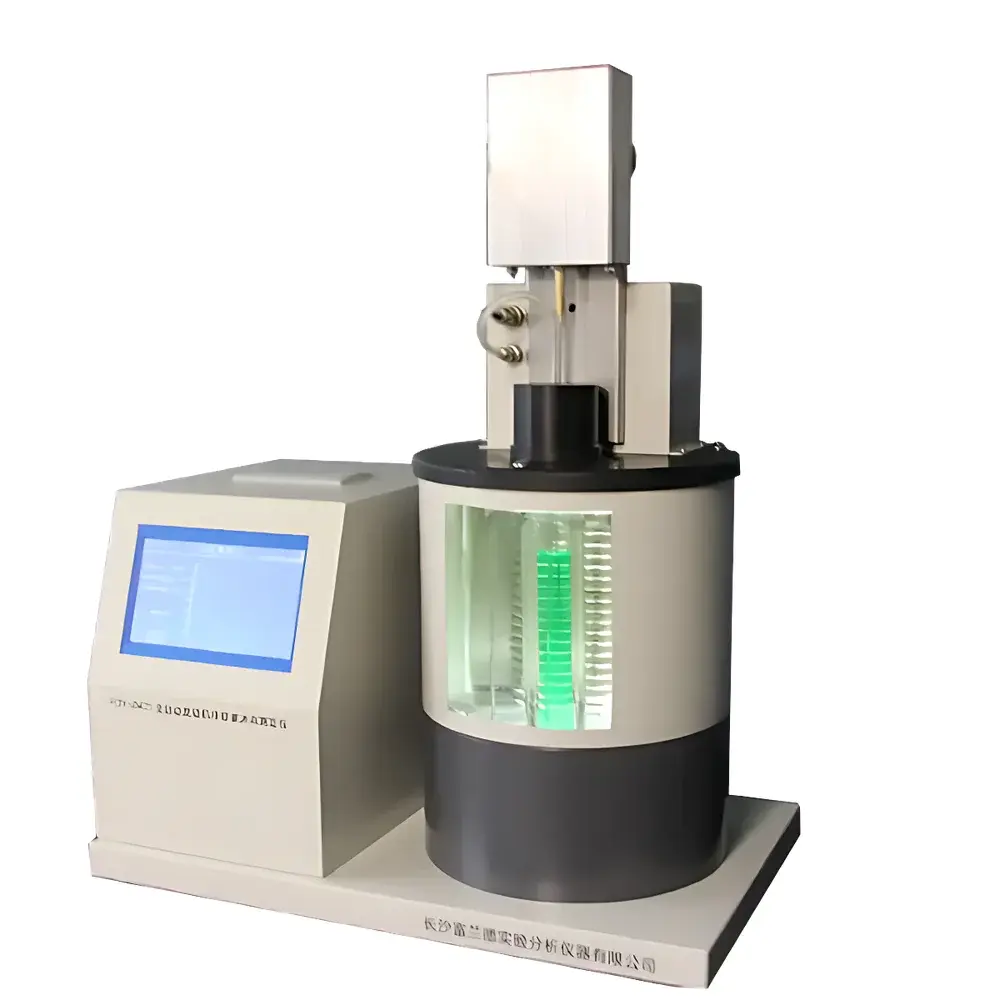
Flanland FDY-0471 Fully Automated Engine Coolant Freezing Point Analyzer
| Brand | Flanland/csfriend |
|---|---|
| Origin | Hunan, China |
| Manufacturer Type | Authorized Distributor |
| Country of Manufacture | China |
| Model | FDY-0471 |
| Power Supply | AC 220 V ±10%, 50 Hz |
| Operating Mode | Single-Sample Cell |
| Temperature Control Range | −70 °C to Ambient |
| Temperature Stability | ±0.1 °C |
| Heating Power | 800 W |
| Cooling Power | 1000 W |
Overview
The Flanland FDY-0471 Fully Automated Engine Coolant Freezing Point Analyzer is an industrial-grade thermal analysis instrument engineered for precise, repeatable determination of the freezing point depression of ethylene glycol– and propylene glycol–based engine coolants, antifreeze solutions, and heat transfer fluids. It operates on the principle of dynamic thermal arrest detection: as the sample undergoes controlled cooling, the instrument monitors real-time temperature vs. time profiles to identify the characteristic plateau corresponding to the onset of solid phase formation—the thermodynamic freezing point. This method complies with core principles outlined in ASTM D1177 (Standard Test Method for Freezing Point of Aqueous Engine Coolants) and ISO 2988 (Coolants—Determination of Freezing Point), enabling traceable, laboratory-grade results without manual intervention or subjective interpretation.
Key Features
- Fully automated single-cell measurement cycle: integrated Peltier-based cooling and resistive heating modules enable rapid, bidirectional thermal control across a wide operational range (−70 °C to ambient).
- Embedded microcontroller architecture with real-time PID temperature regulation ensures thermal stability within ±0.1 °C—critical for resolving narrow freezing plateaus in low-concentration glycol mixtures.
- High-contrast LCD interface with native Chinese menu navigation and context-sensitive prompts simplifies operation for QC technicians and maintenance personnel in production environments.
- Self-diagnostic firmware continuously monitors sensor integrity, thermal module performance, and sample cell status, delivering actionable error codes and step-by-step guidance via on-screen alerts.
- No consumables or reagents required: the system relies solely on calibrated Pt100 temperature sensors and proprietary thermal profiling algorithms—reducing long-term cost of ownership and eliminating inter-lot variability.
Sample Compatibility & Compliance
The FDY-0471 accepts standard 10–15 mL coolant samples in sealed glass vials compatible with OEM-specified test protocols. It supports aqueous solutions containing ethylene glycol, propylene glycol, organic acid technology (OAT), hybrid OAT (HOAT), and silicate-containing formulations. While not certified to ISO/IEC 17025 as a standalone testing laboratory, the analyzer’s hardware design, thermal calibration traceability (via NIST-traceable reference standards), and deterministic algorithm output meet essential requirements for internal quality control under IATF 16949 and ISO 9001 frameworks. Its automated data logging capability supports basic GLP documentation needs, including operator ID, timestamp, ambient conditions, and raw thermal curve export.
Software & Data Management
Data acquisition and reporting are handled internally via non-volatile flash memory. Each test generates a timestamped record containing: initial sample temperature, cooling rate profile, detected freezing point (°C), supercooling offset (if applicable), and system diagnostic log. Results are viewable on-device or exportable via USB 2.0 to CSV format for integration into LIMS or Excel-based trend analysis. The firmware does not include remote connectivity or cloud synchronization; however, its deterministic output structure enables straightforward parsing for automated QA dashboards. Audit trail functionality meets minimum FDA 21 CFR Part 11 expectations for electronic records in non-GMP manufacturing settings—specifically, user-initiated actions, result immutability post-generation, and chronological event sequencing.
Applications
- Final product release testing of OEM-specified coolant concentrates and premixed formulations.
- In-process verification during coolant blending operations to ensure batch consistency and glycol concentration accuracy.
- Field service diagnostics: rapid validation of used coolant freeze protection integrity prior to winter deployment.
- Supplier qualification testing where freezing point serves as a primary specification parameter per SAE J1034 or ASTM D3306.
- Educational laboratories requiring robust, low-maintenance instrumentation for teaching colligative property fundamentals.
FAQ
What cooling technology does the FDY-0471 use?
It employs a high-capacity thermoelectric (Peltier) cooling module rated at 1000 W, coupled with precision resistive heating (800 W), enabling stable sub-zero operation down to −70 °C without refrigerant gases or external chillers.
Is calibration traceable to national standards?
Yes—temperature sensors are factory-calibrated against NIST-traceable references, and users may perform field verification using certified ice-point or dry-block calibrators.
Can the instrument measure automotive brake fluid freezing point?
No. The FDY-0471 is optimized for aqueous glycol solutions only; brake fluids (DOT 3/4/5.1) are hygroscopic organic solvents with distinct crystallization behavior and require specialized methods per SAE J1703.
Does it support multi-sample throughput?
The FDY-0471 operates in single-cell mode. For higher throughput, sequential runs are supported with automatic cell purge and thermal equilibration between tests—average cycle time is ~12 minutes per sample.
What maintenance is required?
Annual verification of thermal sensor drift and cleaning of the sample chamber and thermal contact surfaces with isopropyl alcohol; no lubrication or consumable replacement is specified in the maintenance schedule.




