
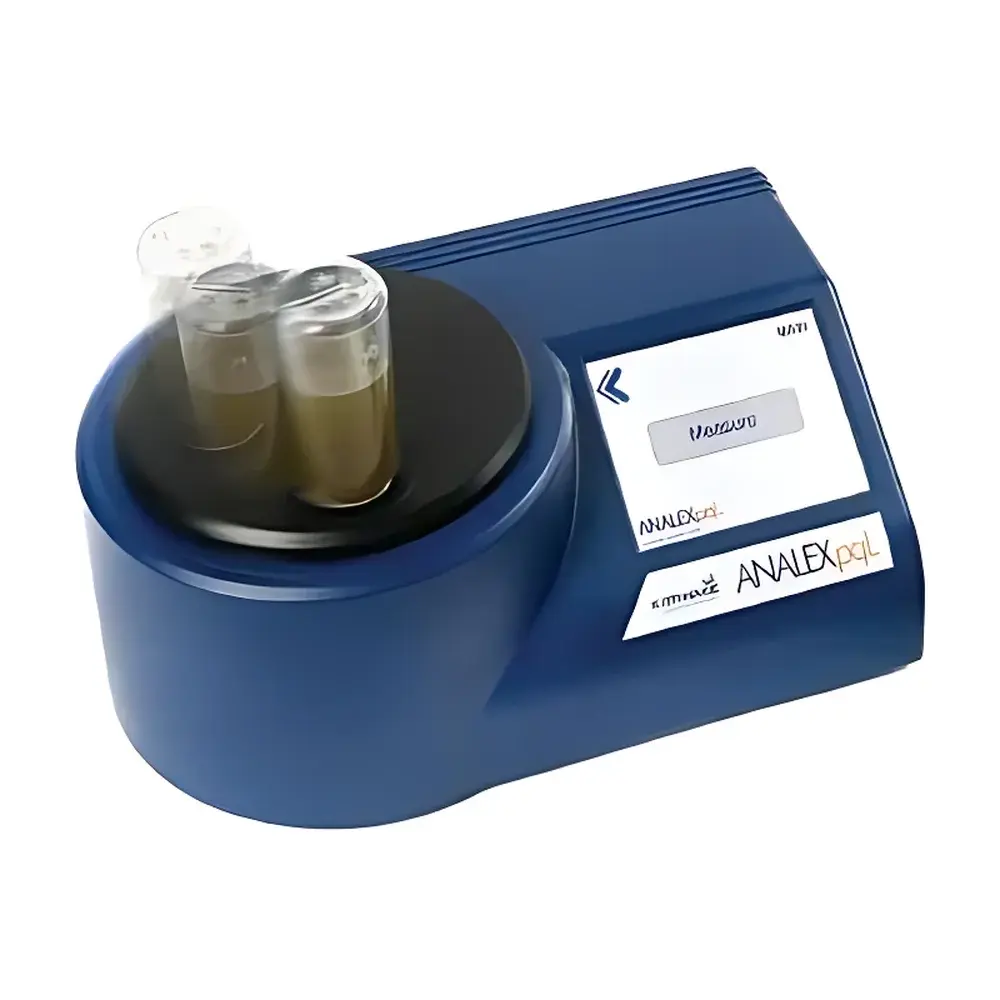
Kittiwake PQL PQ Index Ferroscope
| Brand | Kittiwake |
|---|---|
| Origin | United Kingdom |
| Model | FG-K17000-KW |
| Repeatability | ±4 PQ or ±1% (whichever is greater) |
| Resolution | 1 PQ |
| Measurement Time | 7 seconds |
| Minimum Detectable PQ Value | 5 PQ |
| Dimensions | 370 mm × 230 mm |
| Weight | 3.6 kg |
Overview
The Kittiwake PQL PQ Index Ferroscope is a purpose-built ferromagnetic particle quantification instrument engineered for rapid, non-destructive assessment of ferrous wear debris concentration in lubricating oils, hydraulic fluids, and greases. Unlike conventional analytical ferrography—which relies on magnetic deposition and microscopic imaging—the PQL employs the PQ (Particle Quantifier) index methodology: a calibrated magnetic susceptibility measurement principle based on the perturbation of a high-frequency alternating magnetic field by ferromagnetic particles suspended in the fluid sample. This physics-based approach delivers a dimensionless PQ unit proportional to the total volume of ferromagnetic material per unit volume of oil, enabling early-stage detection of abnormal wear without requiring solvent extraction, filtration, or slide preparation. Designed as the successor to the Parker Kittiwake PQM and PQA systems, the PQL integrates modern embedded electronics, real-time signal processing, and industrial-grade mechanical architecture to meet the evolving demands of predictive maintenance programs in power generation, marine propulsion, wind turbine gearboxes, and heavy-duty hydraulic systems.
Key Features
- Touchscreen-driven user interface with intuitive navigation and on-device result visualization
- Robust, compact footprint (370 mm × 230 mm) optimized for benchtop deployment in constrained laboratory or field-service environments
- High repeatability performance: ±4 PQ units or ±1% (whichever is greater), validated per ASTM D7690–22 “Standard Test Method for Quantitative Ferromagnetic Particle Analysis Using the PQ Index”
- Sub-10-second measurement cycle—including auto-zeroing, sample insertion, acquisition, and PQ value output—enabling throughput of >50 samples per hour
- USB 2.0 interface compliant with Windows-based data acquisition software for secure transfer, timestamped logging, and audit-ready export
- Integrated sample storage tray accommodating up to 12 standard 10-mL vials with alphanumeric labeling support
- Passive thermal stabilization design ensuring measurement consistency across ambient temperatures from 15 °C to 35 °C
Sample Compatibility & Compliance
The PQL accepts undiluted used oil samples in standard 10-mL glass or polymer vials with magnetic susceptibility-compatible caps (non-ferrous). It is validated for mineral-, synthetic-, and semi-synthetic-based lubricants, including ISO VG 32–680 hydraulic oils, engine oils (SAE 5W–40 to 40), turbine oils, and grease extracts prepared via ASTM D5185. The instrument complies with key regulatory and quality frameworks relevant to condition monitoring laboratories: it supports GLP-compliant workflows through electronic signature-capable software, enables full audit trails per FDA 21 CFR Part 11 requirements when paired with validated LIMS integration, and meets ISO/IEC 17025:2017 clause 6.4.3 for equipment suitability verification. Its PQ index output correlates directly with ASTM D7689–22 (Standard Guide for Ferrographic Analysis) and serves as an accepted screening metric under ISO 4406:2017 and ISO 12171:2019 for wear severity trending.
Software & Data Management
The PQL operates with Kittiwake’s proprietary PQ Lab Suite v3.x—a Windows 10/11 compatible application delivering secure local database management, multi-user role-based access control, and automated PQ trend charting with alarm thresholds. All measurements are time-stamped, instrument-serialized, and associated with configurable metadata (sample ID, equipment tag, sampling date, operator ID). Raw signal waveforms and calibration logs are retained for traceability. Export options include CSV (for Excel integration), PDF reports compliant with ISO 17025 documentation requirements, and XML formats compatible with enterprise CMMS platforms such as SAP PM and IBM Maximo. The software supports periodic calibration verification using NIST-traceable PQ reference standards (Kittiwake SR-PQ-01 through SR-PQ-05), with automatic pass/fail flagging against predefined tolerance bands.
Applications
- Predictive maintenance screening for gas turbine bearing systems, where early ferrous debris detection prevents catastrophic rotor imbalance
- Routine monitoring of wind turbine gearbox oils to distinguish normal pitting wear from incipient gear tooth fracture
- Marine diesel engine crankcase oil surveillance to differentiate between cylinder liner scuffing and camshaft lobe wear mechanisms
- Hydraulic system health assessment in mining and construction equipment, supporting ISO 4406 code classification and root cause analysis
- Validation of oil reclamation processes by quantifying residual ferrous contamination post-filtration
- Supporting OEM service bulletins requiring PQ-indexed wear baselines for warranty claim substantiation
FAQ
Does the PQL require sample dilution or chemical pretreatment before analysis?
No. The PQL measures undiluted, as-received oil samples directly—eliminating solvent use, centrifugation, and filter membrane handling.
How does the PQ index correlate with particle size distribution or elemental composition?
The PQ index reflects total ferromagnetic mass concentration but does not resolve particle morphology or alloy chemistry; it is intended as a complementary screen to ICP-OES, SEM-EDS, or analytical ferrography.
Can the PQL be integrated into an existing laboratory information management system (LIMS)?
Yes—via its standardized CSV/XML export protocols and optional API module, supporting bidirectional data exchange with major LIMS vendors under ISO/IEC 17025-aligned validation protocols.
What calibration standards are required, and how often must they be applied?
NIST-traceable PQ reference standards (SR-PQ series) are recommended for daily system suitability checks and full calibration every 90 days—or after instrument relocation, firmware updates, or repair events.
Is the PQL suitable for field use aboard vessels or remote power plants?
Yes. Its shock-resistant chassis, low power consumption (<12 W), and battery-operated touchscreen interface (with optional external 12 V DC supply) enable deployment in Class II Div 2 hazardous locations when housed in appropriate enclosures.






