
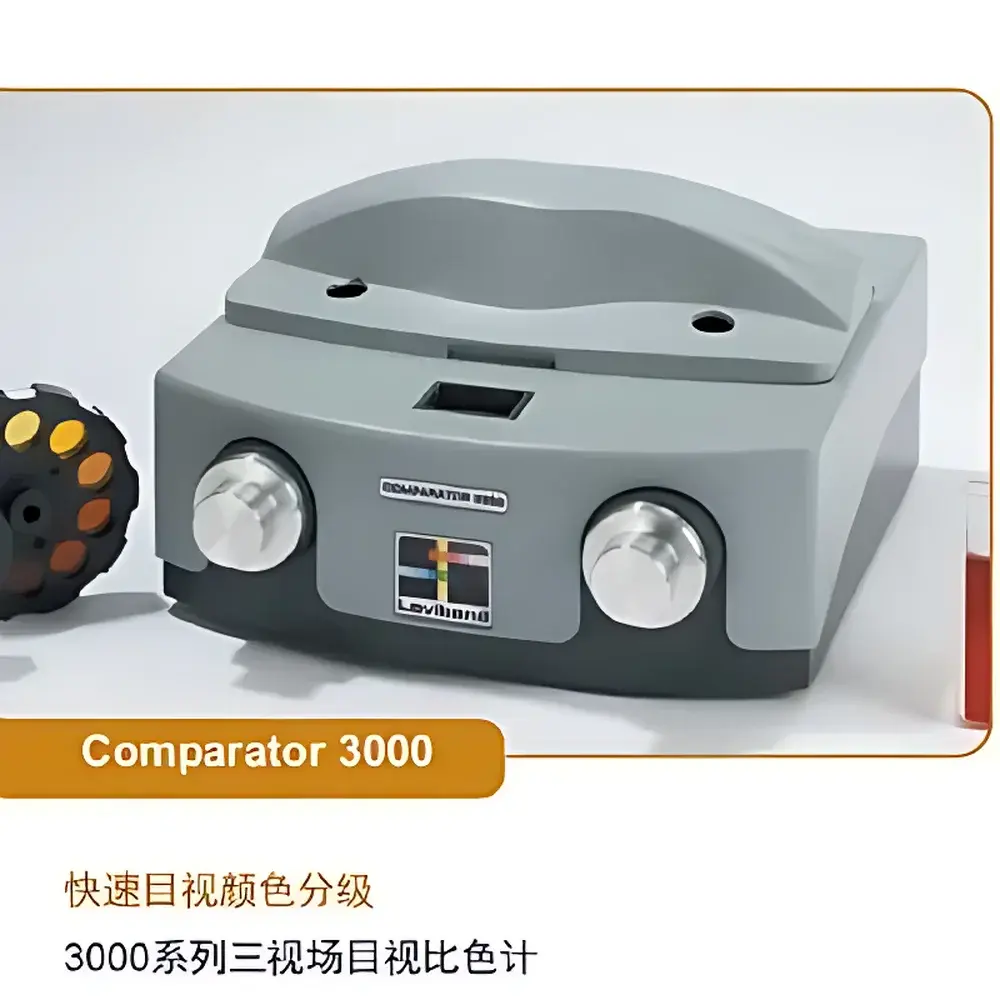
Tintometer Lovibond® Comparator 3000 Series Tristimulus Visual Colorimeter
| Brand | Tintometer (Lovibond®) |
|---|---|
| Origin | United Kingdom |
| Model | Lovibond® Comparator 3000 |
| Light Source | CIE-compliant halogen tungsten lamp |
| Viewing Configuration | Tristimulus field (sample + two adjacent glass color standards) |
| Compliance | ASTM D1500, EBC Method 6.1, AOAC 920.147, ISO 4630, USP <631>, Gardner, FAC, US Military Resin Standards |
| Accessories | Industry-specific calibrated glass color discs (non-fading), optional NIST-traceable filter sets and certified reference standards |
| Application Scope | Petrochemicals, edible oils, resins, beverages, pharmaceutical excipients, industrial chemicals |
Overview
The Tintometer Lovibond® Comparator 3000 Series is a precision-engineered tristimulus visual colorimeter designed for objective, repeatable color grading under controlled illumination. Unlike spectrophotometric instruments, the Comparator 3000 operates on the principle of human visual color matching—leveraging standardized CIE illuminant A (2856 K correlated color temperature) provided by a stabilized halogen tungsten lamp. This optical architecture ensures consistent spectral power distribution across measurement sessions, eliminating variability from ambient daylight or fluorescent lighting. The instrument’s core functionality rests on side-by-side tristimulus comparison: the central viewing field presents the liquid or translucent sample in a standardized Lovibond® glass cell, while left- and right-hand fields display adjacent calibrated glass color standards mounted on rotating discs. By adjusting the discs to bracket the sample’s perceived hue and intensity, users determine the closest match within defined color scales—enabling quantitative assignment of color units without digital signal processing or calibration drift concerns.
Key Features
- Tristimulus optical design with simultaneous three-field viewing (sample + two adjustable glass standards) for unambiguous visual discrimination and reduced observer bias.
- CIE-compliant halogen tungsten lamp with integrated voltage regulation and thermal stabilization—maintains constant luminance and chromaticity over extended operation, meeting ISO 9001 and GLP environmental control requirements.
- Interchangeable, industry-specific glass color disc assemblies—including ASTM D1500 (petroleum), EBC 6.1 (beer), Gardner (resins & varnishes), FAC (fatty acids), and US Military Resin standards—each manufactured to ±0.5 color unit tolerance and certified for long-term stability (no fading, no spectral shift).
- Robust aluminum alloy housing with anti-glare matte finish and ergonomic viewing hood, optimized for benchtop use in QC laboratories operating under ISO/IEC 17025-accredited conditions.
- No software dependency or firmware updates required—ideal for environments with restricted IT access, audit-trail simplicity, and direct operator training per SOP.
Sample Compatibility & Compliance
The Comparator 3000 accommodates standard 10 mm, 20 mm, and 50 mm pathlength Lovibond® glass cells (supplied with each model), compatible with clear to moderately turbid liquids including mineral oils, vegetable oils, glycerin, syrups, solvents, and pharmaceutical suspensions. Its methodology aligns with multiple internationally recognized test methods: ASTM D1500 for petroleum products, EBC Method 6.1 for wort and beer, ISO 4630 for resin color, AOAC 920.147 for edible fats, and USP for pharmaceutical color assessment. Each disc set is supplied with a certificate of conformity referencing NIST-traceable reference materials where applicable. The instrument satisfies regulatory expectations for manual color assessment in GMP-compliant manufacturing—particularly where 21 CFR Part 11 electronic record requirements do not apply, and visual pass/fail decisions must be documented with minimal interpretation variance.
Software & Data Management
The Comparator 3000 is a fully analog, operator-driven instrument with no embedded microprocessor or data logging capability. All measurements are recorded manually in laboratory notebooks or LIMS-integrated paper-based forms, supporting full auditability under GLP and GMP frameworks. Optional accessories include calibrated logbooks with pre-printed scale templates and traceable color standard verification kits—designed to support annual instrument verification per internal SOPs or external accreditation audits (e.g., UKAS, ANAB). For laboratories requiring digital integration, third-party image-capture systems (with CIE-compliant lighting enclosures) may be deployed alongside the Comparator for photographic archiving of matched results—though such workflows remain supplementary and non-automated.
Applications
This instrument serves as the primary color assessment tool in quality control laboratories across regulated and industrial sectors. In petrochemical refineries, it verifies ASTM D1500 compliance for lubricating oils and distillates prior to shipment. In brewing facilities, EBC-scale grading ensures batch-to-batch consistency in malt extracts and finished beer. Edible oil processors rely on FAC and Gardner scales to monitor oxidation progression in frying oils and hydrogenated fats. Pharmaceutical manufacturers apply USP protocols to assess color stability of APIs and excipients during stability studies. Its mechanical simplicity, absence of calibration drift, and direct traceability to physical reference standards make it especially valuable in resource-constrained labs, field testing environments, and educational settings where foundational color science principles are taught.
FAQ
Does the Comparator 3000 require periodic recalibration?
No—glass color standards are physically stable and do not degrade; verification is performed annually using certified reference discs or inter-laboratory comparison protocols.
Can I use non-Lovibond® glass cells with this instrument?
Only Lovibond®-specified cells ensure correct pathlength, refractive index compensation, and alignment with disc calibration; third-party cells invalidate method compliance.
Is the halogen lamp user-replaceable?
Yes—the lamp module is field-serviceable with standard tools; replacement lamps are supplied with photometric certification and batch-specific calibration documentation.
How does the tristimulus design reduce observer error compared to single-field comparators?
By presenting the sample flanked by two adjacent standards, observers perform differential judgment rather than absolute matching—significantly improving repeatability across operators and shifts.
Are digital versions or data export options available?
No—this is a purpose-built analog instrument; digital color measurement requires separate spectrophotometric hardware compliant with ISO 13655 or CIE 15:2018.




