
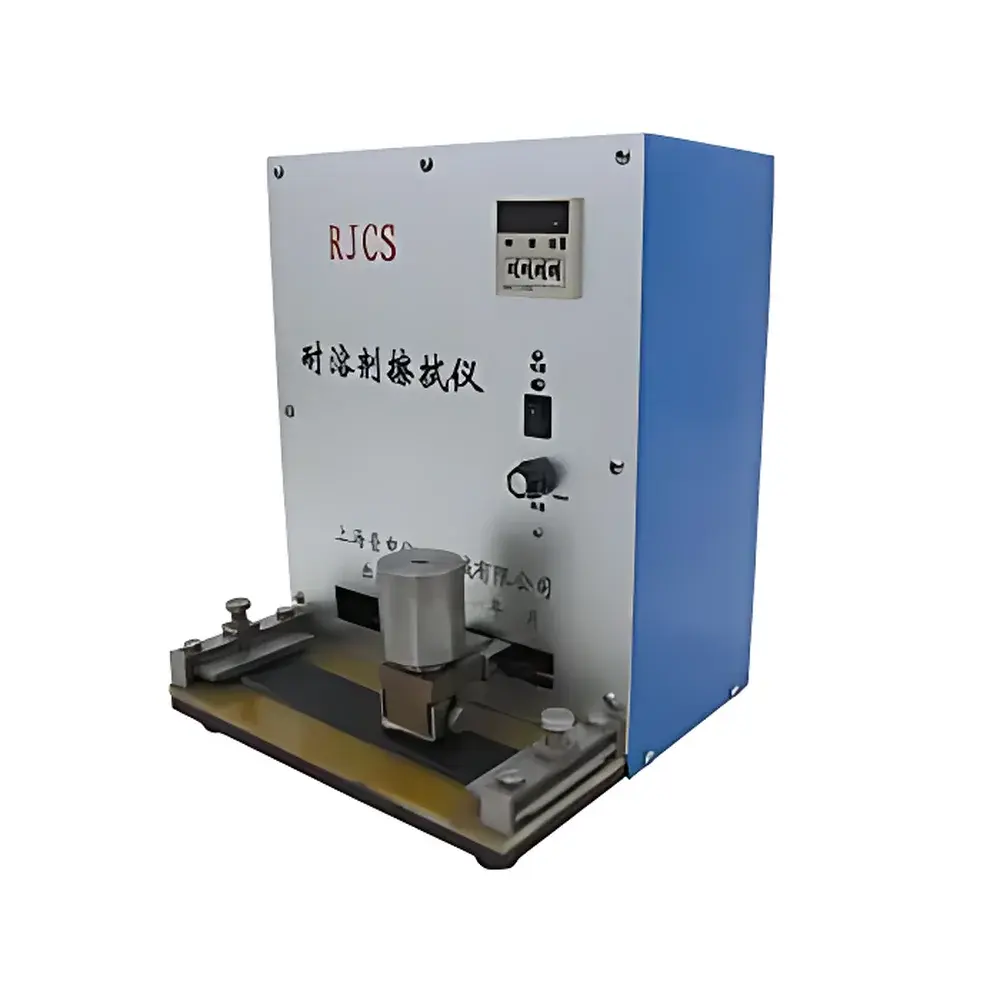
RJCS Solvent Rub Resistance Tester
| Origin | Shanghai, China |
|---|---|
| Manufacturer Type | Authorized Distributor |
| Origin Category | Domestic (China) |
| Model | RJCS |
| Pricing | Available Upon Request |
| Motor | 60 W, 220 V, 50 Hz |
| Stroke Length | 120 ± 5 mm |
| Oscillation Frequency | 0–60 cycles/min |
| Applied Load | 1000 ± 10 g |
| Wiping Tip Contact Diameter | Ø14 ± 0.5 mm |
| Specimen Plate Size | 75 × 200 mm |
| Dimensions (L×W×H) | 260 × 260 × 340 mm |
| Net Weight | 17 kg |
Overview
The RJCS Solvent Rub Resistance Tester is a precision-engineered tribological testing instrument designed to quantitatively evaluate the resistance of coated surfaces—including paints, inks, varnishes, and functional thin films—to mechanical degradation induced by solvent-laden abrasion. It operates on the principle of controlled reciprocating motion under defined normal load and stroke parameters, simulating real-world cleaning, handling, or industrial wiping conditions where solvent exposure coincides with mechanical stress. The device employs a motor-driven horizontal carriage that moves a standardized wiping tip—equipped with solvent-saturated cotton wool—at a user-selectable frequency across a fixed-length linear path (120 ± 5 mm). Each cycle consists of a forward and backward pass, and the integrated digital counter records total cycles until visible coating failure (e.g., gloss loss, pigment exposure, substrate breakthrough, or delamination) occurs. This endpoint-based measurement delivers reproducible, comparative rub resistance data essential for quality control in R&D laboratories, production QA/QC departments, and third-party testing facilities serving automotive OEMs, packaging converters, printing industries, and electronics surface finishing suppliers.
Key Features
- Adjustable oscillation frequency (0–60 cycles/min) enables method flexibility across diverse material systems—from soft thermoplastic coatings to hardened ceramic composites.
- Precisely calibrated static load application (1000 ± 10 g) ensures consistent normal force during each wipe, minimizing inter-test variability and supporting ASTM D5239 and ISO 11998 compliance workflows.
- Standardized wiping tip geometry (Ø14 ± 0.5 mm flat contact surface) guarantees uniform pressure distribution and eliminates edge-effect artifacts during surface interaction.
- Digital cycle counter with reset function provides unambiguous, tamper-resistant test termination logging—critical for audit-ready documentation in GLP- and GMP-regulated environments.
- Robust aluminum alloy frame and low-vibration 60 W induction motor ensure long-term dimensional stability and operational reliability under continuous duty cycles.
- Modular specimen holder accommodates standard 75 × 200 mm test panels (e.g., cold-rolled steel, aluminum, or glass substrates), aligning with common industry sample preparation protocols.
Sample Compatibility & Compliance
The RJCS tester supports a broad range of coated substrates used in industrial applications, including but not limited to: acrylic and polyurethane topcoats, UV-curable inks on flexible packaging films, conductive silver pastes on PCB substrates, anti-fingerprint layers on display glass, and corrosion-inhibiting primers on metal sheets. Its mechanical design conforms to fundamental requirements outlined in ASTM D5239 (“Standard Test Method for Resistance of Organic Coatings to Solvent Rub”) and ISO 11998 (“Paints and Varnishes — Determination of Resistance to Wet Abrasion”). While the instrument itself does not embed regulatory certification, its repeatable kinematics and traceable load calibration facilitate validation against internal SOPs aligned with ISO/IEC 17025-accredited laboratory practices. Users are advised to specify solvent type (e.g., MEK, ethanol, xylene), cotton wool grade (USP Type I or equivalent), and evaluation criteria (e.g., number of cycles to first visible defect per ISO 4618) within their test method documentation.
Software & Data Management
The RJCS Solvent Rub Resistance Tester operates as a standalone electromechanical system without embedded firmware or proprietary software. All operational parameters—including frequency setting, load verification, and cycle counting—are manually configured and monitored via front-panel controls and LED display. For laboratories requiring electronic data capture and traceability, the unit integrates seamlessly with external data acquisition systems via TTL-compatible pulse output (optional accessory interface). Cycle count logs may be exported to LIMS or ELN platforms using standard RS-232 or USB-to-serial adapters. To satisfy FDA 21 CFR Part 11 requirements for electronic records, users must implement validated external software solutions for audit trail generation, electronic signatures, and secure data archiving—none of which are provided with the base instrument.
Applications
- Formulation screening of solvent-borne and waterborne coating systems for automotive clearcoats and interior trim finishes.
- Batch release testing of printed labels and flexible food packaging films subjected to alcohol-based sanitization protocols.
- Development of scratch- and chemical-resistant AR/AF coatings for optical lenses and touchscreens.
- Comparative benchmarking of crosslinked vs. thermoplastic polymer films in medical device housing applications.
- Root-cause analysis of coating failures observed during manufacturing line wipe-down procedures or end-user cleaning regimens.
FAQ
What solvents are compatible with the RJCS tester?
Commonly used solvents include methyl ethyl ketone (MEK), ethanol, isopropanol, toluene, and xylene. Selection must consider both coating chemistry and safety—users must consult SDS documents and perform compatibility verification prior to routine use.
Can the wiping tip be replaced or customized?
Yes. The standard Ø14 mm stainless-steel tip is removable and replaceable. Custom tips (e.g., silicone rubber or PTFE-faced variants) can be fabricated upon request, subject to mechanical interface verification.
Is calibration service available?
Load cell verification and stroke length calibration are recommended annually. Accredited third-party metrology labs can perform traceable calibration using NIST-traceable deadweight standards and laser displacement sensors.
Does the RJCS meet CE or UL safety certification?
The unit complies with IEC 61000-6-2 (immunity) and IEC 61000-6-4 (emissions) for industrial environments. CE marking is not affixed; users must conduct local conformity assessment per applicable regional directives (e.g., EU Machinery Directive 2006/42/EC).
Related Products



