
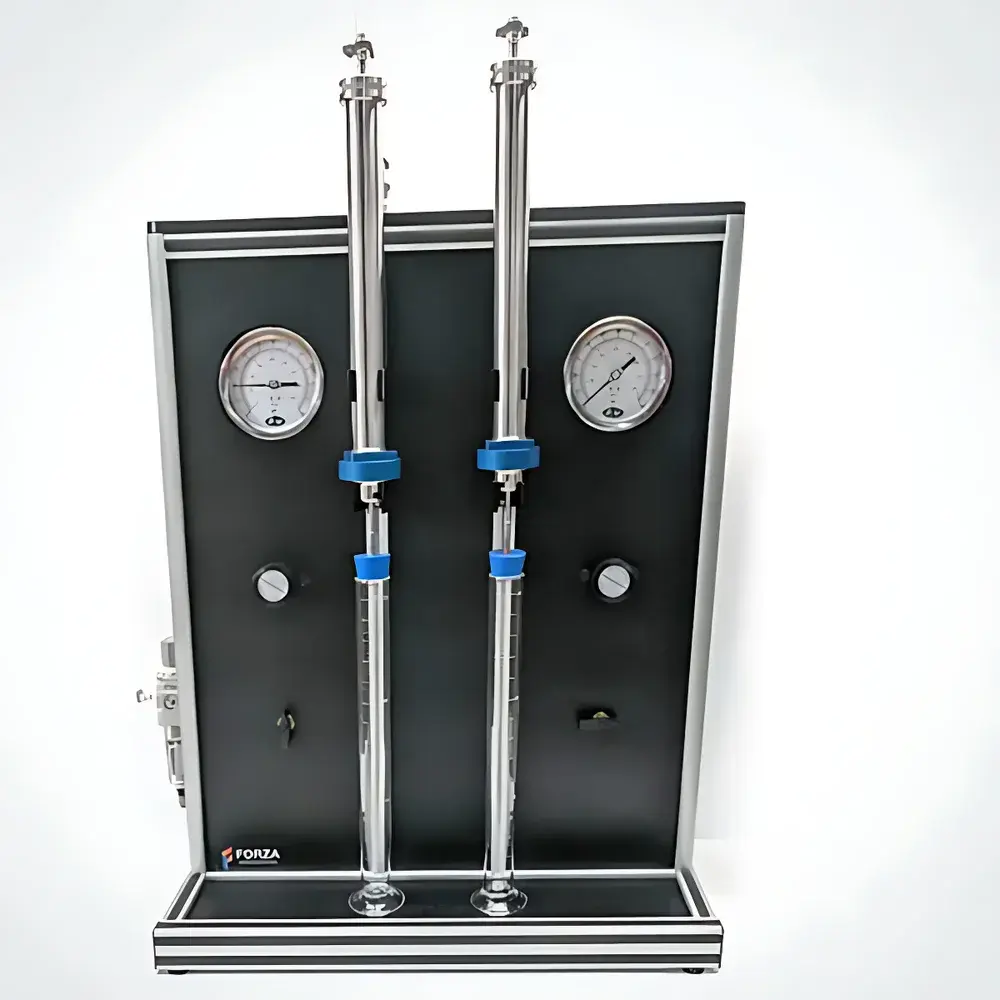
Lubricant Filtration Analyzer FORZA HFLT-AFNOR-M-2
| Brand | FORZA |
|---|---|
| Origin | USA |
| Model | HFLT-AFNOR-M-2 |
| Standards Compliance | IP 448, ISO 13357, AFNOR NF E 48-690 & NF E 48-69, SH/T 0805-2008 |
| Test Vessel Material | Stainless Steel |
| Vessel Volume | 350 mL |
| Pressure Control Accuracy | ±5 kPa |
| Independent Test Stations | 1, 2 or 4 (user-configurable) |
| Integrated Air Supply | Equipped with coalescing and desiccant filtration |
| Data Processing | Includes dedicated Windows-based calculation utility for automatic filtration performance reporting |
Overview
The FORZA HFLT-AFNOR-M-2 Lubricant Filtration Analyzer is a precision-engineered benchtop instrument designed to quantitatively assess the filterability of lubricating oils—particularly those containing additives, oxidation byproducts, or insoluble contaminants that may impair in-service filtration efficiency. It operates on the principle of controlled-pressure vacuum or pressurized gas-driven filtration through standardized membrane filters (typically 0.8 µm or 1.2 µm pore size), measuring time-dependent flow resistance as an indicator of sludge-forming tendency and particulate stability. This methodology directly supports predictive maintenance strategies in turbine, hydraulic, and engine oil monitoring programs, where early detection of filter clogging potential is critical to avoiding unscheduled downtime and component wear.
Key Features
- Multi-station modular design supporting 1, 2, or 4 independent test channels—each with isolated pressure control, real-time pressure monitoring, and autonomous start/stop capability
- Stainless steel test vessels (350 mL capacity) conforming to dimensional and surface finish requirements specified in IP 448 and ISO 13357
- High-stability pneumatic system with ±5 kPa pressure regulation accuracy across the operational range (typically 10–100 kPa), ensuring repeatability per ASTM D2272 and ISO 4406 traceability protocols
- Integrated air supply conditioning: dual-stage filtration comprising coalescing pre-filter (removes oil aerosols and liquid water) and desiccant dryer (reduces dew point to ≤ −40 °C), preventing moisture interference during filtration
- Dedicated Windows-compatible calculation software that imports timed filtration data, computes filtration index (FI), filterability ratio (FR), and pass/fail status against method-defined thresholds, and generates PDF reports compliant with internal QA documentation standards
Sample Compatibility & Compliance
The HFLT-AFNOR-M-2 accommodates a broad range of mineral, synthetic, and semi-synthetic lubricants—including turbine oils, hydraulic fluids, gear oils, and compressor lubricants—as defined in IP 448 and ISO 13357. Its mechanical and procedural architecture aligns with the physical test parameters mandated by AFNOR NF E 48-690 (for industrial lubricants) and NF E 48-69 (for automotive engine oils), including specified membrane type (cellulose ester or polyamide), filtration area (≥ 4.9 cm²), and pressure application sequence. The instrument’s stainless steel wetted parts ensure chemical compatibility with acidic degradation products and additive packages without leaching or catalytic interference. While not certified to GLP or GMP out-of-the-box, its deterministic pressure control, timestamped data logging, and audit-ready software output support validation under ISO/IEC 17025-accredited laboratory quality systems.
Software & Data Management
The included FORZA Filtration Analysis Utility provides calibrated data acquisition, automated calculation of key metrics—including filtration time at 50 mL and 100 mL increments, slope analysis of flow decay curves, and comparative indexing against reference oils—and export to CSV or PDF. All measurement sessions are logged with operator ID, date/time stamp, sample ID, and environmental conditions (ambient temperature/humidity if externally sourced). The software supports 21 CFR Part 11-compliant user access controls when deployed on domain-managed Windows environments, enabling electronic signatures, change tracking, and secure archival—making it suitable for regulated QC laboratories operating under pharmaceutical or aerospace lubricant specifications.
Applications
- Monitoring oxidative degradation onset in in-service turbine oils via progressive increase in filtration resistance
- Evaluating compatibility between new additive packages and base stocks during formulation development
- Assessing the impact of water contamination or glycol ingress on filter plugging behavior
- Supporting root-cause analysis of field-reported filter element failures in hydraulic systems
- Generating reproducible data for technical service bulletins and OEM lubricant approval submissions
FAQ
What membrane filters are recommended for use with the HFLT-AFNOR-M-2?
Standard testing employs 0.8 µm or 1.2 µm pore-size cellulose ester membranes (e.g., Sartorius 11304 or Whatman 10408), as specified in IP 448 and AFNOR NF E 48-690.
Can the instrument be integrated into a LIMS environment?
Yes—the software exports structured CSV files with metadata headers; custom API integration is supported via COM interface upon request.
Is calibration verification traceable to NIST standards?
Pressure transducers are factory-calibrated using NIST-traceable deadweight testers; annual recalibration services are available through FORZA authorized service centers.
Does the system require external compressed air?
No—the integrated air supply includes a quiet oil-free pump and full conditioning train; only standard 100–240 VAC power is required.
How is compliance with ISO 13357 ensured during operation?
The instrument enforces fixed vessel geometry, prescribed pressure ramp profiles, and mandatory 30-second stabilization periods before timing initiation—all programmatically enforced within the software logic.





